
Verwandte Artikel zu Rethinking Expectations: The Way Forward for Macroeconomics
Inhaltsangabe
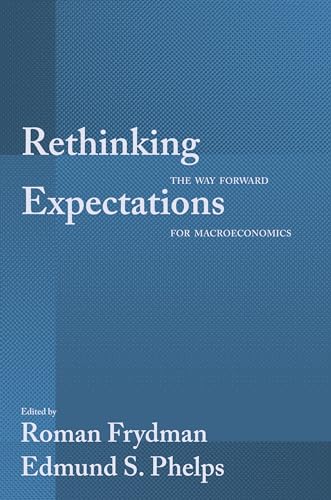
This book originated from a 2010 conference marking the fortieth anniversary of the publication of the landmark "Phelps volume," Microeconomic Foundations of Employment and Inflation Theory, a book that is often credited with pioneering the currently dominant approach to macroeconomic analysis. However, in their provocative introductory essay, Roman Frydman and Edmund Phelps argue that the vast majority of macroeconomic and finance models developed over the last four decades derailed, rather than built on, the Phelps volume's "microfoundations" approach. Whereas the contributors to the 1970 volume recognized the fundamental importance of according market participants' expectations an autonomous role, contemporary models rely on the rational expectations hypothesis (REH), which rules out such a role by design.
The financial crisis that began in 2007, preceded by a spectacular boom and bust in asset prices that REH models implied could never happen, has spurred a quest for fresh approaches to macroeconomic analysis. While the alternatives to REH presented in Rethinking Expectations differ from the approach taken in the original Phelps volume, they are notable for returning to its major theme: understanding aggregate outcomes requires according expectations an autonomous role. In the introductory essay, Frydman and Phelps interpret the various efforts to reconstruct the field--some of which promise to chart its direction for decades to come.
The contributors include Philippe Aghion, Sheila Dow, George W. Evans, Roger E. A. Farmer, Roman Frydman, Michael D. Goldberg, Roger Guesnerie, Seppo Honkapohja, Katarina Juselius, Enisse Kharroubi, Blake LeBaron, Edmund S. Phelps, John B. Taylor, Michael Woodford, and Gylfi Zoega.
Die Inhaltsangabe kann sich auf eine andere Ausgabe dieses Titels beziehen.
Über die Autorin bzw. den Autor
Roman Frydman is professor of economics at New York University and the coauthor (with Michael D. Goldberg) of Beyond Mechanical Markets and Imperfect Knowledge Economics. Edmund S. Phelps, the winner of the 2006 Nobel Prize in Economics, is director of Columbia University's Center on Capitalism and Society. His many books include Structural Slumps and Seven Schools of Macroeconomic Thought.
Von der hinteren Coverseite
"The 1970 Phelps volume has been extremely influential in macroeconomics. Three of its contributors went on to win Nobel prizes for work detailed in the book, and it inspired many others who contributed to the small equilibrium models that became the workhorses of macroeconomics. Yet virtually all of these models use the assumption of rational expectations. In this new volume, Phelps and Roman Frydman assemble a new group of scholars to critique the work based on rational expectations. Phelps and Frydman argue that rational expectations destroyed one of the key premises of the original book--that independent expectations are critical for understanding macroeconomic phenomena. The contributors to this follow-up volume make a convincing case for the failure of several models with rational expectations, and present thought-provoking alternatives. Their efforts to build macroeconomic models without the rational expectations hypothesis might have the impact in their areas of research that the original volume had."--Christopher Pissarides, Nobel Laureate in Economics
"Microeconomic Foundations of Employment and Inflation Theory, edited by Edmund Phelps forty years ago, established the concept of 'micro foundations' as an essential macroeconomics idea. Later, 'rational expectations' was added as the second pillar of the current standard macro model. Recent events have challenged the validity of that model. This new Phelps volume, coedited with Roman Frydman, challenges and offers alternatives to the second pillar while retaining the first. It is a must-read for anyone interested in modern economic thought and its implications for policy."--Dale Mortsensen, Nobel Laureate in Economics
"A great volume."--Peter Howitt, Brown University
"This book brings together an exceptional group of economic theorists who discuss future avenues that the economics profession can take to replace the paradigm of rational expectations. The task is challenging and the outcome of the project still uncertain, but all the chapters are very interesting."--Fabrizio Coricelli, Paris School of Economics
Aus dem Klappentext
"The 1970 Phelps volume has been extremely influential in macroeconomics. Three of its contributors went on to win Nobel prizes for work detailed in the book, and it inspired many others who contributed to the small equilibrium models that became the workhorses of macroeconomics. Yet virtually all of these models use the assumption of rational expectations. In this new volume, Phelps and Roman Frydman assemble a new group of scholars to critique the work based on rational expectations. Phelps and Frydman argue that rational expectations destroyed one of the key premises of the original book--that independent expectations are critical for understanding macroeconomic phenomena. The contributors to this follow-up volume make a convincing case for the failure of several models with rational expectations, and present thought-provoking alternatives. Their efforts to build macroeconomic models without the rational expectations hypothesis might have the impact in their areas of research that the original volume had."--Christopher Pissarides, Nobel Laureate in Economics
"Microeconomic Foundations of Employment and Inflation Theory, edited by Edmund Phelps forty years ago, established the concept of 'micro foundations' as an essential macroeconomics idea. Later, 'rational expectations' was added as the second pillar of the current standard macro model. Recent events have challenged the validity of that model. This new Phelps volume, coedited with Roman Frydman, challenges and offers alternatives to the second pillar while retaining the first. It is a must-read for anyone interested in modern economic thought and its implications for policy."--Dale Mortsensen, Nobel Laureate in Economics
"A great volume."--Peter Howitt, Brown University
"This book brings together an exceptional group of economic theorists who discuss future avenues that the economics profession can take to replace the paradigm of rational expectations. The task is challenging and the outcome of the project still uncertain, but all the chapters are very interesting."--Fabrizio Coricelli, Paris School of Economics
Auszug. © Genehmigter Nachdruck. Alle Rechte vorbehalten.
Rethinking Expectations
THE WAY FORWARD FOR MACROECONOMICSPRINCETON UNIVERSITY PRESS
Copyright © 2013 Princeton University PressAll right reserved.
ISBN: 978-0-691-15523-4
Contents
Which Way Forward for Macroeconomics and Policy Analysis? Roman Frydman and Edmund S. Phelps...............................................11 Expectational Coordination Failures and Market Volatility Roger Guesnerie................................................................492 Learning as a Rational Foundation for Macroeconomics and Finance George W. Evans and Seppo Honkapohja....................................683 Keynes on Knowledge, Expectations, and Rationality Sheila Dow............................................................................1124 The Imperfect Knowledge Imperative in Modern Macroeconomics and Finance Theory Roman Frydman and Michael D. Goldberg.....................1305 Heterogeneous Gain Learning and Long Swings in Asset Prices Blake LeBaron................................................................1696 Opening Models of Asset Prices and Risk to Nonroutine Change Roman Frydman and Michael D. Goldberg.......................................2077 Animal Spirits, Persistent Unemployment, and the Belief Function Roger E. A. Farmer......................................................2518 Indeterminacies in Wage and Asset Price Expectations Edmund S. Phelps....................................................................2779 The Long Swings of Employment, Investment, and Asset Prices Gylfi Zoega..................................................................30110 Imperfect Knowledge, Asset Price Swings, and Structural Slumps Katarina Juselius........................................................32811 Stabilization Policies and Economic Growth Philippe Aghion and Enisse Kharroubi.........................................................35112 Swings and the Rules-Discretion Balance John B. Taylor..................................................................................37313 Principled Policymaking in an Uncertain World Michael Woodford..........................................................................389Contributors................................................................................................................................415Index.......................................................................................................................................421
Chapter One
Expectational Coordination Failures and Market VolatilityRoger Guesnerie
1.1 Introduction
The stability of market economies has been a recurrent subject of debate since the beginning of the nineteenth century, which is usually viewed as the starting point of economics as a scientific field. "L'offre crée sa propre demande" ("supply creates its own demand"): this formula, a remarkable digest of the argument, is supposed to capture the essence of Jean Baptiste Say's analysis (1803). It expressed the basis for some of the early protagonists' strong confidence in the systemic stability of markets. But others strongly disagreed: Jean Baptiste Sismondi and the "catastrophist school"—and its most famous adept, Karl Marx—awaited the next crisis (possibly the final crisis) of the capitalist system. In the middle, Léon Walras thought that Say's argument was unconvincing but developed an alternative analysis that has long been viewed as supporting the optimists. The skepticism about market economies' systemic stability reappeared after the 1929 crisis, and Keynes forcefully argued for government intervention to counter markets' instability.
At the beginning of the current millennium, mainstream economic theory had apparently rallied to Say's optimism. Even if markets may not be fully self-regulating, our knowledge had improved, so that, according to Robert Lucas (2003), the "central problem of depression prevention has been solved." Was not the "great moderation" (see Bernanke 2008) proof of the adequacy and efficiency of the prevailing macroeconomic and monetary policies? But the argument reflected an appraisal of the facts that was intellectually and geographically biased (see Reinhardt and Rogoff 2008). Facts, such as crises and bubbles, are stubborn, and their stubbornness challenges the system of explanations that dominate contemporary economics. Neither the volatility of financial markets nor the logic of crises is satisfactorily explained by the best of our existing models.
Many economists, though not all, would agree that the recent crisis has raised questions about the state of economic theory; a subset would probably agree that reading the crisis through the standard lenses of the dominant approaches signals an outright failure of economic theory. Going somewhat further, I am among those who believe that economic theory has a key responsibility in the financial crisis that triggered recent economic events. The bottom line is that economists have provided an overly optimistic view of the workings of financial markets (many specialists' emphasis on the Efficient Market Hypothesis is a spectacular illustration of this bias). Such an overly optimistic view in the group of financial practitioners—a group already prone to self-satisfaction and reluctant to submit to regulation—triggered the deployment of uncontrolled imagination. Exaggeratedly sanguine conclusions, whether in finance or macroeconomics, reflected uncritical acceptance of modeling principles that, without justification, had become axioms. The question of what went wrong with standard economic theory in general and with its modeling principles in particular is, however, likely to suggest a variety of answers. Let me sketch three.
1. The first answer does not refer so much to modeling principles as to the diversification of modeling. There has been a multiplication of fronts in modern economic research, but progress on each front is increasingly obscure to outsiders, even those from neighboring subfields. I have argued elsewhere that the balkanization of knowledge is more of a problem in the study of economics (or social science more broadly), where social action must rely on all dimensions of understanding, than in a field like physics, where applications depend significantly on specifics. From my teaching experience, I have been struck by the fact that, in the field of finance, the communication between, say, the subfields of standard asset pricing, mathematical finance, "informational" finance, corporate finance, the econometrics of finance, and so forth, is surprisingly limited. Moreover, the difficulty of constructing a synthetic view of the different fronts is exacerbated by the question of systemic stability—not only of the financial system but also of the economy as a whole.
2. A second line of criticism concerns the rationality hypothesis, which has long been a quasi-obligatory ingredient of economic analysis. Real economic agents do not have the supposed rationality of Homo economicus. In fact, the rapid development of behavioral economics in the past 20 years has highlighted the limits of the standard concepts of rationality: behavior under uncertainty, time consistency, and symmetric treatment of losses and gains, to cite a few research themes, have been the subject of critical reconsideration. Hence the problem is not so much a failure to analyze the limits of the standard conception of rationality but rather a failure to focus on the consequences of this reconsideration in, say, finance and macroeconomics.
3. The failure of economic theory stressed here concerns...
„Über diesen Titel“ kann sich auf eine andere Ausgabe dieses Titels beziehen.
Suchergebnisse für Rethinking Expectations: The Way Forward for Macroeconomics

Beispielbild für diese ISBN
Rethinking Expectations: The Way Forward for Macroeconomics
Anbieter: Labyrinth Books, Princeton, NJ, USA
Verkäuferbewertung 5 von 5 Sternen

Zustand: New. Artikel-Nr. 154687
Neu kaufen
EUR 37,64
EUR 4,01 Versand
Versand innerhalb von USA
Versand innerhalb von USA
Anzahl: 4 verfügbar
Beispielbild für diese ISBN
Rethinking Expectations: The Way Forward for Macroeconomics
Verlag:
Princeton University Press 01/n /22 J, 2013
ISBN 10: 0691155232
ISBN 13: 9780691155234
Gebraucht
Hardcover
Anbieter: Bahamut Media, Reading, Vereinigtes Königreich
Verkäuferbewertung 4 von 5 Sternen

Hardcover. Zustand: Very Good. Shipped within 24 hours from our UK warehouse. Clean, undamaged book with no damage to pages and minimal wear to the cover. Spine still tight, in very good condition. Remember if you are not happy, you are covered by our 100% money back guarantee. Artikel-Nr. 6545-9780691155234
Gebraucht kaufen
EUR 48,95
EUR 8,23 Versand
Versand von Vereinigtes Königreich nach USA
Versand von Vereinigtes Königreich nach USA
Anzahl: 1 verfügbar
Beispielbild für diese ISBN
Rethinking Expectations: The Way Forward for Macroeconomics
Anbieter: AwesomeBooks, Wallingford, Vereinigtes Königreich
Verkäuferbewertung 5 von 5 Sternen
Hardcover. Zustand: Very Good. Rethinking Expectations: The Way Forward for Macroeconomics This book is in very good condition and will be shipped within 24 hours of ordering. The cover may have some limited signs of wear but the pages are clean, intact and the spine remains undamaged. This book has clearly been well maintained and looked after thus far. Money back guarantee if you are not satisfied. See all our books here, order more than 1 book and get discounted shipping. Artikel-Nr. 7719-9780691155234
Gebraucht kaufen
EUR 53,21
EUR 4,86 Versand
Versand von Vereinigtes Königreich nach USA
Versand von Vereinigtes Königreich nach USA
Anzahl: 2 verfügbar
Beispielbild für diese ISBN
Rethinking Expectations
Anbieter: PBShop.store US, Wood Dale, IL, USA
Verkäuferbewertung 5 von 5 Sternen
HRD. Zustand: New. New Book. Shipped from UK. Established seller since 2000. Artikel-Nr. WP-9780691155234
Beispielbild für diese ISBN
Rethinking Expectations
Anbieter: PBShop.store UK, Fairford, GLOS, Vereinigtes Königreich
Verkäuferbewertung 5 von 5 Sternen
HRD. Zustand: New. New Book. Shipped from UK. Established seller since 2000. Artikel-Nr. WP-9780691155234
Neu kaufen
EUR 65,50
EUR 5,92 Versand
Versand von Vereinigtes Königreich nach USA
Versand von Vereinigtes Königreich nach USA
Anzahl: 3 verfügbar
Beispielbild für diese ISBN
Rethinking Expectations: The Way Forward for Macroeconomics
Anbieter: Kennys Bookstore, Olney, MD, USA
Verkäuferbewertung 5 von 5 Sternen
Zustand: New. Editor(s): Frydman, Roman; Phelps, Edmund S. Num Pages: 440 pages, 48 line illus. 18 tables. BIC Classification: KCA; KCB; KFF; KFFK. Category: (P) Professional & Vocational; (U) Tertiary Education (US: College). Dimension: 241 x 164 x 33. Weight in Grams: 738. . 2013. Hardcover. . . . . Books ship from the US and Ireland. Artikel-Nr. V9780691155234
Neu kaufen
EUR 78,50
EUR 9,36 Versand
Versand innerhalb von USA
Versand innerhalb von USA
Anzahl: 1 verfügbar
Beispielbild für diese ISBN
Rethinking Expectations
Anbieter: Majestic Books, Hounslow, Vereinigtes Königreich
Verkäuferbewertung 4 von 5 Sternen
Zustand: New. pp. 440. Artikel-Nr. 57101360
Neu kaufen
EUR 83,85
EUR 7,67 Versand
Versand von Vereinigtes Königreich nach USA
Versand von Vereinigtes Königreich nach USA
Anzahl: 3 verfügbar
Beispielbild für diese ISBN
Rethinking Expectations: The Way Forward for Macroeconomics
Anbieter: Ria Christie Collections, Uxbridge, Vereinigtes Königreich
Verkäuferbewertung 5 von 5 Sternen
Zustand: New. In English. Artikel-Nr. ria9780691155234_new
Neu kaufen
EUR 84,27
EUR 13,32 Versand
Versand von Vereinigtes Königreich nach USA
Versand von Vereinigtes Königreich nach USA
Anzahl: 3 verfügbar
Beispielbild für diese ISBN
Rethinking Expectations The Way Forward for Macroeconomics
Anbieter: Revaluation Books, Exeter, Vereinigtes Königreich
Verkäuferbewertung 5 von 5 Sternen
Hardcover. Zustand: Brand New. 440 pages. 9.84x0.59x5.91 inches. In Stock. Artikel-Nr. __0691155232
Neu kaufen
EUR 87,58
EUR 14,75 Versand
Versand von Vereinigtes Königreich nach USA
Versand von Vereinigtes Königreich nach USA
Anzahl: 2 verfügbar