
Verwandte Artikel zu Princeton Encyclopedia of Poetry and Poetics: Fourth...
Inhaltsangabe
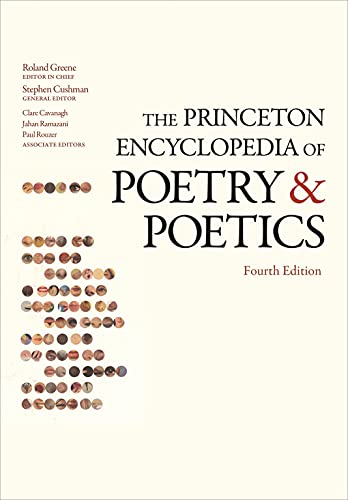
Through three editions over more than four decades, The Princeton Encyclopedia of Poetry and Poetics has built an unrivaled reputation as the most comprehensive and authoritative reference for students, scholars, and poets on all aspects of its subject: history, movements, genres, prosody, rhetorical devices, critical terms, and more. Now this landmark work has been thoroughly revised and updated for the twenty-first century. Compiled by an entirely new team of editors, the fourth edition--the first new edition in almost twenty years--reflects recent changes in literary and cultural studies, providing up-to-date coverage and giving greater attention to the international aspects of poetry, all while preserving the best of the previous volumes. At well over a million words and more than 1,000 entries, the Encyclopedia has unparalleled breadth and depth. Entries range in length from brief paragraphs to major essays of 15,000 words, offering a more thorough treatment--including expert synthesis and indispensable bibliographies--than conventional handbooks or dictionaries.
Die Inhaltsangabe kann sich auf eine andere Ausgabe dieses Titels beziehen.
Über die Autorin bzw. den Autor
Roland Greene is the Mark Pigott KBE Professor in the School of Humanities and Sciences and Professor of English and Comparative Literature at Stanford University. Stephen Cushman is the Robert C. Taylor Professor of English at the University of Virginia. Clare Cavanagh is Professor of Slavic and Comparative Literature at Northwestern University. Jahan Ramazani is the Edgar F. Shannon Professor of English at the University of Virginia. Paul F. Rouzer is Associate Professor of Asian Languages and Literatures at the University of Minnesota.
Auszug. © Genehmigter Nachdruck. Alle Rechte vorbehalten.
The Princeton Encyclopedia of Poetry and Poetics
PRINCETON UNIVERSITY PRESS
Copyright © 2012 Princeton University PressAll right reserved.
ISBN: 978-0-691-15491-6
Contents
Preface...........................................viiAcknowledgments...................................xiTopical List of Entries...........................xvBibliographical Abbreviations.....................xxiiiGeneral Abbreviations.............................xxviiContributors......................................xxviiiEntries A to Z....................................1Index.............................................1555
Chapter One
AABECEDARIUS, abecedarian (med. Lat. term for an ABC primer). An alphabetic *acrostic, a poem in which each line or stanza begins with a successive letter of the alphabet. The abecedarius was often a spiritual or meditative device in the ancient world, used for prayers, hymns, and prophecies, but it also has an inveterate role as a tool for teaching children language. In divine poetry, not only the word but even letters and sounds, given pattern, bear mystical significance and incantatory power—as do numbers (see NUMEROLOGY). The abecedarius, only one of several such forms, has had a special appeal as a literalization of the alpha-omega trope.
The earliest attested examples are Semitic, and abecedarii held an esp. important place in Heb. religious poetry, to judge from the dozen-odd examples in the OT. The best known of these is Psalm , which is made of 22 octave stanzas, one for each letter of the Heb. alphabet, all lines of each octave beginning with the same letter. The more common stanzaic type, however, is that used by Chaucer for his "ABC," where only the first line of the stanza bears the letter (cf. the ornate initials of illuminated mss.). Psalms 111–12 represent the astrophic type, wherein the initials of each successive line form the alphabet. In the comparable Japanese form, Iroha mojigusari, the first line must begin with the first and end with the second character of the alphabet, the second with the second and third, and so on. A number of abecedarii are extant in cl. and Alexandrian Gr., but they were also popular in Byzantine Gr. and are copious in med. Lat.: St. Augustine's well-known abecedarian psalm against the Donatists (Migne, PL 43.23 ff.) is the earliest known example of med. rhythmical verse.
As a mod. instructive device for children, the abecedarius has seen many familiar forms. In Eng., the best-known abecedarius is the song "`A'—You're Adorable," by Buddy Kaye, Fred Wise, and Sidney Lippman (1948).
K. Krumbacher, Geschichte der byzantinischen litteratur, 2d ed. (1897); C. Daux, Le Chant abécédaire de St. Augustin (1905); H. Leclercq, "Abécédaire," Dictionnaire d'archéologie chrétienne, ed. F. Cabrol (1907); Meyer, v. 2, ch. ; F. Dornseiff, Das Alphabet in Mystik und Magie, 2d ed. (1925), sect. 14; R. Marcus, "Alphabetic Acrostics in the Hellenistic and Roman Periods," Journal of Near Eastern Studies 6 (1947); Raby, Secular.
T.V.F. Brogan; D. A. Colón
ABSORPTION. A term for the process of a reader's deep engagement with a poem, marked by a lack of self-consciousness about the materiality of the reading process. Poetic rhythm is often used to enhance the experience of deep absorption in a poem; this is most marked in such hypnotically rhythmic poems as S. T. Coleridge's "Kubla Khan," but the condition is also achieved by a range of representational and material devices that pull the reader into a poem. Absorption typically works by unifying the sound, form, and theme of a poem into a construct that the reader perceives as seamless. Absorption may extend to such effects as a heightened sense of the poem as fiction and an identification with the *persona.
Various modernist modes, incl. *collage, parataxis, and *cacophony, are often understood as disrupting the readability of poems. Such modes may seem to make the reader self-conscious about negotiating the compositional structures of the poem and, by so doing, theatricalize (in Fried's term) the experience of reading. Bertolt Brecht's "alienation effect" (verfremdungseffekt), a term he first used in the 1930s, provides a useful model for breaking the identification of the spectator with the spectacle under *modernism, esp. as this term relates to the Rus. Formalist Viktor Shklovsky's discussion of ostranenie or *defamiliarization. Both verfremdungseffekt and ostranenie are antiabsorptive devices.
Neither absorption nor its converses—impermeability, unreadability, disruption—are inherent poetic values; rather, they suggest approaches to reading and listening. The difference is not as much an essence as a direction: a centrifugal (projective) poetic field versus a centripetal (introjective) one. Poems that attempt to be conventionally absorbing in form and content run the risk of becoming tedious and boring—that is, highly unabsorbing—esp. when they rely on traditional forms and themes that may seem outmoded to historically conscious readers. In contrast, many seemingly antiabsorptive gestures, incl. discontinuity, cut-ups, and opacity, may create rhythmically charged, hyperengaging poems. Moreover, the active use of linguistic materiality—the reader's or listener's acute awareness of the verbal materials and structures of the poem—may contribute to multilevel, supercharged poetic absorption. It seems evident that absorption is historically conditioned: for some readers and listeners, depending on the period and particular poems, *dissonance will be more absorbing than *consonance or *euphony. Indeed, lit. hist. might be seen as incl. cycles of change in readers' affective responses to emerging acoustic, structural, and thematic dimensions of poetry. The shock of the new for some is the invigorating tonic of the contemporary for others. Modernist and avant-garde poetics that emphasize fragmentation, discontinuity, visual materiality, incompleteness, boredom, or noise often do so in order to open new possibilities for "verbivocovisual" (James Joyce's word from Finnegans Wake) engagement of all the senses. Such poetics often explore the chordal possibilities that result from incommensurability, rather than unity, among the levels of form, rhythm, and content; under the sign of overlay and palimpsest, discrepant and impermeable elements of a poem can be recognized as pleats and folds. Temporal, thematic, and stylistic disjunction may form, dissolve, and reform into shifting constellations (to use Benjamin's term) that are open possibilities for a reader's or a listener's absorption into the newly emerging force field of the poem.
See AVANT-GARDE POETICS, DIFFICULTY, LANGUAGE POETRY, PRESENCE.
* B. Brecht, "Brecht on Theater," trans. J. Willett (1977); C. Bernstein, "Artifice of Absorption," in A Poetics (1991); V. Shklovsky, "Art as Device" (1917) in Theory of Prose, trans. B. Sher (1991); Michael Fried, "Art and Objecthood" in Art and Objecthood (1997); W. Benjamin, "The Doctrine of the Similar" (1933), trans. R. Livingstone, Selected Writings, ed. M. W. Jennings et al., v. 2, (1999); R. Tsur, "Kubla Khan"—Poetic Structure, Hypnotic Quality, and Cognitive Style (2006).
C. Bernstein
ACCENT. In Eng., accent is the auditory prominence perceived in one syllable as compared with others in its vicinity. Accent and stress are often treated as synonymous, though some literary scholars and linguists distinguish the two terms...
„Über diesen Titel“ kann sich auf eine andere Ausgabe dieses Titels beziehen.
Suchergebnisse für Princeton Encyclopedia of Poetry and Poetics: Fourth...

Beispielbild für diese ISBN
The Princeton Encyclopedia of
Verlag:
Princeton University Press, 2012
ISBN 10: 0691154910
ISBN 13: 9780691154916
Gebraucht
Softcover
Anbieter: World of Books (was SecondSale), Montgomery, IL, USA
Verkäuferbewertung 5 von 5 Sternen

Zustand: Very Good. Item in very good condition! Textbooks may not include supplemental items i.e. CDs, access codes etc. Artikel-Nr. 00108742766
Gebraucht kaufen
EUR 25,88
Versand gratis
Versand innerhalb von USA
Versand innerhalb von USA
Anzahl: 1 verfügbar
Beispielbild für diese ISBN
The Princeton Encyclopedia of
Verlag:
Princeton University Press, 2012
ISBN 10: 0691154910
ISBN 13: 9780691154916
Gebraucht
Softcover
Anbieter: World of Books (was SecondSale), Montgomery, IL, USA
Verkäuferbewertung 5 von 5 Sternen
Zustand: Good. Item in good condition. Textbooks may not include supplemental items i.e. CDs, access codes etc. Artikel-Nr. 00104270863
Gebraucht kaufen
EUR 25,88
Versand gratis
Versand innerhalb von USA
Versand innerhalb von USA
Anzahl: 2 verfügbar
Beispielbild für diese ISBN
The Princeton Encyclopedia of Poetry and Poetics : Fourth Edition
Verlag:
Princeton University Press, 2012
ISBN 10: 0691154910
ISBN 13: 9780691154916
Gebraucht
Softcover
Anbieter: Better World Books: West, Reno, NV, USA
Verkäuferbewertung 5 von 5 Sternen
Zustand: Good. Former library copy. Pages intact with minimal writing/highlighting. The binding may be loose and creased. Dust jackets/supplements are not included. Includes library markings. Stock photo provided. Product includes identifying sticker. Better World Books: Buy Books. Do Good. Artikel-Nr. 9268106-75
Gebraucht kaufen
EUR 29,05
Versand gratis
Versand innerhalb von USA
Versand innerhalb von USA
Anzahl: 1 verfügbar
Beispielbild für diese ISBN
The Princeton Encyclopedia of Poetry and Poetics : Fourth Edition
Verlag:
Princeton University Press, 2012
ISBN 10: 0691154910
ISBN 13: 9780691154916
Gebraucht
Softcover
Anbieter: Better World Books, Mishawaka, IN, USA
Verkäuferbewertung 5 von 5 Sternen
Zustand: Good. Pages intact with minimal writing/highlighting. The binding may be loose and creased. Dust jackets/supplements are not included. Stock photo provided. Product includes identifying sticker. Better World Books: Buy Books. Do Good. Artikel-Nr. 8566336-6
Gebraucht kaufen
EUR 29,05
Versand gratis
Versand innerhalb von USA
Versand innerhalb von USA
Anzahl: 1 verfügbar
Beispielbild für diese ISBN
The Princeton Encyclopedia of Poetry and Poetics: Fourth Edition
Verlag:
Princeton University Press, 2012
ISBN 10: 0691154910
ISBN 13: 9780691154916
Gebraucht
Paperback
Anbieter: WorldofBooks, Goring-By-Sea, WS, Vereinigtes Königreich
Verkäuferbewertung 5 von 5 Sternen
Paperback. Zustand: Very Good. The book has been read, but is in excellent condition. Pages are intact and not marred by notes or highlighting. The spine remains undamaged. Artikel-Nr. GOR005876456
Gebraucht kaufen
EUR 48,00
EUR 6,54 Versand
Versand von Vereinigtes Königreich nach USA
Versand von Vereinigtes Königreich nach USA
Anzahl: 2 verfügbar
Beispielbild für diese ISBN
The Princeton Encyclopedia of Poetry and Poetics
Anbieter: PBShop.store US, Wood Dale, IL, USA
Verkäuferbewertung 5 von 5 Sternen
PAP. Zustand: New. New Book. Shipped from UK. Established seller since 2000. Artikel-Nr. WP-9780691154916
Beispielbild für diese ISBN
The Princeton Encyclopedia of Poetry and Poetics (4th Ed)
Verlag:
Princeton University Press, 2012
ISBN 10: 0691154910
ISBN 13: 9780691154916
Gebraucht
Softcover
Anbieter: Anybook.com, Lincoln, Vereinigtes Königreich
Verkäuferbewertung 5 von 5 Sternen
Zustand: Good. This is an ex-library book and may have the usual library/used-book markings inside.This book has soft covers. In good all round condition. Please note the Image in this listing is a stock photo and may not match the covers of the actual item,2750grams, ISBN:9780691154916. Artikel-Nr. 8627099
Gebraucht kaufen
EUR 46,15
EUR 20,57 Versand
Versand von Vereinigtes Königreich nach USA
Versand von Vereinigtes Königreich nach USA
Anzahl: 1 verfügbar
Beispielbild für diese ISBN
The Princeton Encyclopedia of Poetry and Poetics: Fourth Edition
Anbieter: Majestic Books, Hounslow, Vereinigtes Königreich
Verkäuferbewertung 4 von 5 Sternen

Zustand: New. pp. 1680. Artikel-Nr. 20702120
Neu kaufen
EUR 68,69
EUR 7,59 Versand
Versand von Vereinigtes Königreich nach USA
Versand von Vereinigtes Königreich nach USA
Anzahl: 3 verfügbar
Beispielbild für diese ISBN
The Princeton Encyclopedia of Poetry and Poetics
Verlag:
Princeton University Press, 2012
ISBN 10: 0691154910
ISBN 13: 9780691154916
Gebraucht
Softcover
Anbieter: medimops, Berlin, Deutschland
Verkäuferbewertung 5 von 5 Sternen
Zustand: good. Befriedigend/Good: Durchschnittlich erhaltenes Buch bzw. Schutzumschlag mit Gebrauchsspuren, aber vollständigen Seiten. / Describes the average WORN book or dust jacket that has all the pages present. Artikel-Nr. M00691154910-G
Gebraucht kaufen
EUR 58,87
EUR 20,00 Versand
Versand von Deutschland nach USA
Versand von Deutschland nach USA
Anzahl: 1 verfügbar
Beispielbild für diese ISBN
The Princeton Encyclopedia of Poetry and Poetics - Fourth Edition
Anbieter: PBShop.store UK, Fairford, GLOS, Vereinigtes Königreich
Verkäuferbewertung 5 von 5 Sternen
PAP. Zustand: New. New Book. Shipped from UK. Established seller since 2000. Artikel-Nr. WP-9780691154916
Neu kaufen
EUR 66,09
EUR 14,98 Versand
Versand von Vereinigtes Königreich nach USA
Versand von Vereinigtes Königreich nach USA
Anzahl: 15 verfügbar