
Verwandte Artikel zu Social Learning: An Introduction to Mechanisms, Methods,...
Inhaltsangabe
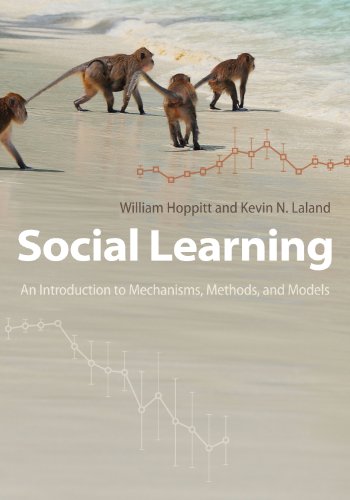
Many animals, including humans, acquire valuable skills and knowledge by copying others. Scientists refer to this as social learning. It is one of the most exciting and rapidly developing areas of behavioral research and sits at the interface of many academic disciplines, including biology, experimental psychology, economics, and cognitive neuroscience. Social Learning provides a comprehensive, practical guide to the research methods of this important emerging field. William Hoppitt and Kevin N. Lala define the mechanisms thought to underlie social learning and demonstrate how to distinguish them experimentally in the laboratory. They present techniques for detecting and quantifying social learning in nature, including statistical modeling of the spatial distribution of behavior traits. They also describe the latest theory and empirical findings on social learning strategies, and introduce readers to mathematical methods and models used in the study of cultural evolution. This book is an indispensable tool for researchers and an essential primer for students.
- Provides a comprehensive, practical guide to social learning research
- Combines theoretical and empirical approaches
- Describes techniques for the laboratory and the field
- Covers social learning mechanisms and strategies, statistical modeling techniques for field data, mathematical modeling of cultural evolution, and more
Die Inhaltsangabe kann sich auf eine andere Ausgabe dieses Titels beziehen.
Über die Autorin bzw. den Autor
William Hoppitt is senior lecturer in zoology at Anglia Ruskin University. Kevin N. Lala is professor of behavioral and evolutionary biology at the University of St. Andrews. His books include Culture Evolves and Niche Construction: The Neglected Process in Evolution
Von der hinteren Coverseite
"The recent explosion of theoretical developments and methodologies in the study of social learning and the evolution of culture has resulted in a daunting accumulation of new terms, definitions, and analytical techniques. Hoppitt and Laland, both leaders in this field, have taken up the challenge of integrating all of this information from multiple disciplines into a single volume, designed to aid researchers and students in evaluating and advancing the current state of the field."--Susan Perry, coeditor of The Biology of Traditions
"Hoppitt and Laland's book provides a coherent synthesis that is long overdue. Comprehensive, up-to-date, and accessible,Social Learning is a must-read for students embarking on a social learning research project and for anyone seeking mastery of the subject, from historical considerations to strategic models of social information use."--Luc-Alain Giraldeau, coauthor of Social Foraging Theory
"This book is a very valuable contribution to the field of social learning. I applaud Hoppitt and Laland for compiling such a wealth of information.Social Learning promises to become a standard reference work."--Stefano Ghirlanda, coauthor ofNeural Networks and Animal Behavior
"This excellent book provides a comprehensive overview of the methods and concepts used in social learning research, and also represents a rich source of information about many of the empirical findings available in the literature. It will be useful to both specialists and nonspecialists interested in social learning. I know of no other book like this."--Josep Call, Max Planck Institute for Evolutionary Anthropology
Aus dem Klappentext
"The recent explosion of theoretical developments and methodologies in the study of social learning and the evolution of culture has resulted in a daunting accumulation of new terms, definitions, and analytical techniques. Hoppitt and Laland, both leaders in this field, have taken up the challenge of integrating all of this information from multiple disciplines into a single volume, designed to aid researchers and students in evaluating and advancing the current state of the field."--Susan Perry, coeditor of The Biology of Traditions
"Hoppitt and Laland's book provides a coherent synthesis that is long overdue. Comprehensive, up-to-date, and accessible,Social Learning is a must-read for students embarking on a social learning research project and for anyone seeking mastery of the subject, from historical considerations to strategic models of social information use."--Luc-Alain Giraldeau, coauthor of Social Foraging Theory
"This book is a very valuable contribution to the field of social learning. I applaud Hoppitt and Laland for compiling such a wealth of information.Social Learning promises to become a standard reference work."--Stefano Ghirlanda, coauthor ofNeural Networks and Animal Behavior
"This excellent book provides a comprehensive overview of the methods and concepts used in social learning research, and also represents a rich source of information about many of the empirical findings available in the literature. It will be useful to both specialists and nonspecialists interested in social learning. I know of no other book like this."--Josep Call, Max Planck Institute for Evolutionary Anthropology
Auszug. © Genehmigter Nachdruck. Alle Rechte vorbehalten.
Social Learning
An Introduction to Mechanisms, Methods, and Models
By William Hoppitt, Kevin N. LalandPRINCETON UNIVERSITY PRESS
Copyright © 2013 Princeton University Press
All rights reserved.
ISBN: 978-0-691-15070-3All rights reserved.
Contents
| Acknowledgments............................................................ | ix |
| 1 Introduction............................................................. | 1 |
| 2 A Brief History of Social Learning Research.............................. | 16 |
| 3 Methods for Studying Social Learning in the Laboratory................... | 33 |
| 4 Social Learning Mechanisms............................................... | 62 |
| 5 Statistical Methods for Diffusion Data................................... | 105 |
| 6 Repertoire-Based Methods for Detecting and Quantifying Social Transmission............................................................... | 129 |
| 7 Developmental Methods for Studying Social Learning....................... | 172 |
| 8 Social Learning Strategies............................................... | 196 |
| 9 Modeling Social Learning and Culture..................................... | 235 |
| 10 Conclusions............................................................. | 260 |
| References................................................................. | 265 |
| Index...................................................................... | 301 |
CHAPTER 1
Introduction
The study of social learning sits at the interface of a truly astonishing number ofacademic disciplines. How many other fields could boast being central to bothsocial anthropology and human evolution; core material for both experimentalpsychologists and theoretically minded economists; or emerging influences inthe fields of both cognitive neuroscience and artificial intelligence?
The observation that many animals, including humans, acquire valuable lifeskills and knowledge through copying others has been the focus of attention ofanimal behaviorists dating back to Darwin. Likewise, social learning, the diffusionof innovations, conformity, and social influences on child development havebeen key concepts within the social sciences for over a century. However, in recentdecades, the field of social learning has received such unprecedented attentionspread across the sciences, social sciences, and humanities, and experiencedsuch growth, that researchers within the field have referred to an "explosion ofinterest" in the topic (Galef and Giraldeau 2001; Shettleworth 2001). Long goneare the days when research on imitation could (ungenerously) be characterizedas the esoteric province of an obscure branch of comparative psychology. Now,social learning is a rapidly growing subfield of animal cognition research; whilebiological anthropologists and archaeologists are constructing models of culturalevolution, economists are frequently talking norms and herding behavior, neuroscientistsare mapping circuitry associated with social influences on decisionmaking, and engineers are building imitating robots.
The diverse backgrounds of the researchers studying social learning contributeto the field's controversies. East African but not West African chimpanzees usestalks to fish for termites, while western but not eastern chimps crack open nutswith stone hammers. Capuchin monkeys in Costa Rica exhibit extraordinarysocial conventions, such as sniffing each other's hands and placing fingers in eachother's mouths. Humpback whales and chaffinches sing different songs than theirfellow conspecifics living in different regions. If these, and other, animal traditionsare acquired through social learning, are behavioral scientists justified inspeaking of animals possessing "culture"? Or are anthropologists correct to assertthat human cultures are so imbued with meaning, so permeated with symbolism,and so reliant on uniquely human aspects of cognition, that to liken them to thebehavioral traditions of animals is, frankly, ridiculous? Is human social learningshaped by evolved structure in the mind then biased to acquire content—fromchoosing sugar rich foods to admiring specific body shapes—that proved adaptiveamong our Pleistocene ancestors, as suggested by many evolutionary psychologists?Or is human learning dominated by general rules (e.g., copying thehighest payoff behavior or conforming to the local norm) that are for the mostpart acquired independently of their content, as claimed by cultural evolutionists?Is imitation critically dependent on the ability to take another individual'sperspective, to understand their goals, or on complex cognition? Are sociallylearned traditions constrained in order to be adaptive? Can cultural processessupport a viable form of group selection? And so on, and so forth. The controversiesare multiple, ripe, and engaging, enriched by the varied standpoints thatcharacterize adjacent disciplines struggling to understand a common topic.
The disparate backgrounds of those drawn into the field have also contributedto the newly emerging methods that are appearing to address these challenges.Until recently, experimental studies of social learning were restricted to behavioralinvestigations, typically conducted in the laboratories of comparative or developmentalpsychologists, and focused on very specific questions, such as: "Cananimals imitate?" or "Do children acquire violent dispositions from others?"Similarly, with the exception of some early experiments on birdsong learning,biologists' interest in social learning was pursued almost entirely through observationsand recordings of the natural behavior of animals, largely by ethologistsand primatologists.
In recent years, however, new methods have become available, considerablyexpanding the social learning researcher's toolbox. These include (i) experimentaland statistical methods that allow researchers to categorize cases of sociallearning according to their underlying psychological processes and learningmechanisms; (ii) neuroscientiic methods for identifying the brain structures,neural circuitry, and physiological processes underlying both social learning andsocial influences on decision making; (iii) mathematical and statistical methodsfor identifying social learning when it occurs in natural populations (or in naturalisticcontexts in captivity); (iv) experimental and statistical methods to predictand explain when humans and other animals copy, from whom they learn("social learning strategies"), and to also detect the strategies deployed; and (v)mathematical methods for predicting the pattern of diffusion of novel learned innovations,and for modeling cultural evolution and gene-culture coevolution. Finally,numerous and diverse tools and procedures are available for applying sociallearning methods outside of academia. These range from commercial hatcheriestraining hatchery-reared fish to recognize predators and thereby enhance restockingefforts, to predicting the pattern of spread of technological innovationsand identifying likely targets for uptake.
This book is designed to be a complete and accessible practical guide for thesocial learning researcher and their students, as well as for others whose interestin social learning is less central. As it currently stands, there is no single sourcethat reviews the aforementioned conceptual and methodological...
„Über diesen Titel“ kann sich auf eine andere Ausgabe dieses Titels beziehen.
Suchergebnisse für Social Learning: An Introduction to Mechanisms, Methods,...

Beispielbild für diese ISBN
Social Learning An Introduction to Mechanisms, Methods, and Models
Anbieter: Revaluation Books, Exeter, Vereinigtes Königreich
Verkäuferbewertung 5 von 5 Sternen

Hardcover. Zustand: Brand New. 320 pages. 10.00x7.25x1.00 inches. In Stock. Artikel-Nr. zk0691150702
Neu kaufen
EUR 142,73
EUR 14,58 Versand
Versand von Vereinigtes Königreich nach USA
Versand von Vereinigtes Königreich nach USA
Anzahl: 1 verfügbar