
Verwandte Artikel zu The Next Catastrophe: Reducing Our Vulnerabilities...
The Next Catastrophe: Reducing Our Vulnerabilities to Natural, Industrial, and Terrorist Disasters - Softcover
Inhaltsangabe
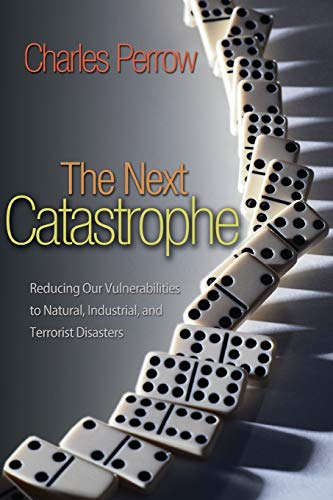
Charles Perrow is famous worldwide for his ideas about normal accidents, the notion that multiple and unexpected failures--catastrophes waiting to happen--are built into our society's complex systems. In The Next Catastrophe, he offers crucial insights into how to make us safer, proposing a bold new way of thinking about disaster preparedness. Perrow argues that rather than laying exclusive emphasis on protecting targets, we should reduce their size to minimize damage and diminish their attractiveness to terrorists. He focuses on three causes of disaster--natural, organizational, and deliberate--and shows that our best hope lies in the deconcentration of high-risk populations, corporate power, and critical infrastructures such as electric energy, computer systems, and the chemical and food industries. Perrow reveals how the threat of catastrophe is on the rise, whether from terrorism, natural disasters, or industrial accidents. Along the way, he gives us the first comprehensive history of FEMA and the Department of Homeland Security and examines why these agencies are so ill equipped to protect us. The Next Catastrophe is a penetrating reassessment of the very real dangers we face today and what we must do to confront them. Written in a highly accessible style by a renowned systems-behavior expert, this book is essential reading for the twenty-first century. The events of September 11 and Hurricane Katrina--and the devastating human toll they wrought--were only the beginning. When the next big disaster comes, will we be ready? In a new preface to the paperback edition, Perrow examines the recent (and ongoing) catastrophes of the financial crisis, the BP oil spill, and global warming.
Die Inhaltsangabe kann sich auf eine andere Ausgabe dieses Titels beziehen.
Über die Autorin bzw. den Autor
Charles Perrow With a new preface by the author
Von der hinteren Coverseite
"The Next Catastrophe is the work of the master at his formidable best--a dazzling array of learning, perspective, good sense, and, above all, command."--Kai Erikson, Yale University
"A profound and vital book, The Next Catastrophe provides a devastating indictment of the U.S. government's response to the deep organizational faults revealed by the September 11 attacks and Katrina. Perrow shows in fascinating detail how our politicians allow human disasters to be transformed into opportunities for profiteering and politicking, and routinely substitute wasteful bureaucracies for smart plans to reorganize fragile systems. The fundamental answer, Perrow writes, is to discard the profit- and power-driven ideologies in favor of our nation's traditional common-sense approach to the challenges of our all-too-real world."--Barry C. Lynn, author of End of the Line: The Rise and Coming Fall of the Global Corporation
"A profound meditation on the paradox that modern technological and management orthodoxies have taken us down an increasingly perilous path. In the name of efficiency, sensitive industries are now so concentrated that they can be crippled at a single blow, from nature, accidents, or acts of terrorism. The mantra of asserting 'central control' in response to catastrophes only makes things worse, Perrow notes, as hierarchies strangle grassroots networks of local responders that might do some good. A trenchant, troubling study."--John Arquilla, Naval Postgraduate School
"From the opening pages, The Next Catastrophe is riveting, eye-opening, and haunting. The causes of disasters go far beyond random acts of nature or terrorism; they reflect underlying systemic and managerial issues that we must confront in order to ensure our safety. Luckily, Charles Perrow digs deeply to find some difficult but promising solutions. Concerned citizens must join the experts in reading this brilliant book."--Rosabeth Moss Kanter, Harvard Business School professor, best-selling author of Confidence: How Winning Streaks and Losing Streaks Begin and End
The Next Catastrophe is a fascinating, stimulating, and far-reaching work. Perrow's signature themes are here--the role of political and economic institutions, the reach of their power into organizations, and the inevitability of major organizational failures. The basic argument will stir discussion, and the feasibility of Perrow's proposed solutions is sure to provoke controversy."--Lynn Eden, author of Whole World on Fire: Organizations, Knowledge, and Nuclear Weapons Devastation
"Perrow's thesis is laudable and his execution is strong. When he discusses the mistakes still being made in the way the U.S. has set up FEMA and Homeland Security, he is especially strong balanced, thoughtful, and convincing--and his explanation of the Enron debacle is one of the clearest ever presented. Overall, he analyzes how our organizations fail, why it is that regulation doesn't solve the problems, and how susceptible we have become as a result, doing so in a way that is just plain splendid."--William R. Freudenburg, University of California, Santa Barbara
"Charles Perrow is the undisputed 'master of disaster.' In this timely and well-written book, Perrow offers not only a shrewd sociological diagnosis of the looming threat of (un)natural disasters, but, lo and behold, in arguing for us to shrink targets and disperse risk, he actually provides a bold yet feasible policy solution to what will surely be a growing threat to our way of life."--Dalton Conley, author of The Pecking Order: A Bold New Look at How Family and Society Determine Who We Become
Auszug. © Genehmigter Nachdruck. Alle Rechte vorbehalten.
The Next Catastrophe
Reducing Our Vulnerabilities to Natural, Industrial, and Terrorist DisastersBy Charles PerrowPRINCETON UNIVERSITY PRESS
Copyright © 2007 Princeton University PressAll right reserved.
ISBN: 978-0-691-15016-1
Contents
Preface to the Paperback Edition...........................................................................viiAcknowledgments............................................................................................xlixPart One: Introduction and Natural Disasters...............................................................liChapter 1 Shrink the Targets..............................................................................1Chapter 2 "Natural" Disasters?............................................................................14Part Two: Can Government Help?.............................................................................41Chapter 3 The Government Response: The First FEMA.........................................................43Chapter 4 The Disaster after 9/11: The Department of Homeland Security and a New FEMA.....................68Part Three: The Disastrous Private Sector..................................................................131Chapter 5 Are Terrorists as Dangerous as Management? The Nuclear Plant Threat.............................133Chapter 6 Better Vulnerability through Chemistry..........................................................174Chapter 7 Disastrous Concentration in the National Power Grid.............................................211Chapter 8 Concentration and Terror on the Internet........................................................248Part Four: What Is to Be Done?.............................................................................289Chapter 9 The Enduring Sources of Failure: Organizational, Executive, and Regulatory......................291Appendix A Three Types of Redundancy......................................................................327Appendix B Networks of Small Firms........................................................................331Bibliography...............................................................................................335Index......................................................................................................355
Chapter One
Shrink the Targets
Disasters from natural sources, from industrial and technological sources, and from deliberate sources such as terrorism have all increased in the United States in recent decades, and no diminution is in sight. Weather disturbances are predicted to increase; low-level industrial accidents continue but threaten to intensify and the threat of cyber attacks on our "critical infrastructure" becomes ever more credible; foreign terrorists have not relaxed and we anxiously await another attack. Cataclysmic fantasies proliferate on movie screens and DVDs, and scholars write books with "collapse," "catastrophe," "our final hour," and "worst cases" in their titles.
But we have neglected a fundamental response to the trio of disaster sources. Instead of focusing only on preventing disasters and coping with their aftermath—which we must continue to do—we should reduce the size of vulnerable targets. Weapons of mass destruction (WMDs) already litter our landscape; terrorists need not sneak them in, and they are more likely to be triggered by natural and industrial disasters than by terrorists. Ninety-ton tank cars of chlorine gas are WMDs that travel daily through our cities; dispersing the deadly gas via a tornado or hurricane, an industrial accident, or a terrorist's suitcase bomb would endanger up to seven million people. New Orleans and its surroundings is, or was, our largest port, but it could have been a target one-third the size of its pre-Katrina population of some 450,000 souls, and much easier to defend and evacuate. Because of the increased concentration of the electric power industry, our vital electric power grid is so poorly managed that sagging power lines hitting tree branches in Ohio plunged the Northeast into darkness for hours and even days in some areas in 2003. The industry has made its grid a better target for a heat spell, a flood, a hurricane, or a few well-placed small bombs. Deconcentrating the industry would uncouple the vulnerabilities and barely decrease efficiency, as we shall see.
Not all of the dangers confronting us can be reduced through downsizing our targets. Some natural hazards we just have to face: we are unlikely to stop settling in earthquake zones, nor can we avoid tsunamis, volcanoes, asteroids, or even tornadoes. Even small targets are at risk in the case of epidemics, and terrorists with biological and radiological weapons can cause such widespread devastation that the size of the target is irrelevant.
But, except for tornadoes, all these are rare. Devastations from the more common sources such as high winds, water and fire damage, industrial and technological accidents, and terrorist attacks on large targets can be greatly reduced. It will not be easy, but given our yearly disaster bill in the billions of dollars, it makes economic sense as well as social sense. It will require a change in our mindset about markets and regulation. Since our current mindset is only decades old—it changed quickly from the 1970s on—it is hardly inconceivable that it could not change again.
Disasters expose our social structure and culture more sharply than other important events. (Clarke 2005) They reveal starkly the failure of organizations, regulations, and the political system. But we regard disasters as exceptional events, and after a disaster we shore up our defenses and try to improve our responses while leaving the target in place. However, as Clarke persuasively argues, disasters are not exceptional but a normal part of our existence. To reduce their damage will require probing our social structure and culture to see how these promote our vulnerabilities. We will do this throughout this book in the hope of prodding changes in these areas.
Two of the major themes in this work are the inevitable failure of organizations, public and private, to protect us from disasters and the increasing concentration of targets that make the disasters more consequential. There are many explanations for the first theme, organizational failures, but we will highlight one in particular: organizations are tools that can be used for ends other than their official ones. To prevent unwarranted use, we require regulation in the private sector and representative governance in the public sectors. The failure of the political system means ineffective regulation. This can be changed.
One goal of regulation is to prevent the accumulation of economic power in private hands. Otherwise, we get the concentration not just of economic power but of hazardous materials, populations in risky areas with inadequate protection, and vulnerabilities in parts of our critical infrastructure such as the Internet, electric power, transportation, and agriculture. (We also need regulation to ensure that the public sector is not wasteful, that standards are adequate to protect us, that corruption is minimized, and so on.) The third major theme concerns a structural alternative to the concentrations that endanger us. We encounter it first in the electric power grid and second in the Internet; these are networked systems, rather than hierarchical systems. Networks are decentralized, with minimal concentrations of destructive energy and economic power. They are...
„Über diesen Titel“ kann sich auf eine andere Ausgabe dieses Titels beziehen.
Suchergebnisse für The Next Catastrophe: Reducing Our Vulnerabilities...

Beispielbild für diese ISBN
The Next Catastrophe: Reducing Our Vulnerabilities to Natural, Industrial, and Terrorist Disasters
Verlag:
Princeton University Press, 2011
ISBN 10: 0691150168
ISBN 13: 9780691150161
Gebraucht
Paperback
Anbieter: World of Books (was SecondSale), Montgomery, IL, USA
Verkäuferbewertung 5 von 5 Sternen

Paperback. Zustand: Good. Focusing on three causes of disaster - natural, organizational, and deliberate - this title shows that our best hope lies in the deconcentration of high-risk populations, corporate power, and critical infrastructures such as electric energy, computer systems, and the chemical and food industries. Artikel-Nr. 00109822998
Gebraucht kaufen
EUR 6,71
Versand gratis
Versand innerhalb von USA
Versand innerhalb von USA
Anzahl: 1 verfügbar
Beispielbild für diese ISBN
The Next Catastrophe : Reducing Our Vulnerabilities to Natural, Industrial, and Terrorist Disasters
Verlag:
Princeton University Press, 2011
ISBN 10: 0691150168
ISBN 13: 9780691150161
Gebraucht
Softcover
Anbieter: Better World Books, Mishawaka, IN, USA
Verkäuferbewertung 5 von 5 Sternen
Zustand: Good. Pages intact with minimal writing/highlighting. The binding may be loose and creased. Dust jackets/supplements are not included. Stock photo provided. Product includes identifying sticker. Better World Books: Buy Books. Do Good. Artikel-Nr. 4334511-6
Gebraucht kaufen
EUR 6,72
Versand gratis
Versand innerhalb von USA
Versand innerhalb von USA
Anzahl: 1 verfügbar
Beispielbild für diese ISBN
The Next Catastrophe : Reducing Our Vulnerabilities to Natural, Industrial, and Terrorist Disasters
Verlag:
Princeton University Press, 2011
ISBN 10: 0691150168
ISBN 13: 9780691150161
Gebraucht
Softcover
Anbieter: Better World Books, Mishawaka, IN, USA
Verkäuferbewertung 5 von 5 Sternen
Zustand: Very Good. Pages intact with possible writing/highlighting. Binding strong with minor wear. Dust jackets/supplements may not be included. Stock photo provided. Product includes identifying sticker. Better World Books: Buy Books. Do Good. Artikel-Nr. 12009658-6
Gebraucht kaufen
EUR 6,72
Versand gratis
Versand innerhalb von USA
Versand innerhalb von USA
Anzahl: 1 verfügbar
Beispielbild für diese ISBN
The Next Catastrophe: Reducing Our Vulnerabilities to Natural, Industrial, and Terrorist Disasters
Verlag:
Princeton University Press, 2011
ISBN 10: 0691150168
ISBN 13: 9780691150161
Gebraucht
Paperback
Anbieter: WorldofBooks, Goring-By-Sea, WS, Vereinigtes Königreich
Verkäuferbewertung 5 von 5 Sternen
Paperback. Zustand: Very Good. The book has been read, but is in excellent condition. Pages are intact and not marred by notes or highlighting. The spine remains undamaged. Artikel-Nr. GOR008526340
Gebraucht kaufen
EUR 20,60
EUR 6,59 Versand
Versand von Vereinigtes Königreich nach USA
Versand von Vereinigtes Königreich nach USA
Anzahl: 2 verfügbar
Beispielbild für diese ISBN
The Next Catastrophe
Anbieter: PBShop.store US, Wood Dale, IL, USA
Verkäuferbewertung 5 von 5 Sternen
PAP. Zustand: New. New Book. Shipped from UK. Established seller since 2000. Artikel-Nr. WP-9780691150161
Beispielbild für diese ISBN
The Next Catastrophe
Anbieter: PBShop.store UK, Fairford, GLOS, Vereinigtes Königreich
Verkäuferbewertung 5 von 5 Sternen
PAP. Zustand: New. New Book. Shipped from UK. Established seller since 2000. Artikel-Nr. WP-9780691150161
Neu kaufen
EUR 28,43
EUR 5,91 Versand
Versand von Vereinigtes Königreich nach USA
Versand von Vereinigtes Königreich nach USA
Anzahl: 1 verfügbar
Beispielbild für diese ISBN
The Next Catastrophe: Reducing Our Vulnerabilities to Natural, Industrial, and Terrorist Disasters
Anbieter: Kennys Bookstore, Olney, MD, USA
Verkäuferbewertung 5 von 5 Sternen
Zustand: New. 2011. With a New preface by the author. Paperback. Focusing on three causes of disaster - natural, organizational, and deliberate - this title shows that our best hope lies in the deconcentration of high-risk populations, corporate power, and critical infrastructures such as electric energy, computer systems, and the chemical and food industries. Num Pages: 432 pages. BIC Classification: JFFC; JKSR; RNR; RNT; RPC. Category: (P) Professional & Vocational; (U) Tertiary Education (US: College). Dimension: 234 x 155 x 27. Weight in Grams: 610. . . . . . Books ship from the US and Ireland. Artikel-Nr. V9780691150161
Neu kaufen
EUR 29,98
EUR 9,33 Versand
Versand innerhalb von USA
Versand innerhalb von USA
Anzahl: 1 verfügbar
Beispielbild für diese ISBN
The Next Catastrophe: Reducing Our Vulnerabilities to Natural, Industrial, and Terrorist Disasters
Anbieter: Ria Christie Collections, Uxbridge, Vereinigtes Königreich
Verkäuferbewertung 5 von 5 Sternen
Zustand: New. In English. Artikel-Nr. ria9780691150161_new
Neu kaufen
EUR 32,56
EUR 13,28 Versand
Versand von Vereinigtes Königreich nach USA
Versand von Vereinigtes Königreich nach USA
Anzahl: 1 verfügbar
Beispielbild für diese ISBN
The Next Catastrophe Reducing Our Vulnerabilities to Natural, Industrial, and Terrorist Disasters
Anbieter: Revaluation Books, Exeter, Vereinigtes Königreich
Verkäuferbewertung 5 von 5 Sternen
Paperback. Zustand: Brand New. with a new preface by the author edition. 432 pages. 9.84x5.91x0.59 inches. In Stock. Artikel-Nr. x-0691150168
Neu kaufen
EUR 40,37
EUR 14,71 Versand
Versand von Vereinigtes Königreich nach USA
Versand von Vereinigtes Königreich nach USA
Anzahl: 2 verfügbar