
Verwandte Artikel zu How Big Banks Fail and What to Do About It
Inhaltsangabe
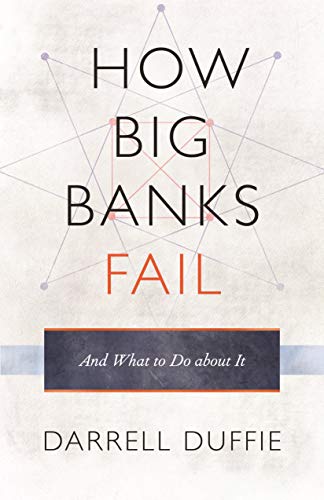
A leading finance expert explains how and why big banks fail—and what can be done to prevent it
Dealer banks—that is, large banks that deal in securities and derivatives, such as J. P. Morgan and Goldman Sachs—are of a size and complexity that sharply distinguish them from typical commercial banks. When they fail, as we saw in the global financial crisis, they pose significant risks to our financial system and the world economy. How Big Banks Fail and What to Do about It examines how these banks collapse and how we can prevent the need to bail them out.
In sharp, clinical detail, Darrell Duffie walks readers step-by-step through the mechanics of large-bank failures. He identifies where the cracks first appear when a dealer bank is weakened by severe trading losses, and demonstrates how the bank's relationships with its customers and business partners abruptly change when its solvency is threatened. As others seek to reduce their exposure to the dealer bank, the bank is forced to signal its strength by using up its slim stock of remaining liquid capital. Duffie shows how the key mechanisms in a dealer bank's collapse—such as Lehman Brothers' failure in 2008—derive from special institutional frameworks and regulations that influence the flight of short-term secured creditors, hedge-fund clients, derivatives counterparties, and most devastatingly, the loss of clearing and settlement services.
How Big Banks Fail and What to Do about It reveals why today's regulatory and institutional frameworks for mitigating large-bank failures don't address the special risks to our financial system that are posed by dealer banks, and outlines the improvements in regulations and market institutions that are needed to address these systemic risks.
Die Inhaltsangabe kann sich auf eine andere Ausgabe dieses Titels beziehen.
Über die Autorin bzw. den Autor
Darrell Duffie is the Dean Witter Distinguished Professor of Finance at Stanford University's Graduate School of Business. He is the author of Dynamic Asset Pricing Theory and the coauthor of Credit Risk: Pricing, Measurement, and Management (both Princeton).
Von der hinteren Coverseite
"In How Big Banks Fail and What to Do about It, Darrell Duffie tackles one of the central but often neglected issues in building a more resilient financial system. Duffie has that rare combination--the rigor of the academy and knowledge of how the plumbing of the financial system works. Anyone interested in regulatory reform will need to engage with his thinking."--Paul Tucker, deputy governor, financial stability, Bank of England
"The book does an excellent job of explaining the institutional setting of big dealer banks and how things went wrong in the financial crisis. The issues are important and the policy suggestions sound. There is nothing quite like this out there."--Franklin Allen, University of Pennsylvania
"Darrell Duffie is one of the leading experts on the problem of large-bank failures. He focuses on issues not addressed elsewhere, but which are being talked about everywhere. This book scores in a big way."--Viral V. Acharya, New York University
Aus dem Klappentext
"In How Big Banks Fail and What to Do about It, Darrell Duffie tackles one of the central but often neglected issues in building a more resilient financial system. Duffie has that rare combination--the rigor of the academy and knowledge of how the plumbing of the financial system works. Anyone interested in regulatory reform will need to engage with his thinking."--Paul Tucker, deputy governor, financial stability, Bank of England
"The book does an excellent job of explaining the institutional setting of big dealer banks and how things went wrong in the financial crisis. The issues are important and the policy suggestions sound. There is nothing quite like this out there."--Franklin Allen, University of Pennsylvania
"Darrell Duffie is one of the leading experts on the problem of large-bank failures. He focuses on issues not addressed elsewhere, but which are being talked about everywhere. This book scores in a big way."--Viral V. Acharya, New York University
Auszug. © Genehmigter Nachdruck. Alle Rechte vorbehalten.
How Big Banks Fail and What to Do about It
By Darrell DuffiePRINCETON UNIVERSITY PRESS
Copyright © 2011 Princeton University PressAll right reserved.
ISBN: 978-0-691-14885-4
Contents
List of Figures and Tables........................................................ixPreface...........................................................................xiChapter One Introduction.........................................................1Chapter Two What Is a Dealer Bank?...............................................9Chapter Three Failure Mechanisms.................................................23Chapter Four Recapitalizing a Weak Bank..........................................43Chapter Five Improving Regulations and Market Infrastructure.....................53Appendix Central Clearing of Derivatives.........................................63Notes.............................................................................71Bibliography......................................................................79Index.............................................................................87
Chapter One
Introduction
I begin with a story of the failure of a bank that is a major dealer in securities and derivatives. Our dealer bank will be unable to stop the drain of cash caused by the departures of its short-term creditors, over-the-counter (OTC) derivatives counterparties, and client hedge funds. The most immediate examples are the 2008 failures of Bear Stearns and Lehman, but the failure mechanics at work could apply to any major dealer bank, once it is sufficiently weakened. There are further lessons to be learned from the major dealers such as Morgan Stanley that did not fail despite severe stresses on their liquidity shortly after the Lehman bankruptcy.
We pick up the story several months before the demise of a hypothetical dealer bank, which we shall call Beta Bank. Beta's capital position has just been severely weakened by losses. The cause need not be a general financial crisis, although that would further reduce Beta's chance of recovery. Once weakened, Beta takes actions that worsen its liquidity position in a rational gamble to signal its strength and protect its franchise value. Beta wishes to reduce the flight of its clients, creditors, and counterparties.
Beta's first move is to bail out some clients from the significant losses that they suffered through investments arranged by Beta. This is an attempt to maintain the value of Beta's reputation for serving its clients' interests. As time passes, and the cracks in Beta's finances become apparent to some market participants, Beta notices that some of its OTC derivatives counterparties have begun to lower their exposures to Beta. Their transactions slant more and more toward trades that drain cash away from Beta and toward these counterparties. Beta believes that it must continue to offer competitive terms on these trades, for to do otherwise would signal financial weakness, thereby exacerbating the flight. Other dealer banks are increasingly being asked to enter derivatives trades, called "novations," which have the effect of inserting the other dealers between Beta and its original derivatives counterparties, insulating those counterparties from Beta's default risk. As those dealers notice this trend, they begin to refuse novations that would expose them to Beta's default. As a result, the market gossip about Beta's weakness begins to circulate more rapidly.
Beta has been operating a significant prime-brokerage business, offering hedge funds such services as information technology, trade execution, accounting reports, and-more important to our story-a repository for the hedge funds' cash and securities. These hedge funds have heard the rumors and have been watching the market prices of Beta's equity and debt in order to gauge Beta's prospects. They begin to shift their cash and securities to better-capitalized prime brokers or, safer yet, to custodian banks. Beta's franchise value is thus rapidly eroding; its prospects for a merger rescue or for raising additional equity capital diminish accordingly. Potential providers of new equity capital question whether their capital infusions would do much more than improve the position of Beta's creditors. In the short run, a departure of prime-brokerage clients is also playing havoc with Beta's cash liquidity, because Beta has been financing its own business in part with the cash and securities left with it by these hedge funds. As they leave, Beta's cash flexibility declines to alarming levels.
Although Beta's short-term secured creditors hold Beta's securities as collateral against default losses, at this point they see no good reason to renew their loans to Beta. Potentially, they could get caught up in the administrative mess that would accompany Beta's default. Moreover, even though the amount of securities that they hold as collateral includes a "haircut"-a buffer for unexpected reductions in the market value of the collateral-there remains the risk that they could not sell the collateral at a high enough price to cover their loans. Most of these creditors fail to renew their loans to Beta. A large fraction of these short-term secured loans are in the form of repurchase agreements, or "repos." The majority of these have a term of one day. Thus, on short notice, Beta must find significant new financing, or conduct costly fire sales of its securities.
Beta's liquidity position is now grave. Beta's treasury department is scrambling to maintain positive cash balances in its clearing accounts. In the normal course of business, Beta's clearing bank would allow Beta and other dealers the flexibility of daylight overdrafts. A clearing bank routinely holds the dealer's securities in amounts sufficient to offset potential cash shortfalls. Today, however, Beta receives word that its clearing bank has exercised its right to stop processing Beta's cash transactions, given the exposure of the clearing bank to Beta's overall position. This is the last straw. Unable to execute its trades, Beta declares bankruptcy.
Beta Bank is a fictional composite. In what follows, my goal is to establish a factual foundation for the key elements of this story. In addition to providing institutional and conceptual frameworks, I will propose revisions to regulations and market infrastructure.
Economic Principles
The basic economic principles at play in the failure of a large dealer bank are not so different from those of a garden-variety run on a typical retail bank, but the institutional mechanisms and the systemic destructiveness are rather different.
A conventional analysis of the stability of a bank, along the lines of Diamond and Dybvig (1983), conceptualizes the bank as an investor in illiquid loans. Financing the loans with short-term deposits makes sense if the bank is a superior intermediator between depositors, who are usually interested in short-term liquidity, and borrowers, who seek project financing. The equity owners of the bank benefit, to a point, from leverage. Occasionally, perhaps from an unexpected surge in the liquidity demands of depositors or from a shock to the ability of borrowers to repay their loans, depositors may become concerned over the bank's solvency. If the concern is sufficiently severe, the anticipation by depositors of a run is self-fulfilling.
The standard regulatory tools for treating the social costs of bank failures are the following: supervision and risk-based capital requirements, which reduce the chance of a solvency threatening loss of capital; deposit...
„Über diesen Titel“ kann sich auf eine andere Ausgabe dieses Titels beziehen.
Suchergebnisse für How Big Banks Fail and What to Do About It

Beispielbild für diese ISBN
How Big Banks Fail and What to Do about It
Verlag:
Princeton University Press, 2010
ISBN 10: 0691148856
ISBN 13: 9780691148854
Gebraucht
Hardcover
Anbieter: Better World Books, Mishawaka, IN, USA
Verkäuferbewertung 5 von 5 Sternen

Zustand: Good. Former library copy. Pages intact with minimal writing/highlighting. The binding may be loose and creased. Dust jackets/supplements are not included. Includes library markings. Stock photo provided. Product includes identifying sticker. Better World Books: Buy Books. Do Good. Artikel-Nr. 5758129-6
Gebraucht kaufen
EUR 20,45
Versand gratis
Versand innerhalb von USA
Versand innerhalb von USA
Anzahl: 1 verfügbar
Beispielbild für diese ISBN
How Big Banks Fail, and What to Do About It
Verlag:
Princeton University Press, 2011
ISBN 10: 0691148856
ISBN 13: 9780691148854
Gebraucht
Hardcover
Anbieter: Anybook.com, Lincoln, Vereinigtes Königreich
Verkäuferbewertung 5 von 5 Sternen
Zustand: Fair. This is an ex-library book and may have the usual library/used-book markings inside.This book has hardback covers. Book contains pencil markings With owner's name inside cover. In fair condition, suitable as a study copy. Dust jacket in good condition. Library sticker on front cover. Please note the Image in this listing is a stock photo and may not match the covers of the actual item,350grams, ISBN:9780691148854. Artikel-Nr. 9701739
Gebraucht kaufen
EUR 14,97
EUR 15,30 Versand
Versand von Vereinigtes Königreich nach USA
Versand von Vereinigtes Königreich nach USA
Anzahl: 1 verfügbar
Beispielbild für diese ISBN
How Big Banks Fail and What to Do about It
Anbieter: PBShop.store UK, Fairford, GLOS, Vereinigtes Königreich
Verkäuferbewertung 5 von 5 Sternen
HRD. Zustand: New. New Book. Shipped from UK. Established seller since 2000. Artikel-Nr. WP-9780691148854
Neu kaufen
EUR 40,40
EUR 4,88 Versand
Versand von Vereinigtes Königreich nach USA
Versand von Vereinigtes Königreich nach USA
Anzahl: 3 verfügbar
Beispielbild für diese ISBN
How Big Banks Fail and What to Do about It
Anbieter: PBShop.store US, Wood Dale, IL, USA
Verkäuferbewertung 5 von 5 Sternen
HRD. Zustand: New. New Book. Shipped from UK. Established seller since 2000. Artikel-Nr. WP-9780691148854
Beispielbild für diese ISBN
How Big Banks Fail and What to Do about It
Anbieter: Majestic Books, Hounslow, Vereinigtes Königreich
Verkäuferbewertung 4 von 5 Sternen

Zustand: New. pp. 160 13 Illus. Artikel-Nr. 3522659
Neu kaufen
EUR 54,36
EUR 7,63 Versand
Versand von Vereinigtes Königreich nach USA
Versand von Vereinigtes Königreich nach USA
Anzahl: 3 verfügbar
Beispielbild für diese ISBN
How Big Banks Fail and What to Do about It
Anbieter: Kennys Bookstore, Olney, MD, USA
Verkäuferbewertung 5 von 5 Sternen
Zustand: New. Dealer banks - that is, large banks that deal in securities and derivatives, such as J P Morgan and Goldman Sachs - are of a size and complexity that sharply distinguish them from typical commercial banks. This book examines how these banks collapse and how we can prevent the need to bail them out. Num Pages: 112 pages, 13 line illus. 2 tables. BIC Classification: KCX; KFFK; KFFM. Category: (UP) Postgraduate, Research & Scholarly. Dimension: 217 x 147 x 15. Weight in Grams: 274. . 2010. Hardcover. . . . . Books ship from the US and Ireland. Artikel-Nr. V9780691148854
Neu kaufen
EUR 53,89
EUR 9,33 Versand
Versand innerhalb von USA
Versand innerhalb von USA
Anzahl: 1 verfügbar
Beispielbild für diese ISBN
How Big Banks Fail, and What to Do About It
Anbieter: Revaluation Books, Exeter, Vereinigtes Königreich
Verkäuferbewertung 5 von 5 Sternen
Hardcover. Zustand: Brand New. 160 pages. 8.75x5.75x0.50 inches. In Stock. Artikel-Nr. __0691148856
Neu kaufen
EUR 55,08
EUR 11,73 Versand
Versand von Vereinigtes Königreich nach USA
Versand von Vereinigtes Königreich nach USA
Anzahl: 2 verfügbar
Beispielbild für diese ISBN
How Big Banks Fail and What to Do about It
Anbieter: Ria Christie Collections, Uxbridge, Vereinigtes Königreich
Verkäuferbewertung 5 von 5 Sternen
Zustand: New. In English. Artikel-Nr. ria9780691148854_new
Neu kaufen
EUR 56,38
EUR 10,99 Versand
Versand von Vereinigtes Königreich nach USA
Versand von Vereinigtes Königreich nach USA
Anzahl: 3 verfügbar