
Verwandte Artikel zu Nonplussed!: Mathematical Proof of Implausible Ideas
Inhaltsangabe
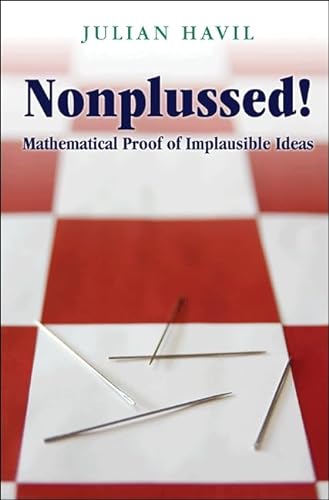
Math—the application of reasonable logic to reasonable assumptions—usually produces reasonable results. But sometimes math generates astonishing paradoxes—conclusions that seem completely unreasonable or just plain impossible but that are nevertheless demonstrably true. Did you know that a losing sports team can become a winning one by adding worse players than its opponents? Or that the thirteenth of the month is more likely to be a Friday than any other day? Or that cones can roll unaided uphill? In Nonplussed!—a delightfully eclectic collection of paradoxes from many different areas of math—popular-math writer Julian Havil reveals the math that shows the truth of these and many other unbelievable ideas.
Nonplussed! pays special attention to problems from probability and statistics, areas where intuition can easily be wrong. These problems include the vagaries of tennis scoring, what can be deduced from tossing a needle, and disadvantageous games that form winning combinations. Other chapters address everything from the historically important Torricelli's Trumpet to the mind-warping implications of objects that live on high dimensions. Readers learn about the colorful history and people associated with many of these problems in addition to their mathematical proofs.
Nonplussed! will appeal to anyone with a calculus background who enjoys popular math books or puzzles.
Die Inhaltsangabe kann sich auf eine andere Ausgabe dieses Titels beziehen.
Über die Autorin bzw. den Autor
Julian Havil is a former Master at Winchester College, England, where he taught mathematics for more than thirty years. He is the author of Gamma: Exploring Euler's Constant and Impossible?: Surprising Solutions to Counterintuitive Conundrums (both Princeton).
Von der hinteren Coverseite
"Nonplussed!, as the title suggests, is a marvelous study of some two dozen choice mathematical problems that boggle the mind. Unlike so many books on recreational math, Havil doesn't hesitate to give crystal-clear proofs and their necessary equations. John Conway's great checker-jumping puzzle is here, along with amazing nontransitive betting paradoxes and other confounding results almost impossible to believe. No one interested in recreational mathematics on an intermediate advanced level should pass up this stimulating, delightful volume."--Martin Gardner
"In Nonplussed!, his new book of fascinating discussions of mathematical questions, Julian Havil's literary signature is evident even without seeing his name on the cover. The presentation always displays his strong ability to weave together the historical with what is often a surprising mathematical twist, even for those problems that have been around long enough to be called classic. Nonplussed! will be a classic, too."--Paul J. Nahin, author of Dr. Euler's Fabulous Formula
"Nonplussed!! is a very interesting and eclectic mix of paradoxes that has the potential to be a very useful and lasting contribution to popular mathematics."--Christopher J. Sangwin, author of Mathematics Galore
"I greatly enjoyed this book and I imagine that anyone who liked high school math will too. Nonplussed! certainly succeeds in surprising-and in giving insightful proofs of the mathematical results discussed. It is a magnificent demonstration of how far even rather straightforward mathematics can take you. And by describing many of the historical characters involved and the problems that motivated them, it makes mathematics seem like an adventure."--Nick Huggett, author of Space from Zeno to Einstein
Auszug. © Genehmigter Nachdruck. Alle Rechte vorbehalten.
Nonplussed!
MATHEMATICAL PROOF OF IMPLAUSIBLE IDEASBy Julian HavilPRINCETON UNIVERSITY PRESS
Copyright © 2007 Julian HavilAll right reserved.
ISBN: 978-0-691-14822-9
Contents
Preface..........................................................xiAcknowledgements.................................................xiiiIntroduction.....................................................1Chapter 1 Three Tennis Paradoxes.................................4Chapter 2 The Uphill Roller......................................16Chapter 3 The Birthday Paradox...................................25Chapter 4 The Spin of a Table....................................37Chapter 5 Derangements...........................................46Chapter 6 Conway's Chequerboard Army.............................62Chapter 7 The Toss of a Needle...................................68Chapter 8 Torricelli's Trumpet...................................82Chapter 9 Nontransitive Effects..................................92Chapter 10 A Pursuit Problem.....................................105Chapter 11 Parrondo's Games......................................115Chapter 12 Hyperdimensions.......................................127Chapter 13 Friday the 13th.......................................151Chapter 14 Fractran..............................................162The Motifs.......................................................180Appendix A The Inclusion-Exclusion Principle.....................187Appendix B The Binomial Inversion Formula........................189Appendix C Surface Area and Arc Length...........................193Index............................................................195
Chapter One
THREE TENNIS PARADOXES
So that as tennis is a game of no use in itself, but of great use in respect it maketh a quick eye and a body ready to put itself into all postures; so in the mathematics, that use which is collateral and intervenient is no less worthy than that which is principal and intended. Roger Bacon
In this first chapter we will look at three examples of sport-related counterintuitive phenomena: the first two couched in terms of tennis, the third intrinsically connected with it.
Winning a Tournament
The late Leo Moser posed this first problem during his long association with the University of Alberta. Suppose that there are three members of a club who decide to embark on a private tournament: a new member M, his friend F (who is a better player) and the club's top player T.
M is encouraged by F and by the offer of a prize if M wins at least two games in a row, played alternately against himself and T.
It would seem sensible for M to choose to play more against his friend F than the top player T, but if we look at the probabilities associated with the two alternative sequences of play, FTF and TFT, matters take on a very different look. Suppose that we write f as the probability of M beating F and t as the probability of M beating T (and assume independence).
If M does choose to play F twice, we have table 1.1, which lists the chances of winning the prize.
This gives a total probability of winning the prize of
[P.sub.F] = ftf + ft(1 - f) + (1 - f)tf = ft(2 - f).
Now suppose that M chooses the seemingly worse alternative of playing T twice, then table 1.2 gives the corresponding probabilities, and the total probability of winning the prize becomes
[P.sub.T] = tf t + tf (1 - t) + (1 - t)ft = ft(2 - t).
Since the top player is a better player than the friend, t < f and so 2 - t > 2 - f, which makes ft(2 - t) > ft(2 - f) and PT > PF. Therefore, playing the top player twice is, in fact, the better option.
Logical calm is restored if we look at the expected number of wins. With FTF it is
[E.sub.F] = 0 x (1 - f)(1 - t)(1 - f) + 1 x {f(1-t)(1-f) + (1-f)t(1-f) + (1-f)(1-t)f} + 2 x {ft(1 - f) + f(1 - t)f + (1 - f)tf} + 3 x ftf = 2f + t
and a similar calculation for TFT yields ET = 2t + f .
Since f > t, 2f - f > 2t - t and so 2f + t > 2t + f, which means that EF > ET - and that we would expect!
Forming a Team
Now let us address a hidden pitfall in team selection.
A selection of 10 tennis players is made, ranked 1 (the worst player, W) to 10 (the best player, B). Suppose now that W challenges B to a competition of all-plays-all in which he can chose the two best remaining players and B, to make it fair, must choose the two worst remaining players.
The challenge accepted, W's team is TW = {1, 8, 9} and B's team is [T.sub.B] = {10, 2, 3}. Table 1.3 shows the (presumed) inevitable outcome of the tournament; at this stage we are interested only in the upper left corner. We can see that W's disadvantage has not been overcome since [T.sub.B] beats [T.sub.W] 5 games to 4.
The remaining players are {4, 5, 6, 7} and W reissues the challenge, telling B that he can add to his team one of the remaining players and then he would do the same from the remainder; of course, both B and W choose the best remaining players, who are ranked 7 and 6 respectively. The teams are now [T.sub.W] = {1, 8, 9, 6} and [T.sub.B] = {10, 2, 3, 7} and the extended table 1.3 now shows that, in spite of B adding the better player to his team, the result is worse for him, with an 8-8 tie.
Finally, the challenge is reissued under the same conditions and the teams finally become [T.sub.W] = {1, 8, 9, 6, 4} and [T.sub.B] = {10, 2, 3, 7, 5} and this time the full table 1.3 shows that [T.sub.W] now beats [T.sub.B] 13-12.
A losing team has become a winning team by adding in worse players than the opposition.
Table 1.4 shows, in each of the three cases, the average ranking of the two teams. We can see that in each case the [T.sub.B] team has an average ranking less than that of the [T.sub.W] team and that the average ranking is increasing for [T.sub.B] and decreasing (or staying steady) for [T.sub.W] as new members join. This has resonances with the simple (but significant) paradox known as the Will Rogers Phenomenon.
Interstate migration brought about by the American Great Depression of the 1930s caused Will Rogers, the wisecracking, lariat-throwing people's philosopher, to remark that
When the Okies left Oklahoma and moved to California, they raised the intellectual level in both states.
Rogers, an 'Okie' (native of Oklahoma), was making a quip, of course, but if we take the theoretical case that the migration was from the ranks of the least intelligent of Oklahoma, all of whom were more intelligent than the native Californians(!), then what he quipped would obviously be true. The result is more subtle, though. For example, if we consider the two sets A = {1, 2, 3, 4} and B = {5, 6, 7, 8, 9}, supposedly ranked by intelligence level (1 low, 9 high), the average ranking of A is 2.5 and that of B is 7. However, if we move the 5 ranking from B to A we have that A = {1, 2, 3, 4, 5} and B = {6, 7, 8, 9} and the average ranking of A is now 3 and that of B is 7.5: both average...
„Über diesen Titel“ kann sich auf eine andere Ausgabe dieses Titels beziehen.
Suchergebnisse für Nonplussed!: Mathematical Proof of Implausible Ideas

Beispielbild für diese ISBN
Nonplussed! : Mathematical Proof of Implausible Ideas
Verlag:
Princeton University Press, 2010
ISBN 10: 0691148228
ISBN 13: 9780691148229
Gebraucht
Softcover
Anbieter: Better World Books, Mishawaka, IN, USA
Verkäuferbewertung 5 von 5 Sternen

Zustand: Very Good. Former library copy. Pages intact with possible writing/highlighting. Binding strong with minor wear. Dust jackets/supplements may not be included. Includes library markings. Stock photo provided. Product includes identifying sticker. Better World Books: Buy Books. Do Good. Artikel-Nr. 39339373-6
Gebraucht kaufen
EUR 6,59
Versand gratis
Versand innerhalb von USA
Versand innerhalb von USA
Anzahl: 1 verfügbar
Beispielbild für diese ISBN
Nonplussed! : Mathematical Proof of Implausible Ideas
Verlag:
Princeton University Press, 2010
ISBN 10: 0691148228
ISBN 13: 9780691148229
Gebraucht
Softcover
Anbieter: Better World Books, Mishawaka, IN, USA
Verkäuferbewertung 5 von 5 Sternen
Zustand: Good. Pages intact with minimal writing/highlighting. The binding may be loose and creased. Dust jackets/supplements are not included. Stock photo provided. Product includes identifying sticker. Better World Books: Buy Books. Do Good. Artikel-Nr. 754700-6
Gebraucht kaufen
EUR 6,59
Versand gratis
Versand innerhalb von USA
Versand innerhalb von USA
Anzahl: 1 verfügbar
Beispielbild für diese ISBN
Nonplussed! : Mathematical Proof of Implausible Ideas
Verlag:
Princeton University Press, 2010
ISBN 10: 0691148228
ISBN 13: 9780691148229
Gebraucht
Softcover
Anbieter: Better World Books, Mishawaka, IN, USA
Verkäuferbewertung 5 von 5 Sternen
Zustand: Very Good. Pages intact with possible writing/highlighting. Binding strong with minor wear. Dust jackets/supplements may not be included. Stock photo provided. Product includes identifying sticker. Better World Books: Buy Books. Do Good. Artikel-Nr. 18531733-6
Gebraucht kaufen
EUR 6,59
Versand gratis
Versand innerhalb von USA
Versand innerhalb von USA
Anzahl: 1 verfügbar
Beispielbild für diese ISBN
Nonplussed!: Mathematical Proof of Implausible Ideas
Verlag:
Princeton University Press, 2010
ISBN 10: 0691148228
ISBN 13: 9780691148229
Gebraucht
paperback
Anbieter: Roundabout Books, Greenfield, MA, USA
Verkäuferbewertung 4 von 5 Sternen

paperback. Zustand: Near Fine. Condition Notes: Excellent, unmarked copy with little wear and tight binding. We ship in recyclable American-made mailers. 100% money-back guarantee on all orders. Artikel-Nr. 1781689
Gebraucht kaufen
EUR 9,64
Versand gratis
Versand innerhalb von USA
Versand innerhalb von USA
Anzahl: 1 verfügbar
Beispielbild für diese ISBN
Nonplussed!
Anbieter: PBShop.store US, Wood Dale, IL, USA
Verkäuferbewertung 5 von 5 Sternen
PAP. Zustand: New. New Book. Shipped from UK. Established seller since 2000. Artikel-Nr. WP-9780691148229
Beispielbild für diese ISBN
Nonplussed!
Anbieter: PBShop.store UK, Fairford, GLOS, Vereinigtes Königreich
Verkäuferbewertung 5 von 5 Sternen
PAP. Zustand: New. New Book. Shipped from UK. Established seller since 2000. Artikel-Nr. WP-9780691148229
Neu kaufen
EUR 20,95
EUR 4,97 Versand
Versand von Vereinigtes Königreich nach USA
Versand von Vereinigtes Königreich nach USA
Anzahl: 15 verfügbar
Beispielbild für diese ISBN
Nonplussed!: Mathematical Proof of Implausible Ideas
Verlag:
Princeton University Press, 2010
ISBN 10: 0691148228
ISBN 13: 9780691148229
Gebraucht
Softcover
Anbieter: medimops, Berlin, Deutschland
Verkäuferbewertung 5 von 5 Sternen
Zustand: very good. Gut/Very good: Buch bzw. Schutzumschlag mit wenigen Gebrauchsspuren an Einband, Schutzumschlag oder Seiten. / Describes a book or dust jacket that does show some signs of wear on either the binding, dust jacket or pages. Artikel-Nr. M00691148228-V
Gebraucht kaufen
EUR 16,45
EUR 10,00 Versand
Versand von Deutschland nach USA
Versand von Deutschland nach USA
Anzahl: 1 verfügbar
Beispielbild für diese ISBN
Nonplussed!
Anbieter: Majestic Books, Hounslow, Vereinigtes Königreich
Verkäuferbewertung 4 von 5 Sternen
Zustand: New. pp. 216. Artikel-Nr. 4459842
Neu kaufen
EUR 25,51
EUR 7,76 Versand
Versand von Vereinigtes Königreich nach USA
Versand von Vereinigtes Königreich nach USA
Anzahl: 3 verfügbar
Beispielbild für diese ISBN
Nonplussed! Mathematical Proof of Implausible Ideas
Anbieter: Revaluation Books, Exeter, Vereinigtes Königreich
Verkäuferbewertung 5 von 5 Sternen
Paperback. Zustand: Brand New. reprint edition. 196 pages. 9.00x6.00x0.75 inches. In Stock. Artikel-Nr. __0691148228
Neu kaufen
EUR 23,62
EUR 11,94 Versand
Versand von Vereinigtes Königreich nach USA
Versand von Vereinigtes Königreich nach USA
Anzahl: 2 verfügbar
Beispielbild für diese ISBN
Nonplussed!: Mathematical Proof of Implausible Ideas
Anbieter: Kennys Bookstore, Olney, MD, USA
Verkäuferbewertung 5 von 5 Sternen
Zustand: New. 2010. Reprint. Paperback. Math - the application of reasonable logic to reasonable assumptions - usually produces reasonable results. But sometimes math generates astonishing paradoxes - conclusions that seem completely unreasonable or just plain impossible but that are nevertheless demonstrably true. This book is a collection of paradoxes from different areas of math. Num Pages: 216 pages, 18 halftones. 143 line illus. BIC Classification: PBW; PDZM. Category: (G) General (US: Trade); (P) Professional & Vocational; (U) Tertiary Education (US: College). Dimension: 234 x 154 x 16. Weight in Grams: 314. . . . . . Books ship from the US and Ireland. Artikel-Nr. V9780691148229
Neu kaufen
EUR 27,22
EUR 9,40 Versand
Versand innerhalb von USA
Versand innerhalb von USA
Anzahl: 16 verfügbar