
Verwandte Artikel zu Clear and Simple as the Truth: Writing Classic Prose...
Inhaltsangabe
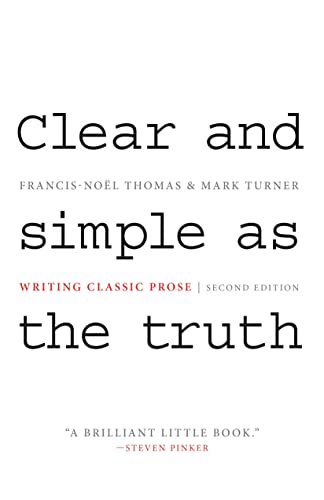
For more than a decade, Clear and Simple as the Truth has guided readers to consider style not as an elegant accessory of effective prose but as its very heart. Francis-Noël Thomas and Mark Turner present writing as an intellectual activity, not a passive application of verbal skills. In classic style, the motive is truth, the purpose is presentation, the reader and writer are intellectual equals, and the occasion is informal. This general style of presentation is at home everywhere, from business memos to personal letters and from magazine articles to student essays. Everyone talks about style, but no one explains it. The authors of this book do; and in doing so, they provoke the reader to consider style, not as an elegant accessory of effective prose, but as its very heart. At a time when writing skills have virtually disappeared, what can be done? If only people learned the principles of verbal correctness, the essential rules, wouldn't good prose simply fall into place? Thomas and Turner say no. Attending to rules of grammar, sense, and sentence structure will no more lead to effective prose than knowing the mechanics of a golf swing will lead to a hole-in-one. Furthermore, ten-step programs to better writing exacerbate the problem by failing to recognize, as Thomas and Turner point out, that there are many styles with different standards. The book is divided into four parts. The first, "Principles of Classic Style," defines the style and contrasts it with a number of others. "The Museum" is a guided tour through examples of writing, both exquisite and execrable. "The Studio," new to this edition, presents a series of structured exercises. Finally, "Further Readings in Classic Prose" offers a list of additional examples drawn from a range of times, places, and subjects. A companion website, classicprose.com, offers supplementary examples, exhibits, and commentary, and features a selection of pieces written by students in courses that used Clear and Simple as the Truth as a textbook.
Die Inhaltsangabe kann sich auf eine andere Ausgabe dieses Titels beziehen.
Über die Autorin bzw. den Autor
Francis-Noël Thomas & Mark Turner
Von der hinteren Coverseite
Praise for the first edition: "[Clear and Simple as the Truth] has changed the way that I write and think about writing."--Paul Bloom, Yale University
Praise for the first edition: "Far and away the best how-to-write book I've ever read. It puts Strunk and White and everyone else in the shade."--John E. Talbott, University of California, Santa Barbara
Praise for the first edition: "Thanks to Thomas and Turner, the cognitive revolution has finally caught up with the analysis of style--brilliantly, learnedly, and, above all, readably."--David Lee Rubin, University of Virginia
Praise for the first edition: "Clear and Simple as the Truth holds the promise of raising the level of the nation's prose.... The book is full of cogency and insight."--Frederick Crews
Praise for the first edition: "A work of great intellectual elegance and power. I have read it with a lot of pleasure, admiring the wisdom and economy of its reflections and the extraordinary range of its citations."--Claude Rawson, Yale University
Praise for the first edition: "A treatment of the classic style that manifests the virtues of the writing it propounds, expounds, and exemplifies in a wealth of fascinating passages, brilliantly analyzed."--M. H. Abrams, Cornell University
Praise for the first edition: "Could well be the most important discussion of style since the great classical rhetoricians."--Wayne C. Booth, University of Chicago
Praise for the first edition: "One of the best discussions of style that I have recently read."--Richard Preston, author of The Hot Zone
Praise for the first edition: "The authors give one of the best discussions of style that I have ever read. Thomas and Turner juxtapose conventionally thought of as disparate, and thereby suggest possible new avenues of interpretation for critics of individual authors. Clear and Simple as the Truth occupies a niche of its own, as a kind of hybrid between books on writing such as The Elements of Style and The Reader over Your Shoulder, and more theoretical studies of representation, such as Mimesis."--Richard Preston, author of American Steel
Auszug. © Genehmigter Nachdruck. Alle Rechte vorbehalten.
Clear and Simple as the Truth
Writing Classic ProseBy Francis-Noël Thomas Mark TurnerPRINCETON UNIVERSITY PRESS
Copyright © 2011 Princeton University PressAll right reserved.
ISBN: 978-0-691-14743-7
Contents
Acknowledgments.............................................viiClear and Simple as the Truth...............................1ONE Principles of Classic Style............................5TWO The Museum.............................................107THREE The Studio...........................................187FOUR Further Readings in Classic Prose.....................229Notes.......................................................239Index.......................................................253
Chapter One
Principles of Classic Style
* The Concept of Style
"Style" is a word everybody uses, but almost no one can explain what it means. It is often understood as the inessential or even disreputable member of a two-term set: style and substance. This set of terms is elastic but in all its many applications, style is the subordinate term and, in the traditional American idiom, there is a persistent suggestion that we would be better off without it. Style is, at best, a harmless if unnecessary bit of window dressing. At worst, it is a polite name for fraud. There used to be a cigar company whose motto was "All Quality. No Style."
When style is considered the opposite of substance, it seems optional and incidental, even when it is admired. In this way of framing things, substantive thought and meaning can be prior to style and completely separable from it. The identical thought or the identical meaning, it is suggested, can be expressed in many styles—or even in none at all, as when just plain integrity or the unvarnished truth is offered as an alternative to the adornments of style. Style, conceived this way, is something fancy that distracts us from what is essential; it is the varnish that makes the truth at least a little harder to see.
The notion that style is something completely separate from substance, so that substance can be offered "straight," lies behind both the motto of the cigar company and William Butler yeats's description of Bernard Shaw's writing, but in the second case the poet puts a high value on style and views writing in no style, while possible, to be something monstrously mechanical. Yeats apparently thought of his own characteristic poetic voice as "style." it was a voice so compelling that attempts to imitate it have ruined quite a number of aspiring poets. Shaw's voice was not poetic in yeats's sense, so yeats considered Shaw to be a writer "without style." Because he held the view that style is optional, yeats could simultaneously view Shaw as "the most formidable man in modern letters," able to write "with great effect," and yet view Shaw's writing as "without music, without style, either good or bad." He described Shaw as a nightmare sewing machine that clicked, shone, and smiled, "smiled perpetually."
Whether style is viewed as spiritual, fraudulent, or something in between, any concept of style that treats it as optional is inadequate not only to writing but to any human action. Nothing we do can be done "simply" and in no style, because style is something inherent in action, not something added to it. In this respect, style is like the typeface in which a text is printed. We may overlook it, and frequently do, but it is always there. The styles we acquire unconsciously remain invisible to us as a rule, and routine actions can seem to be done in no style at all, even though their styles are obvious to experienced observers. A printer, a proofreader, or a type designer cannot fail to notice the type in which a text is printed, but for most of us, that typeface will have to be laid down beside a contrasting face before we even notice it exists. We thought we were looking at words pure and simple and did not notice that they are printed in a specific typeface.
When we do something in a default style acquired unconsciously, we do not notice the style of our activity. In such cases, we have an abstract concept of action that leaves style out of account. We can have a concept of lying without being aware—as a good investigative reporter is—that, in practice, we must have a style of lying. We can have a concept of quarreling without being aware— as a good marriage counselor is—that, in practice, we must have a style of quarreling.
Despite a lifetime of speaking, we can remain unaware of having a style of speaking. Yankees in Maine or Good Ol' Boys in Louisiana think that people from Brooklyn talk funny. WASPS in the Chicago suburbs think that Poles or Lithuanians in Chicago speak English with an accent, as if the suburban WASPS, the Yankees, and the Good Ol' Boys speak just plain American English with no accent. coastal Californians think—just as the ancient Greeks did—that everybody else sounds barbarous. A moment's reflection will convince anyone that it is impossible to speak without an accent. But people who feel they set the local tone do not consider their own accents to be accents. It is hard to think of a child who is just learning to speak wanting to learn a style of speaking. The style is folded into the activity as it is learned: we think that we have learned to speak a language, not that we have learned a regional dialect. Children in Maine do not think they are learning to speak English with a Yankee accent; they think they are learning to speak English.
Although there are certainly a lot of English accents to be heard, even if we restrict the field to America, only a few people consciously choose theirs. Professional broadcasters, of course, do; sometimes people interested in acting careers do. Many politicians with degrees from prestigious universities have learned to speak with one accent in the capitals where they make laws and policy and quite a different one back home where they campaign for office. Senator Fulbright was a Rhodes scholar with an Oxford education. Before he went to the Senate, he had been the dean of a law school and the president of a university. His background was perfectly congruent with what he sounded like in action as chairman of the Senate Foreign relations committee conducting hearings on the Vietnam War, but when he campaigned in rural Arkansas, where he got his votes, there was no hint of oxford, or even Fayetteville. on the stump, he sounded completely down home. After the election, that sound dissipated with every mile he got closer to Washington until he was sworn in for a new term and reassumed both the seat of power and the music of policy.
Senator Fulbright could maintain two dramatically distinct styles of speech in his personal repertory because he was aware of both as styles and consequently did not mistake either of them for just plain English. His awareness of his own styles allowed him to switch back and forth between them and fit them to circumstances. Everyone does this to some extent, but not everyone is aware of doing so. Speakers who are not consciously aware of their styles run into problems when none of their habitual styles fits a particular circumstance very well. We are trapped by our unconscious styles if we cannot recognize them as styles. When all of our styles are effectively default styles, we choose without knowing we are choosing and so cannot recognize the practical possibility of alternative styles.
People who unconsciously have acquired a full complement of routine...
„Über diesen Titel“ kann sich auf eine andere Ausgabe dieses Titels beziehen.
Suchergebnisse für Clear and Simple as the Truth: Writing Classic Prose...

Beispielbild für diese ISBN
Clear and Simple As the Truth : Writing Classic Prose - Second Edition
Verlag:
Princeton University Press, 2011
ISBN 10: 0691147434
ISBN 13: 9780691147437
Gebraucht
Softcover
Anbieter: Better World Books, Mishawaka, IN, USA
Verkäuferbewertung 5 von 5 Sternen

Zustand: Good. Pages intact with minimal writing/highlighting. The binding may be loose and creased. Dust jackets/supplements are not included. Stock photo provided. Product includes identifying sticker. Better World Books: Buy Books. Do Good. Artikel-Nr. 5902441-20
Gebraucht kaufen
EUR 21,34
Versand gratis
Versand innerhalb von USA
Versand innerhalb von USA
Anzahl: 1 verfügbar
Beispielbild für diese ISBN
Clear and Simple as the Truth: Writing Classic Prose (Second Edition)
Verlag:
Princeton University Press, 2011
ISBN 10: 0691147434
ISBN 13: 9780691147437
Gebraucht
Paperback
Anbieter: WorldofBooks, Goring-By-Sea, WS, Vereinigtes Königreich
Verkäuferbewertung 5 von 5 Sternen
Paperback. Zustand: Very Good. The book has been read, but is in excellent condition. Pages are intact and not marred by notes or highlighting. The spine remains undamaged. Artikel-Nr. GOR007303273
Gebraucht kaufen
EUR 17,08
EUR 6,67 Versand
Versand von Vereinigtes Königreich nach USA
Versand von Vereinigtes Königreich nach USA
Anzahl: 3 verfügbar
Beispielbild für diese ISBN
Clear and Simple as the Truth
Anbieter: PBShop.store US, Wood Dale, IL, USA
Verkäuferbewertung 5 von 5 Sternen
PAP. Zustand: New. New Book. Shipped from UK. Established seller since 2000. Artikel-Nr. WP-9780691147437
Beispielbild für diese ISBN
Clear and Simple as the Truth: Writing Classic Prose - Second Edition
Verlag:
Princeton University Press, 2011
ISBN 10: 0691147434
ISBN 13: 9780691147437
Gebraucht
Soft cover
Anbieter: Seagull Books, Hove, Vereinigtes Königreich
Verkäuferbewertung 5 von 5 Sternen
Soft cover. Zustand: Fair. 2nd Edition. Has some light general reading/shelfwear, with small amount of highlighting on a few pages - otherwise this is a clean, tight copy. Quick dispatch from the UK. Artikel-Nr. 091273
Gebraucht kaufen
EUR 17,12
EUR 16,08 Versand
Versand von Vereinigtes Königreich nach USA
Versand von Vereinigtes Königreich nach USA
Anzahl: 1 verfügbar
Beispielbild für diese ISBN
Clear and Simple as the Truth
Anbieter: PBShop.store UK, Fairford, GLOS, Vereinigtes Königreich
Verkäuferbewertung 5 von 5 Sternen
PAP. Zustand: New. New Book. Shipped from UK. Established seller since 2000. Artikel-Nr. WP-9780691147437
Neu kaufen
EUR 30,34
EUR 4,96 Versand
Versand von Vereinigtes Königreich nach USA
Versand von Vereinigtes Königreich nach USA
Anzahl: 15 verfügbar
Beispielbild für diese ISBN
Clear and Simple as the Truth
Anbieter: Majestic Books, Hounslow, Vereinigtes Königreich
Verkäuferbewertung 4 von 5 Sternen

Zustand: New. pp. 272 Illus. Artikel-Nr. 5480885
Neu kaufen
EUR 40,80
EUR 7,74 Versand
Versand von Vereinigtes Königreich nach USA
Versand von Vereinigtes Königreich nach USA
Anzahl: 3 verfügbar
Beispielbild für diese ISBN
Clear and Simple as the Truth: Writing Classic Prose - Second Edition
Anbieter: Ria Christie Collections, Uxbridge, Vereinigtes Königreich
Verkäuferbewertung 5 von 5 Sternen
Zustand: New. In English. Artikel-Nr. ria9780691147437_new
Neu kaufen
EUR 41,61
EUR 11,16 Versand
Versand von Vereinigtes Königreich nach USA
Versand von Vereinigtes Königreich nach USA
Anzahl: Mehr als 20 verfügbar
Beispielbild für diese ISBN
Clear and Simple as the Truth: Writing Classic Prose - Second Edition
Anbieter: Kennys Bookstore, Olney, MD, USA
Verkäuferbewertung 5 von 5 Sternen
Zustand: New. 2011. 2nd Edition. Paperback. Guides readers to consider style not as an elegant accessory of effective prose but as its very heart. This title presents writing as an intellectual activity, not a passive application of verbal skills. Num Pages: 272 pages, 1 line illus. BIC Classification: 2AB; CBW; JNZ. Category: (P) Professional & Vocational; (U) Tertiary Education (US: College). Dimension: 216 x 142 x 20. Weight in Grams: 358. . . . . . Books ship from the US and Ireland. Artikel-Nr. V9780691147437
Neu kaufen
EUR 48,67
EUR 9,35 Versand
Versand innerhalb von USA
Versand innerhalb von USA
Anzahl: 14 verfügbar
Beispielbild für diese ISBN
Clear and Simple as the Truth Writing Classic Prose Second Edition
Anbieter: Revaluation Books, Exeter, Vereinigtes Königreich
Verkäuferbewertung 5 von 5 Sternen
Paperback. Zustand: Brand New. 2nd revised edition edition. 272 pages. 8.40x5.40x0.90 inches. In Stock. Artikel-Nr. x-0691147434
Neu kaufen
EUR 47,17
EUR 11,91 Versand
Versand von Vereinigtes Königreich nach USA
Versand von Vereinigtes Königreich nach USA
Anzahl: 2 verfügbar
Beispielbild für diese ISBN
CLEAR AND SIMPLE AS THE TRUTH WRITING C
Anbieter: Speedyhen, Hertfordshire, Vereinigtes Königreich
Verkäuferbewertung 5 von 5 Sternen
Zustand: NEW. Artikel-Nr. NW9780691147437
Neu kaufen
EUR 30,36
EUR 48,84 Versand
Versand von Vereinigtes Königreich nach USA
Versand von Vereinigtes Königreich nach USA
Anzahl: 2 verfügbar