
Verwandte Artikel zu Why Not Kill Them All?: The Logic and Prevention of...
Inhaltsangabe
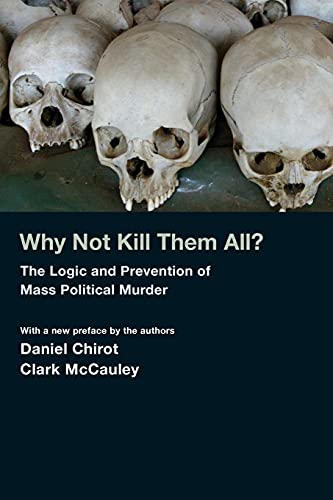
Genocide, mass murder, massacres. The words themselves are chilling, evoking images of the slaughter of countless innocents. What dark impulses lurk in our minds that even today can justify the eradication of thousands and even millions of unarmed human beings caught in the crossfire of political, cultural, or ethnic hostilities? This question lies at the heart of Why Not Kill Them All? Cowritten by historical sociologist Daniel Chirot and psychologist Clark McCauley, the book goes beyond exploring the motives that have provided the psychological underpinnings for genocidal killings. It offers a historical and comparative context that adds up to a causal taxonomy of genocidal events. Rather than suggesting that such horrors are the product of abnormal or criminal minds, the authors emphasize the normality of these horrors: killing by category has occurred on every continent and in every century. But genocide is much less common than the imbalance of power that makes it possible. Throughout history human societies have developed techniques aimed at limiting intergroup violence. Incorporating ethnographic, historical, and current political evidence, this book examines the mechanisms of constraint that human societies have employed to temper partisan passions and reduce carnage. Might an understanding of these mechanisms lead the world of the twenty-first century away from mass murder? Why Not Kill Them All? makes clear that there are no simple solutions, but that progress is most likely to be made through a combination of international pressures, new institutions and laws, and education. If genocide is to become a grisly relic of the past, we must fully comprehend the complex history of violent conflict and the struggle between hatred and tolerance that is waged in the human heart. In a new preface, the authors discuss recent mass violence and reaffirm the importance of education and understanding in the prevention of future genocides.
Die Inhaltsangabe kann sich auf eine andere Ausgabe dieses Titels beziehen.
Über die Autorin bzw. den Autor
Daniel Chirot is the Job and Gertrud Tamaki Professor of International Studies and professor of sociology at the University of Washington. Clark McCauley is the Rachel C. Hale Professor of Science and Mathematics and codirector of the Solomon Asch Center for Study of Ethnopolitical Conflict at Bryn Mawr College, and founding editor of Dynamics of Asymmetric Conflict: Pathways toward Terrorism and Genocide.
Von der hinteren Coverseite
"Why Not Kill Them All? is an excellent book that adopts a fresh and complex approach to the problem of mass killings. In a study that ranges widely around the globe and through history, Chirot and McCauley demonstrate that genocides and other large-scale atrocities are relatively rare events. The human capacity for evil is deep-seated, the authors argue, but so is our inclination to settle conflicts amicably. The ties that bind us together are at least as strong as the forces that always threaten to rupture human connections. The challenge is to foster the social, cultural, and political tendencies that lead to cohesion rather than conflict. In their conclusion, the authors develop a set of powerful recommendations that students, policymakers, and concerned citizens will all want to consider."--Eric D. Weitz, Professor of History, University of Minnesota, author of A Century of Genocide
"In recent years a parade of social commentators has grappled with the question of the causes of mass killing and genocide. But none of these researchers have brought the breadth of historical and sociological comparison to the issue that Chirot and McCauley do. None has delved as deeply into the social psychology that rationalizes violence. A brilliant synthesis of psychology and historical sociology, this book breaks new ground in the study of mass violence. Troubling and yet hopeful, the book will appeal to specialists as well as the general reader trying to make sense of one of the most morally perplexing issues of our age."--Robert Hefner, Professor of Anthropology, Boston University
"In this wide-ranging book, Daniel Chirot and Clark McCauley make an important contribution to our understanding of genocide and other atrocities by seeking to explain why these tragic events are not more common. By posing this counterintuitive question the authors remind us that although genocide remains far more frequent than we might hope, it is in fact remarkably rare compared to the innumerable motives and opportunities that exist for violence between human social groups. In uncovering the mechanisms already in place in most societies that act to mitigate such violence, they help point the way to making genocide even less common in the future."--Ben Valentino, Dartmouth College, author of Final Solutions: Mass Killing and Genocide in the Twentieth Century
"In their new book, Chirot and McCauley bring to bear on the issue of mass murder a rich ethnographic literature dealing with the ubiquitous subject of violence in society. In particular, they draw the attention of readers to various institutions and practices that emerged in collective life to control violence. Why Not Kill Them All? is bound to become a standard text in university classes addressing the subject of genocide and mass political murder."--Jan T. Gross, author of Neighbors: The Destruction of the Jewish Community in Jedwabne, Poland
Auszug. © Genehmigter Nachdruck. Alle Rechte vorbehalten.
Why Not Kill Them All?
The Logic and Prevention of Mass Political MurderBy Daniel Chirot Clark MccauleyPrinceton University Press
Copyright © 2006 Princeton University PressAll right reserved.
ISBN: 978-0-691-14594-5
Contents
Preface to the Paperback Edition..........................................................................ixAcknowledgments...........................................................................................xvINTRODUCTION Are We Killers or Peacemakers?..............................................................1CHAPTER ONE Why Genocides? Are They Different Now Than in the Past?......................................11CHAPTER TWO The Psychological Foundations of Genocidal Killing...........................................51CHAPTER THREE Why Is Limited Warfare More Common Than Genocide?..........................................95CHAPTER FOUR Strategies to Decrease the Chances of Mass Political Murder in Our Time.....................149CONCLUSION Our Question Answered.........................................................................211References................................................................................................219Index.....................................................................................................249
Chapter One
Why Genocides? Are They Different Now Than in the Past?
Qui tacet, consentire videtur. (He who keeps silent seems to consent.) —From a letter written by General von Trotha, commander of the German army in Southwest Africa, to German Chancellor Bülow in 1905 (Dedering 1999)
The term genocide was coined only in 1944 (Lemkin 1944) and was designated as an international crime by the United Nations in 1948 (L. Kuper 1981, 210–14). Ethnic cleansing is an even newer term. It came into use during the Yugoslav wars of the early 1990s and was declared a crime against humanity by the United Nations in 1993 (Teitel 1996, 81). Though the two terms are distinct, there is considerable overlap in their meaning. In practice, modern episodes of ethnic cleansing have caused large numbers of deaths and often conform to the United Nations' definition of genocide, which is the attempt to destroy "in whole or in part, a national, ethnical, racial, or religious group" (Fein 1990, 1; Freeman 1995, 209). Norman Naimark's historical account of such catastrophes in Europe in the twentieth century (including the genocide of Armenians in Anatolia in 1915) shows that what may have begun in some cases as state-sponsored ethnic cleansing quickly turned into mass killing by deliberate murder, abuse, famine, and disease. Such, for example, was the case with the Germans expelled from large parts of eastern Europe after World War II. About 11.5 million civilian Germans were "cleansed" from this area, of whom up to 2.5 million died. Most of these deportations and deaths took place in the last year of World War II, but more than half a million deaths occurred after the war, particularly in deportations from Poland and Czechoslovakia (Naimark 2001, 14, 110–38, 187).
Neither genocide nor ethnic cleansing is unique to the twentieth century. When the Cherokees were expelled from the southeastern United States in 1838, the resulting death rates certainly mark the episode as genocidal even though it was not the specific intent of the U.S. government at that time to exterminate them. Those who made it to what would later become Oklahoma and survived the hardships and disease remained there, more or less unmolested. Nevertheless, a recent demographic estimate suggests that as many as 20 percent of the sixteen thousand Cherokees deported on the "Trail of Tears" died on the way, and if deaths from disease immediately after resettlement are counted, the death toll may be closer to 50 percent. The damage done to the Cherokees would certainly have been considered genocidal by our own era's standards (Farb 1968, 250; Thornton 1990, 47–80).
The terms genocide and ethnic cleansing have come to be interpreted in somewhat similar ways, as extreme examples of attempts by a politically dominant group, typically claiming to represent a majority of the people in a given political entity, to get rid of specific ethnic or racial groups viewed as enemies. In fact, the definition of ethnic is very fuzzy. The Nazis treated Jews as an ethnic group defined by a common heredity, or what is sometimes called a race, not as a religiously defined one. Bosnian Muslims, Orthodox Serbs, and Catholic Croats also treated each other as ethnic or racial entities, not as religious ones. Nor were the Armenians in 1915 singled out because of their religion, but because the Ottoman authorities perceived them as an ethnic nation, a people sharing a common culture and hereditary kinship bent on carving out a new, hostile state in the heart of Anatolia. Neither conversion nor how any of these people prayed was the issue (Browning 1992a; Glenny 1993; Suny 1993). The biggest case of genocide in the late twentieth century, the slaughter of Tutsis by the Hutus then in power in Rwanda in 1994, had no religious component at all; in fact, on close inspection, it is questionable whether these two groups were really distinct ethnicities at all, as they had intermarried for four centuries, spoke the same language, and practiced the same religions. Gérard Prunier considers them to have been "status groups," in Max Weber's sense, rather than "ethnic groups" (1997). Nevertheless, the rest of the world interpreted Hutus and Tutsis as different ethnicities, and so did many Hutu and Tutsi themselves. This has reinforced the notion that genocides are the most extreme example of ethnic cleansing. Because of the salience of modern examples of genocide and ethnic cleansing, and perhaps because of United Nations focus on such examples, these are now widely considered to be the most common forms of political mass murder.
Despite this currently popular interpretation, it would be shortsighted to think that mass murder and expulsion are limited to ethnic enemies. Genocide is part of a larger phenomenon of mass killing that has, at various times, targeted groups defined in terms of their religion, ideology, economic class, or merely because of the region in which they lived. If religion seems to have been secondary to ethnic and national concerns in twentieth-century examples, or in many of the cases associated with European expansion into the Americas and Australia, that was not always the case in the past; and in the twentieth century itself, ethnicity or nationality were not the only reasons for which certain groups were subjected to mass deportation and murder.
Jews were expelled from Spain in 1492 on religious grounds and could escape this fate by converting, unlike the Jews who faced Hitler's genocide. In the Spanish case, the "cleansing" was religious, not specifically ethnic, at least in the minds of King Ferdinand and Queen Isabella, who ordered the expulsion under pressure from the Catholic Church's Holy Office of the Inquisition. About half of the eighty thousand Jews living in Spain in 1492 fled, and most of the rest converted. About two thousand converted Jews were executed in the period encompassing the decades immediately before the expulsion through about 1530, but the vast majority of conversos gradually blended into Christian Spain. As in all cases, the motives for...
„Über diesen Titel“ kann sich auf eine andere Ausgabe dieses Titels beziehen.
Suchergebnisse für Why Not Kill Them All?: The Logic and Prevention of...

Beispielbild für diese ISBN
Why Not Kill Them All?: The Logic and Prevention of Mass Political Murder
Verlag:
Princeton University Press, 2010
ISBN 10: 0691145946
ISBN 13: 9780691145945
Gebraucht
Paperback
Anbieter: ThriftBooks-Dallas, Dallas, TX, USA
Verkäuferbewertung 5 von 5 Sternen

Paperback. Zustand: As New. No Jacket. Pages are clean and are not marred by notes or folds of any kind. ~ ThriftBooks: Read More, Spend Less. Artikel-Nr. G0691145946I2N00
Gebraucht kaufen
EUR 16,90
Versand gratis
Versand innerhalb von USA
Versand innerhalb von USA
Anzahl: 1 verfügbar
Beispielbild für diese ISBN
Why Not Kill Them All?: The Logic and Prevention of Mass Political Murder
Verlag:
Princeton University Press, 2010
ISBN 10: 0691145946
ISBN 13: 9780691145945
Gebraucht
Paperback
Anbieter: ThriftBooks-Dallas, Dallas, TX, USA
Verkäuferbewertung 5 von 5 Sternen
Paperback. Zustand: Very Good. No Jacket. May have limited writing in cover pages. Pages are unmarked. ~ ThriftBooks: Read More, Spend Less. Artikel-Nr. G0691145946I4N00
Gebraucht kaufen
EUR 16,90
Versand gratis
Versand innerhalb von USA
Versand innerhalb von USA
Anzahl: 1 verfügbar
Beispielbild für diese ISBN
Why Not Kill Them All?: The Logic and Prevention of Mass Political Murder
Verlag:
Princeton University Press, 2010
ISBN 10: 0691145946
ISBN 13: 9780691145945
Gebraucht
Paperback
Anbieter: ThriftBooks-Atlanta, AUSTELL, GA, USA
Verkäuferbewertung 5 von 5 Sternen
Paperback. Zustand: Good. No Jacket. Pages can have notes/highlighting. Spine may show signs of wear. ~ ThriftBooks: Read More, Spend Less. Artikel-Nr. G0691145946I3N00
Gebraucht kaufen
EUR 16,90
Versand gratis
Versand innerhalb von USA
Versand innerhalb von USA
Anzahl: 1 verfügbar
Beispielbild für diese ISBN
Why Not Kill Them All?: The Logic and Prevention of Mass Political Murder
Verlag:
Princeton University Press, 2010
ISBN 10: 0691145946
ISBN 13: 9780691145945
Gebraucht
Softcover
Anbieter: Anybook.com, Lincoln, Vereinigtes Königreich
Verkäuferbewertung 5 von 5 Sternen
Zustand: Good. This is an ex-library book and may have the usual library/used-book markings inside.This book has soft covers. In good all round condition. Please note the Image in this listing is a stock photo and may not match the covers of the actual item,500grams, ISBN:9780691145945. Artikel-Nr. 9988306
Gebraucht kaufen
EUR 22,86
EUR 15,83 Versand
Versand von Vereinigtes Königreich nach USA
Versand von Vereinigtes Königreich nach USA
Anzahl: 1 verfügbar
Beispielbild für diese ISBN
Why Not Kill Them All?: The Logic and Prevention of Mass Political Murder
Anbieter: Kennys Bookstore, Olney, MD, USA
Verkäuferbewertung 5 von 5 Sternen
Zustand: New. 2010. With a New preface by the authors. Paperback. What dark impulses lurk in our minds that can justify the eradication of thousands and even millions of unarmed human beings caught in the crossfire of political, cultural, or ethnic hostilities? This book addresses this question. It explores the motives that have provided the psychological underpinnings for genocidal killings. Num Pages: 288 pages, 1 table. BIC Classification: HBTZ. Category: (UP) Postgraduate, Research & Scholarly. Dimension: 236 x 155 x 19. Weight in Grams: 482. . . . . . Books ship from the US and Ireland. Artikel-Nr. V9780691145945
Neu kaufen
EUR 40,87
EUR 9,15 Versand
Versand innerhalb von USA
Versand innerhalb von USA
Anzahl: 1 verfügbar
Beispielbild für diese ISBN
Why Not Kill Them All?: The Logic and Prevention of Mass Political Murder
Anbieter: Ria Christie Collections, Uxbridge, Vereinigtes Königreich
Verkäuferbewertung 5 von 5 Sternen
Zustand: New. In English. Artikel-Nr. ria9780691145945_new
Neu kaufen
EUR 37,90
EUR 13,14 Versand
Versand von Vereinigtes Königreich nach USA
Versand von Vereinigtes Königreich nach USA
Anzahl: 1 verfügbar
Beispielbild für diese ISBN
Why Not Kill Them All? The Logic and Prevention of Mass Political Murder
Anbieter: Revaluation Books, Exeter, Vereinigtes Königreich
Verkäuferbewertung 5 von 5 Sternen
Paperback. Zustand: Brand New. new edition edition. 288 pages. 9.25x6.00x0.75 inches. In Stock. Artikel-Nr. x-0691145946
Neu kaufen
EUR 54,92
EUR 11,64 Versand
Versand von Vereinigtes Königreich nach USA
Versand von Vereinigtes Königreich nach USA
Anzahl: 2 verfügbar