
Verwandte Artikel zu The Arctic Guide: Wildlife of the Far North (Princeton...
The Arctic Guide: Wildlife of the Far North (Princeton Field Guides)
Buch 50 von 80: Princeton Field Guides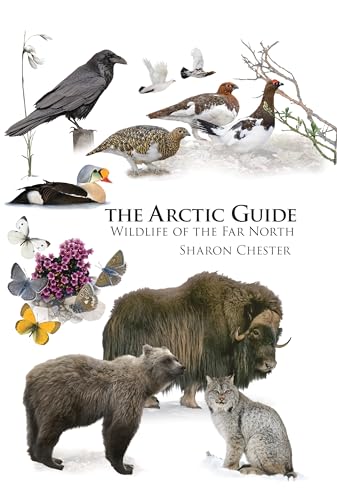
Inhaltsangabe
The Arctic Guide presents the traveler and naturalist with a portable, authoritative guide to the flora and fauna of earths northernmost region. Featuring superb color illustrations, this one-of-a-kind book covers the complete spectrum of wildlife - more than 800 species of plants, fishes, butterflies, birds, and mammals - that inhabit the Arctics polar deserts, tundra, taiga, sea ice, and oceans. It can be used anywhere in the entire Holarctic region, including Norways Svalbard archipelago, Siberia, the Russian Far East, islands of the Bering Sea, Alaska, the Canadian Arctic, and Greenland. Detailed species accounts describe key identification features, size, habitat, range, scientific name, and the unique characteristics that enable these organisms to survive in the extreme conditions of the Far North. A color distribution map accompanies each species account, and alternative names in German, French, Norwegian, Russian, Inuit, and Inupiaq are also provided
Die Inhaltsangabe kann sich auf eine andere Ausgabe dieses Titels beziehen.
Über die Autorin bzw. den Autor
Sharon Chester is a naturalist, wildlife photographer, illustrator, and author of several natural history guides, including A Wildlife Guide to Chile (Princeton). She splits her time between San Mateo, California, and her home in Fulton, Illinois, near the Upper Mississippi River National Wildlife and Fish Refuge.
Von der hinteren Coverseite
"I can think of no other book that covers the same territory so completely."--George L. Armistead, coauthor of Better Birding
"This book is an astonishing achievement. It is the perfect one-stop field guide for anyone visiting the Arctic, whether in the Old World or the New World."--Nigel Redman, coauthor of Birds of the Horn of Africa
Auszug. © Genehmigter Nachdruck. Alle Rechte vorbehalten.
The Arctic Guide
Wildlife of the Far North
By Sharon ChesterPRINCETON UNIVERSITY PRESS
Copyright © 2016 Princeton University Press
All rights reserved.
ISBN: 978-0-691-13975-3All rights reserved.
Contents
Acknowledgments, 2,
About This Book, 3,
Geographic Coordinates, 4,
Glossary, 5,
Arktos, 10,
Defining the Arctic, 11,
Map of the Arctic, 12,
Mammals, 25,
Birds, 127,
Fishes, 373,
Lizards and Frogs, 399,
Flies, Bees, and Butterflies, 401,
Flora, 425,
Bibliography, 535,
Indexes, 537,
CHAPTER 1
ARKTOS
TO THE ANCIENT GREEKS, the Arctic was the realm of Boreas, god of the north wind, and the region where the celestial sphere of northernmost stars was always visible. They called this place Arktos, meaning "bear," alluding to the Great Bear and Little Bear constellations, Ursa Major and Ursa Minor.
There are many myths and legends about these groups of stars. Greek mythology relates that the bear constellations are the spirits of the nymph Callisto, the reluctant concubine of the god Zeus, and their son, Arcas. Zeus changed the pair into stars and placed them in the heavens, where they are tended by Arcturus, the bear guard, who faithfully follows them around the night sky.
The brightest stars of the bear constellations form the Big and Little Dippers, so named for their resemblance to ladles. At the end of the Little Dipper's handle is the bright triple star Alpha Ursae Minoris, known to us as Polaris, the North Star. Polaris marks the point of due north and has a seemingly fixed position in the arctic sky. The Inuit call it Nuuttuittuq, the star that never moves, and the Finns call it the North Nail.
CHAPTER 2DEFINING THE ARCTIC
THE ARCTIC is the region of land and ocean that centers roughly on the North Pole and extends southward to and beyond the Arctic Circle. It is a place of exaggerated seasonality with brief, cool summers and long, dark, icy winters. This vast wilderness, also known as the Far North, encompasses the Arctic Ocean, the world's largest island (Greenland), and parts of eight countries: the United States (Alaska), Canada, Denmark (Greenland), Iceland, Norway, Sweden, Finland, and Russia.
The Ancient Greek astronomers were the first to define the Arctic's boundaries. They based their conclusions on observations of the celestial sphere, an imaginary shell surrounding the earth. They believed that the stars and other celestial bodies were fixed on the inside surface of the sphere, as if it were the underside of a dome. It is easy to understand how the early astronomers came to this belief, for if one steps outside on a clear, starry night and looks up, the constellations appear to be set on a dome that surrounds the earthbound observer, who is standing in the middle of it. The stars seem to slowly rotate from east to west — an illusion caused by the earth's rotation.
Aristotle (384–322 BC) noted in his treatise Meteorology that some stars were always visible to an observer at a particular location and that these always-visible stars could be used to mark standard reference circles on the celestial sphere and earth. A short time later, in his essay Phenomena, Euclid hinted that astronomers had used Aristotle's hypothesis to approximate the position of the North Celestial Pole (the imaginary point where earth's axis of rotation meets the celestial sphere) as well as the celestial equator, tropics, and Arctic Circle.
In the first century BC, Greek Stoic philosopher Posidonius applied his observations of solar phenomena to define a precise boundary for earth's northernmost region. He proposed that the Arctic be delimited by a circle of fixed size, located 24° south of the North Celestial Pole. This put Posidonius's circle at 66°N latitude, a location nearly identical to the position of the present- day Arctic Circle at 66°33'N.
Today, the Arctic Circle is commonly used by political administrators, geographers, and cartographers to mark the Arctic's southern boundary and it also provides travelers a point to celebrate their entry into the Arctic. More importantly, the Arctic Circle marks the northernmost point at which the sun is visible on the northern winter solstice, around December 21, and the southernmost point at which the midnight sun can be seen on the northern summer solstice, around June 21.
Scientists have many other words and ways to define the Arctic. Biologists often use the term Holarctic, which comprises the Palearctic (Old World) and Nearctic (New World) regions combined. The two regions have been linked intermittently by the Bering Land Bridge and their flora and fauna are closely related.
Climatologists and ecologists tend to use the Köppen climate classification system to delimit the arctic zone. The system, which is based on the concept that native vegetation is the best expression of climate, was first proposed in 1884 by Russian-German meteorologist, climatologist, and botanist Wladimir Köppen (1846–1940).
Köppen's system defines the arctic zone as the area enclosed by the 10°C July isotherm — a line connecting points where the average temperature for the warmest month of the year, usually July, does not exceed 10°C (50°F). The position of the 10°C July isotherm fluctuates between 62°N and 70°N latitudes and roughly parallels the boreal treeline, the northern limit of tree growth. The arctic tundra lies to the north of the 10°C July isotherm and the boreal forests and taiga lie to the south.
The map on pages 12–13 shows the approximate location of the 10°C July isotherm, the treeline, and the bioclimatic zones, including the Polar Desert, High Arctic, Low Arctic, Boreal Forest, and Taiga. Color-coded sidebars list some plant and animal species associated with each zone. Much of the information presented on the map was adapted from the Circumpolar Arctic Vegetation Map compiled by the Alaska Geobotany Center at the University of Alaska Fairbanks.
Polar Desert
Land is mostly barren and dry, with permanently frozen subsoil. Sites with more sun and moisture bear a thin cover of lichens, mosses, bryophytes, low grasses, and a few wildflowers such as saxifrages, poppies, and heaths.
Typical wildlife includes polar bears, arctic hares, lemmings, rock ptarmigans, snowy owls, and ivory gulls. Mean July temperature is 32°–37°F (0°–3°C).
High Arctic Tundra
Permafrost underlies the tundra, which bears a highly uneven cover of mosses, lichens, dwarf willows, scurvygrass, and wildflowers such as avens, saxifrage, and lousewort.
Typical wildlife includes muskoxen, arctic foxes, wolves, stoats, caribou, eiders, gyrfalcons, snow buntings, and red-throated loons. Mean July temperature is 37°–45°F (3°–7°C).
Low Arctic Tundra
Permafrost underlies the tundra, which bears a discontinuous cover of sedges, rushes, sphagnum moss, lichens, dwarf willow, dwarf birch, sorrel, crowberry, buttercups, and many other wildflowers.
Typical wildlife includes caribou, arctic ground squirrels, ravens, and a variety of nesting waders and waterfowl. Mean July temperature is 45–54°F (7–12°C).
Taiga/Boreal Forest
An irregular band of forest-tundra with groves of spruce, larch, pine, poplar, dwarf birch, willow, and tundra flowers occurs along the southern edge of the tundra. South of this is a parallel zone of...
„Über diesen Titel“ kann sich auf eine andere Ausgabe dieses Titels beziehen.
Suchergebnisse für The Arctic Guide: Wildlife of the Far North (Princeton...

Beispielbild für diese ISBN
The Arctic Guide â" Wildlife of the Far North: 109 (Princeton Field Guides)
Verlag:
Princeton University Press, 2016
ISBN 10: 069113975X
ISBN 13: 9780691139753
Gebraucht
Paperback
Anbieter: WorldofBooks, Goring-By-Sea, WS, Vereinigtes Königreich
Verkäuferbewertung 5 von 5 Sternen

Paperback. Zustand: Very Good. The book has been read, but is in excellent condition. Pages are intact and not marred by notes or highlighting. The spine remains undamaged. Artikel-Nr. GOR007952889
Gebraucht kaufen
EUR 23,09
EUR 6,54 Versand
Versand von Vereinigtes Königreich nach USA
Versand von Vereinigtes Königreich nach USA
Anzahl: 1 verfügbar
Beispielbild für diese ISBN
The Arctic Guide
Anbieter: PBShop.store UK, Fairford, GLOS, Vereinigtes Königreich
Verkäuferbewertung 5 von 5 Sternen
PAP. Zustand: New. New Book. Shipped from UK. Established seller since 2000. Artikel-Nr. WP-9780691139753
Neu kaufen
EUR 30,25
EUR 7,90 Versand
Versand von Vereinigtes Königreich nach USA
Versand von Vereinigtes Königreich nach USA
Anzahl: 15 verfügbar
Beispielbild für diese ISBN
The Arctic Guide
Anbieter: Majestic Books, Hounslow, Vereinigtes Königreich
Verkäuferbewertung 4 von 5 Sternen

Zustand: New. pp. 400 800 Maps (Col.). Artikel-Nr. 322534745
Neu kaufen
EUR 37,99
EUR 7,59 Versand
Versand von Vereinigtes Königreich nach USA
Versand von Vereinigtes Königreich nach USA
Anzahl: 3 verfügbar
Beispielbild für diese ISBN
The Arctic Guide: Wildlife of the Far North
Anbieter: Kennys Bookstore, Olney, MD, USA
Verkäuferbewertung 5 von 5 Sternen
Zustand: New. 2016. Paperback. Num Pages: 528 pages, 200+ color plates. 800+ color maps. BIC Classification: 1MTN; WNC; WNP. Category: (G) General (US: Trade); (U) Tertiary Education (US: College). Dimension: 216 x 140. . . . . . . Books ship from the US and Ireland. Artikel-Nr. V9780691139753
Neu kaufen
EUR 37,61
EUR 9,06 Versand
Versand innerhalb von USA
Versand innerhalb von USA
Anzahl: Mehr als 20 verfügbar
Beispielbild für diese ISBN
The Arctic Guide: Wildlife of the Far North (Princeton Field Guides)
Anbieter: Ria Christie Collections, Uxbridge, Vereinigtes Königreich
Verkäuferbewertung 5 von 5 Sternen
Zustand: New. In English. Artikel-Nr. ria9780691139753_new
Neu kaufen
EUR 35,02
EUR 14,00 Versand
Versand von Vereinigtes Königreich nach USA
Versand von Vereinigtes Königreich nach USA
Anzahl: Mehr als 20 verfügbar
Beispielbild für diese ISBN
The Arctic Guide Wildlife of the Far North
Anbieter: Revaluation Books, Exeter, Vereinigtes Königreich
Verkäuferbewertung 5 von 5 Sternen
Paperback. Zustand: Brand New. 542 pages. 9.00x6.00x1.50 inches. In Stock. Artikel-Nr. 069113975X
Neu kaufen
EUR 31,70
EUR 17,53 Versand
Versand von Vereinigtes Königreich nach USA
Versand von Vereinigtes Königreich nach USA
Anzahl: 1 verfügbar
Beispielbild für diese ISBN
The Arctic Guide Wildlife of the Far North
Anbieter: Revaluation Books, Exeter, Vereinigtes Königreich
Verkäuferbewertung 5 von 5 Sternen
Paperback. Zustand: Brand New. 542 pages. 9.00x6.00x1.50 inches. In Stock. Artikel-Nr. __069113975X
Neu kaufen
EUR 37,55
EUR 17,53 Versand
Versand von Vereinigtes Königreich nach USA
Versand von Vereinigtes Königreich nach USA
Anzahl: 2 verfügbar
Beispielbild für diese ISBN
The Arctic Guide Wildlife of the Far North
Anbieter: Revaluation Books, Exeter, Vereinigtes Königreich
Verkäuferbewertung 5 von 5 Sternen
Paperback. Zustand: Brand New. 542 pages. 9.00x6.00x1.50 inches. In Stock. Artikel-Nr. xi069113975X
Neu kaufen
EUR 44,06
EUR 17,53 Versand
Versand von Vereinigtes Königreich nach USA
Versand von Vereinigtes Königreich nach USA
Anzahl: 2 verfügbar
Beispielbild für diese ISBN
The Arctic Guide Wildlife of the Far North
Anbieter: Revaluation Books, Exeter, Vereinigtes Königreich
Verkäuferbewertung 5 von 5 Sternen
Paperback. Zustand: Brand New. 542 pages. 9.00x6.00x1.50 inches. In Stock. Artikel-Nr. xr069113975X
Neu kaufen
EUR 44,06
EUR 17,53 Versand
Versand von Vereinigtes Königreich nach USA
Versand von Vereinigtes Königreich nach USA
Anzahl: 2 verfügbar
Foto des Verkäufers
The Arctic Guide : Wildlife of the Far North
Verlag:
Princeton University Press Okt 2016, 2016
ISBN 10: 069113975X
ISBN 13: 9780691139753
Neu
Taschenbuch
Anbieter: AHA-BUCH GmbH, Einbeck, Deutschland
Verkäuferbewertung 5 von 5 Sternen
Taschenbuch. Zustand: Neu. Neuware - The Arctic Guide presents the traveler and naturalist with a portable, authoritative guide to the flora and fauna of earths northernmost region. Featuring superb color illustrations, this one-of-a-kind book covers the complete spectrum of wildlife - more than 800 species of plants, fishes, butterflies, birds, and mammals - that inhabit the Arctics polar deserts, tundra, taiga, sea ice, and oceans. It can be used anywhere in the entire Holarctic region, including Norways Svalbard archipelago, Siberia, the Russian Far East, islands of the Bering Sea, Alaska, the Canadian Arctic, and Greenland. Detailed species accounts describe key identification features, size, habitat, range, scientific name, and the unique characteristics that enable these organisms to survive in the extreme conditions of the Far North. A color distribution map accompanies each species account, and alternative names in German, French, Norwegian, Russian, Inuit, and Inupiaq are also provided. Artikel-Nr. 9780691139753
Neu kaufen
EUR 35,00
EUR 38,24 Versand
Versand von Deutschland nach USA
Versand von Deutschland nach USA
Anzahl: 1 verfügbar