
Verwandte Artikel zu On Fact and Fraud: Cautionary Tales from the Front...
Inhaltsangabe
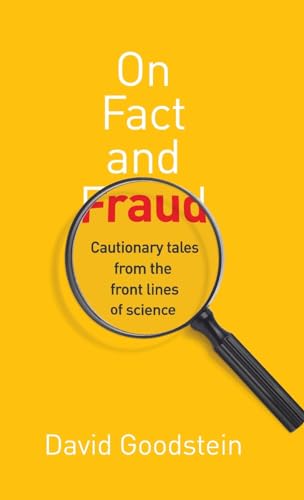
An in-depth look at scientific fraud Fraud in science is not as easy to identify as one might think. When accusations of scientific misconduct occur, truth can often be elusive, and the cause of a scientist's ethical misstep isn't always clear. On Fact and Fraud looks at actual cases in which fraud was committed or alleged, explaining what constitutes scientific misconduct and what doesn't, and providing readers with the ethical foundations needed to discern and avoid fraud wherever it may arise. In David Goodstein's varied experience-as a physicist and educator, and as vice provost at Caltech, a job in which he was responsible for investigating all allegations of scientific misconduct-a deceptively simple question has come up time and again: what constitutes fraud in science? Here, Goodstein takes us on a tour of real controversies from the front lines of science and helps readers determine for themselves whether or not fraud occurred. Cases include, among others, those of Robert A. Millikan, whose historic measurement of the electron's charge has been maligned by accusations of fraud; Martin Fleischmann and Stanley Pons and their "discovery" of cold fusion; Victor Ninov and the supposed discovery of element 118; Jan Hendrik Schön from Bell Labs and his work in semiconductors; and J. Georg Bednorz and Karl Müller's discovery of high-temperature superconductivity, a seemingly impossible accomplishment that turned out to be real. On Fact and Fraud provides a user's guide to identifying, avoiding, and preventing fraud in science, along the way offering valuable insights into how modern science is practiced.
Die Inhaltsangabe kann sich auf eine andere Ausgabe dieses Titels beziehen.
Über die Autorin bzw. den Autor
David Goodstein is the Frank J. Gilloon Distinguished Teaching and Service Professor in the Department of Physics at the California Institute of Technology. His books include Out of Gas: The End of the Age of Oil and Feynman's Lost Lecture.
Von der hinteren Coverseite
"Bracing reading. On Fact and Fraud is important because it combines a considered ethical stance and an analysis of the conditions under which fraud takes place with recognition of the all-too-real difficulties of handling, under pressure, hard-to-reproduce effects. This is a smart, deft book by someone deeply familiar with the moral and ethical complexities in contemporary science."--Peter Galison, Harvard University
"The success and credibility of science is anchored in a culture of complete openness. For more than twenty years, Caltech physicist David Goodstein has been on the front lines defending that culture against attacks of fraud and self-delusion. In this tightly written book, he shares insights drawn from cases that have shaken the physical sciences."--Robert L. Park, author ofSuperstition: Belief in the Age of Science
"This is a superb book. Goodstein not only discusses the subject in an accessible way, but his thoughts are refreshing to a working physicist such as me, one who has wrestled with many of these issues. It will be the definitive book on the subject. I know of nothing that competes. Goodstein is clearly an expert."--Richard A. Muller, University of California, Berkeley
"This book includes considerable material of interest. On Fact and Fraud offers an interesting read for anyone who has a career focus on these topics."--Michael W. Kalichman, director of the Research Ethics Program at the University of California, San Diego
"Goodstein's important book explores how science is really done, and distinguishes itself from other books on the topic in that it is a story told from the inside, by a physicist. Goodstein examines the structure of the entire enterprise, from the motivations of individual scientists, to the reward system, to the corridors of power. Along the way, he destroys a number of popular and enduring myths."--Anthony Tyson, University of California, Davis
Aus dem Klappentext
"Bracing reading. On Fact and Fraud is important because it combines a considered ethical stance and an analysis of the conditions under which fraud takes place with recognition of the all-too-real difficulties of handling, under pressure, hard-to-reproduce effects. This is a smart, deft book by someone deeply familiar with the moral and ethical complexities in contemporary science."--Peter Galison, Harvard University
"The success and credibility of science is anchored in a culture of complete openness. For more than twenty years, Caltech physicist David Goodstein has been on the front lines defending that culture against attacks of fraud and self-delusion. In this tightly written book, he shares insights drawn from cases that have shaken the physical sciences."--Robert L. Park, author ofSuperstition: Belief in the Age of Science
"This is a superb book. Goodstein not only discusses the subject in an accessible way, but his thoughts are refreshing to a working physicist such as me, one who has wrestled with many of these issues. It will be the definitive book on the subject. I know of nothing that competes. Goodstein is clearly an expert."--Richard A. Muller, University of California, Berkeley
"This book includes considerable material of interest. On Fact and Fraud offers an interesting read for anyone who has a career focus on these topics."--Michael W. Kalichman, director of the Research Ethics Program at the University of California, San Diego
"Goodstein's important book explores how science is really done, and distinguishes itself from other books on the topic in that it is a story told from the inside, by a physicist. Goodstein examines the structure of the entire enterprise, from the motivations of individual scientists, to the reward system, to the corridors of power. Along the way, he destroys a number of popular and enduring myths."--Anthony Tyson, University of California, Davis
Auszug. © Genehmigter Nachdruck. Alle Rechte vorbehalten.
On Fact and Fraud
Cautionary Tales from the Front Lines of ScienceBy David GoodsteinPRINCETON UNIVERSITY PRESS
Copyright © 2010 Princeton University PressAll right reserved.
ISBN: 978-0-691-13966-1
Contents
List of Illustrations............................................................ixPreface..........................................................................xiOne Setting the Stage...........................................................1Two In the Matter of Robert Andrews Millikan....................................29Three Bad News in Biology.......................................................51Four Codifying Misconduct: Evolving Approaches in the 1990s.....................59Five The Cold Fusion Chronicles.................................................69Six Fraud in Physics............................................................97Seven The Breakthrough That Wasn't Too Good to Be True..........................107Eight What Have We Learned?.....................................................127Appendix Caltech Policy on Research Misconduct..................................135Acknowledgments..................................................................147Notes............................................................................149Index............................................................................155
Chapter One
Setting the Stage
Fraud in science is, in essence, a violation of the scientific method. It is feared and denigrated by all scientists. Let's look at a few real cases that have come up in the past.
Piltdown Man, a human cranium and ape jaw found in a gravel pit in England around 1910, is perhaps the most famous case. Initially hailed as the authentic remnants of one of our more distant ancestors, the interspecies skeletal remains were exposed as a fraud by modern dating methods in 1954. To this day no one knows who perpetrated the deception or why. One popular theory is that the perpetrator was only trying to help along what was thought to be the truth. Prehistoric hominid remains had been discovered in France and Germany, and there were even rumors of findings in Africa. Surely humanity could not have originated in those uncivilized places. Better to have human life begin in good old England!
As it turned out, the artifact was rejected by the body of scientific knowledge long before modern dating methods showed it to be a hoax. Growing evidence that our ancient forebears looked nothing like Piltdown Man made the discovery an embarrassment at the fringes of anthropology. The application of modern dating methods confirmed that both artifacts were not much older than their discovery date.
Sir Cyril Burt was a famous British psychologist who studied the heritability of intelligence by means of identical twins who had been separated at birth. Unfortunately there seem not to have been enough such convenient subjects to study, so he apparently invented thirty-three additional pairs, and because that gave him more work than he could handle, he also invented two assistants to take care of them. His duplicity was uncovered in 1974, some three years after his death.
That same year, William Summerlin, a researcher at the Sloan-Kettering Institute for Cancer Research in New York City, conducted a series of experiments aimed at inducing healthy black skin grafts to grow on a white mouse. Evidently, nature wasn't sufficiently cooperative, for he was caught red-handed trying to help her out with a black felt-tipped pen.
John Darsee was a prodigious young researcher at Harvard Medical School, turning out a research paper about once every eight days. That lasted a couple of years until 1981, when he was caught fabricating data out of whole cloth.
Stephen Breuning was a psychologist at the University of Pittsburgh studying the effects of drugs such as Ritalin on patients. In 1987 it was determined that he had fabricated data. His case was particularly bad, because protocols for treating patients had been based on his spurious results.
Science is self-correcting, in the sense that a falsehood injected into the body of scientific knowledge will eventually be discovered and rejected. But that fact does not protect the scientific enterprise against fraud, because injecting falsehoods into the body of science is rarely, if ever, the purpose of those who perpetrate fraud. They almost always believe that they are injecting a truth into the scientific record, as in the cases above, but without going through all the trouble that the real scientific method demands.
That's why science needs active measures to protect it. Fraud, or misconduct, means dishonest professional behavior, characterized by the intent to deceive—the very antithesis of ethical behavior in science. When you read a scientific paper, you are free to agree or disagree with its conclusions, but you must always be confident that you can trust its account of the procedures that were used and the results produced by those procedures.
For years it was thought that scientific fraud was almost always restricted to biomedicine and closely related sciences, and although there are exceptions, most instances do surface in these fields. There are undoubtedly many reasons for this curious state of affairs. For example, many misconduct cases involve medical doctors rather than scientists with Ph.D.s (who are trained to do research). To a doctor, the welfare of his or her patient may be more important than scientific truth. In a case that came up in the 1980s, for example, a physician in Montreal was found to have falsified the records of participants in a large-scale breast-cancer study. Asked why he did it, he said it was in order to get better medical care for his patients. However, the greater number of cases arises from more self-interested motives. Although the perpetrators usually think that they're doing the right thing, they also know that they're committing fraud.
In recent cases of scientific fraud, three motives, or risk factors, have always been present. In nearly all cases, the perpetrators
1. were under career pressure; 2. knew, or thought they knew, what the answer to the problem they were considering would turn out to be if they went to all the trouble of doing the work properly; and
3. were working in a field where individual experiments are not expected to be precisely reproducible.
It is by no means true that fraud always arises when these three factors are present. In fact, just the opposite is true: These factors are often present, and fraud is quite rare. But they do seem to be present whenever fraud occurs. Let us consider them one at a time.
Career pressure. This is clearly a motivating factor, but it does not offer us any special insights into why a small number of scientists stray professionally when most do not. All scientists, at all levels, from fame to obscurity, are pretty much always under career pressure. On the other hand, simple monetary gain is seldom if ever a factor in scientific fraud.
Knowing the answer. Scientific fraud is almost always a transgression against the methods of science, not purposely against the body of knowledge. Perpetrators think they know how the experiment would come out if it were done properly, and they decide that it is not necessary to go to all the trouble of doing it properly.
Reproducibility. In reality, experiments are seldom repeated by others in science. Nevertheless, the belief that someone else...
„Über diesen Titel“ kann sich auf eine andere Ausgabe dieses Titels beziehen.
Suchergebnisse für On Fact and Fraud: Cautionary Tales from the Front...

Beispielbild für diese ISBN
On Fact and Fraud: Cautionary Tales from the Front Lines of Science
Verlag:
Princeton University Press, 2010
ISBN 10: 0691139660
ISBN 13: 9780691139661
Gebraucht
Hardcover
Anbieter: World of Books (was SecondSale), Montgomery, IL, USA
Verkäuferbewertung 5 von 5 Sternen

Hardback. Zustand: Good. Fraud in science is not as easy to identify as one might think. This title looks at actual cases in which fraud was committed or alleged, explaining what constitutes scientific misconduct and what doesn't, and providing readers with the ethical foundations needed to discern and avoid fraud wherever it may arise. Artikel-Nr. 00101588518
Gebraucht kaufen
EUR 6,10
Versand gratis
Versand innerhalb von USA
Versand innerhalb von USA
Anzahl: 2 verfügbar
Beispielbild für diese ISBN
On Fact and Fraud: Cautionary Tales from the Front Lines of Science
Verlag:
Princeton University Press, 2010
ISBN 10: 0691139660
ISBN 13: 9780691139661
Gebraucht
Hardcover
Anbieter: ThriftBooks-Dallas, Dallas, TX, USA
Verkäuferbewertung 5 von 5 Sternen
Hardcover. Zustand: Good. No Jacket. Pages can have notes/highlighting. Spine may show signs of wear. ~ ThriftBooks: Read More, Spend Less. Artikel-Nr. G0691139660I3N00
Gebraucht kaufen
EUR 6,15
Versand gratis
Versand innerhalb von USA
Versand innerhalb von USA
Anzahl: 1 verfügbar
Beispielbild für diese ISBN
On Fact and Fraud: Cautionary Tales from the Front Lines of Science
Verlag:
Princeton University Press, 2010
ISBN 10: 0691139660
ISBN 13: 9780691139661
Gebraucht
Hardcover
Anbieter: ThriftBooks-Atlanta, AUSTELL, GA, USA
Verkäuferbewertung 5 von 5 Sternen
Hardcover. Zustand: Very Good. No Jacket. Missing dust jacket; May have limited writing in cover pages. Pages are unmarked. ~ ThriftBooks: Read More, Spend Less. Artikel-Nr. G0691139660I4N01
Gebraucht kaufen
EUR 6,18
Versand gratis
Versand innerhalb von USA
Versand innerhalb von USA
Anzahl: 1 verfügbar
Beispielbild für diese ISBN
On Fact and Fraud : Cautionary Tales from the Front Lines of Science
Verlag:
Princeton University Press, 2010
ISBN 10: 0691139660
ISBN 13: 9780691139661
Gebraucht
Hardcover
Anbieter: Better World Books, Mishawaka, IN, USA
Verkäuferbewertung 5 von 5 Sternen
Zustand: Very Good. Pages intact with possible writing/highlighting. Binding strong with minor wear. Dust jackets/supplements may not be included. Stock photo provided. Product includes identifying sticker. Better World Books: Buy Books. Do Good. Artikel-Nr. 5964676-6
Gebraucht kaufen
EUR 6,47
Versand gratis
Versand innerhalb von USA
Versand innerhalb von USA
Anzahl: 1 verfügbar
Beispielbild für diese ISBN
On Fact and Fraud : Cautionary Tales from the Front Lines of Science
Verlag:
Princeton University Press, 2010
ISBN 10: 0691139660
ISBN 13: 9780691139661
Gebraucht
Hardcover
Anbieter: Better World Books, Mishawaka, IN, USA
Verkäuferbewertung 5 von 5 Sternen
Zustand: Good. Former library copy. Pages intact with minimal writing/highlighting. The binding may be loose and creased. Dust jackets/supplements are not included. Includes library markings. Stock photo provided. Product includes identifying sticker. Better World Books: Buy Books. Do Good. Artikel-Nr. 7934126-6
Gebraucht kaufen
EUR 6,47
Versand gratis
Versand innerhalb von USA
Versand innerhalb von USA
Anzahl: 2 verfügbar
Beispielbild für diese ISBN
On Fact and Fraud: Cautionary Tales from the Front Lines of Science
Verlag:
Princeton University Press, 2010
ISBN 10: 0691139660
ISBN 13: 9780691139661
Gebraucht
Hardcover
Anbieter: WorldofBooks, Goring-By-Sea, WS, Vereinigtes Königreich
Verkäuferbewertung 5 von 5 Sternen
Hardback. Zustand: Very Good. The book has been read, but is in excellent condition. Pages are intact and not marred by notes or highlighting. The spine remains undamaged. Artikel-Nr. GOR009909686
Gebraucht kaufen
EUR 12,34
EUR 6,51 Versand
Versand von Vereinigtes Königreich nach USA
Versand von Vereinigtes Königreich nach USA
Anzahl: 1 verfügbar
Beispielbild für diese ISBN
On Fact and Fraud: Cautionary Tales from the Front Lines of Science
Verlag:
Princeton University Press, 2010
ISBN 10: 0691139660
ISBN 13: 9780691139661
Gebraucht
Hardcover
Anbieter: medimops, Berlin, Deutschland
Verkäuferbewertung 5 von 5 Sternen
Zustand: good. Befriedigend/Good: Durchschnittlich erhaltenes Buch bzw. Schutzumschlag mit Gebrauchsspuren, aber vollständigen Seiten. / Describes the average WORN book or dust jacket that has all the pages present. Artikel-Nr. M00691139660-G
Gebraucht kaufen
EUR 27,33
EUR 10,00 Versand
Versand von Deutschland nach USA
Versand von Deutschland nach USA
Anzahl: 1 verfügbar
Beispielbild für diese ISBN
On Fact and Fraud
Anbieter: PBShop.store UK, Fairford, GLOS, Vereinigtes Königreich
Verkäuferbewertung 5 von 5 Sternen
HRD. Zustand: New. New Book. Shipped from UK. Established seller since 2000. Artikel-Nr. WP-9780691139661
Neu kaufen
EUR 34,22
EUR 4,84 Versand
Versand von Vereinigtes Königreich nach USA
Versand von Vereinigtes Königreich nach USA
Anzahl: 2 verfügbar
Beispielbild für diese ISBN
On Fact and Fraud: Cautionary Tales from the Front Lines of Science
Anbieter: Kennys Bookstore, Olney, MD, USA
Verkäuferbewertung 5 von 5 Sternen
Zustand: New. 2010. Hardcover. Fraud in science is not as easy to identify as one might think. This title looks at actual cases in which fraud was committed or alleged, explaining what constitutes scientific misconduct and what doesn't, and providing readers with the ethical foundations needed to discern and avoid fraud wherever it may arise. Num Pages: 176 pages, 22 halftones. BIC Classification: JFMG; PD. Category: (P) Professional & Vocational; (U) Tertiary Education (US: College). Dimension: 223 x 146 x 21. Weight in Grams: 422. . . . . . Books ship from the US and Ireland. Artikel-Nr. V9780691139661
Neu kaufen
EUR 41,30
EUR 9,23 Versand
Versand innerhalb von USA
Versand innerhalb von USA
Anzahl: 1 verfügbar
Beispielbild für diese ISBN
On Fact and Fraud: Cautionary Tales from the Front Lines of Science
Anbieter: Ria Christie Collections, Uxbridge, Vereinigtes Königreich
Verkäuferbewertung 5 von 5 Sternen
Zustand: New. In English. Artikel-Nr. ria9780691139661_new
Neu kaufen
EUR 44,04
EUR 13,13 Versand
Versand von Vereinigtes Königreich nach USA
Versand von Vereinigtes Königreich nach USA
Anzahl: 2 verfügbar