
Verwandte Artikel zu Economic Geography: The Integration of Regions and...
Inhaltsangabe
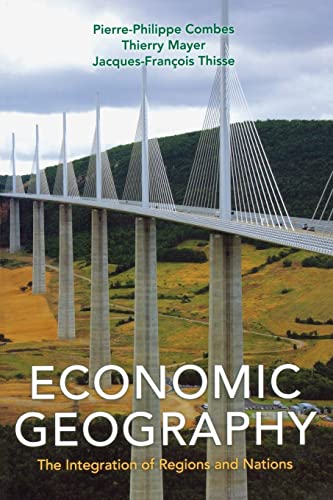
Economic Geography is the most complete, up-to-date textbook available on the important new field of spatial economics. This book fills a gap by providing advanced undergraduate and graduate students with the latest research and methodologies in an accessible and comprehensive way. It is an indispensable reference for researchers in economic geography, regional and urban economics, international trade, and applied econometrics, and can serve as a resource for economists in government. Economic Geography presents advances in economic theory that explain why, despite the increasing mobility of commodities, ideas, and people, the diffusion of economic activity is very unequal and remains agglomerated in a limited number of spatial entities. The book complements theoretical analysis with detailed discussions of the empirics of the economics of agglomeration, offering a mix of theoretical and empirical research that gives a unique perspective on spatial disparities. It reveals how location continues to matter for trade and economic development, yet how economic integration is transforming the global economy into an economic space in which activities are performed within large metropolitan areas exchanging goods, skills, and information. Economic Geography examines the future implications of this evolution in the spatial economy and relates them to other major social and economic trends. Provides a complete introduction to economic geography Explains the latest theory and methodologies Covers the empirics of agglomeration, from spatial concentration measurement to structural estimations of economic geography models Includes history and background of the field Serves as a textbook for students and a resource for professionals
Die Inhaltsangabe kann sich auf eine andere Ausgabe dieses Titels beziehen.
Über die Autorin bzw. den Autor
Pierre-Philippe Combes, Thierry Mayer & Jacques-François Thisse
Von der hinteren Coverseite
"Combes, Mayer, and Thisse have just given me an indispensable teaching tool and a great text for my students. Their book offers the most up-to-date, balanced, comprehensive treatment of both theoretical and empirical research."--Kiminori Matsuyama, Northwestern University
"In the field of geographical economics, this is exactly the kind of book that I have been waiting for. After presenting lucid and comprehensive coverage of the current state of theory, it provides the modern methodology for measuring spatial concentration and inequalities. Then it confronts the challenging task of comparing theory with facts. This book will serve as an ideal textbook for graduate students and scholars in economic geography, regional development, international trade, and public policy."--Masahisa Fujita, RIETI, Japan
"Economic geography has undergone something of a revolution in the last fifteen years with the application of formal theoretical modeling and econometric estimation to old questions. The many advances have, however, left us with a literature that is discursive, disparate, and disjointed. This book does an exceptional job of adding the needed structure, and helps all of us move toward a more complete and integrated understanding of this still-evolving area."--James R. Markusen, University of Colorado at Boulder
"Combes, Mayer, and Thisse have put together a marvelous book on economic geography. With clear, lucid writing, they present the theory and empirics of economic geography in a way that will provide insights to both those new to the field and those in search of an excellent reference work."--David Weinstein, Columbia University
"Combes, Mayer, and Thisse have produced the rare text that is of value to both theorists and empirical researchers. They present the current state of knowledge about economic geography in an accessible way, paying equal attention to formal models and applied work. Their framework provides an elegant synthesis of concepts in regional economics, international trade, and economic development, which will be of broad interest to scholars and policymakers alike."--Gordon Hanson, University of California, San Diego
"A welcome addition to the literature. The authors are well-known researchers in the subject both on the theoretical and empirical sides. They put heavy emphasis on recent empirical research, not only reviewing the literature but also teaching the methodologies commonly used. No existing textbook in economic geography does this. This book fills a real gap."--Philippe Martin, coauthor of Economic Geography and Public Policy
"This book is well-written, extremely clear, and very well-focused. Other books are either too advanced for anyone starting in the field or too basic to be of any use beyond basic undergraduate courses. Beyond teaching, this book should also be very useful as a reference."--Gilles Duranton, University of Toronto
Auszug. © Genehmigter Nachdruck. Alle Rechte vorbehalten.
Economic Geography
By Pierre-Philippe Combes Thierry Mayer Jacques-Franois ThissePrinceton University Press
Copyright © 2008 Princeton University PressAll right reserved.
ISBN: 978-0-691-13942-5
Chapter One
Spatial Inequalities: A Brief Historical Overview
During the second millennium, the world's population increased by a factor of twenty-two, while world income increased by a factor of three hundred. This development, however, was not uniform and did not affect all countries in the same way. Between 1000 and 1820, the annual growth rate of income per capita in the countries of Western Europe was estimated at around 0.15%, which is extremely low. That rate then rose to 1.5%, thus reaching a level ten times higher than it had been for the previous eight centuries. This change of pace was to have considerable consequences for economic disparities between nations. Indeed, income increases by less than 4% in a twenty-five year period (roughly one generation) when the annual growth rate is 0.15%, while it grows by 45% when the growth rate reaches 1.5%. To put it another way, income per capita doubles after 46 years in the second case, while the same doubling takes 463 years in the first. Thus, while the income per capita of Europeans hardly differed from that of other inhabitants of the planet at the beginning of the second millennium, it is currently seven times higher (Maddison 2001, chapter 1). The reason for this dramatic change is well-known: the Industrial Revolution.
In this chapter, we briefly discuss two major features of the Industrial Revolution that have been instrumental in reshaping the European economic space: (i) the existence of gigantic productivity gains and the tremendous lowering of transport costs; and (ii) the profound transformation of agricultural and rural societies into industrial and urbanized ones. Subsequently, we will see how, because of the Industrial Revolution, spatial inequalities became increasingly marked, not only between countries but also within them.
Our historical survey should ideally cover Europe, the United States, and Japan. However, in order to allow for meaningful long-run comparisons, we must consider economic spaces that have (more or less) the same borders. Furthermore, our aim is not to provide a detailed discussion of all the spatial implications of the Industrial Revolution. Instead, we are interested in a few facts that are directly relevant for economic geography. All of this has led us to focus mainly, but not solely, on Europe.
1.1 The Space-Economy and the Industrial Revolution
The Industrial Revolution began in Great Britain during the second half of the eighteenth century and then diffused to Continental Europe and North America. Since then, productivity gains have been steady and their accumulation has generated considerable multiplier effects. This economic development was accompanied by spectacular decreases in transport costs and massive rural-urban migration. The old agricultural economy became industrial and then, in the twentieth century, services became the primary economic sector.
1.1.1 Productivity Gains and Falling Transport Costs
The most distinctive feature of the Industrial Revolution was the considerable increase in productivity. According to Bairoch:
[I]t can be considered that, for the whole of the economy, the total factor productivity was multiplied on average in Western developed countries by 40 to 45 between 1700 and 1990. Even limiting ourselves to the years 1000 to 1700, which, in Europe, were on the whole a period of progress, it can be very roughly estimated that the productivity of the whole economy was, at best, multiplied by 2. Bairoch (1997, volume 1, pp. 97-98) [our translation]
Such productivity gains allowed an appreciable increase in individual incomes. The question of whether European countries were richer than others before the Industrial Revolution is still discussed by historians-but this debate changes the global picture very little. For example, while Bairoch (1993) believes that China and other Asian civilizations were more advanced than Western Europe in the sixteenth century, he is "still inclined to think that there was no sizable difference in the levels of income of the different civilizations when they reached their preindustrial peak" (p. 106). Whatever the value of these differences, there is no longer any question that the Industrial Revolution generated income disparities between countries and regions of a completely different nature and on an unprecedented scale.
The transportation sector underwent the most stunning changes during the Industrial Revolution. In particular, the great divergence between nations appeared when all distance-related costs underwent a drastic and historically unprecedented fall. The scope of this decline led Cipolla to contend that:
Fast and cheap transportation has been one of the main products of the Industrial Revolution. Distances have been shortened at an astonishing pace. Day by day the world seems smaller and smaller and societies that for millennia practically ignored each other are suddenly put in contact-or in conflict. Cipolla (1962, p. 13)
This was later confirmed by Bairoch in an evaluation of that spectacular transformation in the means of transportation:
On the whole, between 1800 and 1910, it can be estimated that the lowering of the real (weighted) average prices of transportation was on the order of 10 to 1. Bairoch (1997, volume 2, p. 26) [our translation]
The cost of transporting maritime cargo dropped dramatically during the nineteenth century, leading to the convergence of prices of several goods and to the gradual integration of international markets. One example is the case of wheat, whose price in Liverpool exceeded that of wheat in Chicago by 57.6% in 1870 but by only 15.6% in 1913; the price of steel in London was 75% higher than it was in Philadelphia in 1870, but only 20.6% higher in 1913; the price differential of cotton between Liverpool and Bombay fell from 57% in 1873 to 20% in 1913, while the price difference of jute between London and Calcutta dropped from 35% to 4% (Findlay and O'Rourke 2003).
In the first half of the nineteenth century the costs of ground transportation were still very high and weighed heavily on the prices of commodities. France provides a good illustration of this. For example, the transport of coal from Saint-Etienne to the ironworks of Champagnes-a distance of 545 km-multiplied the sale price by five. The coal of Sarrebrck was sold for F 9.50 a ton locally, but the price in Saint-Dizier, located 220 km away, was F 51.50, with transport costs representing 82% of the total price (Lon 1976).
After the emergence of railroads, things changed dramatically. For example, prior to the Industrial Revolution the average cost of ground transportation of grains per ton-kilometer was equal to the average cost of buying 4 or 5 kg of grain, but this cost fell to 0.1 kg per ton-kilometer in 1910 thanks to long-distance transportation by rail. Once we account for the decrease in the price of grain generated by technological innovations in agriculture, the decrease in transport costs is even larger: they are divided by a factor close to 50 (Bairoch 1997, chapter 4). In the United States, the average cost of moving a ton a mile in 1890 was 18.5 cents,...
„Über diesen Titel“ kann sich auf eine andere Ausgabe dieses Titels beziehen.
Suchergebnisse für Economic Geography: The Integration of Regions and...

Beispielbild für diese ISBN
Economic Geography: The Integration of Regions and Nations
Verlag:
Princeton University Press, 2008
ISBN 10: 0691139423
ISBN 13: 9780691139425
Gebraucht
Paperback
Anbieter: World of Books (was SecondSale), Montgomery, IL, USA
Verkäuferbewertung 5 von 5 Sternen

Paperback. Zustand: Good. Complements theoretical analysis with detailed discussions of the empirics of the economics of agglomeration, offering a mix of theoretical and empirical research that gives a fresh perspective on spatial disparities. This book provides an introduction to economic geography and includes history and background of the field of spatial economics. Artikel-Nr. CIN0691139423G
Gebraucht kaufen
EUR 26,79
Versand gratis
Versand innerhalb von USA
Versand innerhalb von USA
Anzahl: 1 verfügbar
Beispielbild für diese ISBN
Economic Geography: The Integration of Regions and Nations
Verlag:
Princeton University Press (edition ), 2008
ISBN 10: 0691139423
ISBN 13: 9780691139425
Gebraucht
Paperback
Anbieter: BooksRun, Philadelphia, PA, USA
Verkäuferbewertung 5 von 5 Sternen
Paperback. Zustand: Very Good. It's a well-cared-for item that has seen limited use. The item may show minor signs of wear. All the text is legible, with all pages included. It may have slight markings and/or highlighting. Artikel-Nr. 0691139423-11-1
Gebraucht kaufen
EUR 28,23
Versand gratis
Versand innerhalb von USA
Versand innerhalb von USA
Anzahl: 1 verfügbar
Beispielbild für diese ISBN
Economic Geography: The Integration of Regions and Nations
Verlag:
Princeton University Press, 2008
ISBN 10: 0691139423
ISBN 13: 9780691139425
Gebraucht
Softcover
Anbieter: Anybook.com, Lincoln, Vereinigtes Königreich
Verkäuferbewertung 5 von 5 Sternen
Zustand: Good. This is an ex-library book and may have the usual library/used-book markings inside.This book has soft covers. In good all round condition. Please note the Image in this listing is a stock photo and may not match the covers of the actual item,700grams, ISBN:9780691139425. Artikel-Nr. 9980737
Gebraucht kaufen
EUR 44,56
EUR 15,47 Versand
Versand von Vereinigtes Königreich nach USA
Versand von Vereinigtes Königreich nach USA
Anzahl: 1 verfügbar
Foto des Verkäufers
Economic Geography The Integration of Regions and Nations
Verlag:
Princeton & Oxford : Princeton University Press, 2008
ISBN 10: 0691139423
ISBN 13: 9780691139425
Gebraucht
23,5 x 15,5 cm
Anbieter: avelibro OHG, Dinkelscherben, Deutschland
Verkäuferbewertung 5 von 5 Sternen
23,5 x 15,5 cm. Zustand: Gut. 395 Pages ; With Figures, Tables and Maps Original Broschur in sehr gutem Zustand. Innen mit Bibliotheksstempeln. Englische Sprache - Original Paperback in very good condition. Inside with Library stamps. English Language B04-04-02A|S29 Sprache: Englisch Gewicht in Gramm: 604. Artikel-Nr. 68468
Gebraucht kaufen
EUR 58,00
EUR 10,00 Versand
Versand von Deutschland nach USA
Versand von Deutschland nach USA
Anzahl: 1 verfügbar
Beispielbild für diese ISBN
Economic Geography: The Integration of Regions and Nations
Anbieter: Ria Christie Collections, Uxbridge, Vereinigtes Königreich
Verkäuferbewertung 5 von 5 Sternen
Zustand: New. In English. Artikel-Nr. ria9780691139425_new
Neu kaufen
EUR 133,07
EUR 13,39 Versand
Versand von Vereinigtes Königreich nach USA
Versand von Vereinigtes Königreich nach USA
Anzahl: Mehr als 20 verfügbar
Beispielbild für diese ISBN
Economic Geography The Integration of Regions and Nations
Anbieter: Revaluation Books, Exeter, Vereinigtes Königreich
Verkäuferbewertung 5 von 5 Sternen
Paperback. Zustand: Brand New. illustrated edition. 416 pages. 9.00x6.00x1.00 inches. In Stock. Artikel-Nr. x-0691139423
Neu kaufen
EUR 169,21
EUR 14,82 Versand
Versand von Vereinigtes Königreich nach USA
Versand von Vereinigtes Königreich nach USA
Anzahl: 2 verfügbar
Beispielbild für diese ISBN
Economic Geography The Integration of Regions and Nations Combes, Pierre-Philippe, Thierry Mayer und Jacques-Francois Thisse
Verlag:
Princeton & Oxford : Princeton University Press, 2008
ISBN 10: 0691139423
ISBN 13: 9780691139425
Gebraucht
Softcover
Anbieter: BUCHSERVICE / ANTIQUARIAT Lars Lutzer, Wahlstedt, Deutschland
Verkäuferbewertung 5 von 5 Sternen
Zustand: gut. 2008. Economic Geography The Integration of Regions and Nations In englischer Sprache. pages. Artikel-Nr. BN448658
Gebraucht kaufen
EUR 179,00
EUR 39,95 Versand
Versand von Deutschland nach USA
Versand von Deutschland nach USA
Anzahl: 1 verfügbar