
Verwandte Artikel zu The Making of an Economist, Redux
Inhaltsangabe
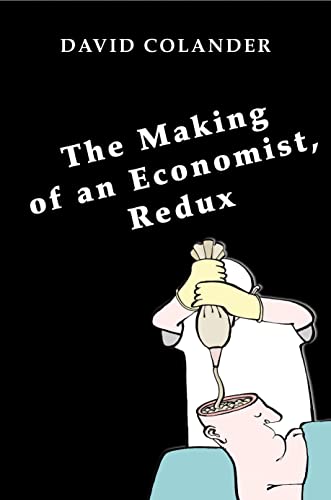
Economists seem to be everywhere in the media these days. But what exactly do today's economists do? What and how are they taught? Updating David Colander and Arjo Klamer's classic The Making of an Economist, this book shows what is happening in elite U.S. economics Ph.D. programs. By examining these programs, Colander gives a view of cutting-edge economics--and a glimpse at its likely future. And by comparing economics education today to the findings of the original book, the new book shows how much--and in what ways--the field has changed over the past two decades. The original book led to a reexamination of graduate education by the profession, and has been essential reading for prospective graduate students. Like its predecessor, The Making of an Economist, Redux is likely to provoke discussion within economics and beyond. The book includes new interviews with students at Harvard, Princeton, Stanford, MIT, Chicago, and Columbia. In these conversations, the students--the next generation of elite economists--colorfully and frankly describe what they think of their field and what graduate economics education is really like. The book concludes with reflections by Colander, Klamer, and Robert Solow. This inside look at the making of economists will interest anyone who wants to better understand the economics profession. An indispensible tool for anyone thinking about graduate education in economics, this edition is complete with colorful interviews and predictions about the future of cutting-edge economics.
Die Inhaltsangabe kann sich auf eine andere Ausgabe dieses Titels beziehen.
Über die Autorin bzw. den Autor
David Colander is Christian A. Johnson Distinguished Professor of Economics at Middlebury College. He is the author or editor of more than thirty books, including Why Aren't Economists as Important as Garbagemen?, The Lost Art of Economics, Economics (Irwin/McGraw-Hill), and The Stories Economists Tell (Irwin/McGraw-Hill).
Von der hinteren Coverseite
"The Making of an Economist, Redux is self-recommending. David Colander's work on the profession of economics is by far the best we have. A significant follow-up to his book of twenty years ago, it will become the standard account of what economics graduate school is like."--Tyler Cowen, George Mason University
Auszug. © Genehmigter Nachdruck. Alle Rechte vorbehalten.
The Making of an Economist, Redux
By David ColanderPrinceton University Press
Copyright © 2007 Princeton University PressAll right reserved.
ISBN: 978-0-691-13851-0
Chapter One
Introduction: Understanding Economics and EconomistsECONOMISTS HAVE BECOME ubiquitous. You turn on the TV news and you hear from them-economists say inflation is slowing; economists question the tax cut proposal; economists predict that a recession is likely. You pick up your newspaper or newsmagazine, and you read about economists.
As with many things ubiquitous, there is an ambiguity about what precisely an economist is, and what it is that he (most economists are male) is supposed to know. Thus, nowhere will one find a specified body of knowledge that an economist must know to call himself or herself an economist. In fact, unlike in law or medicine, where there are licenses that one must have to be called a lawyer or doctor, anyone can simply put the suffix "economist" after his name and call himself an economist.
One way of specifying who is an economist might be to consider who studies economics as an undergraduate. Each year approximately 25,000 undergraduate students (about 2 percent of all college seniors) major in economics. The large majority of these majors have no intention of becoming economists; they are planning to go into business, with banking, finance, and general management the most popular fields. So, undergraduate economics majors do not, for the most part, consider themselves economists. Most are majoring in economics because business is not an acceptable liberal arts major, and the undergraduate economics major is a surrogate for a business major. Another way of limiting the number of economists might be to restrict it to members of an economic association. That wouldn't work either, however, since anyone can join these associations-there are no restrictions. Pay your dues and you are a member.
So it seems that anyone can be an economist. The lack of formal requirements about who can call himself or herself an economist, however, masks another reality by which individuals who are economists judge whether or not someone is a "true" economist. For example, were an undergraduate student to ask an economist how to become an economist, he would tell her to go to graduate school. She might demur, asking, "Wouldn't it make more sense to go to Wall Street and learn how markets work?" Getting firsthand experience may sound like a good idea to her, but most economists would briskly dismiss the suggestion. "Well, maybe I should get a job in a real business-say, turning out automobiles." The answer will be "no" again: "That's not how you learn economics." She might try one more time. "Well, how about if I read all the top economists of the past-John Stuart Mill, David Ricardo, Adam Smith?" Most economists would say, "It wouldn't hurt, but it probably won't help." Instead, he would most likely tell her, "To become an economist who is considered an economist by other economists, you have to go to graduate school in economics." So the reality is that, to economists, an economist is someone who has a graduate degree (doctorates strongly preferred) in economics. This means that what defines an economist is what he or she learns in graduate school.
A Profile of Economics Graduate Students
To get an idea of who becomes an economist, let's consider a profile that Wendy Stock and John Siegfried compiled.
As you can see, each year somewhat more than 900 Ph.D.'s are awarded, a rate slightly higher than in the past. Assuming the rate of production has averaged 800 over the past forty years, and that the average economist works for approximately forty years, and that few economists trained outside the United States come to work in the United States, and that 20 percent of the students who get Ph.D.'s do not stay in the United States, then there are about 25,000 Ph.D. economists currently in the United States. The composition of this group is constantly changing, and each year a bit over 2 percent of the economists are replaced with younger cohorts, which means that over a decade the nature of economists is likely to change considerably, with new graduate students replacing retiring economists.
This table gives you a pretty good sense of who the graduate students are who are replacing the old economists. The first thing to note is that the percentage of U.S. citizens in graduate economics programs is declining; economics, like many of the sciences, is becoming a field dominated by non-U.S. citizens, the majority of whom stay in the United States to work. Notice also that while the percentage of women is increasing, the economics profession remains a primarily male profession. Another point to note is that most students finance their education with fellowships, along with research and/or teaching assistantships, although about 30 percent finance it themselves.
Graduate economics students attend one of the over one hundred Ph.D. programs in economics within the United States. The group as a whole, however, isn't the subject of this book. Instead, the book's main focus is the graduate students at elite graduate schools. These elite schools are disproportionately influential, and the students at these schools are destined to become the future elite of economics. This follows, since schools seldom hire from other schools ranked significantly lower than themselves, which means that this group will populate the top schools in the future and decide how economics is done.
Schools' rankings are generally well understood by economists, and conversations with newly minted economists often begin with, "Where did you get your Ph.D.?" Upon hearing where, the questioner will make a judgment about the quality of one's training and whether or not one should be considered a serious economist. (It's a bit like two dogs marking out their territory.) If you are planning to go on in serious economic research, you had better be able to answer that question with "I went to (fill in the name of one of the twenty of the top-ten-ranked economics graduate programs)." Otherwise you don't pass the initial sniff test.
Notice that I said "twenty of the top ten." The reason is that there are many different ranking systems. Developing rankings, and discussing the advantages and disadvantages of various rankings, is an industry in itself. There can be survey rankings (done in a variety of different ways), publication-based rankings (with publications weighted in a variety of different ways), and citation-based rankings (with citations weighted in a variety of different ways). Each of these rankings can be measured on a per-faculty or a total-number criterion (using various alternative measures of what is determined a faculty member). With so many ways of creating a ranking, there are many different possible rankings. Most possible rankings are explored and published, since college administrations often determine the level of support they will give a program on the basis of these rankings.
Where there is general agreement about rankings is about the schools at the top, and six of the seven schools that I included in this study-Harvard, Stanford, Chicago, MIT, Princeton, and Yale-are consistently ranked in the top ten. (They are ranked as the top six in a recent survey, and the seventh school in this study-Columbia-is ranked twelfth; Thursby 2000.) These elite schools compete vigorously for top students. They invite accepted candidates to campus, wine and dine them, have them meet with faculty members, and work hard to sell their school to them. Except at Chicago, which follows a somewhat...
„Über diesen Titel“ kann sich auf eine andere Ausgabe dieses Titels beziehen.
Suchergebnisse für The Making of an Economist, Redux

Beispielbild für diese ISBN
The Making of an Economist, Redux
Verlag:
Princeton University Press, 2008
ISBN 10: 0691138516
ISBN 13: 9780691138510
Gebraucht
Softcover
Anbieter: Better World Books, Mishawaka, IN, USA
Verkäuferbewertung 5 von 5 Sternen

Zustand: Good. Pages intact with minimal writing/highlighting. The binding may be loose and creased. Dust jackets/supplements are not included. Stock photo provided. Product includes identifying sticker. Better World Books: Buy Books. Do Good. Artikel-Nr. 8677494-6
Gebraucht kaufen
EUR 6,91
Versand gratis
Versand innerhalb von USA
Versand innerhalb von USA
Anzahl: 1 verfügbar
Beispielbild für diese ISBN
The Making of an Economist, Redux
Anbieter: PBShop.store UK, Fairford, GLOS, Vereinigtes Königreich
Verkäuferbewertung 5 von 5 Sternen
PAP. Zustand: New. New Book. Shipped from UK. Established seller since 2000. Artikel-Nr. WP-9780691138510
Neu kaufen
EUR 33,65
EUR 4,84 Versand
Versand von Vereinigtes Königreich nach USA
Versand von Vereinigtes Königreich nach USA
Anzahl: 2 verfügbar
Beispielbild für diese ISBN
The Making of an Economist, Redux
Anbieter: Kennys Bookstore, Olney, MD, USA
Verkäuferbewertung 5 von 5 Sternen
Zustand: New. Shows what is happening in US economics PhD programs. By examining these programs, this book offers a view of economics. It also shows how much - and in what ways - the field has changed over the years. It includes interviews with students that describe what they think of their field and what graduate economics education is really like. Num Pages: 280 pages, 17 tables. BIC Classification: 1KBB; KC. Category: (UU) Undergraduate. Dimension: 155 x 232 x 20. Weight in Grams: 406. . 2008. Illustrated. Paperback. . . . . Books ship from the US and Ireland. Artikel-Nr. V9780691138510
Neu kaufen
EUR 41,15
EUR 9,23 Versand
Versand innerhalb von USA
Versand innerhalb von USA
Anzahl: 1 verfügbar
Foto des Verkäufers
The Making Of An Economist, Redux
Verlag:
Princeton University Press, 2008
ISBN 10: 0691138516
ISBN 13: 9780691138510
Gebraucht
Softcover
Anbieter: Book Broker, Berlin, Deutschland
Verkäuferbewertung 5 von 5 Sternen
Zustand: Sehr gut. Illustrated. 268 S. Alle Bücher & Medienartikel von Book Broker sind stets in gutem & sehr gutem gebrauchsfähigen Zustand. Unser Produktfoto entspricht dem hier angebotenen Artikel, dieser weist folgende Merkmale auf: Helle/saubere Seiten in fester Bindung. Leichte Gebrauchsspuren. 2. Auflage 2007 Sprache: Englisch Gewicht in Gramm: 397 Taschenbuch, Maße: 15.75 cm x 1.73 cm x 23.34 cm. Artikel-Nr. 661094273
Gebraucht kaufen
EUR 19,51
EUR 34,34 Versand
Versand von Deutschland nach USA
Versand von Deutschland nach USA
Anzahl: 1 verfügbar
Beispielbild für diese ISBN
The Making of an Economist, Redux
Anbieter: Ria Christie Collections, Uxbridge, Vereinigtes Königreich
Verkäuferbewertung 5 von 5 Sternen
Zustand: New. In English. Artikel-Nr. ria9780691138510_new
Neu kaufen
EUR 41,68
EUR 13,13 Versand
Versand von Vereinigtes Königreich nach USA
Versand von Vereinigtes Königreich nach USA
Anzahl: 2 verfügbar
Beispielbild für diese ISBN
The Making Of An Economist, Redux
Anbieter: Revaluation Books, Exeter, Vereinigtes Königreich
Verkäuferbewertung 5 von 5 Sternen
Paperback. Zustand: Brand New. illustrated edition. 280 pages. 9.25x6.25x0.50 inches. In Stock. Artikel-Nr. x-0691138516
Neu kaufen
EUR 58,14
EUR 11,63 Versand
Versand von Vereinigtes Königreich nach USA
Versand von Vereinigtes Königreich nach USA
Anzahl: 2 verfügbar