
Verwandte Artikel zu When Movements MATTEr: The Townsend Plan and the Rise...
When Movements MATTEr: The Townsend Plan and the Rise of Social Security (Princeton Studies in American Politics: Historical, International, and Comparative Perspectives) - Softcover
Buch 24 von 67: Princeton Studies in American Politics: Historical, International, and Comparative Perspectives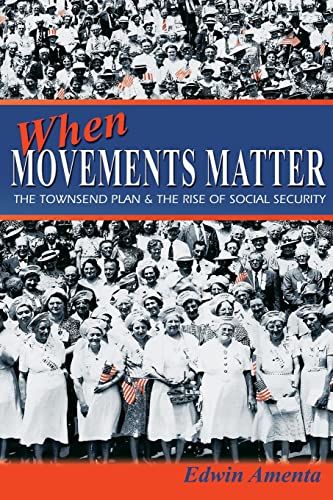
Inhaltsangabe
When Movements Matter accounts for the origins of Social Security as we know it. The book tells the overlooked story of the Townsend Plan--a political organization that sought to alleviate poverty and end the Great Depression through a government-provided retirement stipend of $200 a month for every American over the age of sixty. Both the Townsend Plan, which organized two million older Americans into Townsend clubs, and the wider pension movement failed to win the generous and universal senior citizens' pensions their advocates demanded. But the movement provided the political impetus behind old-age policy in its formative years and pushed America down the track of creating an old-age welfare state. Drawing on a wealth of primary evidence, historical detail, and arresting images, Edwin Amenta traces the ups and downs of the Townsend Plan and its elderly leader Dr. Francis E. Townsend in the struggle to remake old age. In the process, Amenta advances a new theory of when social movements are influential. The book challenges the conventional wisdom that U.S. old-age policy was a result mainly of the Depression or farsighted bureaucrats. It also debunks the current view that America immediately embraced Social Security when it was adopted in 1935. And it sheds new light on how social movements that fail to achieve their primary goals can still influence social policy and the way people relate to politics.
Die Inhaltsangabe kann sich auf eine andere Ausgabe dieses Titels beziehen.
Über die Autorin bzw. den Autor
Edwin Amenta is professor of sociology and history at the University of California, Irvine. He is the author of Professor Baseball and Bold Relief: Institutional Politics and the Origins of Modern American Social Policy (Princeton).
Von der hinteren Coverseite
"This is historical sociology at its best, written by one of the field's best practitioners."--Edward Berkowitz, George Washington University
Auszug. © Genehmigter Nachdruck. Alle Rechte vorbehalten.
When Movements Matter
The Townsend Plan and the Rise of Social SecurityBy Edwin AmentaPrinceton University Press
Copyright © 2006 Princeton University PressAll right reserved.
ISBN: 978-0-691-13826-8
Introduction
THE TOWNSEND PLAN'S IMAGE PROBLEM
Because of the efforts of our national membership, the aged people of this nation today are receiving millions of dollars annually in the form of old-age pensions which they had never received before. This is the result of the individual work of our members carrying forward the message of security and thus making our nation pension-conscious. -Francis E. Townsend, 1943.
With the exception of probably not more than a half-dozen members [of the House of Representatives], all felt that the Townsend [pension-recovery bill] was utterly impossible; at the same time they hesitated to vote against it. The Townsend [Plan] had the effect of taking away from the economic security bill its strongest natural support-that of the old people. -Edwin E. Witte, 1937.
In the great depression, older Americans rallied behind a proposal. Francis E. Townsend, a sixty-seven-year-old physician from Long Beach, California, suggested that the government pay $200 per month for Americans sixty years old or older who agreed not to work and to spend the money right away. This pension-recovery plan would free jobs, end the Depression, and provide the aged with security. Dr. Townsend landed on the cover of Newsweek when a bill based on his idea was introduced in Congress in January 1935, as President Franklin D. Roosevelt forwarded his own social security legislation. Led by its secretary Robert Earl Clements, the Townsend Plan, the name affixed both to the idea and to the organization promoting it, called on its affiliated Townsend clubs to flood Washington with letters. Soon the Townsend Plan spread from its western outpost across the nation. Townsend clubs claimed nearly a fifth of Americans over sixty years old, 2 million altogether, a size never reached by any organization in the civil rights or women's movement, and the Townsend Plan was raising funds at a more rapid clip than the Democratic Party. Townsend was back on the cover of Newsweek, and the Townsend Plan was featured in the nation's movie theaters. In terms of yearly coverage in the New York Times, the Townsend Plan's for 1936 ranks it as the eighth-most publicized U.S. social movement organization of the twentieth century.
Instead of passing the Townsend Plan's bill, however, Congress adopted the Social Security Act. With far less generous and more restricted benefits than Townsend's proposal, the security act addressed the immediate poverty of the aged with Old-Age Assistance (OAA), a federal-state matching program, and also created a national old-age annuity program. The Townsend Plan kept the pressure on for years, and although the doctor's pension-recovery proposal never passed, old-age benefits were increased again and again, and the fledgling annuity program was eventually transformed into Social Security as we know it today. In his 1943 autobiography New Horizons, Townsend was not shy about taking credit for these developments, and many of his contemporaries were inclined to agree. In Social Security in the United States (1936), Paul Douglas, economist, reformer, and no fan of Townsend, conceded that the mobilization behind his proposal "probably did weaken the die-hard opposition to the security bill." Scholarship often concurs. The political scientist Abraham Holtzman concludes that the Townsend Plan's impact was substantial, as do the historian Arthur M. Schlesinger Jr. and the social scientists Frances Fox Piven and Richard A. Cloward.
Yet the Townsend Plan may not have been so influential. It reached its zenith in membership and attention after the passage of the Social Security Act, and when Social Security was greatly upgraded in 1950, the Townsend Plan was a spent force. Today it is largely forgotten. It seems possible, too, that the Townsend Plan had some detrimental effects. It fought the social security legislation in 1935, and its congressional endorsements usually went to Republicans, whose party often combated augmentations in old-age security. In his seminal book The Development of the Social Security Act, Edwin Witte, the University of Wisconsin economist and executive secretary of the committee that wrote the bill, complained that the Townsend Plan impeded the cause of old-age security, and President Roosevelt considered himself, not Dr. Townsend, to be the author of Social Security. Also, Townsend's proposal was attacked as wildly extravagant by virtually the entire economics profession-despite the fact that in 1935 the Townsend Plan reduced the amount of its pension to about $60 per month. More soberly, the historian Edward D. Berkowitz shows that the movement for old-age security had generated great momentum before 1934, and the sociologist Ann Shola Orloff argues that the Townsend Plan may have induced Witte and his colleagues to make old-age policy more conservative than it would have been. The standard view is a weak version of Witte's argument. The Townsend Plan may have helped to keep old age foremost in the Social Security Act, but it was erratic in action and faded in influence once that act went into effect.
This dispute among contemporaries and scholars suggests several historical questions: Did the Townsend Plan bring about the Social Security Act? Did it influence the process by which Social Security as we know it was created? Why and how, if at all, did the Townsend Plan-and social spending challengers like Huey Long's Share Our Wealth and other groups in the old-age pension movement-contribute to the development of social policy? Is the conventional wisdom true? Or did the Townsend Plan and the pension movement produce other long-lasting benefits for the aged-such as increasing their possibilities for future organization, providing an identity that was useful in politics and elsewhere, or simply improving their image or what people called them? Witte had no qualms about employing the undignified construction "the old people" to refer to the elderly, who also were often referred to by many a jocular label, such as "oldsters." Was Townsend, as he portrayed himself, a hero for the aged?
In addressing this dispute about the impact of the Townsend Plan, I follow it from its origins through its heyday and beyond, examining the different ways it and the pension movement it led attempted to influence old age in America. Social scientists want to do more, however, than to assess whether this or that challenger influenced one or another social change, no matter how important. We want to know something more general about social movements and their impacts and to uncover what lessons a case has for other challengers and their efforts. So I also seek to understand what it means for a social movement to have an impact and why movements are sometimes influential and sometimes not.
The Townsend Plan and the pension movement seem to fit contradictory images of social movements in the social science literature. The old-style view, based on movements of the 1930s, was that they make unrealistic demands, attract the disengaged and credulous, and are prey to unscrupulous political leaders. Having migrated to California and having recently lost his job to the Depression, Townsend seemed to many scholars and journalists of the day to be an embodiment of rootlessness and despair. Richard Neuberger and Kelley Loe's book An...
„Über diesen Titel“ kann sich auf eine andere Ausgabe dieses Titels beziehen.
Suchergebnisse für When Movements MATTEr: The Townsend Plan and the Rise...

Beispielbild für diese ISBN
When Movements Matter: The Townsend Plan and the Rise of Social Security
Verlag:
Princeton University Press, 2008
ISBN 10: 0691138265
ISBN 13: 9780691138268
Gebraucht
Paperback
Anbieter: World of Books (was SecondSale), Montgomery, IL, USA
Verkäuferbewertung 5 von 5 Sternen

Paperback. Zustand: Good. When Movements Matter accounts for the origins of Social Security as we know it. The book tells the overlooked story of the Townsend Plan--a political organization that sought to alleviate poverty and end the Great Depression through a government-provided retirement stipend of $200 a month for every American over the age of sixty. Both the Townsend Plan, which organized two million older Americans into Townsend clubs, and the wider pension movement failed to win the generous and universal senior citizens' pensions their advocates demanded. But the movement provided the political impetus behind old-age policy in its formative years and pushed America down the track of creating an old-age welfare state. Drawing on a wealth of primary evidence, historical detail, and arresting images, Edwin Amenta traces the ups and downs of the Townsend Plan and its elderly leader Dr. Francis E. Townsend in the struggle to remake old age. In the process, Amenta advances a new theory of when social movements are influential. The book challenges the conventional wisdom that U.S. old-age policy was a result mainly of the Depression or farsighted bureaucrats. It also debunks the current view that America immediately embraced Social Security when it was adopted in 1935. And it sheds new light on how social movements that fail to achieve their primary goals can still influence social policy and the way people relate to politics. Artikel-Nr. 00110356542
Gebraucht kaufen
EUR 12,26
Versand gratis
Versand innerhalb von USA
Versand innerhalb von USA
Anzahl: 1 verfügbar
Beispielbild für diese ISBN
When Movements Matter: The Townsend Plan and the Rise of Social Security
Verlag:
Princeton University Press, 2008
ISBN 10: 0691138265
ISBN 13: 9780691138268
Gebraucht
Paperback
Anbieter: ThriftBooks-Dallas, Dallas, TX, USA
Verkäuferbewertung 5 von 5 Sternen
Paperback. Zustand: Very Good. No Jacket. May have limited writing in cover pages. Pages are unmarked. ~ ThriftBooks: Read More, Spend Less. Artikel-Nr. G0691138265I4N00
Gebraucht kaufen
EUR 15,91
Versand gratis
Versand innerhalb von USA
Versand innerhalb von USA
Anzahl: 1 verfügbar
Beispielbild für diese ISBN
When Movements Matter The Townsend Plan and the Rise of Social Security
Anbieter: Revaluation Books, Exeter, Vereinigtes Königreich
Verkäuferbewertung 5 von 5 Sternen
Paperback. Zustand: Brand New. illustrated edition. 336 pages. 9.00x6.00x0.75 inches. In Stock. Artikel-Nr. x-0691138265
Neu kaufen
EUR 65,37
EUR 14,73 Versand
Versand von Vereinigtes Königreich nach USA
Versand von Vereinigtes Königreich nach USA
Anzahl: 2 verfügbar