Inhaltsangabe
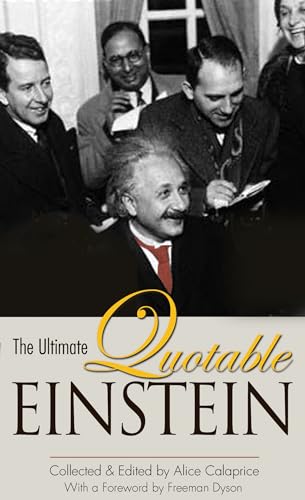
Here is the definitive new edition of the hugely popular collection of Einstein quotations that has sold tens of thousands of copies worldwide and been translated into twenty-five languages. The Ultimate Quotable Einstein features 400 additional quotes, bringing the total to roughly 1,600 in all. This ultimate edition includes new sections--"On and to Children," "On Race and Prejudice," and "Einstein's Verses: A Small Selection"--as well as a chronology of Einstein's life and accomplishments, Freeman Dyson's authoritative foreword, and new commentary by Alice Calaprice. In The Ultimate Quotable Einstein, readers will also find quotes by others about Einstein along with quotes attributed to him. Every quotation in this informative and entertaining collection is fully documented, and Calaprice has carefully selected new photographs and cartoons to introduce each section. * Features 400 additional quotations * Contains roughly 1,600 quotations in all * Includes new sections on children, race and prejudice, and Einstein's poetry * Provides new commentary * Beautifully illustrated * The most comprehensive collection of Einstein quotes ever published
Die Inhaltsangabe kann sich auf eine andere Ausgabe dieses Titels beziehen.
Über die Autorin bzw. den Autor
Alice Calaprice is a renowned expert on Albert Einstein and was a longtime senior editor at Princeton University Press. She has worked with the "Collected Papers of Albert Einstein" since the founding of the project, has copyedited and overseen the production of all the volumes, and administered the accompanying translation series with a grant from the National Science Foundation. She is the author of several popular books on Einstein and was a recipient of the Literary Market Places award for individual achievement in scholarly editing.
Auszug. © Genehmigter Nachdruck. Alle Rechte vorbehalten.
The Ultimate Quotable Einstein
PRINCETON UNIVERSITY PRESS
Copyright © 2011 Princeton University PressAll right reserved.
ISBN: 978-0-691-13817-6
Contents
FOREWORD, BY FREEMAN DYSON.................................................IXA (LONG) NOTE ABOUT THIS FINAL EDITION.....................................XVIIA BRIEF CHRONOLOGY.........................................................XXVOn Einstein Himself........................................................1On and to His Family.......................................................29On Aging...................................................................53On America and Americans...................................................61On and to Children.........................................................75On Death...................................................................89On Education, Students, and Academic Freedom...............................97On and to Friends, Specific Scientists, and Others.........................111On Germans and Germany.....................................................159On Humankind...............................................................171On Jews, Israel, Judaism, and Zionism......................................191On Life....................................................................227On Music...................................................................233On Pacifism, Disarmament, and World Government.............................243On Peace, War, the Bomb, and the Military..................................261On Politics, Patriotism, and Government....................................287On Race and Prejudice......................................................309On Religion, God, and Philosophy...........................................319On Science and Scientists, Mathematics, and Technology.....................347On Miscellaneous Subjects..................................................411Einstein's Verses: A Small Selection.......................................461Attributed to Einstein.....................................................471Others on Einstein.........................................................487BIBLIOGRAPHY...............................................................547INDEX OF KEY WORDS.........................................................557SUBJECT INDEX..............................................................563
Chapter One
On Einstein Himself
A happy man is too satisfied with the present to think too much about the future.
Written at age seventeen (September 18, 1896) for a school essay in French entitled "My Future Plans." CPAE, Vol. 1, Doc. 22
Strenuous intellectual work and the study of God's Nature are the angels that will lead me through all the troubles of this life with consolation, strength, and uncompromising rigor.
To Pauline Winteler, mother of Einstein's girlfriend Marie, May (?) 1897. CPAE, Vol. 1, Doc. 34
*In many a lucid moment I appear to myself as an ostrich who buries his head in the desert sand so as not to perceive a danger. One creates a small world for oneself and ... one feels miraculously great and important, just like a mole in its self-dug hole.
Ibid.
*I know this sort of animal personally, from my own experience, as I am one of them myself. Not too much should be expected of them.... Today we are sullen, tomorrow high-spirited, after tomorrow cold, then again irritated and half-sick of life—not to mention unfaithfulness, ingratitude, and selfishness.
To friend Julia Niggli, ca. August 6, 1899, after she asked him his opinion about her relationship with an older man. CPAE, Vol. 1, Doc. 51
I decided the following about our future: I will look for a position immediately, no matter how modest it is. My scientific goals and my personal vanity will not prevent me from accepting even the most subordinate position.
To future wife Mileva Maric, ca. July 7, 1901, while having difficulty finding his first job. CPAE, Vol. 1, Doc. 114
In living through this "great epoch," it is difficult to reconcile oneself to the fact that one belongs to that mad, degenerate species that boasts of its free will. How I wish that somewhere there existed an island for those who are wise and of good will! In such a place even I should be an ardent patriot!
To Paul Ehrenfest, early December 1914. CPAE, Vol. 8, Doc. 39
Do not feel sorry for me. Despite terrible appearances, my life goes on in full harmony; I am entirely devoted to reflection. I resemble a farsighted man who is charmed by the vast horizon and who is disturbed by the foreground only when an opaque object obstructs his view.
To Helene Savic, September 8, 1916, after separation from his family. In Popovic, ed., In Albert's Shadow, 110. CPAE, Vol. 8, Doc. 258
I very rarely think in words at all. A thought comes, and I may try to express it in words afterwards.
From a conversation with psychologist Max Wertheimer in 1916. In Wertheimer, Productive Thinking (New York: Harper, 1945), footnote on p. 184
I have come to know the mutability of all human relationships and have learned to insulate myself against both heat and cold so that a temperature balance is fairly well assured.
To Heinrich Zangger, March 10, 1917. CPAE, Vol. 8, Doc. 309
I am by heritage a Jew, by citizenship a Swiss, and by disposition a human being, and only a human being, without any special attachment to any state or national entity whatsoever.
To Adolf Kneser, June 7, 1918. CPAE, Vol. 8, Doc. 560
I was originally supposed to become an engineer, but the thought of having to expend my creative energy on things that make practical everyday life even more refined, with a loathsome capital gain as the goal, was unbearable to me.
To Heinrich Zangger, ca. August 1918. CPAE, Vol. 8, Doc. 597
I lack any sentiment of the sort; all I have is a sense of duty toward all people and an attachment to those with whom I have become intimate.
To Heinrich Zangger, June 1, 1919, regarding his lack of attachment to any particular place, as, for example, physicist Max Planck had to Germany. CPAE, Vol. 9, Doc. 52
I also had little inclination for history [in school]. But I think it had more to do with the method of instruction than with the subject itself.
To sons Hans Albert and Eduard, June 13, 1919. CPAE, Vol. 9, Doc. 60
I have not yet eaten enough of the fruit of the Tree of Knowledge, though in my profession I am obliged to feed on it regularly.
To Max Born, November 9, 1919. In Born, Born-Einstein Letters, 16; CPAE, Vol. 9, Doc. 162
By an application of the theory of relativity to the taste of readers, to-day in Germany I am called a German man of science, and in England I am represented as a Swiss Jew. If I come to be represented as a bête noire, the descriptions will be reversed, and I shall become a Swiss Jew for the Germans and a German man of science for the English!
To The Times (London), November 28, 1919, 13–14, written at the request of the newspaper. Also referred to in a letter to Paul Ehrenfest, December 4, 1919. See also the quotation of April 6, 1922, below. CPAE, Vol. 7, Doc. 26
Another funny thing is that I myself count everywhere as a Bolshevist, God knows why; perhaps because I do not take all that slop in the Berliner Tageblatt as milk and honey.
To Heinrich Zangger, December 15 or 22, 1919. CPAE, Vol. 9, Doc. 217
With fame I become more and more stupid, which of course is a very common phenomenon.
To Heinrich Zangger, December 24, 1919. CPAE, Vol. 9, Doc. 233
Since the light deflection result became public, such a cult has been made out of me that I feel like a pagan idol. But this, too, God willing, will pass.
To Heinrich Zangger, January 3, 1920. CPAE, Vol. 9, Doc. 242. Einstein had even been asked to give a three-week "performance" at the London Palladium to explain relativity.
I do know that kind fate allowed me to find a couple of nice ideas after many years of feverish labor.
To Dutch physicist H. A. Lorentz, January 19, 1920. CPAE, Vol. 9, Doc. 265
An awareness of my limitations pervades me all the more keenly in recent times because my faculties have been quite overrated since a few consequences of general relativity theory have stood the test.
Ibid.
I am being so terribly deluged with inquiries, invitations, and requests that at night I dream I am burning in hell and the mailman is the devil and is continually yelling at me, hurling a fresh bundle of letters at my head because I still haven't answered the old ones.
To Ludwig Hopf, February 2, 1920. CPAE, Vol. 9, Doc. 295
My father's ashes lie in Milan. I buried my mother here [Berlin] only a few days ago. I myself have journeyed to and fro continuously—a stranger everywhere. My children are in Switzerland.... A person like me has as his ideal to be at home anywhere with his near and dear ones.
To Max Born, March 3, 1920. In Born, Born-Einstein Letters, 25. CPAE, Vol. 9, Doc. 337
The teaching faculty in elementary school was liberal and did not make any denominational distinctions. Among the Gymnasium teachers there were a few anti-Semites. Among the children, anti-Semitism was alive especially in elementary school. It was based on conspicuous racial characteristics and on impressions left from the lessons on religion. Active attacks and verbal abuse on the way to and from school were frequent but usually not all that serious. They sufficed, however, to establish an acute feeling of alienation already in childhood.
To Paul Nathan, political editor of the Berliner Tageblatt, for an article on anti-Semitism, April 3, 1920. CPAE, Vol. 9, Doc. 366
I will always fondly recall the hours spent in your home, including the pearls of Persian wisdom with which I became acquainted through your hospitality and your work. As an Oriental by blood, I feel they are especially meaningful to me.
To Friedrich Rosen, German envoy in The Hague, May 1920. Rosen had apparently been posted in Persia at one time and edited a collection of Persian stories. Einstein Archives 9-492
It also pleases me that it is still possible, even today, to be treated as an internationally minded person without being compartmentalized into one of the two big drawers.
To H. A. Lorentz, June 15, 1920. The "two big drawers" at the time were the pro–Central Powers and the pro-Allies. CPAE, Vol. 10, Doc. 56
*Don't be too hard on me. Everyone has to sacrifice at the altar of stupidity from time to time, to please the Deity and the human race. And this I have done thoroughly with my article.
To Max and Hedi Born, September 9, 1920, downplaying criticism for an article he wrote. In Born, Born-Einstein Letters, 34. CPAE, Vol. 7, Doc. 45
Like the man in the fairytale who turned everything he touched into gold, so with me everything is turned into newspaper clamor.
Ibid. To his friend Paul Ehrenfest he wrote ten years later, on March 21, 1930, "With me, every peep becomes a trumpet solo" (Einstein Archives 10-212).
Personally, I experience the greatest degree of pleasure in having contact with works of art. They furnish me with happy feelings of an intensity that I cannot derive from other sources.
1920. Quoted by Moszkowski, Conversations with Einstein, 184. Here, according to the context, Einstein refers only to literature.
*I do not care to speak about my work. The sculptor, the artists, the musician, the scientist work because they love their work. Fame and honor are secondary. My work is my life, and when I find the truth I proclaim it.... Opposition does not affect my work.
Quoted in New York Call, May 31, 1921, 2. See also Illy, Albert Meets America, 312
To be called to account publicly for what others have said in your name, when you cannot defend yourself, is a sad situation indeed.
From "Einstein and the Interviewers," August 1921. Einstein Archives 21-047
If my theory of relativity is proven successful, Germany will claim me as a German and France will declare that I am a citizen of the world. Should my theory prove untrue, France will say that I am a German and Germany will declare that I am a Jew.
From an address to the French Philosophical Society at the Sorbonne, April 6, 1922. See also French press clipping, April 7, 1922, Einstein Archives 36-378; and Berliner Tageblatt, April 8, 1922. Einstein Archives 79-535
When a blind beetle crawls over the surface of a curved branch, it doesn't notice that the track it has covered is indeed curved. I was lucky enough to notice what the beetle didn't notice.
In answer to his son Eduard's question about why he is so famous, 1922. Quoted in Flückiger, Albert Einstein in Bern, and Grüning, Ein Haus für Albert Einstein, 498
Now I am sitting peacefully in Holland after being told that certain people in Germany have it in for me as a "Jewish saint." In Stuttgart there was even a poster in which I appeared in first place among the richest Jews.
To sons Hans Albert and Eduard, November 24, 1923. Einstein Archives 75-627
Of all the communities available to us, there is not one I would want to devote myself to except for the society of the true searchers, which has very few living members at any one time.
To Max and Hedwig Born, April 29, 1924. In Born, Born-Einstein Letters, 79. Einstein Archives 8-176
[I] must seek in the stars that which was denied [to me] on Earth.
To his secretary Betty Neumann, 1924, with whom he had fallen in love while married to Elsa, upon ending his relationship with her. She was the niece of his friend Hans Muehsam. See Pais, Subtle Is the Lord, 320; and Fölsing, Albert Einstein, 548
Imagination is more important than knowledge. Knowledge is limited. Imagination encircles the world.
In answer to the question, "Do you trust more to your imagination than to your knowledge?" From interview with G. S. Viereck, "What Life Means to Einstein," Saturday Evening Post, October 26, 1929; reprinted in Viereck, Glimpses of the Great, 447
My own career was undoubtedly determined not by my own will, but by various factors over which I have no control, primarily those mysterious glands in which nature prepares the very essence of life.
In a discussion on free will and determinism. Ibid. Reprinted in Viereck, Glimpses of the Great, 442
To punish me for my contempt of authority, Fate has made me an authority myself.
Aphorism for a friend, September 18, 1930. Quoted in Hoffmann, Albert Einstein: Creator and Rebel, 24. Einstein Archives 36-598
I am an artist's model.
As recalled and noted by Herbert Samuel, who asked him his occupation, reflecting Einstein's feeling that he was constantly posing for sculptures and paintings, October 31, 1930. Einstein Archives 21-006. The photographer Philippe Halsmann's version is a bit different: An elderly woman on a bus told Einstein she must have seen his picture somewhere because he looked familiar, and Einstein responded, "I am a photographer's model." See Halsmann, letter to editors, New York Review of Books, May 26, 1966
I have never looked upon ease and happiness as ends in themselves—such an ethical basis I call the ideal of a pigsty.... The ideals which have always shone before me and filled me with the joy of living are goodness, beauty, and truth. To make a goal of comfort or happiness has never appealed to me.
From "What I Believe," Forum and Century 84 (1930), 193–194. See also Rowe and Schulmann, Einstein on Politics, 226, for background information and the whole essay. This and other passages from the essay have been variously translated elsewhere. For this edition of the book, I am consistently using the versions in Forum and Century.
*Possessions, outward success, publicity, luxury—to me these have always been contemptible. I believe that a simple and unassuming life is best for ... the body and mind.
Ibid.
*My passionate interest in social justice and social responsibility has always stood in curious contrast to a marked lack of desire for direct association with men and women. I am a horse for single harness, not cut out for tandem or team work. I have never belonged wholeheartedly to country or state, to my circle of friends, or even to my own family. These ties have always been accompanied by a vague aloofness, and the wish to withdraw into myself increases with the years.
Ibid.
Many times a day I realize how much my outer and inner life is based upon the labors of my fellow men, both living and dead, and how much I must exert myself in order to give in return as much as I have received.
Ibid.
It is an irony of fate that I myself have been the recipient of excessive admiration and reverence from my fellow-beings, through no fault or merit of my own.
Ibid.
Professor Einstein begs you to treat your publications for the time being as if he were already dead.
Written on Einstein's behalf by his secretary, Helen Dukas, March 1931, after he was besieged by one too many manuscripts. Einstein Archives 46-487
It strikes me as unfair, and even in bad taste, to select a few individuals for boundless admiration, attributing superhuman powers of mind and character to them. This has been my fate, and the contrast between the popular assessment of my powers and achievements and the reality is simply grotesque.
From "Impressions of the U.S.A.," ca. 1931, reprinted in Rowe and Schulmann, Einstein on Politics, 242–246. Einstein Archives 28-168
Although I try to be universal in thought, I am European by instinct and inclination.
Quoted in Daily Express (London), September 11, 1933. Also in Holton, Advancement of Science, 126
People flatter me as long as I'm of use to them. But when I try to serve goals with which they are in disagreement, they immediately turn to abuse and calumny in defense of their interests.
To an unidentified pacifist, 1932. Einstein Archives 28-191
I suffered at the hands of my teachers a similar treatment; they disliked me for my independence and passed me over when they wanted assistants. (I must admit, though, that I was somewhat less of a model student than you.)
To a young girl, Irene Freuder, November 20, 1932. Reprinted as "Education and Educators," in Ideas and Opinions, 56. Einstein Archives 28-221
(Continues...)
Excerpted from The Ultimate Quotable Einstein Copyright © 2011 by Princeton University Press. Excerpted by permission of PRINCETON UNIVERSITY PRESS. All rights reserved. No part of this excerpt may be reproduced or reprinted without permission in writing from the publisher.
Excerpts are provided by Dial-A-Book Inc. solely for the personal use of visitors to this web site.
„Über diesen Titel“ kann sich auf eine andere Ausgabe dieses Titels beziehen.
Weitere beliebte Ausgaben desselben Titels

Suchergebnisse für The Ultimate Quotable Einstein

Beispielbild für diese ISBN
The Ultimate Quotable Einstein
Verlag:
Princeton University Press, 2010
ISBN 10: 0691138176
ISBN 13: 9780691138176
Gebraucht
Hardcover
Anbieter: ThriftBooks-Dallas, Dallas, TX, USA
Verkäuferbewertung 5 von 5 Sternen

Hardcover. Zustand: Very Good. No Jacket. May have limited writing in cover pages. Pages are unmarked. ~ ThriftBooks: Read More, Spend Less. Artikel-Nr. G0691138176I4N00
Gebraucht kaufen
EUR 5,90
Versand gratis
Versand innerhalb von USA
Versand innerhalb von USA
Anzahl: 1 verfügbar
Beispielbild für diese ISBN
The Ultimate Quotable Einstein
Verlag:
Princeton University Press, 2010
ISBN 10: 0691138176
ISBN 13: 9780691138176
Gebraucht
Hardcover
Anbieter: ThriftBooks-Atlanta, AUSTELL, GA, USA
Verkäuferbewertung 5 von 5 Sternen
Hardcover. Zustand: Good. No Jacket. Pages can have notes/highlighting. Spine may show signs of wear. ~ ThriftBooks: Read More, Spend Less. Artikel-Nr. G0691138176I3N00
Gebraucht kaufen
EUR 5,90
Versand gratis
Versand innerhalb von USA
Versand innerhalb von USA
Anzahl: 1 verfügbar
Beispielbild für diese ISBN
The Ultimate Quotable Einstein
Verlag:
Princeton University Press, 2010
ISBN 10: 0691138176
ISBN 13: 9780691138176
Gebraucht
Hardcover
Anbieter: ThriftBooks-Dallas, Dallas, TX, USA
Verkäuferbewertung 5 von 5 Sternen
Hardcover. Zustand: Good. No Jacket. Former library book; Pages can have notes/highlighting. Spine may show signs of wear. ~ ThriftBooks: Read More, Spend Less. Artikel-Nr. G0691138176I3N10
Gebraucht kaufen
EUR 5,90
Versand gratis
Versand innerhalb von USA
Versand innerhalb von USA
Anzahl: 1 verfügbar
Beispielbild für diese ISBN
The Ultimate Quotable Einstein
Verlag:
Princeton University Press, 2010
ISBN 10: 0691138176
ISBN 13: 9780691138176
Gebraucht
Hardcover
Anbieter: ThriftBooks-Dallas, Dallas, TX, USA
Verkäuferbewertung 5 von 5 Sternen
Hardcover. Zustand: Very Good. No Jacket. Former library book; May have limited writing in cover pages. Pages are unmarked. ~ ThriftBooks: Read More, Spend Less. Artikel-Nr. G0691138176I4N10
Gebraucht kaufen
EUR 5,90
Versand gratis
Versand innerhalb von USA
Versand innerhalb von USA
Anzahl: 1 verfügbar
Beispielbild für diese ISBN
The Ultimate Quotable Einstein
Verlag:
Princeton University Press, 2010
ISBN 10: 0691138176
ISBN 13: 9780691138176
Gebraucht
Hardcover
Anbieter: WorldofBooks, Goring-By-Sea, WS, Vereinigtes Königreich
Verkäuferbewertung 5 von 5 Sternen
Hardback. Zustand: Fair. A readable copy of the book which may include some defects such as highlighting and notes. Cover and pages may be creased and show discolouration. Artikel-Nr. GOR014558599
Gebraucht kaufen
EUR 4,32
EUR 6,38 shipping
Versand von Vereinigtes Königreich nach USA
Versand von Vereinigtes Königreich nach USA
Anzahl: 1 verfügbar
Beispielbild für diese ISBN
The Ultimate Quotable Einstein
Anbieter: PBShop.store US, Wood Dale, IL, USA
Verkäuferbewertung 5 von 5 Sternen
HRD. Zustand: New. New Book. Shipped from UK. Established seller since 2000. Artikel-Nr. WP-9780691138176
Beispielbild für diese ISBN
The Ultimate Quotable Einstein
Anbieter: PBShop.store UK, Fairford, GLOS, Vereinigtes Königreich
Verkäuferbewertung 5 von 5 Sternen
HRD. Zustand: New. New Book. Shipped from UK. Established seller since 2000. Artikel-Nr. WP-9780691138176
Neu kaufen
EUR 25,00
EUR 5,72 shipping
Versand von Vereinigtes Königreich nach USA
Versand von Vereinigtes Königreich nach USA
Anzahl: 11 verfügbar
Beispielbild für diese ISBN
The Ultimate Quotable Einstein
Anbieter: Majestic Books, Hounslow, Vereinigtes Königreich
Verkäuferbewertung 4 von 5 Sternen

Zustand: New. pp. xxviii + 578 27 Illus. Artikel-Nr. 8064912
Neu kaufen
EUR 27,54
EUR 7,40 shipping
Versand von Vereinigtes Königreich nach USA
Versand von Vereinigtes Königreich nach USA
Anzahl: 3 verfügbar
Beispielbild für diese ISBN
The Ultimate Quotable Einstein
Anbieter: Revaluation Books, Exeter, Vereinigtes Königreich
Verkäuferbewertung 5 von 5 Sternen
Hardcover. Zustand: Brand New. 576 pages. 8.00x5.25x1.75 inches. In Stock. Artikel-Nr. __0691138176
Neu kaufen
EUR 25,11
EUR 11,39 shipping
Versand von Vereinigtes Königreich nach USA
Versand von Vereinigtes Königreich nach USA
Anzahl: 2 verfügbar
Foto des Verkäufers
The ultimate quotable Einstein
Verlag:
Princeton University Press, PRINCETON, 2011
ISBN 10: 0691138176
ISBN 13: 9780691138176
Gebraucht
Hardcover
Anbieter: Biblioteca di Babele, Tarquinia, VT, Italien
Verkäuferbewertung 5 von 5 Sternen
Zustand: OTTIMO USATO. IED. INGLESE Libro usato che è già stato letto, ma in condizioni ottime. Nessun danno evidente alle coperte, potrebbe presentare minimi segni di usura alle copertine e alle pagine. Nessuna pagina mancante o strappata, nessuna sottolineatura/evidenziazione di testo né scritte ai margini. La foto corrisponde al libro in vendita. Altre foto su richiesta. Lingue italiano e inglese. Presente sovraccoperta. Numero pagine 578. Artikel-Nr. KNE7467
Gebraucht kaufen
EUR 6,00
EUR 42,00 shipping
Versand von Italien nach USA
Versand von Italien nach USA
Anzahl: 1 verfügbar