
Verwandte Artikel zu Darwin Loves You: Natural Selection and the Re-enchantment...
Inhaltsangabe
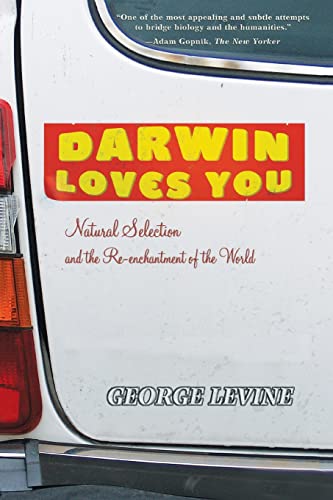
Jesus and Darwin do battle on car bumpers across America. Medallions of fish symbolizing Jesus are answered by ones of amphibians stamped "Darwin," and stickers proclaiming "Jesus Loves You" are countered by "Darwin Loves You." The bumper sticker debate might be trivial and the pronouncement that "Darwin Loves You" may seem merely ironic, but George Levine insists that the message contains an unintended truth. In fact, he argues, we can read it straight. Darwin, Levine shows, saw a world from which his theory had banished transcendence as still lovable and enchanted, and we can see it like that too--if we look at his writings and life in a new way. Although Darwin could find sublimity even in ants or worms, the word "Darwinian" has largely been taken to signify a disenchanted world driven by chance and heartless competition. Countering the pervasive view that the facts of Darwin's world must lead to a disenchanting vision of it, Levine shows that Darwin's ideas and the language of his books offer an alternative form of enchantment, a world rich with meaning and value, and more wonderful and beautiful than ever before. Without minimizing or sentimentalizing the harsh qualities of life governed by natural selection, and without deifying Darwin, Levine makes a moving case for an enchanted secularism--a commitment to the value of the natural world and the human striving to understand it.
Die Inhaltsangabe kann sich auf eine andere Ausgabe dieses Titels beziehen.
Über die Autorin bzw. den Autor
George Levine is Professor Emeritus of English at Rutgers University. His books include Darwin and the Novelists; Dying to Know: Narrative and Scientific Epistemology in Victorian England; The Realistic Imagination: English Fiction from Frankenstein to Lady Chatterley; The Boundaries of Fiction; and a memoir about birdwatching, Lifebirds.
Von der hinteren Coverseite
"Darwin Loves You is the most interesting book I have read this year. It is wise, brave, and beautifully written. Levine's reflections on the important issue of Darwinism as an ideology are bound to engage readers. He shows that Darwin's science is not dehumanising or amoral and that it's possible to be a Darwinist and still believe that the world has meaning."--Janet Browne, author of Charles Darwin: The Power of Place
"George Levine has thought deeply about Darwinism, its cultural history, and its implications for moral and spiritual values. Darwin Loves You should be read by everyone who thinks that their values are threatened by evolutionary theory."--David Sloan Wilson, author of Darwin's Cathedral: Evolution, Religion, and the Nature of Society and How to be a Good Evolutionist
"Darwin Loves You is a very important work that deserves to be read by many people well outside the narrow circle of Darwin specialists. First, it is a brilliant account of how a science is taken up and used for diverse cultural ends, far beyond the intention of the author and the content of the text. Second, it is crucially relevant to the present day with the horrifying rise of fundamentalist religion in America and abroad. It shows how science gets misused and misunderstood in dangerous ways by fanatics. Third, and most important of all, it introduces us to a man who is deeply in love with his subject, wanting to engage the reader. One learns here truly why scholarship is such a joyful activity."--Michael Ruse, author of The Evolution-Creation Struggle
"This is a rich and multilayered argument for a wider appreciation of a 'kinder, gentler' Darwin. It examines many of the ways in which Darwin's writings have been appropriated by later social Darwinist and eugenicist thought. Levine makes a cogent defence of the practice of close reading both Darwin and his many commentators. The result is a subtle but powerful argument about the way in which distinctive strands of Darwin's intellectual and personal identity--as romantic materialist and emotional subject--need to be appreciated as a possible resource of re-enchantment, overturning pessimistic, rationalistic, and technological disenchantment."--David Amigoni, Keele University, coeditor of Charles Darwin's "Origin of Species": New Interdisciplinary Essays
"Passionate, erudite, and polemical, Darwin Loves You draws its arguments from a heady array of writers and philosophers. This is a book to think with."--Rebecca Stott, Anglia Ruskin University, Cambridge, author of Darwin and the Barnacle
Auszug. © Genehmigter Nachdruck. Alle Rechte vorbehalten.
Darwin Loves You
Natural Selection and the Re-enchantment of the WorldBy George LevinePrinceton University Press
Copyright © 2006 Princeton UniversityAll right reserved.
ISBN: 978-0-691-13639-4
Chapter One
SECULAR RE-ENCHANTMENT
The gentle gentleman Charles Darwin, who was buried in Westminster Abbey, lives in public consciousness within an adjective describing a brutally competitive and mechanistic world, and as the author of a controversial theory that has made him to many the Antichrist. He has survived not only as the icon of a revolutionary shift in the way we think about origins and humanity but as an unpleasant idea. And for those who think about such things, in extending naturalistic explanation even to human behavior, he is seen as perhaps the most striking embodiment of that scientific rationalism that, in Max Weber's terminology, "disenchanted" the modern world. Evolution by natural selection seems to have removed both meaning and consolation from the world; those who discovered it and who now argue for it often engage in a kind of triumphal rationalism that treads all affective and extramaterial explanation underfoot. It is one thing to believe that science can explain the movement of the stars or even the composition of matter; it is quite another to believe that science can explain human nature itself, and all the disorderly intricacies of human life.
Certainly, Weber's reading of the disenchantment of the world was consistent with the responses of many Victorians to the progress of science. As against the scientific naturalists, T. H. Huxley, John Tyndall, and W. K. Clifford, who exuberantly advertised the power of science to transform the world, W. H. Mallock, among their most brilliant and witty antagonists, noted of the world in a book significantly called Is Life Worth Living? that "in a number of ways, whilst we have not been perceiving it, its objective grandeur has been dwindling." Instead of finding that the new knowledge enspirits and enlivens, Mallock claims that "in the last few generations man has been curiously changing."
And the change is the result of too much knowledge, too much reflection. Man "has become a creature looking before and after; and his native hue of resolution has been sicklied over by thought" (19). Mallock's formulation of the Victorian experience can serve as a strong example of Weber's point that the authority of scientific explanation drives meaning and value from the world.
And the Victorian struggle over this problem takes an even starker shape today. One of the more popular scientific books of recent years is called, not immodestly, How the Mind Works, and its author, Stephen Pinker, recognizing its immodesty, begins on an uncharacteristic "note of humility" by confessing that "we don't know how the mind works." But, Pinker says, we are on our way, arguing that our understanding of how the mind works has been "upgraded" from a "mystery" to a "problem." And it is precisely the fact that Pinker's project is recognized as a legitimate enterprise of science-the upgrade from mystery to problem anticipates another upgrade to resolution-that, according to Weber, marks modern culture's understanding that science can indeed explain everything. Weber contends that meaning drains out of the world precisely as we come to believe that "if one wished one could learn" virtually anything; "there are no mysterious incalculable forces."
There is widespread agreement that this is the case. Pinker's project has deep roots, but in the nineteenth century, particularly in the work of the positivists and scientific naturalists, the enterprise of producing a full scientific description of all phenomena had gained enormous energy. When William James contemplated the project in 1902, he registered a response that confirms Weber's later thesis. "When we read ... proclamations of the intellect bent on showing the existential conditions of absolutely everything," he asserts with something like contempt, "we feel- quite apart from our legitimate impatience at the somewhat ridiculous swagger of the program ... menaced and negated in the springs of our innermost life." He talks of "cold-blooded assimilations" that "threaten ... to undo our soul's vital secrets," and of the "assumption that spiritual value is undone if lowly origin be asserted" (12-13). James's project is to open the way to a recognition of the importance and validity of the religious experience, but to do that he also makes plain the inadequacy for personal and spiritual satisfactions of this scientific "program." He describes, in effect, the condition of disenchantment, about which Weber was to write, and he feels obliged to engage immediately with what is certainly a fundamentally Darwinian project, the explanation of origins in "lowly" terms.
James mocks the pretensions of those who claim to be on their way to describing "the existential conditions of absolutely everything," but that program is not dead. Nor is it self-evident that it's not worth attempting. In effect, it is the program of evolutionary psychology for which Pinker argues, and the outlines of the debate have remained roughly the same over the course of a century, though the technical understanding has changed.
Pinker explains that the mind "is a system of organs of computation designed by natural selection to solve the problems faced by our evolutionary ancestors in their foraging way of life" (x). There is Darwin again, his theory being used here not to explain how species emerge from other species but to explain what is thought to be most distinctive about the human species: mind. It is not a romantic or religious conception that Pinker offers. The mind is a "system," not the seat of the soul; there are problems in its working, but no mysteries. Not only, then, does the use of Darwin imply a disenchanted world, but also (and here is where much modern controversy develops) a world in which morality itself ceases to be a mystery and becomes- again I invoke Pinker-only a problem. As James put it about his contemporary version of evolutionary psychology, the project threatens to undo the soul's vital secrets. The primary problem is that, since Darwin's theory seems to imply that natural selection "acts solely by and for the good of each," that is, it works only on individuals, not on groups or species, it seems impossible to account for "altruism"-the hot issue for sociobiologists and evolutionary psychologists. This is not the place to join the altruism wars of recent theory, but what is clear is that modern uses of Darwin further propagate that sense of him and his work as offering us a world debased because it is explained in terms of lowly origins-as though it were certain that such explanation is somehow degrading. Evolutionary psychology gives us once again a godless nature red in tooth and claw, ruthless competition, survival of the fittest-and now algorithmic social theory and the biologizing of everything human.
When James confronts these arguments, he dismisses the question of "origins" entirely. That is, the quality of an idea, or a work of art, or a person, depends not on its origins but on its effects. It is Jamesian pragmatism carried over into consideration of religion. As for Darwin humankind is not demeaned because we can trace its origins to apelike ancestors, for James religion is not disqualified because we can trace the origins of belief back to some physiological basis. Athough I do not want to dispute that Weber was describing a real phenomenon in registering the dispirited reaction of a culture to the power of...
„Über diesen Titel“ kann sich auf eine andere Ausgabe dieses Titels beziehen.
Suchergebnisse für Darwin Loves You: Natural Selection and the Re-enchantment...

Beispielbild für diese ISBN
Darwin Loves You: Natural Selection and the Re-enchantment of the World
Verlag:
Princeton University Press (edition ), 2008
ISBN 10: 0691136394
ISBN 13: 9780691136394
Gebraucht
Paperback
Anbieter: BooksRun, Philadelphia, PA, USA
Verkäuferbewertung 5 von 5 Sternen

Paperback. Zustand: Very Good. It's a well-cared-for item that has seen limited use. The item may show minor signs of wear. All the text is legible, with all pages included. It may have slight markings and/or highlighting. Artikel-Nr. 0691136394-11-1
Gebraucht kaufen
EUR 5,65
Versand gratis
Versand innerhalb von USA
Versand innerhalb von USA
Anzahl: 1 verfügbar
Beispielbild für diese ISBN
Darwin Loves You : Natural Selection and the Re-Enchantment of the World
Verlag:
Princeton University Press, 2008
ISBN 10: 0691136394
ISBN 13: 9780691136394
Gebraucht
Softcover
Anbieter: Better World Books, Mishawaka, IN, USA
Verkäuferbewertung 5 von 5 Sternen
Zustand: Good. Pages intact with minimal writing/highlighting. The binding may be loose and creased. Dust jackets/supplements are not included. Stock photo provided. Product includes identifying sticker. Better World Books: Buy Books. Do Good. Artikel-Nr. 5238794-6
Gebraucht kaufen
EUR 6,35
Versand gratis
Versand innerhalb von USA
Versand innerhalb von USA
Anzahl: 1 verfügbar
Beispielbild für diese ISBN
Darwin Loves You : Natural Selection and the Re-Enchantment of the World
Verlag:
Princeton University Press, 2008
ISBN 10: 0691136394
ISBN 13: 9780691136394
Gebraucht
Softcover
Anbieter: Better World Books Ltd, Dunfermline, Vereinigtes Königreich
Verkäuferbewertung 5 von 5 Sternen
Zustand: Very Good. Former library copy. Pages intact with possible writing/highlighting. Binding strong with minor wear. Dust jackets/supplements may not be included. Includes library markings. Stock photo provided. Product includes identifying sticker. Better World Books: Buy Books. Do Good. Artikel-Nr. 4913719-6
Gebraucht kaufen
EUR 9,16
EUR 5,84 Versand
Versand von Vereinigtes Königreich nach USA
Versand von Vereinigtes Königreich nach USA
Anzahl: 1 verfügbar
Beispielbild für diese ISBN
Darwin Loves You
Anbieter: PBShop.store UK, Fairford, GLOS, Vereinigtes Königreich
Verkäuferbewertung 5 von 5 Sternen
PAP. Zustand: New. New Book. Shipped from UK. Established seller since 2000. Artikel-Nr. WP-9780691136394
Neu kaufen
EUR 34,44
EUR 5,87 Versand
Versand von Vereinigtes Königreich nach USA
Versand von Vereinigtes Königreich nach USA
Anzahl: 1 verfügbar
Beispielbild für diese ISBN
Darwin Loves You: Natural Selection and the Re-enchantment of the World
Anbieter: Kennys Bookstore, Olney, MD, USA
Verkäuferbewertung 5 von 5 Sternen
Zustand: New. Countering the pervasive view that the facts of Darwin's world must lead to a disenchanting vision of it, the author shows that Darwin's ideas and the language of his books offer an alternative form of enchantment. He makes a case for an enchanted secularism - a commitment to the value of the natural world and the human striving to understand it. Num Pages: 336 pages. BIC Classification: PDX; PSAJ. Category: (P) Professional & Vocational; (U) Tertiary Education (US: College). Dimension: 229 x 152 x 20. Weight in Grams: 457. . 2008. Paperback. . . . . Books ship from the US and Ireland. Artikel-Nr. V9780691136394
Neu kaufen
EUR 38,11
EUR 9,06 Versand
Versand innerhalb von USA
Versand innerhalb von USA
Anzahl: 1 verfügbar
Beispielbild für diese ISBN
Darwin Loves You: Natural Selection and the Re-enchantment of the World
Anbieter: Ria Christie Collections, Uxbridge, Vereinigtes Königreich
Verkäuferbewertung 5 von 5 Sternen
Zustand: New. In English. Artikel-Nr. ria9780691136394_new
Neu kaufen
EUR 38,04
EUR 14,00 Versand
Versand von Vereinigtes Königreich nach USA
Versand von Vereinigtes Königreich nach USA
Anzahl: 1 verfügbar
Beispielbild für diese ISBN
Darwin Loves You Natural Selection and the ReEnchantment of the World
Anbieter: Revaluation Books, Exeter, Vereinigtes Königreich
Verkäuferbewertung 5 von 5 Sternen
Paperback. Zustand: Brand New. 304 pages. 9.00x6.00x1.00 inches. In Stock. Artikel-Nr. x-0691136394
Neu kaufen
EUR 48,36
EUR 14,60 Versand
Versand von Vereinigtes Königreich nach USA
Versand von Vereinigtes Königreich nach USA
Anzahl: 2 verfügbar