
Verwandte Artikel zu Trusting Doctors: The Decline of Moral Authority in...
Inhaltsangabe
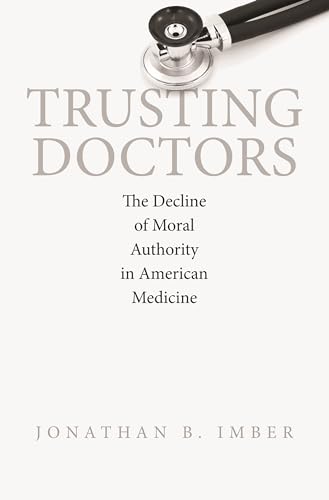
For more than a century, the American medical profession insisted that doctors be rigorously trained in medical science and dedicated to professional ethics. Patients revered their doctors as representatives of a sacred vocation. Do we still trust doctors with the same conviction? In Trusting Doctors, Jonathan Imber attributes the development of patients' faith in doctors to the inspiration and influence of Protestant and Catholic clergymen during the nineteenth and early twentieth centuries. He explains that as the influence of clergymen waned, and as reliance on medical technology increased, patients' trust in doctors steadily declined.
Trusting Doctors discusses the emphasis that Protestant clergymen placed on the physician's vocation; the focus that Catholic moralists put on specific dilemmas faced in daily medical practice; and the loss of unchallenged authority experienced by doctors after World War II, when practitioners became valued for their technical competence rather than their personal integrity. Imber shows how the clergy gradually lost their impact in defining the physician's moral character, and how vocal critics of medicine contributed to a decline in patient confidence. The author argues that as modern medicine becomes defined by specialization, rapid medical advance, profit-driven industry, and ever more anxious patients, the future for a renewed trust in doctors will be confronted by even greater challenges.
Trusting Doctors provides valuable insights into the religious underpinnings of the doctor-patient relationship and raises critical questions about the ultimate place of the medical profession in American life and culture.
Die Inhaltsangabe kann sich auf eine andere Ausgabe dieses Titels beziehen.
Über die Autorin bzw. den Autor
Jonathan B. Imber is the Class of 1949 Professor in Ethics and professor of sociology at Wellesley College. He is the author of Abortion and the Private Practice of Medicine.
Von der hinteren Coverseite
"Jonathan Imber's Trusting Doctors is an important, interesting, and readable book. We all know that our modern doctors do not have the social aura they once did. Imber effectively tells us the eye-opening story of why that change has happened."--Daniel Callahan, cofounder of the Hastings Center
"Doctors and people who have no choice but to trust doctors--which means all of us--need to read this book. With both sympathy and uncompromising honesty, Jonathan Imber traces the frequently troubled history of a medical profession that needs to attend to its increasingly fragile moral authority."--Richard John Neuhaus, editor in chief of the journalFirst Things
"Trusting Doctors is a major book, a benchmark on medical morality and trust, and an exemplar of religion's impact on medicine."--Peter Conrad, Brandeis University
"This important book challenges many ideas that have long been taken for granted in medical sociology and the history of medicine: ideas about the work of bioethics and epidemiology, as well as the relation between religion and medicine."--Raymond G. De Vries, University of Michigan
Aus dem Klappentext
"Jonathan Imber's Trusting Doctors is an important, interesting, and readable book. We all know that our modern doctors do not have the social aura they once did. Imber effectively tells us the eye-opening story of why that change has happened."--Daniel Callahan, cofounder of the Hastings Center
"Doctors and people who have no choice but to trust doctors--which means all of us--need to read this book. With both sympathy and uncompromising honesty, Jonathan Imber traces the frequently troubled history of a medical profession that needs to attend to its increasingly fragile moral authority."--Richard John Neuhaus, editor in chief of the journalFirst Things
"Trusting Doctors is a major book, a benchmark on medical morality and trust, and an exemplar of religion's impact on medicine."--Peter Conrad, Brandeis University
"This important book challenges many ideas that have long been taken for granted in medical sociology and the history of medicine: ideas about the work of bioethics and epidemiology, as well as the relation between religion and medicine."--Raymond G. De Vries, University of Michigan
Auszug. © Genehmigter Nachdruck. Alle Rechte vorbehalten.
Trusting Doctors
The Decline of Moral Authority in American MedicineBy Jonathan B. ImberPrinceton University Press
Copyright © 2008 Princeton University PressAll right reserved.
ISBN: 978-0-691-13574-8
Chapter One
Protestantism, Piety, and Professionalism
Whether trusted or not, doctors have used the Hippocratic oath for two thousand years as the equivalent of a social contract between the medical profession and the public, administered in modern times at graduation from medical school. Even though the legacy of that contract may now seem to raise more questions than it answers about the physician's duties, the original oath has been described as "the Medical Decalogue [equivalent to the Ten Commandments], universally accepted as such."
That original, as translated by Ludwig Edelstein in his book The Hippocratic Oath: Text, Translation, and Interpretation (1943), reads as follows:
I swear by Apollo Physician and Asclepius and Hygieia and Panaceia and all the gods and goddesses, making them my witnesses, that I will fulfill according to my ability and judgment this oath and this covenant:
To hold him who has taught me this art as equal to my parents and to live my life in partnership with him, and if he is in need of money to give him a share of mine, and to regard his offspring as equal to my brothers in male lineage and to teach them this art-if they desire to learn it-without fee and covenant; to give a share of precepts and oral instruction and all the other learning to my sons and to the sons of him who has instructed me and to pupils who have signed the covenant and have taken an oath according to the medical law, but no one else.
I will apply dietetic measures for the benefit of the sick according to my ability and judgment; I will keep them from harm and injustice.
I will neither give a deadly drug to anybody who asked for it, nor will I make a suggestion to this effect. Similarly I will not give to a woman an abortive remedy. In purity and holiness I will guard my life and my art.
I will not use the knife, not even on sufferers from stone, but will withdraw in favor of such men as are engaged in this work.
Whatever houses I may visit, I will come for the benefit of the sick, remaining free of all intentional injustice, of all mischief and in particular of sexual relations with both female and male persons, be they free or slaves.
What I may see or hear in the course of the treatment or even outside of the treatment in regard to the life of men, which on no account one must spread abroad, I will keep to myself, holding such things shameful to be spoken about.
If I fulfill this oath and do not violate it, may it be granted to me to enjoy life and art, being honored with fame among all men for all time to come; if I transgress it and swear falsely, may the opposite of all this be my lot.
A more contemporary adaptation was written in 1964 by Louis Lasagna (1923-2003), who was for many years the academic dean of Tufts University Medical School. As an introduction to the central concerns of this book, it is worth comparing the two.
I swear to fulfill, to the best of my ability and judgment, this covenant:
I will respect the hard-won scientific gains of those physicians in whose steps I walk, and gladly share such knowledge as is mine with those who are to follow.
I will apply, for the benefit of the sick, all measures [that] are required, avoiding those twin traps of overtreatment and therapeutic nihilism.
I will remember that there is art to medicine as well as science, and that warmth, sympathy, and understanding may outweigh the surgeon's knife or the chemist's drug.
I will not be ashamed to say "I know not," nor will I fail to call in my colleagues when the skills of another are needed for a patient's recovery.
I will respect the privacy of my patients, for their problems are not disclosed to me that the world may know. Most especially must I tread with care in matters of life and death. If it is given me to save a life, all thanks. But it may also be within my power to take a life; this awesome responsibility must be faced with great humbleness and awareness of my own frailty. Above all, I must not play at God.
I will remember that I do not treat a fever chart, a cancerous growth, but a sick human being, whose illness may affect the person's family and economic stability. My responsibility includes these related problems, if I am to care adequately for the sick.
I will prevent disease whenever I can, for prevention is preferable to cure.
I will remember that I remain a member of society, with special obligations to all my fellow human beings, those sound of mind and body as well as the infirm.
If I do not violate this oath, may I enjoy life and art, respected while I live and remembered with affection thereafter. May I always act so as to preserve the finest traditions of my calling and may I long experience the joy of healing those who seek my help.
Lasagna's updated pledge is a recasting to accommodate to more modern times: the Greek gods are no longer invoked, the language no longer refers to male family lineages or "pupils who have taken an oath" only, and the dismissal of "the knife" has been changed to acknowledge that surgery is often a key component of medical treatment.
Today, however, even relatively contemporary formulations like Lasagna's or an earlier one adopted in Geneva in 1948 by the Second General Assembly of the World Medical Association might seem dated. In fact, according to a recent graduate of Harvard Medical School, her class wrote its own, even newer pledge. Much has changed with regard to the moral and ethical challenges today's doctors face-and with regard to the implications of those challenges for the bond of trust between physician and patient. What has not changed is that within the profession of medicine the tradition of making a solemn commitment to adhere to certain standards of character and morality endures. And even in times that present them with many new dilemmas, fledgling doctors still vow to uphold those parts of the ancient oath that are seen as timeless. Respect for one's teachers; cooperation with one's colleagues; and above all, the protection of patients' interests, including a promise of confidentiality-these assurances are deeply embedded in the institutional foundations of what it means to be and act as a physician.
These foundations do not, for our purposes here, determine what a physician actually does; rather they represent a key to understanding the historical belief in the United States that doctors are worthy of our trust. The Hippocratic oath was the first rhetorical foundation of that trust, the pagan halo under which all subsequent collective efforts to stipulate the physician's duties emerged. And the sacred nature of that pledge, in all its contemporary variants and in the broadest sense of the word "sacred," still resonates in American society-despite an erosion of personal and public trust in doctors in recent decades-because of the historical connections between religious beliefs, religious establishments, and the medical profession.
The Protestant Vision of Medicine as a Sacred...
„Über diesen Titel“ kann sich auf eine andere Ausgabe dieses Titels beziehen.
Suchergebnisse für Trusting Doctors: The Decline of Moral Authority in...

Beispielbild für diese ISBN
Trusting Doctors : The Decline of Moral Authority in American Medicine
Verlag:
Princeton University Press, 2008
ISBN 10: 0691135746
ISBN 13: 9780691135748
Gebraucht
Hardcover
Anbieter: Better World Books, Mishawaka, IN, USA
Verkäuferbewertung 5 von 5 Sternen

Zustand: Good. Former library copy. Pages intact with minimal writing/highlighting. The binding may be loose and creased. Dust jackets/supplements are not included. Includes library markings. Stock photo provided. Product includes identifying sticker. Better World Books: Buy Books. Do Good. Artikel-Nr. 18230034-6
Gebraucht kaufen
EUR 8,39
Versand gratis
Versand innerhalb von USA
Versand innerhalb von USA
Anzahl: 2 verfügbar
Beispielbild für diese ISBN
Trusting Doctors
Anbieter: PBShop.store UK, Fairford, GLOS, Vereinigtes Königreich
Verkäuferbewertung 5 von 5 Sternen
HRD. Zustand: New. New Book. Shipped from UK. Established seller since 2000. Artikel-Nr. WP-9780691135748
Neu kaufen
EUR 55,76
EUR 5,85 Versand
Versand von Vereinigtes Königreich nach USA
Versand von Vereinigtes Königreich nach USA
Anzahl: 1 verfügbar
Beispielbild für diese ISBN
Trusting Doctors: The Decline of Moral Authority in American Medicine
Anbieter: Kennys Bookstore, Olney, MD, USA
Verkäuferbewertung 5 von 5 Sternen
Zustand: New. 2008. 1st Edition. Hardcover. . . . . . Books ship from the US and Ireland. Artikel-Nr. V9780691135748
Neu kaufen
EUR 58,97
EUR 9,17 Versand
Versand innerhalb von USA
Versand innerhalb von USA
Anzahl: 1 verfügbar
Beispielbild für diese ISBN
Trusting Doctors - The Decline of Moral Authority in American Medicine
Anbieter: PBShop.store US, Wood Dale, IL, USA
Verkäuferbewertung 5 von 5 Sternen
HRD. Zustand: New. New Book. Shipped from UK. Established seller since 2000. Artikel-Nr. WP-9780691135748
Beispielbild für diese ISBN
Trusting Doctors: The Decline of Moral Authority in American Medicine
Anbieter: Ria Christie Collections, Uxbridge, Vereinigtes Königreich
Verkäuferbewertung 5 von 5 Sternen
Zustand: New. In English. Artikel-Nr. ria9780691135748_new
Neu kaufen
EUR 63,13
EUR 13,16 Versand
Versand von Vereinigtes Königreich nach USA
Versand von Vereinigtes Königreich nach USA
Anzahl: 1 verfügbar
Beispielbild für diese ISBN
Trusting Doctors The Decline of Moral Authority in American Medicine
Anbieter: Revaluation Books, Exeter, Vereinigtes Königreich
Verkäuferbewertung 5 von 5 Sternen
Hardcover. Zustand: Brand New. illustrated edition. 296 pages. 9.25x6.25x1.00 inches. In Stock. Artikel-Nr. __0691135746
Neu kaufen
EUR 63,40
EUR 14,57 Versand
Versand von Vereinigtes Königreich nach USA
Versand von Vereinigtes Königreich nach USA
Anzahl: 1 verfügbar