
Verwandte Artikel zu Beyond Camelot: Rethinking Politics and Law for the...
Inhaltsangabe
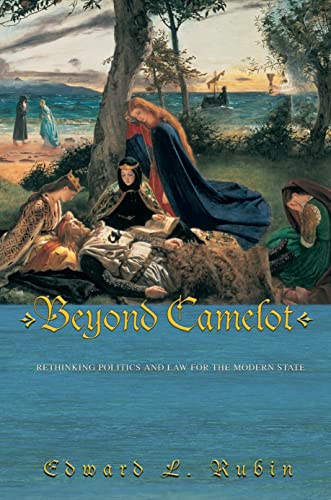
This book argues that many of the basic concepts that we use to describe and analyze our governmental system are out of date. Developed in large part during the Middle Ages, they fail to confront the administrative character of modern government. These concepts, which include power, discretion, democracy, legitimacy, law, rights, and property, bear the indelible imprint of this bygone era's attitudes, and Arthurian fantasies, about governance. As a result, they fail to provide us with the tools we need to understand, critique, and improve the government we actually possess. Beyond Camelot explains the causes and character of this failure, and then proposes a new conceptual framework, drawn from management science and engineering, which describes our administrative government more accurately, and identifies its weaknesses instead of merely bemoaning its modernity. This book's proposed framework envisions government as a network of connected units that are authorized by superior units and that supervise subordinate ones. Instead of using inherited, emotion-laden concepts like democracy and legitimacy to describe the relationship between these units and private citizens, it directs attention to the particular interactions between these units and the citizenry, and to the mechanisms by which government obtains its citizens' compliance. Instead of speaking about law and legal rights, it proposes that we address the way that the modern state formulates policy and secures its implementation. Instead of perpetuating outdated ideas that we no longer really believe about the sanctity of private property, it suggests that we focus on the way that resources are allocated in order to establish markets as our means of regulation. Highly readable, Beyond Camelot offers an insightful and provocative discussion of how we must transform our understanding of government to keep pace with the transformation that government itself has undergone.
Die Inhaltsangabe kann sich auf eine andere Ausgabe dieses Titels beziehen.
Über die Autorin bzw. den Autor
Edward L. Rubin is dean of Vanderbilt University Law School. He is the author of Judicial Policymaking and the Modern State: How the Courts Reformed America's Prisons and Federalism: A Theoretical Inquiry, both with Malcolm Feeley. He has served as a legal consultant to the Russian Federation and the People's Republic of China.
Auszug. © Genehmigter Nachdruck. Alle Rechte vorbehalten.
Beyond Camelot
Rethinking Politics and Law for the Modern StateBy Edward L. RubinPrinceton University Press
Copyright © 2005 Princeton University PressAll right reserved.
ISBN: 978-0-691-13397-3
Chapter One
INTRODUCTIONThe Thesis
Social Nostalgia
OVER the course of the last two centuries, we have developed a new mode of governance-the administrative state-and it makes us feel miserable. We rail at the bloated bulk and dreary pragmatism of our public institutions. We condemn the uninspired, cumbersome rigidity that, despite such pragmatism, makes those institutions ineffective. We yearn for times that were not only simpler but more joyous and more integrated, when our individual experience was directly connected to the collectivity and we inhabited a political world that was suffused with moral values. This set of attitudes can be described as social nostalgia.
Social nostalgia pervades both our political and our popular culture. Citizens complain that government has become too large, too bureaucratic, too remote. Politicians, even when they are incumbents, regularly campaign against the prevailing administration, promising to restore the virtues of some prior period, to bring the government "closer to the people," or to "return to normalcy." In the movies, anyone with an ordinary administrative role-an office supervisor, university dean, or government official-is either an actual villain or, at the very least, an impediment to justice and good sense. How often have we seen our hero, a police officer, for example, slam his badge down on the captain's desk and say, "I've had it with your rules; now I'm going to take care of things myself." Indeed, the romance of life outside the administrative state rivals sex and violence as the dominant theme in contemporary cinema. The Wild West, the Middle Ages, the urban ghetto, outer space, and Earth after a nuclear or environmental holocaust all serve as settings where heroism and adventure flourish in the absence of bureaucracy. One might imagine that the planetary and interplanetary regimes in Star Wars would require a good deal more administrative resources than the small segments of our own planet that constitute contemporary nation-states, yet planets are ruled by queens and princesses, the evil intergalactic empire is controlled by Darth Vader's personal commands, and political conflicts are resolved by individual combat between opposing leaders.
The thesis of this book is that many of the basic concepts that we use to describe our current government are the products of social nostalgia. The three branches of government, power and discretion, democracy, legitimacy, law, legal rights, human rights, and property are all ideas that originated in pre-administrative times and that derive much of their continuing appeal from their outdated origins. Of course, they are sedimented with many centuries of subsequent thought, and are so central to our prevailing theories that they themselves have become causal factors, structuring our institutions and our interactions. But in the final analysis, it will be argued, these concepts are simply not the most useful or meaningful ones that we could find to describe contemporary government. Our thoughts fare like Miniver Cheevy, who "grew lean while he assailed the seasons." They reveal an abiding distaste for our current situation, a distaste that is sufficiently profound that we have difficulty confronting the reality of the government we actually possess.
Social nostalgia may seem like an odd notion, almost an oxymoron. The term 'nostalgia' generally refers to an individual experience, the longing that people feel for some previous period in their lives. It is often ascribed to the experience of loss-a village destroyed, a neighborhood transformed, a baseball team transferred. Nostalgia of this sort can be a collective phenomenon if a group of people share the same experience, such as the conquest of their homeland by a foreign power. Raymond Williams notes a permanent pastoralism in English literary culture, as each generation mourned the loss of the rural world that its members knew in their own childhoods.
But the social nostalgia that generates our collective yearning for the pre-administrative state seems different, since no living person who has grown up in a contemporary Western nation can remember any different mode of governance. It must be based instead on a collective memory, in Maurice Halbwachs's terms, an image of some prior era that is preserved and yet constructed by the written texts and continuing traditions of society. Such memories are common, but they are not self-activating; history also provides numerous examples of texts discarded, traditions abandoned, and entire epochs or social experiences consigned to oblivion. Our present yearning for the pre-administrative past seems motivated by our collective dissatisfaction with the particular system of governance that we have created, and in which we find ourselves inextricably immersed.
One should not imagine, however, that social nostalgia is a unique affliction of these unpoetic, overcomplicated times, or that in other eras, when the world was younger, people were better integrated and more optimistic. That would be social nostalgia. People always feel that their era is the oldest in the world-as indeed it always is-that life is dreary, and that the difficulties they confront are particularly severe. Their yearning for the past regularly dominates the present, dictating taste in art and architecture, and teaching virtue through archaic, misinterpreted examples. For the entirety of the past millennium, images of classical antiquity have held the Western world in thrall; Burckhardt found this to be the defining mentality of the fifteenth and sixteenth centuries, Charles Homer Haskins then identified it as equally central to the twelfth century, and R. W. Southern discovered the same inclination, albeit in somewhat more diluted form, in the tenth and eleventh centuries. The stranglehold of classical antiquity was partially broken in the nineteenth century, and then only because it was displaced by a newfound yearning for the Middle Ages-those same Middle Ages that had themselves been yearning for antiquity. Similar attitudes, of course, prevailed in antiquity itself. The Imperial Romans, the Republican Romans, the Hellenistic Greeks, even the Periclean Greeks were all persuaded of their own degeneracy. If we go back to the very dawn of the written tradition in the West, the time when, by all subsequent accounts, the world was young, we find this same ever-unrequited yearning. In the eighth century B.C., Works and Days, Hesiod's famous tantrum against his deadbeat brother, recounted four long eras that precede the present one, with golden people who never age and obtain food without working, silver people who enjoy a hundred-year-long childhood, bronze people made out of ash trees who have no need for agriculture, and "the godly race of the heroes who are called demigods," all of this leading up to Hesiod's own iron age, where people "will never cease from toil and misery by day or night, in constant distress, and the gods will give them harsh troubles."
In a sense, then, the particular era that serves as the source of social nostalgia is irrelevant to the phenomenon itself; people will always find some prior period, whether real or imaginary, which they can use to flagellate the present. But in another sense, the choice is an important one, for the specific features of a prior, partially or entirely imagined past both reveal and influence the...
„Über diesen Titel“ kann sich auf eine andere Ausgabe dieses Titels beziehen.
Suchergebnisse für Beyond Camelot: Rethinking Politics and Law for the...

Beispielbild für diese ISBN
Beyond Camelot
Anbieter: PBShop.store US, Wood Dale, IL, USA
Verkäuferbewertung 5 von 5 Sternen

PAP. Zustand: New. New Book. Shipped from UK. Established seller since 2000. Artikel-Nr. WP-9780691133973
Beispielbild für diese ISBN
Beyond Camelot
Anbieter: PBShop.store UK, Fairford, GLOS, Vereinigtes Königreich
Verkäuferbewertung 5 von 5 Sternen
PAP. Zustand: New. New Book. Shipped from UK. Established seller since 2000. Artikel-Nr. WP-9780691133973
Neu kaufen
EUR 59,54
EUR 6,84 Versand
Versand von Vereinigtes Königreich nach USA
Versand von Vereinigtes Königreich nach USA
Anzahl: 1 verfügbar
Beispielbild für diese ISBN
Beyond Camelot: Rethinking Politics and Law for the Modern State
Anbieter: Kennys Bookstore, Olney, MD, USA
Verkäuferbewertung 5 von 5 Sternen
Zustand: New. Argues that many of the basic concepts that we use to describe and analyze our governmental system are out of date. This work explains the causes and character of this failure, and then proposes a new conceptual framework, which describes our administrative government, and identifies its weaknesses instead of merely bemoaning its modernity. Num Pages: 496 pages, black & white illustrations. BIC Classification: JPA. Category: (P) Professional & Vocational; (U) Tertiary Education (US: College). Dimension: 159 x 234 x 33. Weight in Grams: 774. . 2007. Paperback. . . . . Books ship from the US and Ireland. Artikel-Nr. V9780691133973
Neu kaufen
EUR 66,16
EUR 9,03 Versand
Versand innerhalb von USA
Versand innerhalb von USA
Anzahl: 1 verfügbar
Beispielbild für diese ISBN
Beyond Camelot: Rethinking Politics and Law for the Modern State
Anbieter: Ria Christie Collections, Uxbridge, Vereinigtes Königreich
Verkäuferbewertung 5 von 5 Sternen
Zustand: New. In English. Artikel-Nr. ria9780691133973_new
Neu kaufen
EUR 64,79
EUR 13,15 Versand
Versand von Vereinigtes Königreich nach USA
Versand von Vereinigtes Königreich nach USA
Anzahl: 1 verfügbar
Beispielbild für diese ISBN
Beyond Camelot Rethinking Politics and Law for the Modern State
Anbieter: Revaluation Books, Exeter, Vereinigtes Königreich
Verkäuferbewertung 5 von 5 Sternen
Paperback. Zustand: Brand New. 471 pages. 9.00x6.00x1.25 inches. In Stock. Artikel-Nr. x-0691133972
Neu kaufen
EUR 101,29
EUR 14,56 Versand
Versand von Vereinigtes Königreich nach USA
Versand von Vereinigtes Königreich nach USA
Anzahl: 2 verfügbar