
Verwandte Artikel zu When Computers Were Human
Inhaltsangabe
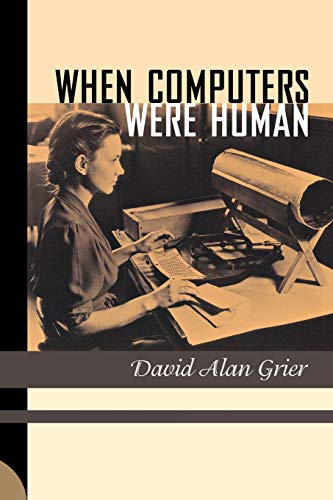
Before Palm Pilots and iPods, PCs and laptops, the term "computer" referred to the people who did scientific calculations by hand. These workers were neither calculating geniuses nor idiot savants but knowledgeable people who, in other circumstances, might have become scientists in their own right. When Computers Were Human represents the first in-depth account of this little-known, 200-year epoch in the history of science and technology. Beginning with the story of his own grandmother, who was trained as a human computer, David Alan Grier provides a poignant introduction to the wider world of women and men who did the hard computational labor of science. His grandmother's casual remark, "I wish I'd used my calculus," hinted at a career deferred and an education forgotten, a secret life unappreciated; like many highly educated women of her generation, she studied to become a human computer because nothing else would offer her a place in the scientific world. The book begins with the return of Halley's comet in 1758 and the effort of three French astronomers to compute its orbit. It ends four cycles later, with a UNIVAC electronic computer projecting the 1986 orbit. In between, Grier tells us about the surveyors of the French Revolution, describes the calculating machines of Charles Babbage, and guides the reader through the Great Depression to marvel at the giant computing room of the Works Progress Administration. When Computers Were Human is the sad but lyrical story of workers who gladly did the hard labor of research calculation in the hope that they might be part of the scientific community. In the end, they were rewarded by a new electronic machine that took the place and the name of those who were, once, the computers.
Die Inhaltsangabe kann sich auf eine andere Ausgabe dieses Titels beziehen.
Über die Autorin bzw. den Autor
David Alan Grier is Associate Professor in the Center for International Science and Technology Policy at George Washington University. His articles on the history of science have appeared in the American Mathematical Monthly, Chance, the Christian Science Monitor, and the Washington Post. He is Editor in Chief of the IEEE Annals of the History of Computing. Long before he learned that his grandmother had been trained as a human computer, he absorbed the methods of programming the electronic computer from his father, who was a scientific computing specialist for the Burroughs Corporation.
Von der hinteren Coverseite
"When Computers Were Human is a detailed and fascinating look at a world I had not even known existed. After reading these accounts of ingenuity, determination, and true creative breakthrough, readers will look at today's computer-based society in an entirely different way."--James Fallows, National Correspondent, Atlantic Monthly
"How did the lives of people and the lives of numbers become so intimately entwined? David Alan Grier's authoritative, engaging, and richly detailed account of this neglected chapter in the history (and prehistory) of computing abounds with remarkable characters, sheds long-awaited light on their achievements, and could not have been better told."--George Dyson, author of Darwin among the Machines
"The story of computation before the invention of the computer is an important one--one that has not been told in this way before. This narrative grabs you right from the first page. Grier tells the human story behind some of the greatest scientific accomplishments, and tells it in a very readable way."--Michael R. Williams, Head Curator, Computer History Museum
"The history of the electronic computer has become the topic of a fair amount of scholarly work, and yet the wonderful story of the (collective) human computer has barely been noticed. This book will appeal both to an appreciable range of scholars and to more general readers. The style is pleasant and informal; the mathematics, accessible and interesting."--Theodore M. Porter, author of Trust in Numbers: The Pursuit of Objectivity in Science and Public Life
Auszug. © Genehmigter Nachdruck. Alle Rechte vorbehalten.
When Computers Were Human
By David Alan GrierPrinceton University Press
Copyright © 2005 Princeton University PressAll right reserved.
ISBN: 978-0-691-13382-9
Introduction
A GRANDMOTHER'S SECRET LIFE
After a while nothing matters ... any more than these little things, that used to be necessary and important to forgotten people, and now have to be guessed at under a magnifying glass and labeled: "Use unknown." Edith Wharton, The Age of Innocence (1920)
IT BEGAN with a passing remark, a little comment, a few words not understood, a confession of a secret life. On a cold winter evening, now many years ago, I was sharing a dinner with my grandmother. I was home from graduate school, full of myself and confident of the future. We sat at a small table in her kitchen, eating foods that had been childhood favorites and talking about cousins and sisters and aunts and uncles. There was much to report: marriages and great-grandchildren, new homes and jobs. As we cleared the dishes, she became quiet for a moment, as if she were lost in thought, and then turned to me and said, "You know, I took calculus in college."
I'm certain that I responded to her, but I could not have said anything beyond "Oh really" or "How interesting" or some other empty phrase that allowed the conversation to drift toward another subject and lose the opportunity of the moment. In hindsight, her statement was every bit as strange and provocative as if she had said that she'd fought with the Loyalists in the Spanish Civil War or had spent her youth dealing baccarat at Monte Carlo. Yet, at that instant, I could not recognize that she had told me something unusual. I studied with many women who had taken calculus and believed they would have careers in the mathematical sciences like my intended career. I did not stop to consider that only a few women of my grandmother's generation had even attended college and that fewer still had ever heard of calculus.
My grandmother's comment was temporarily ignored, but it was not lost. It came rushing back into my thoughts, some six or seven years later, as I was sitting in a mathematics seminar. Such events are often conducive to reflection, and this occasion promised plenty of opportunity to think about other subjects. The speaker, a wild-haired, ill-clad academic, was discussing a new mathematical theory with allegedly important applications that were far more abstract than the theory itself. As I was helping myself to tea and cookies, a staple of mathematical talks, I caught a remark from a senior professor. I had always admired this individual, for he had the ability to sleep during the boring parts of seminars and still catch enough of the material to ask deep and penetrating questions during the discussion period. This professor, who had recently retired, was describing his early days at the university during the Great Depression of the 1930s. Having just arrived in the United States from his native Poland and knowing only rudimentary English, he was assigned to teach the engineering calculus course. "This," he stated with a flourish, "was the first time that calculus was required of engineering students at the university." As I listened to his story, I heard my grandmother's phrase from that night long before. "You know, I took calculus in college." I did not know when she had attended college, but having heard my mother's stories of the Depression, I was certain it would have been before 1930. As I settled into my chair, I started to ponder what my grandmother had said. For the next hour, I was lost in my own thoughts and oblivious to the talk, which proved to be the best seminar of the term. During the discussion period, I was asking myself the questions I should have raised at that dinner years before: Where had my grandmother attended college? What courses had she taken? What had she hoped to learn from calculus?
By then, it was too late to ask these questions. My grandmother was gone, and no one knew much about her early life. My mother believed that my grandmother had studied to be an accountant or an actuary. My uncle thought that my grandmother had taken some bookkeeping classes. Our family genealogist, a distant cousin who seemed to know everything about our relations, expressed her opinion that my grandmother's family had been too poor to send her to college. Still bothered by that one phrase, I decided to see what I could learn. My grandmother had been raised in Ann Arbor, the home of the University of Michigan. So one day, I called the college registrar and asked if she had a transcript for my grandmother. I tried to use a tone of voice to suggest that it was the most natural thing in the world for a grandson to review his grandmother's college grades, rather than the other way around. With surprisingly little hesitation, the registrar agreed to my request and left the phone. In a few minutes, she returned and said, "I have her records here."
Catching my breath, I asked, "When did she graduate?"
"Nineteen twenty-one," the registrar responded.
"What was her major?" was my next question.
After a moment of shuffling paper, she replied, "Mathematics."
Three weeks later, I was sitting at a long library table with a little gray box that contained the university's record of my grandmother's life. As I worked through her transcript and the course record books, I was surprised but pleased to see that she had taken a rigorous program of study. In all, she had taken about two-thirds of the mathematics courses that I had taken as an undergraduate, and she had studied with several well-known mathematicians of the 1920s. The professors' record books were particularly intriguing, for they contained little notes that hinted at the activity and turmoil outside the classroom. One mentioned the male students who had left for the First World War; another recorded that he had devoted part of the term to analyzing ballistics problems; a third mentioned that two students had died in the influenza epidemic.
Perhaps the most surprising revelation was the fact that my grandmother was not the only female mathematics student. Of the twelve students who had taken a mathematics degree in 1921, six of them, including my grandmother, were women. The University of Michigan was more progressive than the Ivy League schools, but its liberalism had limits. About a quarter of the university student body was female, but the school provided no dormitory for women and barred them from the student union building, as it was attached to a men's residence hall. University officials also discouraged women from studying medicine, business, engineering, physics, biology, and chemistry. For women with scientific interests, the mathematics department was about the only division of the school that welcomed them. Much of this welcome was provided by a single professor, James W. Glover (1868-1941), who served as the advisor to my grandmother and most of her female peers.
Glover was an applied mathematician, an expert in the mathematics of finance, insurance, and governance. He had been employed as an actuary for Michigan's Teacher Retirement fund, had held the presidency of Andrew Carnegie's Teachers Insurance and Annuity Association, and, in the early years of the century, had served as a member of the Progressive Party's "brain trust," the circle of academic advisors to the party leader, Robert La Follette. Within the University of Michigan, Glover was an advocate for women's education, though he was at least partly motivated by a desire to increase enrollments in mathematics courses. He welcomed women to his classes, encouraged them to...
„Über diesen Titel“ kann sich auf eine andere Ausgabe dieses Titels beziehen.
Suchergebnisse für When Computers Were Human

Beispielbild für diese ISBN
When Computers Were Human
Verlag:
Princeton University Press, 2007
ISBN 10: 0691133824
ISBN 13: 9780691133829
Gebraucht
Paperback
Anbieter: World of Books (was SecondSale), Montgomery, IL, USA
Verkäuferbewertung 5 von 5 Sternen

Paperback. Zustand: Good. Offers an introduction to the world of women and men who did the hard computational labor of science. This book tells us about the surveyors of the French Revolution, describes the calculating machines of Charles Babbage, and guides readers through the Great Depression to marvel at the giant computing room of the Works Progress Administration. Artikel-Nr. 00110060190
Gebraucht kaufen
EUR 33,64
Versand gratis
Versand innerhalb von USA
Versand innerhalb von USA
Anzahl: 1 verfügbar
Beispielbild für diese ISBN
When Computers Were Human
Anbieter: PBShop.store UK, Fairford, GLOS, Vereinigtes Königreich
Verkäuferbewertung 5 von 5 Sternen
PAP. Zustand: New. New Book. Shipped from UK. Established seller since 2000. Artikel-Nr. WP-9780691133829
Neu kaufen
EUR 53,45
EUR 5,99 Versand
Versand von Vereinigtes Königreich nach USA
Versand von Vereinigtes Königreich nach USA
Anzahl: 3 verfügbar
Beispielbild für diese ISBN
When Computers Were Human
Anbieter: Kennys Bookstore, Olney, MD, USA
Verkäuferbewertung 5 von 5 Sternen
Zustand: New. Offers an introduction to the world of women and men who did the hard computational labor of science. This book tells us about the surveyors of the French Revolution, describes the calculating machines of Charles Babbage, and guides readers through the Great Depression to marvel at the giant computing room of the Works Progress Administration. Num Pages: 424 pages, 50 halftones. BIC Classification: PDR; PDX; TBX; UYZ. Category: (P) Professional & Vocational; (U) Tertiary Education (US: College). Dimension: 233 x 160 x 23. Weight in Grams: 622. . 2007. Paperback. . . . . Books ship from the US and Ireland. Artikel-Nr. V9780691133829
Neu kaufen
EUR 60,05
EUR 9,36 Versand
Versand innerhalb von USA
Versand innerhalb von USA
Anzahl: 1 verfügbar
Beispielbild für diese ISBN
When Computers Were Human
Anbieter: Ria Christie Collections, Uxbridge, Vereinigtes Königreich
Verkäuferbewertung 5 von 5 Sternen
Zustand: New. In English. Artikel-Nr. ria9780691133829_new
Neu kaufen
EUR 76,48
EUR 13,46 Versand
Versand von Vereinigtes Königreich nach USA
Versand von Vereinigtes Königreich nach USA
Anzahl: Mehr als 20 verfügbar
Beispielbild für diese ISBN
When Computers Were Human
Anbieter: Revaluation Books, Exeter, Vereinigtes Königreich
Verkäuferbewertung 5 von 5 Sternen
Paperback. Zustand: Brand New. illustrated edition. 424 pages. 9.00x6.00x1.00 inches. In Stock. Artikel-Nr. x-0691133824
Neu kaufen
EUR 87,96
EUR 14,91 Versand
Versand von Vereinigtes Königreich nach USA
Versand von Vereinigtes Königreich nach USA
Anzahl: 2 verfügbar