
Verwandte Artikel zu Baseball in Blue and Gray: The National Pastime during...
Inhaltsangabe
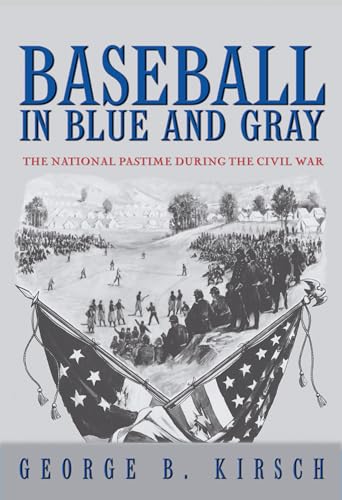
During the Civil War, Americans from homefront to battlefront played baseball as never before. While soldiers slaughtered each other over the country's fate, players and fans struggled over the form of the national pastime. George Kirsch gives us a color commentary of the growth and transformation of baseball during the Civil War. He shows that the game was a vital part of the lives of many a soldier and civilian--and that baseball's popularity had everything to do with surging American nationalism. By 1860, baseball was poised to emerge as the American sport. Clubs in northeastern and a few southern cities played various forms of the game. Newspapers published statistics, and governing bodies set rules. But the Civil War years proved crucial in securing the game's place in the American heart. Soldiers with bats in their rucksacks spread baseball to training camps, war prisons, and even front lines. As nationalist fervor heightened, baseball became patriotic. Fans honored it with the title of national pastime. War metaphors were commonplace in sports reporting, and charity games were scheduled. Decades later, Union general Abner Doubleday would be credited (wrongly) with baseball's invention. The Civil War period also saw key developments in the sport itself, including the spread of the New York-style of play, the advent of revised pitching rules, and the growth of commercialism. Kirsch recounts vivid stories of great players and describes soldiers playing ball to relieve boredom. He introduces entrepreneurs who preached the gospel of baseball, boosted female attendance, and found new ways to make money. We witness bitterly contested championships that enthralled whole cities. We watch African Americans embracing baseball despite official exclusion. And we see legends spring from the pens of early sportswriters. Rich with anecdotes and surprising facts, this narrative of baseball's coming-of-age reveals the remarkable extent to which America's national pastime is bound up with the country's defining event.
Die Inhaltsangabe kann sich auf eine andere Ausgabe dieses Titels beziehen.
Über die Autorin bzw. den Autor
George B. Kirsch is Professor of History at Manhattan College and the author of several books, including The Creation of American Team Sports. He is the editor of two volumes of Sports in North America: A Documentary History and the general editor of the Encyclopedia of Ethnicity and Sports in the United States.
Von der hinteren Coverseite
"This fine social history tells a very powerful story, and one that will stir a lot of interest. It is full of lively analysis and overflowing with fascinating research. The author has done a splendid job of putting his material into an enticing format that draws the reader into an absorbing narrative. He makes a compelling case that the stories of baseball and the epic of the Civil War were inextricably bound."--Catherine Clinton, author of Fanny Kembel's Civil Wars
"This book, written in a straightforward and accessible style, is clearly the most complete book on baseball in the Civil War era yet written."--Jules Tygiel, author of Past Time: Baseball as History
"This is an impressive work on Civil War baseball that shows a sport developing and growing even as war raged--a testament to the popularity of the game. Kirsch recounts the stories of the early players who answered the call for service, does a fine and honest job of discussing the baseball-in-prison issue, and covers the early history of the game itself in a pleasing manner."--Randy Roberts, author of John Wayne America
Auszug. © Genehmigter Nachdruck. Alle Rechte vorbehalten.
Baseball in Blue and Gray
The National Pastime During the Civil WarBy George B. KirschPrinceton University Press
Copyright © 2006 Princeton University PressAll right reserved.
ISBN: 978-0-691-13043-9
Chapter One
THE RISE OF BASEBALLIn Albert G. Spalding's classic early history and celebration of baseball, America's National Game, he included a long newspaper description of the game as it was played by country boys long before the time of Doubleday or the Knickerbockers. The author of the story, undated from the Memphis Appeal, recalled that on Saturday afternoons "the neighborhood boys met on some cropped pasture, and whether ten or forty, every one was to take part in the game." He explained that "self-appointed leaders chose sides and whirled a bat that decided who would hit first. The bat was "a stout paddle, with a blade two inches thick and four inches wide." The ball "was usually made on the spot by some boy offering up his woolen socks as an oblation, and these were raveled and wound around a bullet, a handful of strips cut from a rubber overshoe, a piece of cork or almost anything." The field might have four, six, or seven bases, which "were not equidistant, but were marked by any fortuitous rock, or shrub, or depression in the ground where the steers were wont to bellow and paw up the earth." Home plate was "the den." In addition, "there were no masks, or mitts, or protectors. There was no science or chicanery, now called 'head-work.'" The pitcher's object "was to throw a ball that could be hit. The paddleman's object was to hit the ball, and if he struck at it-which he need not do unless he chose-and missed it, the catcher, standing well back, tried to catch it" for an out. After hitting the ball the batsman ran from base to base. "There was no effort to pounce upon a base runner and touch him with the ball. Anyone having the ball could throw it at him, and if it hit him he was 'dead'-almost literally sometimes. If he dodged the ball, he kept on running till the den was reached ... No matter how many players were on a side, each and every one had to be put out." There was no umpire, and "very little wrangling." The score was kept by someone cutting notches in a stick, and "the runs in an afternoon ran into the hundreds."
Before the Civil War there were numerous variations on the rules and customs reported in this reminiscence. Young men in Philadelphia, Boston, and New York City adapted and tried to improve the ball games that city youth and rural boys had enjoyed for generations. In 1831 a few young sportsmen began a new era of Philadelphia ball playing when they crossed the Delaware River for regular contests of "two old cat" at Camden, New Jersey. Before long they had recruited enough players for Saturday afternoon townball, despite being "frequently reproved and censured by their friends for degrading themselves by indulging in such childish amusement." These ball players competed on public grounds, where neither rent nor permission was required, and made their own bats and balls. After another group of townball enthusiasts joined them in 1833, the two formally merged and organized the Olympic Ball Club, drawing up a constitution and field rules to govern their play.
These pioneer athletes were principally merchants and "respectable and well-known citizens of Philadelphia," several of whom later distinguished themselves in their city's business and professional life. They were remembered as a "conservative and temperate body of gentlemen who enjoyed mixing their sports with good conversation, wit, food, and drink." A highlight of each season was the Fourth of July celebration, when their president read the Declaration of Independence and the members sang songs and heard "an address delivered for the perpetuation of the Stars and Stripes." Thus townball displayed an early association between ball play and nationalism that would increase significantly during the Civil War era and well beyond into the twentieth century. That pastime remained popular in the Philadelphia area through the late 1850s, with several clubs in Camden and Germantown joining Philadelphia's Olympics, Excelsiors, and Athletics. There is some evidence that emigrants from the City of Brotherly Love carried their sport to Cincinnati, Ohio, and neighboring towns in northern Kentucky, where townball flourished before the Civil War.
Townball players in the Philadelphia region generally made their own bats and balls and competed according to rules that resembled English rounders. Brief newspaper accounts and box scores suggest that they played with eleven men on a side for either two or eleven innings. All men batted in an inning when only two innings were played. When one out retired a side the game lasted eleven or more innings. They also seemed to have used stakes as bases. Detailed box scores gave the total score, including runs per inning. Typically the victorious team scored at least 75 runs. The box scores also listed statistics for each man for "Fielding" and "How Put Out." The "Fielding" section listed numbers for balls caught on the "fly," on the first "bound," and "behind" (probably tipped balls received by the catcher). The "How Put Out" part listed "fly," "bound," "behind," and also "no balls" and "On Stakes." "No balls" probably counted strikeouts (three missed swings). "On Stakes" likely meant runners put out on the bases, although there is no indication if runners were tagged out or if they were hit with balls thrown at them by fielders.
Yankee varieties of townball were called "base" or "round-ball." In 1856 a Boston enthusiast described that sport as "truly national," a game that "is played by the school boys in every country village in New England, as well as in the parks of many of our New England cities." He continued: "Base used to be a favorite game with the students of the English High and Latin Schools of Boston, a few years ago ... Base is also a favorite game upon the green in front of village school-houses in the country throughout New England; and in this city, on Fast Day ... Boston Common is covered with amateur parties of men and boys playing Base." Boston's truckmen attracted large crowds of spectators, who admired their "supply of muscle that renders them able to outdo all competitors in striking and throwing."
This "Massachusetts game" generally matched sides of eight to fifteen men on a square field with bases or tall stakes (up to five feet high) at each corner. The batter stood midway between first and fourth (home) base and tried to hit a ball "made of yarn, tightly wound round a lump or cork or India rubber, and covered with smooth calf-skin in quarters ... the seams closed snugly, and not raised, lest they should blister the hands of the thrower and catcher." The round bat varied from three to three and a half feet in length and was often "a portion of stout rake or pitchfork handle ... wielded generally in one hand by the muscular young players at the country schools." The pitcher threw the ball swiftly overhand (not underhand, as in the New York version), "with a vigor ... that made it whistle through the air, and stop with a solid smack in the catcher's hands." The receiver had to be able "to catch expertly a swiftly delivered ball, or he would be admonished of his inexpertness by a request from some player to 'butter his fingers'!" The batter could strike the ball in any direction, there being no foul territory. James D'Wolf Lovett recalled that when he played as a boy for a junior club near Boston, batters sometimes shortened up on the bat, grasping it near the middle, "and by a...
„Über diesen Titel“ kann sich auf eine andere Ausgabe dieses Titels beziehen.
Suchergebnisse für Baseball in Blue and Gray: The National Pastime during...

Beispielbild für diese ISBN
Baseball in Blue and Gray: The National Pastime during the Civil War
Verlag:
Princeton University Press, 2007
ISBN 10: 0691130434
ISBN 13: 9780691130439
Gebraucht
Softcover
Anbieter: World of Books (was SecondSale), Montgomery, IL, USA
Verkäuferbewertung 5 von 5 Sternen

Zustand: Acceptable. Item in acceptable condition! Textbooks may not include supplemental items i.e. CDs, access codes etc. Artikel-Nr. 00104628646
Gebraucht kaufen
EUR 4,26
Versand gratis
Versand innerhalb von USA
Versand innerhalb von USA
Anzahl: 1 verfügbar
Beispielbild für diese ISBN
Baseball in Blue and Gray: The National Pastime During the Civil War
Verlag:
Princeton University Press, 2007
ISBN 10: 0691130434
ISBN 13: 9780691130439
Gebraucht
Paperback
Anbieter: ThriftBooks-Phoenix, Phoenix, AZ, USA
Verkäuferbewertung 5 von 5 Sternen
Paperback. Zustand: Very Good. No Jacket. May have limited writing in cover pages. Pages are unmarked. ~ ThriftBooks: Read More, Spend Less. Artikel-Nr. G0691130434I4N00
Gebraucht kaufen
EUR 5,97
Versand gratis
Versand innerhalb von USA
Versand innerhalb von USA
Anzahl: 1 verfügbar
Beispielbild für diese ISBN
Baseball in Blue and Gray: The National Pastime During the Civil War
Verlag:
Princeton University Press, 2007
ISBN 10: 0691130434
ISBN 13: 9780691130439
Gebraucht
Paperback
Anbieter: ThriftBooks-Reno, Reno, NV, USA
Verkäuferbewertung 5 von 5 Sternen
Paperback. Zustand: Very Good. No Jacket. May have limited writing in cover pages. Pages are unmarked. ~ ThriftBooks: Read More, Spend Less. Artikel-Nr. G0691130434I4N00
Gebraucht kaufen
EUR 5,97
Versand gratis
Versand innerhalb von USA
Versand innerhalb von USA
Anzahl: 1 verfügbar
Beispielbild für diese ISBN
Baseball in Blue and Gray: The National Pastime During the Civil War
Verlag:
Princeton University Press, 2007
ISBN 10: 0691130434
ISBN 13: 9780691130439
Gebraucht
Paperback
Anbieter: ThriftBooks-Atlanta, AUSTELL, GA, USA
Verkäuferbewertung 5 von 5 Sternen
Paperback. Zustand: Very Good. No Jacket. May have limited writing in cover pages. Pages are unmarked. ~ ThriftBooks: Read More, Spend Less. Artikel-Nr. G0691130434I4N00
Gebraucht kaufen
EUR 5,97
Versand gratis
Versand innerhalb von USA
Versand innerhalb von USA
Anzahl: 2 verfügbar
Beispielbild für diese ISBN
Baseball in Blue and Gray: The National Pastime During the Civil War
Verlag:
Princeton University Press, 2007
ISBN 10: 0691130434
ISBN 13: 9780691130439
Gebraucht
Paperback
Anbieter: ThriftBooks-Dallas, Dallas, TX, USA
Verkäuferbewertung 5 von 5 Sternen
Paperback. Zustand: Very Good. No Jacket. May have limited writing in cover pages. Pages are unmarked. ~ ThriftBooks: Read More, Spend Less. Artikel-Nr. G0691130434I4N00
Gebraucht kaufen
EUR 5,97
Versand gratis
Versand innerhalb von USA
Versand innerhalb von USA
Anzahl: 1 verfügbar
Beispielbild für diese ISBN
Baseball in Blue and Gray: The National Pastime During the Civil War
Verlag:
Princeton University Press, 2007
ISBN 10: 0691130434
ISBN 13: 9780691130439
Gebraucht
Paperback
Anbieter: ThriftBooks-Atlanta, AUSTELL, GA, USA
Verkäuferbewertung 5 von 5 Sternen
Paperback. Zustand: Good. No Jacket. Pages can have notes/highlighting. Spine may show signs of wear. ~ ThriftBooks: Read More, Spend Less. Artikel-Nr. G0691130434I3N00
Gebraucht kaufen
EUR 5,98
Versand gratis
Versand innerhalb von USA
Versand innerhalb von USA
Anzahl: 1 verfügbar
Beispielbild für diese ISBN
Baseball in Blue and Gray: The National Pastime during the Civil War
Verlag:
Princeton University Press, 2007
ISBN 10: 0691130434
ISBN 13: 9780691130439
Gebraucht
Softcover
Anbieter: Wonder Book, Frederick, MD, USA
Verkäuferbewertung 5 von 5 Sternen
Zustand: Very Good. Very Good condition. A copy that may have a few cosmetic defects. May also contain light spine creasing or a few markings such as an owner's name, short gifter's inscription or light stamp. Artikel-Nr. K03N-01453
Gebraucht kaufen
EUR 6,20
Versand gratis
Versand innerhalb von USA
Versand innerhalb von USA
Anzahl: 2 verfügbar
Beispielbild für diese ISBN
Baseball in Blue and Gray : The National Pastime During the Civil War
Verlag:
Princeton University Press, 2007
ISBN 10: 0691130434
ISBN 13: 9780691130439
Gebraucht
Softcover
Anbieter: Better World Books, Mishawaka, IN, USA
Verkäuferbewertung 5 von 5 Sternen
Zustand: Good. New Ed. Pages intact with minimal writing/highlighting. The binding may be loose and creased. Dust jackets/supplements are not included. Stock photo provided. Product includes identifying sticker. Better World Books: Buy Books. Do Good. Artikel-Nr. 4497979-6
Gebraucht kaufen
EUR 6,34
Versand gratis
Versand innerhalb von USA
Versand innerhalb von USA
Anzahl: 3 verfügbar
Beispielbild für diese ISBN
Baseball in Blue and Gray: The National Pastime during the Civil War
Verlag:
Princeton University Press, 2007
ISBN 10: 0691130434
ISBN 13: 9780691130439
Gebraucht
Paperback
Anbieter: My Dead Aunt's Books, Hyattsville, MD, USA
Verkäuferbewertung 5 von 5 Sternen
Paperback. Zustand: Very Good. 144 p., clean and unmarked; ill.; binding tight; clean pictorial wrapper has only minimal wear, but just enough to keep this from being "like new.". Artikel-Nr. 069803
Gebraucht kaufen
EUR 8,77
EUR 4,74 Versand
Versand innerhalb von USA
Versand innerhalb von USA
Anzahl: 1 verfügbar
Beispielbild für diese ISBN
Baseball in Blue and Gray
Anbieter: PBShop.store US, Wood Dale, IL, USA
Verkäuferbewertung 5 von 5 Sternen
PAP. Zustand: New. New Book. Shipped from UK. Established seller since 2000. Artikel-Nr. WP-9780691130439