
Verwandte Artikel zu Guesstimation: Solving the World's Problems on...
Inhaltsangabe
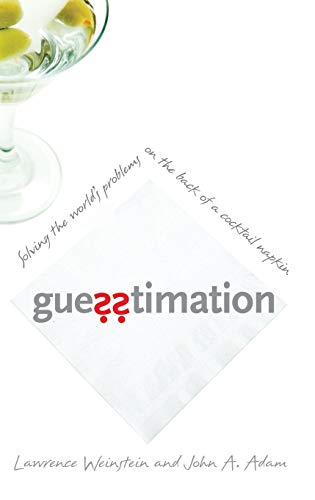
Guesstimation is a book that unlocks the power of approximation--it's popular mathematics rounded to the nearest power of ten! The ability to estimate is an important skill in daily life. More and more leading businesses today use estimation questions in interviews to test applicants' abilities to think on their feet. Guesstimation enables anyone with basic math and science skills to estimate virtually anything--quickly--using plausible assumptions and elementary arithmetic. Lawrence Weinstein and John Adam present an eclectic array of estimation problems that range from devilishly simple to quite sophisticated and from serious real-world concerns to downright silly ones. How long would it take a running faucet to fill the inverted dome of the Capitol? What is the total length of all the pickles consumed in the US in one year? What are the relative merits of internal-combustion and electric cars, of coal and nuclear energy? The problems are marvelously diverse, yet the skills to solve them are the same. The authors show how easy it is to derive useful ballpark estimates by breaking complex problems into simpler, more manageable ones--and how there can be many paths to the right answer. The book is written in a question-and-answer format with lots of hints along the way. It includes a handy appendix summarizing the few formulas and basic science concepts needed, and its small size and French-fold design make it conveniently portable. Illustrated with humorous pen-and-ink sketches, Guesstimation will delight popular-math enthusiasts and is ideal for the classroom.
Die Inhaltsangabe kann sich auf eine andere Ausgabe dieses Titels beziehen.
Über die Autorin bzw. den Autor
Lawrence Weinstein & John A. Adam
Von der hinteren Coverseite
"Guesstimation is a delightful book that, page after page, gleams with insight into the measure of all things--from house pets to lottery tickets and from the kitchen to the cosmos. Meanwhile, the authors cleverly teach you some fundamental chemistry, physics, and biology, leaving you enlightened and curiously comfortable with all that once seemed intractable in the world."--Neil deGrasse Tyson, astrophysicist at the American Museum of Natural History, author of Death by Black Hole: And Other Cosmic Quandaries
"Wow, I suddenly grasped concepts that have eluded me for a lifetime. If you work anywhere in the professional world and are aiming for the corner office, this little book could have significant impact on both your analytical abilities and the way you are perceived by others. An absolute eye-opener!"--Martin Yate, New York Times best-selling author of the Knock 'Em Dead job-search and career-management books
"In a world where we are constantly bombarded with quantitative information (and disinformation) and where implausible factoids become established truths by repetition, acquiring a sound grounding in 'numeric literacy' has almost become a civic duty. Weinstein and Adam show to us that it can also be fun! An extremely useful book--not just for the intelligent layperson, but for virtually everyone: politicians, students, policymakers and, yes, sometimes even physicists."--Riccardo Rebonato, Royal Bank of Scotland, author of Plight of the Fortune Tellers
"As well as giving insight into how scientists think, this book packs in more amazing facts than you could shake a stick at. Learn the technique of 'guesstimation' and you will be able to astound your friends at parties, as well as avoid getting ripped off by misleading advertising claims. You may even be able to work out how many facts you can shake a stick at."--John Gribbin, author of Deep Simplicity: Bringing Order to Chaos and Complexity
"A very interesting and informative work, showing both how important and how easy it can be to estimate magnitudes. This book will amuse you while it instructs."--Gino Segrè, author of A Matter of Degrees
"This is definitely my kind of book. The authors show, using numerous examples, how readers can make numerical estimates of quantities--some absurd and some fascinating--in a wide variety of areas. This is a very useful talent--be it in everyday life, in one's career, or in job interviews."--Robert Ehrlich, author of Eight Preposterous Propositions
"This book will benefit teachers and students in science and engineering, from grade school to college. The problems are well chosen to illustrate increasingly complex themes, culminating in energy conservation, risk assessment, and environmental problems. The solutions are careful, complete, and illuminating. General readers with a taste for mathematical puzzles will enjoy it."--Hans Christian von Baeyer, author of The Fermi Solution
Auszug. © Genehmigter Nachdruck. Alle Rechte vorbehalten.
Guesstimation
By Lawrence Weinstein John A. AdamPrinceton University Press
Copyright © 2008 Princeton University PressAll right reserved.
ISBN: 978-0-691-12949-5
Chapter One
STEP 1: Write down the answer. In other words, come up with a reasonably close solution. This is frequently all the information you need.For example, if it is 250 miles from New York to Boston, how long will it take to drive? You would immediately estimate that it should take about four or five hours, based on an average speed of 50-60 mph. This is enough information to decide whether or not you will drive to Boston for the weekend. If you do decide to drive, you will look at maps or the Internet and figure out the exact route and the exact expected driving time.
Similarly, before you go into a store, you usually know how much you are willing to spend. You might think it is reasonable to spend about $100 on an XGame2. If you see it for $30, you will automatically buy it. If it sells for $300, you will automatically not buy it. Only if the price is around $100 will you have to think about whether to buy it.
We will apply the same reasoning here. We'll try to estimate the answer to within a factor of ten. Why a factor of ten? Because that is good enough to make most decisions.
Once you have estimated the answer to a problem, the answer will fall into one of the three "Goldilocks" categories:
1. too big
2. too small
3. just right
If the answer is too big or too small, then you know what to do (e.g., buy the item, don't drive to Boston). Only if the answer is just right will you need to put more work into solving the problem and refining the answer. (But that's beyond the scope of this book. We just aim to help you estimate the answer to within a factor of ten.)
If all problems were as simple as that, you wouldn't need this book. Many problems are too complicated for you to come up with an immediate correct answer. These problems will need to be broken down into smaller and smaller pieces. Eventually, the pieces will be small enough and simple enough that you can estimate an answer for each one. And so we come to
STEP 2: If you can't estimate the answer, break the problem into smaller pieces and estimate the answer for each one. You only need to estimate each answer to within a factor of ten. How hard can that be?
It is often easier to establish lower and upper bounds for a quantity than to estimate it directly. If we are trying to estimate, for example, how many circus clowns can fit into a Volkswagen Beetle, we know the answer must be more than one and less than 100. We could average the upper and lower bounds and use 50 for our estimate. This is not the best choice because it is a factor of 50 greater than our lower bound and only a factor of two lower than our upper bound.
Since we want our estimate to be the same factor away from our upper and lower bounds, we will use the geometric mean. To take the approximate geometric mean of any two numbers, just average their coefficients and average their exponents. In the clown case, the geometric mean of one ([10.sup.0]) and 100 ([10.sup.2]) is 10 ([10.sup.1]) because one is the average of the exponents zero and two. Similarly, the geometric mean of 2 x [10.sup.15] and 6 x [10.sup.3] is about 4 x [10.sup.9] (because 4 = 2+6/2 and 9 = 15+3/2). If the sum of the exponents is odd, it is a little more complicated. Then you should decrease the exponent sum by one so it is even, and multiply the final answer by three. Therefore, the geometric mean of one and [10.sup.3] is 3 x [10.sup.1] = 30.
EXAMPLE 1: MongaMillions Lottery Ticket Stack
Here's a relatively straightforward example: Your chance of winning the MongaMillions lottery is one in 100 million. If you stacked up all the possible different lottery tickets, how tall would this stack be? Which distance is this closest to: a tall building (100 m or 300 ft), a small mountain (1000 m), Mt Everest (10,000 m), the height of the atmosphere ([10.sup.5] m), the distance from New York to Chicago ([10.sup.6] m), the diameter of the Earth ([10.sup.7] m), or the distance to the moon (4x [10.sup.8]m)? Imagine trying to pick the single winning ticket from a stack this high.
Solution: To solve this problem, we need two pieces of information: the number of possible tickets and the thickness of each ticket. Because your chance of winning is one in 100 million, this means that there are 100 million ([10.sup.8]) possible different tickets. We can't reliably estimate really thin items like a single lottery ticket (is it 1/16 in. or 1/64 in.? is it 1 mm or 0.1 mm?) so let's try to get the thickness of a pack of tickets.
Let's think about packs of paper in general. One ream of copier or printer paper (500 sheets) is about 1.5 to 2 in. (or about 5 cm since 1 in. = 2.5cm) but paper is thinner than lottery tickets. A pack of 52 playing cards is also about 1 cm. That's probably closer. This means that the thickness of one ticket is
t = 1 cm/52 tickets = 0.02 cm/ticket x 1 m/[10.sup.2] cm
= 2 x [10.sup.-4] m/ticket
Therefore, the thickness of [10.sup.8] tickets is
T = 2 x [10.sup.-4] m/ticket x [10.sup.8] tickets = 2 x [10.sup.4] m
2 x [10.sup.4] m is 20 kilometers or 20 km (which is about 15 miles since 1 mi = 1.6km).
If stacked horizontally, it would take you four or five hours to walk that far.
If stacked vertically, it would be twice as high as Mt Everest (30,000 ft or 10 km) and twice as high as jumbo jets fly.
Now perhaps you used the thickness of regular paper so your stack is a few times shorter. Perhaps you used 1 mm per ticket so your stack is a few times taller. Does it really matter whether the stack is 10 km or 50 km? Either way, your chance of pulling the single winning ticket from that stack is pretty darn small.
EXAMPLE 2: Flighty Americans
These problems are great fun because, first, we are not looking for an exact answer, and second, there are many different ways of estimating the answer. Here is a slightly harder question with multiple solutions.
How many airplane flights do Americans take in one year?
We can estimate this from the top down or from the bottom up. We can start with the number of airports or with the number of Americans.
Solution 1: Start with the number of Americans and estimate how many plane flights each of us take per year. There are 3 x [10.sup.8] Americans. Most of us probably travel once a year (i.e., two flights) on vacation or business and a small fraction of us (say 10%) travel much more than that. This means that the number of flights per person per year is between two and four (so we'll use three). Therefore, the total number of flights per year is
N = 3 x [10.sup.8] people x 3 flights/person-year = 9 x [10.sup.8] passengers/year
Solution 2: Start with the number of airports and then estimate the flights per airport and the passengers per flight. There are several reasonable size airports in a medium-sized state (e.g., Virginia has Dulles, Reagan-National, Norfolk, Richmond, and Charlottesville; and Massachusetts has Boston and Springfield). If each of the fifty states has three airports then there are 150 airports in the US. Each airport can handle at most one flight every two minutes, which is 30 flights per hour or 500 flights per 16-hour day. Most airports will have many fewer flights than the maximum. Each airplane can hold between 50 and 250 passengers. This means that we have about
N = 150...
„Über diesen Titel“ kann sich auf eine andere Ausgabe dieses Titels beziehen.
Suchergebnisse für Guesstimation: Solving the World's Problems on...

Beispielbild für diese ISBN
Guesstimation: Solving the World's Problems on the Back of a Cocktail Napkin
Verlag:
Princeton University Press, 2008
ISBN 10: 0691129495
ISBN 13: 9780691129495
Gebraucht
Softcover
Anbieter: World of Books (was SecondSale), Montgomery, IL, USA
Verkäuferbewertung 5 von 5 Sternen

Zustand: Acceptable. Item in acceptable condition! Textbooks may not include supplemental items i.e. CDs, access codes etc. Artikel-Nr. 00098022730
Gebraucht kaufen
EUR 4,43
Versand gratis
Versand innerhalb von USA
Versand innerhalb von USA
Anzahl: 2 verfügbar
Beispielbild für diese ISBN
Guesstimation: Solving the World's Problems on the Back of a Cocktail Napkin
Verlag:
Princeton University Press, 2008
ISBN 10: 0691129495
ISBN 13: 9780691129495
Gebraucht
Softcover
Anbieter: World of Books (was SecondSale), Montgomery, IL, USA
Verkäuferbewertung 5 von 5 Sternen
Zustand: Very Good. Item in very good condition! Textbooks may not include supplemental items i.e. CDs, access codes etc. Artikel-Nr. 00109568328
Gebraucht kaufen
EUR 4,43
Versand gratis
Versand innerhalb von USA
Versand innerhalb von USA
Anzahl: 1 verfügbar
Beispielbild für diese ISBN
Guesstimation: Solving the World's Problems on the Back of a Cocktail Napkin
Verlag:
Princeton University Press, 2008
ISBN 10: 0691129495
ISBN 13: 9780691129495
Gebraucht
Softcover
Anbieter: World of Books (was SecondSale), Montgomery, IL, USA
Verkäuferbewertung 5 von 5 Sternen
Zustand: Good. Item in good condition. Textbooks may not include supplemental items i.e. CDs, access codes etc. Artikel-Nr. 00085389023
Gebraucht kaufen
EUR 4,43
Versand gratis
Versand innerhalb von USA
Versand innerhalb von USA
Anzahl: 12 verfügbar
Beispielbild für diese ISBN
Guesstimation: Solving the World's Problems on the Back of a Cocktail Napkin
Verlag:
Princeton University Press (edition with French flaps), 2008
ISBN 10: 0691129495
ISBN 13: 9780691129495
Gebraucht
Paperback
Anbieter: BooksRun, Philadelphia, PA, USA
Verkäuferbewertung 5 von 5 Sternen
Paperback. Zustand: Very Good. with French flaps. It's a well-cared-for item that has seen limited use. The item may show minor signs of wear. All the text is legible, with all pages included. It may have slight markings and/or highlighting. Artikel-Nr. 0691129495-8-1
Gebraucht kaufen
EUR 4,64
Versand gratis
Versand innerhalb von USA
Versand innerhalb von USA
Anzahl: 1 verfügbar
Beispielbild für diese ISBN
Guesstimation: Solving the World's Problems on the Back of a Cocktail Napkin
Verlag:
Princeton University Press, 2008
ISBN 10: 0691129495
ISBN 13: 9780691129495
Gebraucht
Paperback
Anbieter: ThriftBooks-Atlanta, AUSTELL, GA, USA
Verkäuferbewertung 5 von 5 Sternen
Paperback. Zustand: Good. No Jacket. Pages can have notes/highlighting. Spine may show signs of wear. ~ ThriftBooks: Read More, Spend Less. Artikel-Nr. G0691129495I3N00
Gebraucht kaufen
EUR 5,86
Versand gratis
Versand innerhalb von USA
Versand innerhalb von USA
Anzahl: 1 verfügbar
Beispielbild für diese ISBN
Guesstimation: Solving the World's Problems on the Back of a Cocktail Napkin
Verlag:
Princeton University Press, 2008
ISBN 10: 0691129495
ISBN 13: 9780691129495
Gebraucht
Paperback
Anbieter: ThriftBooks-Dallas, Dallas, TX, USA
Verkäuferbewertung 5 von 5 Sternen
Paperback. Zustand: Good. No Jacket. Pages can have notes/highlighting. Spine may show signs of wear. ~ ThriftBooks: Read More, Spend Less. Artikel-Nr. G0691129495I3N00
Gebraucht kaufen
EUR 5,86
Versand gratis
Versand innerhalb von USA
Versand innerhalb von USA
Anzahl: 1 verfügbar
Beispielbild für diese ISBN
Guesstimation: Solving the World's Problems on the Back of a Cocktail Napkin
Verlag:
Princeton University Press, 2008
ISBN 10: 0691129495
ISBN 13: 9780691129495
Gebraucht
Paperback
Anbieter: ThriftBooks-Reno, Reno, NV, USA
Verkäuferbewertung 5 von 5 Sternen
Paperback. Zustand: Good. No Jacket. Pages can have notes/highlighting. Spine may show signs of wear. ~ ThriftBooks: Read More, Spend Less. Artikel-Nr. G0691129495I3N00
Gebraucht kaufen
EUR 5,86
Versand gratis
Versand innerhalb von USA
Versand innerhalb von USA
Anzahl: 1 verfügbar
Beispielbild für diese ISBN
Guesstimation: Solving the World's Problems on the Back of a Cocktail Napkin
Verlag:
Princeton University Press, 2008
ISBN 10: 0691129495
ISBN 13: 9780691129495
Gebraucht
Paperback
Anbieter: ThriftBooks-Atlanta, AUSTELL, GA, USA
Verkäuferbewertung 5 von 5 Sternen
Paperback. Zustand: As New. No Jacket. Pages are clean and are not marred by notes or folds of any kind. ~ ThriftBooks: Read More, Spend Less. Artikel-Nr. G0691129495I2N00
Gebraucht kaufen
EUR 5,86
Versand gratis
Versand innerhalb von USA
Versand innerhalb von USA
Anzahl: 1 verfügbar
Beispielbild für diese ISBN
Guesstimation : Solving the World's Problems on the Back of a Cocktail Napkin
Verlag:
Princeton University Press, 2008
ISBN 10: 0691129495
ISBN 13: 9780691129495
Gebraucht
Softcover
Anbieter: Better World Books, Mishawaka, IN, USA
Verkäuferbewertung 5 von 5 Sternen
Zustand: Very Good. Former library copy. Pages intact with possible writing/highlighting. Binding strong with minor wear. Dust jackets/supplements may not be included. Includes library markings. Stock photo provided. Product includes identifying sticker. Better World Books: Buy Books. Do Good. Artikel-Nr. 4172777-6
Gebraucht kaufen
EUR 6,46
Versand gratis
Versand innerhalb von USA
Versand innerhalb von USA
Anzahl: 1 verfügbar
Beispielbild für diese ISBN
Guesstimation : Solving the World's Problems on the Back of a Cocktail Napkin
Verlag:
Princeton University Press, 2008
ISBN 10: 0691129495
ISBN 13: 9780691129495
Gebraucht
Softcover
Anbieter: Better World Books, Mishawaka, IN, USA
Verkäuferbewertung 5 von 5 Sternen
Zustand: Good. Pages intact with minimal writing/highlighting. The binding may be loose and creased. Dust jackets/supplements are not included. Stock photo provided. Product includes identifying sticker. Better World Books: Buy Books. Do Good. Artikel-Nr. 3932802-6
Gebraucht kaufen
EUR 6,46
Versand gratis
Versand innerhalb von USA
Versand innerhalb von USA
Anzahl: 1 verfügbar