
Verwandte Artikel zu Promoting Peace With Information: Transparency As a...
Inhaltsangabe
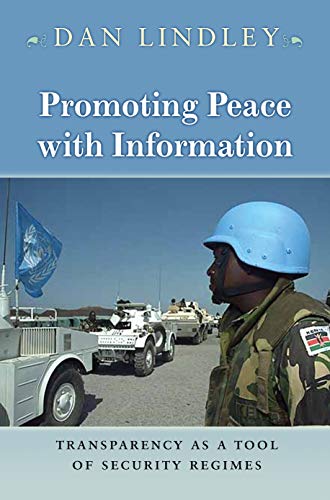
It is normally assumed that international security regimes such as the United Nations can reduce the risk of war by increasing transparency among adversarial nations. The more adversaries understand each other's intentions and capabilities, the thinking goes, the less likely they are to be led to war by miscalculations and unwarranted fears. But how is transparency provided, how does it actually work, and how effective is it in preserving or restoring peace? In Promoting Peace with Information, Dan Lindley provides the first scholarly answer to these important questions.
Lindley rigorously examines a wide range of cases, including U.N. peacekeeping operations in Cyprus, the Golan Heights, Namibia, and Cambodia; arms-control agreements, including the Nuclear Non-Proliferation Treaty; and the historical example of the Concert of Europe, which sought to keep the peace following the defeat of Napoleon in 1815. Making nuanced arguments based on extensive use of primary sources, interviews, and field research, Lindley shows when transparency succeeds in promoting peace, and when it fails. His analysis reveals, for example, that it is surprisingly hard for U.N. buffer-zone monitors to increase transparency, yet U.N. nation-building missions have creatively used transparency to refute harmful rumors and foster democracy.
For scholars, Promoting Peace with Information is a major advance into the relatively uncharted intersection of institutionalism and security studies. For policymakers, its findings will lead to wiser peacekeeping, public diplomacy, and nation building.
Die Inhaltsangabe kann sich auf eine andere Ausgabe dieses Titels beziehen.
Über die Autorin bzw. den Autor
Dan Lindley is Assistant Professor of Political Science and a Fellow at the Joan Kroc Institute for International Peace Studies at the University of Notre Dame.
Von der hinteren Coverseite
"Transparency has received increased theoretical attention, but we need to understand how and when it supports or impedes cooperation among nations.Promoting Peace with Information provides that empirical investigation. Dan Lindley is scrupulously fair in his presentation of case-study materials and his evaluation of his hypotheses. Readers ought to feel they are in sure, capable, and unbiased hands."--Charles Lipson, University of Chicago
"Promoting Peace with Information is a very thorough and careful study of the effects of transparency on cooperation in post-conflict situations. Transparency is a central component of current theories of what makes cooperation possible and of contemporary practice in peacekeeping and conflict resolution, but its effects have seldom been systematically assessed. Dan Lindley makes a real contribution to our understanding of this vital issue."--Andrew Kydd, University of Pennsylvania
Aus dem Klappentext
"Transparency has received increased theoretical attention, but we need to understand how and when it supports or impedes cooperation among nations.Promoting Peace with Information provides that empirical investigation. Dan Lindley is scrupulously fair in his presentation of case-study materials and his evaluation of his hypotheses. Readers ought to feel they are in sure, capable, and unbiased hands."--Charles Lipson, University of Chicago
"Promoting Peace with Information is a very thorough and careful study of the effects of transparency on cooperation in post-conflict situations. Transparency is a central component of current theories of what makes cooperation possible and of contemporary practice in peacekeeping and conflict resolution, but its effects have seldom been systematically assessed. Dan Lindley makes a real contribution to our understanding of this vital issue."--Andrew Kydd, University of Pennsylvania
„Über diesen Titel“ kann sich auf eine andere Ausgabe dieses Titels beziehen.
Suchergebnisse für Promoting Peace With Information: Transparency As a...

Beispielbild für diese ISBN
Promoting Peace with Information: Transparency as a Tool of Security Regimes
Anbieter: Labyrinth Books, Princeton, NJ, USA
Verkäuferbewertung 5 von 5 Sternen

Zustand: New. Artikel-Nr. 127533
Neu kaufen
EUR 33,09
EUR 4,02 Versand
Versand innerhalb von USA
Versand innerhalb von USA
Anzahl: 3 verfügbar
Beispielbild für diese ISBN
Promoting Peace with Information
Anbieter: PBShop.store US, Wood Dale, IL, USA
Verkäuferbewertung 5 von 5 Sternen
HRD. Zustand: New. New Book. Shipped from UK. Established seller since 2000. Artikel-Nr. WP-9780691129433
Beispielbild für diese ISBN
Promoting Peace with Information
Anbieter: PBShop.store UK, Fairford, GLOS, Vereinigtes Königreich
Verkäuferbewertung 5 von 5 Sternen
HRD. Zustand: New. New Book. Shipped from UK. Established seller since 2000. Artikel-Nr. WP-9780691129433
Neu kaufen
EUR 65,36
EUR 5,94 Versand
Versand von Vereinigtes Königreich nach USA
Versand von Vereinigtes Königreich nach USA
Anzahl: 1 verfügbar
Beispielbild für diese ISBN
Promoting Peace with Information: Transparency as a Tool of Security Regimes
Anbieter: Kennys Bookstore, Olney, MD, USA
Verkäuferbewertung 5 von 5 Sternen
Zustand: New. It is normally assumed that international security regimes such as the United Nations can reduce the risk of war by increasing transparency among adversarial nations. But how is transparency provided, how does it actually work, and how effective is it in preserving or restoring peace? This work provides answer to these important questions. Num Pages: 296 pages, 15 tables. BIC Classification: JPS; JWLP. Category: (P) Professional & Vocational; (U) Tertiary Education (US: College). Dimension: 244 x 165 x 26. Weight in Grams: 554. . 2007. Hardcover. . . . . Books ship from the US and Ireland. Artikel-Nr. V9780691129433
Neu kaufen
EUR 81,03
EUR 9,37 Versand
Versand innerhalb von USA
Versand innerhalb von USA
Anzahl: 1 verfügbar
Beispielbild für diese ISBN
Promoting Peace with Information: Transparency as a Tool of Security Regimes
Anbieter: Ria Christie Collections, Uxbridge, Vereinigtes Königreich
Verkäuferbewertung 5 von 5 Sternen
Zustand: New. In English. Artikel-Nr. ria9780691129433_new
Neu kaufen
EUR 84,54
EUR 13,36 Versand
Versand von Vereinigtes Königreich nach USA
Versand von Vereinigtes Königreich nach USA
Anzahl: 1 verfügbar
Beispielbild für diese ISBN
Promoting Peace with Information Transparency as a Tool of Security Regimes
Anbieter: Revaluation Books, Exeter, Vereinigtes Königreich
Verkäuferbewertung 5 von 5 Sternen
Hardcover. Zustand: Brand New. 280 pages. 9.50x6.25x1.00 inches. In Stock. Artikel-Nr. x-0691129436
Neu kaufen
EUR 129,01
EUR 14,79 Versand
Versand von Vereinigtes Königreich nach USA
Versand von Vereinigtes Königreich nach USA
Anzahl: 2 verfügbar
Foto des Verkäufers
Promoting Peace with Information
Anbieter: moluna, Greven, Deutschland
Verkäuferbewertung 5 von 5 Sternen
Gebunden. Zustand: New. It is normally assumed that international security regimes such as the United Nations can reduce the risk of war by increasing transparency among adversarial nations. But how is transparency provided, how does it actually work, and how effective is it in pr. Artikel-Nr. 447030774
Neu kaufen
EUR 96,21
EUR 48,99 Versand
Versand von Deutschland nach USA
Versand von Deutschland nach USA
Anzahl: Mehr als 20 verfügbar
Foto des Verkäufers
Promoting Peace with Information : Transparency as a Tool of Security Regimes
Verlag:
Princeton University Press Mai 2007, 2007
ISBN 10: 0691129436
ISBN 13: 9780691129433
Neu
Hardcover
Anbieter: AHA-BUCH GmbH, Einbeck, Deutschland
Verkäuferbewertung 5 von 5 Sternen
Buch. Zustand: Neu. Neuware - It is normally assumed that international security regimes such as the United Nations can reduce the risk of war by increasing transparency among adversarial nations. The more adversaries understand each other's intentions and capabilities, the thinking goes, the less likely they are to be led to war by miscalculations and unwarranted fears. But how is transparency provided, how does it actually work, and how effective is it in preserving or restoring peace In Promoting Peace with Information, Dan Lindley provides the first scholarly answer to these important questions.Lindley rigorously examines a wide range of cases, including U.N. peacekeeping operations in Cyprus, the Golan Heights, Namibia, and Cambodia; arms-control agreements, including the Nuclear Non-Proliferation Treaty; and the historical example of the Concert of Europe, which sought to keep the peace following the defeat of Napoleon in 1815. Making nuanced arguments based on extensive use of primary sources, interviews, and field research, Lindley shows when transparency succeeds in promoting peace, and when it fails. His analysis reveals, for example, that it is surprisingly hard for U.N. buffer-zone monitors to increase transparency, yet U.N. nation-building missions have creatively used transparency to refute harmful rumors and foster democracy.For scholars, Promoting Peace with Information is a major advance into the relatively uncharted intersection of institutionalism and security studies. For policymakers, its findings will lead to wiser peacekeeping, public diplomacy, and nation building. Artikel-Nr. 9780691129433
Neu kaufen
EUR 129,73
EUR 35,00 Versand
Versand von Deutschland nach USA
Versand von Deutschland nach USA
Anzahl: 1 verfügbar