
Verwandte Artikel zu The Known, the Unknown, and the Unknowable in Financial...
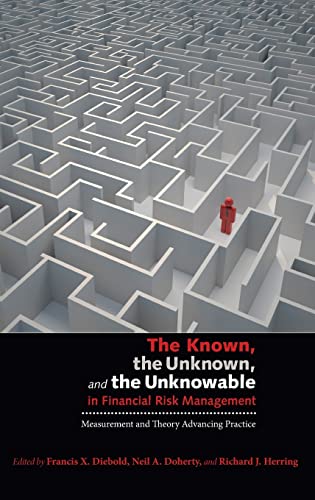
The Known, the Unknown, and the Unknowable in Financial Risk Management: Measurement and Theory Advancing Practice - Hardcover
Inhaltsangabe
A clear understanding of what we know, don't know, and can't know should guide any reasonable approach to managing financial risk, yet the most widely used measure in finance today--Value at Risk, or VaR--reduces these risks to a single number, creating a false sense of security among risk managers, executives, and regulators. This book introduces a more realistic and holistic framework called KuU --the K nown, the u nknown, and the U nknowable--that enables one to conceptualize the different kinds of financial risks and design effective strategies for managing them. Bringing together contributions by leaders in finance and economics, this book pushes toward robustifying policies, portfolios, contracts, and organizations to a wide variety of KuU risks. Along the way, the strengths and limitations of "quantitative" risk management are revealed. In addition to the editors, the contributors are Ashok Bardhan, Dan Borge, Charles N. Bralver, Riccardo Colacito, Robert H. Edelstein, Robert F. Engle, Charles A. E. Goodhart, Clive W. J. Granger, Paul R. Kleindorfer, Donald L. Kohn, Howard Kunreuther, Andrew Kuritzkes, Robert H. Litzenberger, Benoit B. Mandelbrot, David M. Modest, Alex Muermann, Mark V. Pauly, Til Schuermann, Kenneth E. Scott, Nassim Nicholas Taleb, and Richard J. Zeckhauser. Introduces a new risk-management paradigm Features contributions by leaders in finance and economics Demonstrates how "killer risks" are often more economic than statistical, and crucially linked to incentives Shows how to invest and design policies amid financial uncertainty
Die Inhaltsangabe kann sich auf eine andere Ausgabe dieses Titels beziehen.
Über die Autorin bzw. den Autor
Francis X. Diebold is the Paul F. and E. Warren Shafer Miller Professor of Economics at the University of Pennsylvania and professor of finance and statistics at the university's Wharton School. Neil A. Doherty is the Frederick H. Ecker Professor of Insurance and Risk Management at the Wharton School. Richard J. Herring is the Jacob Safra Professor of International Banking and professor of finance at the Wharton School.
Von der hinteren Coverseite
"The financial risk management issues discussed under the KuU framework are highly relevant, and this especially in the light of the subprime credit crisis. Bringing them together in this timely volume will encourage further academic research and remind regulators and practitioners alike first to learn to walk before attempting to run."--Paul Embrechts, RiskLab, ETH Zurich
"This book brings together a series of important and thought-provoking contributions by a group of highly distinguished academics and notable finance practitioners. The organizational principle of the book--theKnown, the unknown, and the Unknowable, orKuU--is as relevant and timely as ever. I highly recommend the book to anybody interested in learning about the latest developments and thinking by some of the leading and most influential minds in the area of modern risk management."--Tim Bollerslev, Duke University
"Diebold, Doherty, and Herring have provided tremendous public service in applying their considerable expertise in risk, insurance, and financial institutions to assemble this fascinating collection of papers on risk management--this book should be required reading for anyone with decision-making authority in the finance and insurance industries, and especially among regulators."--Andrew W. Lo, author ofHedge Funds
"This book tackles the complexities of risk management head-on, directly confronting the full range of issues and challenges that permeate the field. It nicely fills a void by offering up thoughtful and disciplined analysis across highly diverse topics. A truly welcome addition to the burgeoning literature on the theory and practice of risk management."--Torben G. Andersen, Northwestern University
"A very informative, interesting book."--Paul Embrechts, coauthor of Quantitative Risk Management
"Each year when I teach my market risk management class, I have one or two senior risk officers from banks give a talk. At the end of the talk I always ask them: 'So what keeps you awake at night?' The answer is virtually always the same: 'Risks that I do not know about.' This book is therefore extremely important in my view. I thoroughly enjoyed reading it."--Peter Christoffersen, McGill University
"I consider this book one of the best compendiums available today on key risk issues facing the global financial system. These are issues whose resolution will determine the nature of the world financial architecture going forward. They will be actively discussed in the months and years ahead, and this volume represents an invaluable resource in this debate."--Ingo Walter, New York University
Auszug. © Genehmigter Nachdruck. Alle Rechte vorbehalten.
The Known, the Unknown, and the Unknowable in Financial Risk Management
Measurement and Theory Advancing PracticeBy Francis X. Diebold Neil A. Doherty Richard J. HerringPRINCETON UNIVERSITY PRESS
Copyright © 2010 Princeton University PressAll right reserved.
ISBN: 978-0-691-12883-2
Contents
1. Introduction Francis X. Diebold, Neil A. Doherty, and Richard J. Herring...........................................................................................................................12. Risk: A Decision Maker's Perspective Sir Clive W. J. Granger.......................................................................................................................................313. Mild vs. Wild Randomness: Focusing on Those Risks That Matter Benoit B. Mandelbrot and Nassim Nicholas Taleb.......................................................................................474. The Term structure of Risk, the Role of Known and Unknown Risks, and nonstationary Distributions Riccardo Colacito and Robert F. Engle.............................................................595. Crisis and noncrisis Risk in Financial Markets: A Unified Approach to Risk Management Robert H. Litzenberger and David M. Modest...................................................................746. What We Know, Don't Know, and Can't Know about Bank Risk: A View from the Trenches Andrew Kuritzkes and Til Schuermann.............................................................................1037. Real estate through the Ages: The Known, the Unknown, and the Unknowable Ashok Bardhan and Robert H. Edelstein.....................................................................................1458. Reflections on Decision-making under Uncertainty Paul R. Kleindorfer................................................................................................................................1649. On the Role of Insurance Brokers in Resolving the Known, the Unknown, and the Unknowable Neil A. Doherty and Alexander Muermann....................................................................19410. Insuring against Catastrophes Howard Kunreuther and Mark V. Pauly.................................................................................................................................21011. Managing Increased Capital Markets Intensity: The Chief Financial Officer's Role in Navigating the Known, the Unknown, and the Unknowable Charles N. Bralver and Daniel Borge.....................23912. The Role of Corporate Governance in Coping with Risk and Unknowns Kenneth E. Scott................................................................................................................27713. Domestic Banking Problems Charles A. E. Goodhart..................................................................................................................................................28614. Crisis Management: The Known, The Unknown, and the Unknowable Donald L. Kohn......................................................................................................................29615. Investing in the Unknown and Unknowable Richard J. Zeckhauser.....................................................................................................................................304List of Contributors...................................................................................................................................................................................347Index..................................................................................................................................................................................................359
Chapter One
IntroductionFrancis X. Diebold, Neil A. Doherty, and Richard J. Herring
Successful financial risk management requires constant grappling with the known, the unknown and the unknowable ("KuU"). But think of KuU as more than simply an acronym for "the known, the unknown, and the unknowable"; indeed, we think of it as a conceptual framework. We believe that "KuU thinking" can promote improved decision making—helping us to recognize situations of K and u and U and their differences, using different tools in different situations, while maintaining awareness that the boundaries are fuzzy and subject to change.
Perhaps the broadest lesson is recognition of the wide applicability of KuU thinking, and the importance of each of K and u and U. KuU thinking spans all types of financial risk, with the proportion of uU increasing steadily as one moves through market, credit, and operational risks. In addition, KuU thinking spans risk measurement and management in all segments of the financial services industry, including investing, asset management, banking, insurance, and real estate. Finally, KuU thinking spans both the regulated and the regulators: regulators' concerns largely match those of the regulated (risk measurement and management), but with an extra layer of concern for systemic risk.
1.1. KNOWLEDGE AS MEASUREMENT, AND KNOWLEDGE AS THEORY
Knowledge is both measurement and theory. Observed or measured facts about our world have no meaning for us outside our ability to relate them to a conceptual model. For example, the numerous stones we find with what appear to be reverse images of animals and plants would be unremarkable if it were not for their place in our intellectual model of the world we live in. Without the evolutionary theories associated with Darwin, the fossil record would be no more than a collection of pretty stones. And, indeed, without the pretty stones, Darwin may not have conceived his theory.
When we speak of knowledge, there is no bright line that separates our measurements from our theories. Though we may see the deficit at one, or the other, end of the spectrum, knowledge joins phenomenological observations with conceptual structures that organize them in a manner meaningful to our wider human experience. We would argue, for example, that both of the following assertions are true:
When you can measure what you are speaking about, and express it in numbers, you know something about it; but when you cannot measure it, when you cannot express it in numbers, your knowledge is of a meager and unsatisfactory kind: it may be the beginning of knowledge, but you have scarcely, in your thoughts, advanced to the stage of science. Lord Kelvin (Popular Lectures and Addresses, 1891–1894)
The whole machinery of our intelligence, our general ideas and laws, fixed and external object, principles, persons and gods, are so many symbolic, algebraic expressions. They stand for experience, experience which we are incapable of retaining and surveying in its multitudinous immediacy. We should flounder hopelessly, like the animals, did we not keep ourselves afloat and direct our course by these intellectual devices. Theory helps us to bear our ignorance of fact. George Santayana (The Sense of Beauty, 1896).
Thus, if we talk of what is known and what is unknown, we may be referring to the presence or absence of data to corroborate our theories, or to the inability of our theories to provide meaning to the curious phenomena we observe and measure.
For this volume, we have adopted the taxonomy of knowledge used in a famous article by Ralph Gomory (1995). Gomory classifies knowledge into the...
„Über diesen Titel“ kann sich auf eine andere Ausgabe dieses Titels beziehen.
Suchergebnisse für The Known, the Unknown, and the Unknowable in Financial...

Beispielbild für diese ISBN
The Known, the Unknown, and the Unknowable in Financial Risk Management : Measurement and Theory Advancing Practice
Verlag:
Princeton University Press, 2010
ISBN 10: 0691128839
ISBN 13: 9780691128832
Gebraucht
Hardcover
Anbieter: Better World Books, Mishawaka, IN, USA
Verkäuferbewertung 5 von 5 Sternen

Zustand: Very Good. Pages intact with possible writing/highlighting. Binding strong with minor wear. Dust jackets/supplements may not be included. Stock photo provided. Product includes identifying sticker. Better World Books: Buy Books. Do Good. Artikel-Nr. 67463026-75
Gebraucht kaufen
EUR 36,51
Versand gratis
Versand innerhalb von USA
Versand innerhalb von USA
Anzahl: 1 verfügbar
Beispielbild für diese ISBN
The Known, the Unknown, and the Unknowable in Financial Risk Management : Measurement and Theory Advancing Practice
Verlag:
Princeton University Press, 2010
ISBN 10: 0691128839
ISBN 13: 9780691128832
Gebraucht
Hardcover
Anbieter: Better World Books: West, Reno, NV, USA
Verkäuferbewertung 5 von 5 Sternen
Zustand: Good. Pages intact with minimal writing/highlighting. The binding may be loose and creased. Dust jackets/supplements are not included. Stock photo provided. Product includes identifying sticker. Better World Books: Buy Books. Do Good. Artikel-Nr. 7574054-75
Gebraucht kaufen
EUR 36,51
Versand gratis
Versand innerhalb von USA
Versand innerhalb von USA
Anzahl: 1 verfügbar
Beispielbild für diese ISBN
The Known, the Unknown, and the Unknowable in Financial Risk Management : Measurement and Theory Advancing Practice
Verlag:
Princeton University Press, 2010
ISBN 10: 0691128839
ISBN 13: 9780691128832
Gebraucht
Hardcover
Anbieter: Better World Books: West, Reno, NV, USA
Verkäuferbewertung 5 von 5 Sternen
Zustand: Very Good. Pages intact with possible writing/highlighting. Binding strong with minor wear. Dust jackets/supplements may not be included. Stock photo provided. Product includes identifying sticker. Better World Books: Buy Books. Do Good. Artikel-Nr. 67463026-75
Gebraucht kaufen
EUR 36,51
Versand gratis
Versand innerhalb von USA
Versand innerhalb von USA
Anzahl: 1 verfügbar
Beispielbild für diese ISBN
The Known, the Unknown, and the Unknowable in Financial Risk Management: Measurement and Theory Advancing Practice
Verlag:
Princeton University Press, 2010
ISBN 10: 0691128839
ISBN 13: 9780691128832
Gebraucht
Hardcover
Anbieter: ThriftBooks-Dallas, Dallas, TX, USA
Verkäuferbewertung 5 von 5 Sternen
Hardcover. Zustand: Very Good. No Jacket. May have limited writing in cover pages. Pages are unmarked. ~ ThriftBooks: Read More, Spend Less. Artikel-Nr. G0691128839I4N00
Gebraucht kaufen
EUR 38,04
Versand gratis
Versand innerhalb von USA
Versand innerhalb von USA
Anzahl: 1 verfügbar
Beispielbild für diese ISBN
The Known, the Unknown, and the Unknowable in Financial Risk Management: Measurement and Theory Advancing Practice
Anbieter: Labyrinth Books, Princeton, NJ, USA
Verkäuferbewertung 5 von 5 Sternen
Zustand: New. Artikel-Nr. 126020
Neu kaufen
EUR 54,89
EUR 4,00 Versand
Versand innerhalb von USA
Versand innerhalb von USA
Anzahl: 6 verfügbar
Beispielbild für diese ISBN
The Known, the Unknown, and the Unknowable in Financial Risk Management
Anbieter: PBShop.store US, Wood Dale, IL, USA
Verkäuferbewertung 5 von 5 Sternen
HRD. Zustand: New. New Book. Shipped from UK. Established seller since 2000. Artikel-Nr. WP-9780691128832
Beispielbild für diese ISBN
The Known, the Unknown, and the Unknowable in Financial Risk Management
Anbieter: PBShop.store UK, Fairford, GLOS, Vereinigtes Königreich
Verkäuferbewertung 5 von 5 Sternen
HRD. Zustand: New. New Book. Shipped from UK. Established seller since 2000. Artikel-Nr. WP-9780691128832
Neu kaufen
EUR 85,00
EUR 6,91 Versand
Versand von Vereinigtes Königreich nach USA
Versand von Vereinigtes Königreich nach USA
Anzahl: 1 verfügbar
Beispielbild für diese ISBN
The Known, the Unknown, and the Unknowable in Financial Risk Management: Measurement and Theory Advancing Practice
Anbieter: Kennys Bookstore, Olney, MD, USA
Verkäuferbewertung 5 von 5 Sternen
Zustand: New. Introduces a more realistic and holistic framework called KuU - the Known, the unknown, and the Unknowable - that enables one to conceptualize the different kinds of financial risks and design effective strategies for managing them. Editor(s): Diebold, Francis X.; Doherty, Neil A.; Herring, Richard J. Num Pages: 392 pages, 4 halftones. 31 line illus. 23 tables. BIC Classification: GPQD; KJMV1. Category: (P) Professional & Vocational; (U) Tertiary Education (US: College). Dimension: 243 x 166 x 30. Weight in Grams: 730. . 2010. Hardcover. . . . . Books ship from the US and Ireland. Artikel-Nr. V9780691128832
Neu kaufen
EUR 116,51
EUR 9,33 Versand
Versand innerhalb von USA
Versand innerhalb von USA
Anzahl: 1 verfügbar
Beispielbild für diese ISBN
The Known, the Unknown, and the Unknowable in Financial Risk Management: Measurement and Theory Advancing Practice
Anbieter: Ria Christie Collections, Uxbridge, Vereinigtes Königreich
Verkäuferbewertung 5 von 5 Sternen
Zustand: New. In English. Artikel-Nr. ria9780691128832_new
Neu kaufen
EUR 119,94
EUR 13,28 Versand
Versand von Vereinigtes Königreich nach USA
Versand von Vereinigtes Königreich nach USA
Anzahl: 1 verfügbar
Beispielbild für diese ISBN
Known, the Unknown, and the Unknowable in Financ Financial Risk Management Measurement and Theory Advancing Practice
Anbieter: Revaluation Books, Exeter, Vereinigtes Königreich
Verkäuferbewertung 5 von 5 Sternen
Hardcover. Zustand: Brand New. 392 pages. 9.75x6.50x1.25 inches. In Stock. Artikel-Nr. x-0691128839
Neu kaufen
EUR 176,46
EUR 14,71 Versand
Versand von Vereinigtes Königreich nach USA
Versand von Vereinigtes Königreich nach USA
Anzahl: 2 verfügbar