
Inhaltsangabe
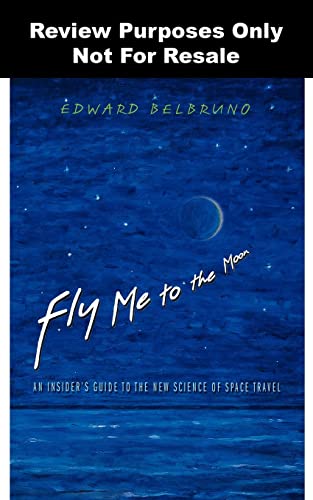
When a leaf falls on a windy day, it drifts and tumbles, tossed every which way on the breeze. This is chaos in action. In Fly Me to the Moon, Edward Belbruno shows how to harness the same principle for low-fuel space travel--or, as he puts it, "surfing the gravitational field."
Belbruno devised one of the most exciting concepts now being used in space flight, that of swinging through the cosmos on the subtle fluctuations of the planets' gravitational pulls. His idea was met with skepticism until 1991, when he used it to get a stray Japanese satellite back on course to the Moon. The successful rescue represented the first application of chaos to space travel and ushered in an emerging new field.
Part memoir, part scientific adventure story, Fly Me to the Moon gives a gripping insider's account of that mission and of Belbruno's personal struggles with the science establishment. Along the way, Belbruno introduces readers to recent breathtaking advances in American space exploration. He discusses ways to capture and redirect asteroids; presents new research on the origin of the Moon; weighs in on discoveries like 2003 UB313 (now named Eris), a dwarf planet detected in the far outer reaches of our solar system--and much more.
Grounded in Belbruno's own rigorous theoretical research but written for a general audience, Fly Me to the Moon is for anybody who has ever felt moved by the spirit of discovery.
Die Inhaltsangabe kann sich auf eine andere Ausgabe dieses Titels beziehen.
Über die Autorin bzw. den Autor
Edward Belbruno is President of Innovative Orbital Design, visiting research collaborator in the Department of Astrophysical Sciences at Princeton University, and a consultant on advanced astrodynamics with NASA. He is the author of Capture Dynamics and Chaotic Motions in Celestial Mechanics (Princeton).
Von der hinteren Coverseite
"Almost fifty years after the beginning of space flight, Belbruno's work offers a realistic beginning for minimum--fuel and maximum--payload trajectories for interplanetary operations. It is a mark of sophistication in the evolution of space travel that simplified solutions to the vexing many-body problem are found to have practical applications. Belbruno's three-body solution for low-thrust minimum-fuel trajectories serves well not only the future of space flight but helps astronomy in understanding the sometimes erratic motions of celestial bodies."--Edgar D. Mitchell, Apollo 14 astronaut
"Fly Me to the Moon is a fast, easy read that explains in simple nonscientific terms very complex matters of celestial mechanics, and it is delightful reading for students and professionals to update or learn very important new background materials. It is also a must-read for the lawyer-scientist."--Ambassador Edward R. Finch, Jr.
"This is an excellent book. The author succeeds in writing an exciting story about his research on low-fuel space travel, a subject that is not widely known but that will interest many readers. Moreover, the mathematical aspects of chaos in the context of space missions is well treated at the level of the nonexpert."--Florin Diacu, University of Victoria
"This is a good story. It is rare to see a nonpedantic book on celestial mechanics that gives some backroom stories about trajectory geeks. Belbruno ties very abstract concepts to real problems and situations."--Wendell W. Mendell, NASA Johnson Space Center, Astromaterials Research & Exploration Science Directorate
"This is an excellent book. It is an inside look at the important new field of chaotic trajectories by one of the masters and originators of the field. As we continue into space, I think we will be hearing more and more about these clever trajectories. Ed Belbruno has covered in a beautiful and interesting way the important applications of chaos to astrophysics and spacecraft trajectories. He also tells a very interesting personal story of his battles to get these trajectories used, and how he was able to save the Hiten spacecraft and get it to the moon. This is a great story, and he tells it very well."--Richard Gott, Princeton University
"The author's newly discovered interplanetary highways offer a romantic reflection of the pre-rocket, pre-airplane era, where balloons would transport us, with hardly any energy of our own, from one unexplored vista to another."--From the foreword by Neil deGrasse Tyson, astrophysicist and Director of the Hayden Planetarium, American Museum of Natural History, author of Death by Black Hole: And Other Cosmic Quandaries
Aus dem Klappentext
"Almost fifty years after the beginning of space flight, Belbruno's work offers a realistic beginning for minimum--fuel and maximum--payload trajectories for interplanetary operations. It is a mark of sophistication in the evolution of space travel that simplified solutions to the vexing many-body problem are found to have practical applications. Belbruno's three-body solution for low-thrust minimum-fuel trajectories serves well not only the future of space flight but helps astronomy in understanding the sometimes erratic motions of celestial bodies."--Edgar D. Mitchell, Apollo 14 astronaut
"Fly Me to the Moon is a fast, easy read that explains in simple nonscientific terms very complex matters of celestial mechanics, and it is delightful reading for students and professionals to update or learn very important new background materials. It is also a must-read for the lawyer-scientist."--Ambassador Edward R. Finch, Jr.
"This is an excellent book. The author succeeds in writing an exciting story about his research on low-fuel space travel, a subject that is not widely known but that will interest many readers. Moreover, the mathematical aspects of chaos in the context of space missions is well treated at the level of the nonexpert."--Florin Diacu, University of Victoria
"This is a good story. It is rare to see a nonpedantic book on celestial mechanics that gives some backroom stories about trajectory geeks. Belbruno ties very abstract concepts to real problems and situations."--Wendell W. Mendell, NASA Johnson Space Center, Astromaterials Research & Exploration Science Directorate
"This is an excellent book. It is an inside look at the important new field of chaotic trajectories by one of the masters and originators of the field. As we continue into space, I think we will be hearing more and more about these clever trajectories. Ed Belbruno has covered in a beautiful and interesting way the important applications of chaos to astrophysics and spacecraft trajectories. He also tells a very interesting personal story of his battles to get these trajectories used, and how he was able to save the Hiten spacecraft and get it to the moon. This is a great story, and he tells it very well."--Richard Gott, Princeton University
"The author's newly discovered interplanetary highways offer a romantic reflection of the pre-rocket, pre-airplane era, where balloons would transport us, with hardly any energy of our own, from one unexplored vista to another."--From the foreword by Neil deGrasse Tyson, astrophysicist and Director of the Hayden Planetarium, American Museum of Natural History, author ofDeath by Black Hole: And Other Cosmic Quandaries
„Über diesen Titel“ kann sich auf eine andere Ausgabe dieses Titels beziehen.
Suchergebnisse für Fly Me to the Moon: An Insider's Guide to the New...

Beispielbild für diese ISBN
Fly Me to the Moon: An Insider's Guide to the New Science of Space Travel
Verlag:
Princeton University Press, 2007
ISBN 10: 0691128227
ISBN 13: 9780691128221
Gebraucht
Hardcover
Anbieter: ThriftBooks-Dallas, Dallas, TX, USA
Verkäuferbewertung 5 von 5 Sternen

Hardcover. Zustand: Good. No Jacket. Pages can have notes/highlighting. Spine may show signs of wear. ~ ThriftBooks: Read More, Spend Less. Artikel-Nr. G0691128227I3N00
Gebraucht kaufen
EUR 6,85
Versand gratis
Versand innerhalb von USA
Versand innerhalb von USA
Anzahl: 1 verfügbar
Beispielbild für diese ISBN
Fly Me to the Moon: An Insider's Guide to the New Science of Space Travel
Verlag:
Princeton University Press, 2007
ISBN 10: 0691128227
ISBN 13: 9780691128221
Gebraucht
Hardcover
Anbieter: ThriftBooks-Dallas, Dallas, TX, USA
Verkäuferbewertung 5 von 5 Sternen
Hardcover. Zustand: Very Good. No Jacket. Former library book; May have limited writing in cover pages. Pages are unmarked. ~ ThriftBooks: Read More, Spend Less. Artikel-Nr. G0691128227I4N10
Gebraucht kaufen
EUR 6,85
Versand gratis
Versand innerhalb von USA
Versand innerhalb von USA
Anzahl: 1 verfügbar
Beispielbild für diese ISBN
Fly Me to the Moon: An Insider's Guide to the New Science of Space Travel
Verlag:
Princeton University Press, 2007
ISBN 10: 0691128227
ISBN 13: 9780691128221
Gebraucht
Hardcover
Anbieter: ThriftBooks-Dallas, Dallas, TX, USA
Verkäuferbewertung 5 von 5 Sternen
Hardcover. Zustand: Very Good. No Jacket. May have limited writing in cover pages. Pages are unmarked. ~ ThriftBooks: Read More, Spend Less. Artikel-Nr. G0691128227I4N00
Gebraucht kaufen
EUR 6,85
Versand gratis
Versand innerhalb von USA
Versand innerhalb von USA
Anzahl: 1 verfügbar
Beispielbild für diese ISBN
Fly Me to the Moon: An Insider's Guide to the New Science of Space Travel
Verlag:
Princeton University Press (edition ), 2007
ISBN 10: 0691128227
ISBN 13: 9780691128221
Gebraucht
Hardcover
Anbieter: BooksRun, Philadelphia, PA, USA
Verkäuferbewertung 5 von 5 Sternen
Hardcover. Zustand: Very Good. With dust jacket. It's a well-cared-for item that has seen limited use. The item may show minor signs of wear. All the text is legible, with all pages included. It may have slight markings and/or highlighting. Artikel-Nr. 0691128227-11-1-29
Gebraucht kaufen
EUR 7,37
Versand gratis
Versand innerhalb von USA
Versand innerhalb von USA
Anzahl: 1 verfügbar
Beispielbild für diese ISBN
Fly Me to the Moon: An Insider's Guide to the New Science of Space Travel
Verlag:
Princeton University Press, 2007
ISBN 10: 0691128227
ISBN 13: 9780691128221
Gebraucht
Hardcover
Anbieter: Heisenbooks, Fairless Hills, PA, USA
Verkäuferbewertung 2 von 5 Sternen

hardcover. Zustand: Very Good. US Hard Cover Very Good Edition. Book is in great condition! Little to no damage present on cover, pages, spine, or corners. Dustcover is included if applicable. An amazing buy! Artikel-Nr. WI-MM-G120437
Gebraucht kaufen
EUR 4,32
EUR 3,41 Versand
Versand innerhalb von USA
Versand innerhalb von USA
Anzahl: 1 verfügbar
Beispielbild für diese ISBN
Fly Me to the Moon; An Insider's Guide to the New Science of Space Travel
Verlag:
Princeton University Press, Princeton, 2007
ISBN 10: 0691128227
ISBN 13: 9780691128221
Gebraucht
Hardcover
Erstausgabe
Anbieter: Ground Zero Books, Ltd., Silver Spring, MD, USA
Verkäuferbewertung 5 von 5 Sternen
Hardcover. Zustand: Very good. Zustand des Schutzumschlags: very good. First Edition, First Printing. xix, [3], 148, [4] pages. Bibliography. Index. Foreword by Neil deGrasse Tyson. Belbruno devised one of the most exciting concepts now being used in space flight, that of swinging through the cosmos on the subtle fluctuations of the planets' gravitational pulls. His idea was met with skepticism until 1991, when he used it to get a stray Japanese satellite back on course to the Moon. The successful rescue represented the first application of chaos to space travel and ushered in an emerging new field. Part memoir, part scientific adventure story, Fly Me to the Moon gives a gripping insider's account of that mission and of Belbruno's personal struggles with the science establishment. Along the way, Belbruno introduces readers to recent breathtaking advances in American space exploration. He discusses ways to capture and redirect asteroids; presents new research on the origin of the Moon; weighs in on discoveries like 2003 UB313 (now named Eris), a dwarf planet detected in the far outer reaches of our solar system--and much more. Grounded in Belbruno's own rigorous theoretical research but written for a general audience, Fly Me to the Moon is for anybody who has ever felt moved by the spirit of discovery. Edward Belbruno (born 1951 in Heidelberg, Germany) is a mathematician whose interests are in celestial mechanics, dynamical systems, dynamical astronomy, and aerospace engineering. Belbruno received his associate degree from Mitchell College, his Bachelor of Science degree in mathematics from New York University and his PhD in mathematics from New York University s Courant Institute in 1981, where his mentor was mathematician J rgen Moser. He was employed by the Jet Propulsion Laboratory from 1985 to 1990 as an orbital analyst on such missions as Galileo, Magellan, Cassini, Ulysses, Mars Observer, and others. During that time, he laid the foundations for the first systematic application of chaos theory to space flight originally called fuzzy boundary theory, which allows for the construction of very low energy paths for spacecraft. In 1990 Belbruno applied his ideas for low energy transfer orbits to the Japanese lunar probe Hiten, which had been designed only for lunar swing-by and had suffered a failure of the Hagoromo lunar orbiter. The main Hiten probe lacked the fuel to enter lunar orbit using a conventional Hohmann transfer trajectory, but Belbruno was able to devise a ballistic capture trajectory that would put it in lunar orbit using only a negligible amount of fuel. The probe entered lunar orbit in 1991, the first time that Belbruno's ideas had been put to the test. Belbruno had first proposed using a low-energy transfer orbit for a JPL probe in 1988. However, he faced a great deal of skepticism, and found himself in conflict with engineers. He had also expected to make no progress on Hiten, but the Japanese proved receptive to his ideas and called ballistic capture an "amazing result." He left JPL in fall of 1990 and took a position at Pomona College. Belbruno is president and founder of the company Innovative Orbital Design, Inc., based in Princeton, New Jersey and holds patents on routes in space. He consulted on the rescue of the Asiasat-3 communications satellite for Hughes, although a different trajectory was ultimately used for the rescue. Belbruno's books include Fly Me to the Moon and Capture Dynamics and Chaotic Motions in Celestial Mechanics. He is a consultant with the National Aeronautics and Space Administration, and has made appearances on NBC's Today Show. He is also an oil painter and has had many international exhibitions of his works, including in Paris, Rome, Los Angeles, Washington DC, New York, Minneapolis, and a painting of his is in NASA s executive collection in Washington, DC. Artikel-Nr. 72229
Gebraucht kaufen
EUR 24,29
EUR 4,29 Versand
Versand innerhalb von USA
Versand innerhalb von USA
Anzahl: 1 verfügbar
Beispielbild für diese ISBN
Fly Me to the Moon An Insider`s Guide to the New Science of Space Travel
Anbieter: Revaluation Books, Exeter, Vereinigtes Königreich
Verkäuferbewertung 5 von 5 Sternen
Hardcover. Zustand: Brand New. illustrated edition. 176 pages. 7.50x5.25x0.75 inches. In Stock. Artikel-Nr. 0691128227
Neu kaufen
EUR 30,91
EUR 11,48 Versand
Versand von Vereinigtes Königreich nach USA
Versand von Vereinigtes Königreich nach USA
Anzahl: 1 verfügbar