
Verwandte Artikel zu Karl Pearson: The Scientific Life in a Statistical...
Inhaltsangabe
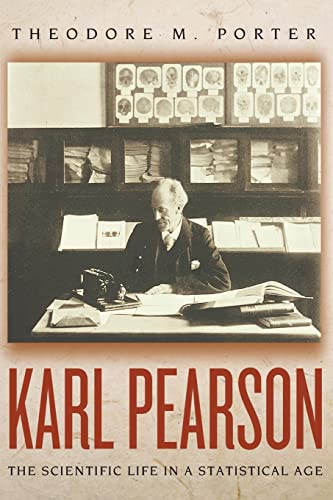
Karl Pearson, founder of modern statistics, came to this field by way of passionate early studies of philosophy and cultural history as well as ether physics and graphical geometry. His faith in science grew out of a deeply moral quest, reflected also in his socialism and his efforts to find a new basis for relations between men and women. This biography recounts Pearson's extraordinary intellectual adventure and sheds new light on the inner life of science. Theodore Porter's intensely personal portrait of Pearson extends from religious crisis and sexual tensions to metaphysical and even mathematical anxieties. Pearson sought to reconcile reason with enthusiasm and to achieve the impersonal perspective of science without sacrificing complex individuality. Even as he longed to experience nature directly and intimately, he identified science with renunciation and positivistic detachment. Porter finds a turning point in Pearson's career, where his humanistic interests gave way to statistical ones, in his Grammar of Science (1892), in which he attempted to establish scientific method as the moral educational basis for a refashioned culture. In this original and engaging book, a leading historian of modern science investigates the interior experience of one man's scientific life while placing it in a rich tapestry of social, political, and intellectual movements.
Die Inhaltsangabe kann sich auf eine andere Ausgabe dieses Titels beziehen.
Über die Autorin bzw. den Autor
Theodore M. Porter
Von der hinteren Coverseite
"Karl Pearson was one of the most significant architects of modern statistics. In this remarkable book, Theodore Porter superbly captures the romance (and seldom has the use of this word been so appropriate) of Karl Pearson's early flirtation with philosophy and the tortured path that led him to statistics."--Stephen Stigler, University of Chicago
"Brilliant! Karl Pearson is fortunate to have a biographer who saves him from what he most abhorred: his fear that a life could be reduced to a mere discovery, stripped of all its personal and historical specificity. "--Ken Alder, Northwestern University, author of The Measure of All Things
Aus dem Klappentext
"Karl Pearson was one of the most significant architects of modern statistics. In this remarkable book, Theodore Porter superbly captures the romance (and seldom has the use of this word been so appropriate) of Karl Pearson's early flirtation with philosophy and the tortured path that led him to statistics."--Stephen Stigler, University of Chicago
"Brilliant! Karl Pearson is fortunate to have a biographer who saves him from what he most abhorred: his fear that a life could be reduced to a mere discovery, stripped of all its personal and historical specificity. "--Ken Alder, Northwestern University, author of "The Measure of All Things
Auszug. © Genehmigter Nachdruck. Alle Rechte vorbehalten.
Karl Pearson
The Scientific Life in a Statistical AgeBy Theodore M. PorterPrinceton University Press
Copyright © 2004 Princeton University PressAll right reserved.
ISBN: 978-0-691-12635-7
Chapter One
INTRODUCTION
AN IMPROBABLE PERSONAGE
When I get my hand in sufficiently I think I will write "Karl Pearson, a Tragedy." Can anything be done to rescue you from your professorship? -George Bernard Shaw to Karl Pearson, 20 June 1893 (Pearson Papers 627)
BEGINNING IN 1892, when he took up statistics as his scientific vocation, Karl Pearson devoted himself relentlessly to a project of almost universal quantification. This work, the invention of a mathematical field of statistics, defined one of the landmark transitions in the history of the sciences, or indeed of public rationality. Until then he had been a thoroughly restless intellectual, as involved in politics, literature, and history as in science. These studies and experiences set up his wide-ranging career as a quantifier, and at the same time created conditions for enduring doubts about this mission, to which he thereafter dedicated his career, and about the form of society it helped to fashion. Having sought through philosophy, history, marital partnership, scientific method, and statistics to discipline and socialize the egoistic self, he came increasingly to fear that the modern project of specialized science would fragment selfhood and suppress individuality.
When Pearson was twenty-three, in 1880, the autobiographical Arthur of his novel The New Werther effervesced to his lover, Ethel: "What meaning has the word 'kiss' to him who does not know that through the electric contact of a moment two fiery souls may feel united for an eternity? What meaning has the word 'life' for him who has only existed in order to hand down his name to posterity in the footnotes of a classic or as inventor of an integral?" Half a century later, as his wife (he thought) lay dying, he recalled his grand scientific ambitions and pronounced his career a failure. "Twenty years hence a curve or a symbol will be called 'Pearson's' & nothing more remembered of the toil of the years." In this his most tragic voice he ascended to prophecy, for this "Pearson" has survived primarily as the name of a correlation coefficient. Forgotten is not only a complex individual, but also the historical mood, the ethical and political aspirations, the literary and philosophical sources, and the scientific vision that brought into being this technical art, which in the twentieth century would reconfigure scientific and social reason.
As revolutions devour their children, so science has meant the compression of memory. Artists and authors are at least memorialized by their works, which may then be linked to the circumstances of their lives and times. The sciences reduce even their most eminent men and women to a few discrete discoveries, a single dimension. The legitimacy, perhaps even necessity, of forgetting is often seen as concomitant to scientific progress, and statistics in the twentieth century has been integral to this aspect of the scientific identity. Pearson, who was unfailingly attentive to the past, recognized this characteristic of the institutions to which he devoted his life, and lamented it. In later life he devoted much attention to the history of his field. Beginning in his youth he wrote a series of more-or-less disguised or fictionalized autobiographies, stories of a dissatisfied man with grand ambitions, later the apostle of a new faith. He preserved an immense fund of documents, whether flattering or not, among the most extraordinary of which is the letter just mentioned, addressed to his sister-in-law, Elisabeth Cobb. In it he summed up his career and his marriage, both as tragic failures. "Please destroy," it begins, followed by a salutation: "My dear Bessie, I want you when you have read this to destroy this at once. I should not like it to come by accident into any other person's hands and you must let me know that you have destroyed it." Below his signature he reiterated, "As I have said, destroy at once." But she never had the opportunity. At the top of the last page, in thinner script, we find: "Never sent. K. P."
From youth on, Pearson's acquaintances often characterized him as cold, emotionless, and rationalistic. In view of his fierce intellectuality and disposition to theorize about everything from religious faith to sexual love, it was a pardonable misperception. Yet he cultivated also-and he wanted the world to know-a different self, one that pondered deeply and suffered, living a life that he alternately imagined as tragic and as triumphant, but that in any case was formed against a background of fateful social and intellectual change. Most of the time he was self-consciously in revolt against the dominant tendencies of his age, yet in retrospect he has seemed often to epitomize some of its less attractive features, especially by his faith in eugenics. An opponent of all compartmentalization, he was a strong advocate of cultural history, which for him was made up of folklore, religion, economy, labor, art, and science, of emotion and reason, none separable from the others. He saw his own life in these terms and deliberately left behind its traces, from which his younger daughter, Helga, later gathered up, organized, and annotated a vast collection of letters and other documents. Through these papers his intense commitments and wide-ranging intellectual ambitions can be reconstructed, and with them, some of the richness of his connections to his age. We are reminded that rationality, even in its guise as calculation, does not reduce to scientific and administrative routines. In Pearson's life we experience it in a scene of personal cultivation and social struggle, where it has inspired the fiercest of passions.
Pearson's research interests were almost bewilderingly disparate. He was sometimes proud of the range of his scholarly activities, but he also worried of falling into dilettantism. He wanted badly to believe that there was some coherence to it all, or at least to the trajectory of his development. For contemporary humanistic scholarship, which adores fragmentation and is skeptical of unitary "metanarratives," his self-conception must appear largely as wishful thinking. Indeed, no life achieves full coherence, and his centrifugal tendencies were stronger than most. Yet Pearson was right. My aim here is to examine the ways that it all holds together-how, for example, the author of an unsuccessful "nineteenth-century passion play" left his imprint on the philosophy of scientific method and even on statistics.
After trying out a sequence of possible careers and displaying vast iconoclastic ambition in each, Pearson made his mark in what seems one of the more mundane areas of modern life. He endeavored to provide appropriate tools of measurement and calculation for the quantitative analysis of social and scientific problems. This statistical project has been a curious and paradoxical one. It has brought forth many prophets and missionaries-calling for a great reformation of scientific or practical life, and working to reshape a discipline or a professional practice-but no saints. It has never been personified, at least not to a larger public. Pearson himself preached impersonally on behalf of "Saint Biometrika," and in his gloomy letter to Cobb he explained that his ambition had been to establish "a new tool in science which would give certainty...
„Über diesen Titel“ kann sich auf eine andere Ausgabe dieses Titels beziehen.
Suchergebnisse für Karl Pearson: The Scientific Life in a Statistical...

Beispielbild für diese ISBN
Karl Pearson: The Scientific Life in a Statistical Age
Verlag:
Princeton University Press, 2006
ISBN 10: 0691126356
ISBN 13: 9780691126357
Gebraucht
Paperback
Anbieter: World of Books (was SecondSale), Montgomery, IL, USA
Verkäuferbewertung 5 von 5 Sternen

Paperback. Zustand: Very Good. Recounts Karl Pearson's extraordinary intellectual adventure and sheds light on the inner life of science. In this book, a leading historian of modern science investigates the interior experience of one man's scientific life while placing it in a tapestry of social, political, and intellectual movements. Artikel-Nr. CIN0691126356VG
Gebraucht kaufen
EUR 31,92
Versand gratis
Versand innerhalb von USA
Versand innerhalb von USA
Anzahl: 1 verfügbar
Beispielbild für diese ISBN
Karl Pearson: The Scientific Life in a Statistical Age
Verlag:
Princeton University Press, 2006
ISBN 10: 0691126356
ISBN 13: 9780691126357
Gebraucht
Softcover
Anbieter: medimops, Berlin, Deutschland
Verkäuferbewertung 5 von 5 Sternen
Zustand: good. Befriedigend/Good: Durchschnittlich erhaltenes Buch bzw. Schutzumschlag mit Gebrauchsspuren, aber vollständigen Seiten. / Describes the average WORN book or dust jacket that has all the pages present. Artikel-Nr. M00691126356-G
Gebraucht kaufen
EUR 34,11
EUR 10,00 Versand
Versand von Deutschland nach USA
Versand von Deutschland nach USA
Anzahl: 1 verfügbar
Beispielbild für diese ISBN
Karl Pearson: The Scientific Life in a Statistical Age
Anbieter: Kennys Bookstore, Olney, MD, USA
Verkäuferbewertung 5 von 5 Sternen
Zustand: New. Recounts Karl Pearson's extraordinary intellectual adventure and sheds light on the inner life of science. In this book, a leading historian of modern science investigates the interior experience of one man's scientific life while placing it in a tapestry of social, political, and intellectual movements. Num Pages: 352 pages, 18 halftones. BIC Classification: BGT; PBT. Category: (P) Professional & Vocational; (U) Tertiary Education (US: College). Dimension: 157 x 236 x 28. Weight in Grams: 534. . 2005. Paperback. . . . . Books ship from the US and Ireland. Artikel-Nr. V9780691126357
Neu kaufen
EUR 59,31
EUR 9,36 Versand
Versand innerhalb von USA
Versand innerhalb von USA
Anzahl: 1 verfügbar
Foto des Verkäufers
Karl Pearson: The Scientific Life in a Statistical Age
Verlag:
Princeton University Press, 2005
ISBN 10: 0691126356
ISBN 13: 9780691126357
Gebraucht
Softcover
Anbieter: Book Broker, Berlin, Deutschland
Verkäuferbewertung 5 von 5 Sternen
Zustand: Sehr gut. Revised ed. 352 S. Alle Bücher & Medienartikel von Book Broker sind stets in gutem & sehr gutem gebrauchsfähigen Zustand. Die Ausgabe des gelieferten Exemplars kann um bis zu 10 Jahre vom angegebenen Veröffentlichungsjahr abweichen und es kann sich um eine abweichende Auflage handeln. Unser Produktfoto entspricht dem hier angebotenen Artikel, dieser weist folgende Merkmale auf: Helle/saubere Seiten in fester Bindung. Leichte Gebrauchsspuren. Sprache: Englisch Gewicht in Gramm: 539 Taschenbuch, Maße: 15.57 cm x 2.24 cm x 23.5 cm. Artikel-Nr. 661492895
Gebraucht kaufen
EUR 34,08
EUR 35,18 Versand
Versand von Deutschland nach USA
Versand von Deutschland nach USA
Anzahl: 1 verfügbar
Beispielbild für diese ISBN
Karl Pearson: The Scientific Life in a Statistical Age
Anbieter: Ria Christie Collections, Uxbridge, Vereinigtes Königreich
Verkäuferbewertung 5 von 5 Sternen
Zustand: New. In English. Artikel-Nr. ria9780691126357_new
Neu kaufen
EUR 76,48
EUR 13,46 Versand
Versand von Vereinigtes Königreich nach USA
Versand von Vereinigtes Königreich nach USA
Anzahl: Mehr als 20 verfügbar
Beispielbild für diese ISBN
Karl Pearson The Scientific Life in a Statistical Age
Anbieter: Revaluation Books, Exeter, Vereinigtes Königreich
Verkäuferbewertung 5 von 5 Sternen
Paperback. Zustand: Brand New. 342 pages. 9.30x6.25x0.80 inches. In Stock. Artikel-Nr. x-0691126356
Neu kaufen
EUR 86,74
EUR 14,91 Versand
Versand von Vereinigtes Königreich nach USA
Versand von Vereinigtes Königreich nach USA
Anzahl: 2 verfügbar
Beispielbild für diese ISBN
Karl Pearson: The Scientific Life in a Statistical Age Porter, Theodore M.
Verlag:
Princeton University Press, 2005
ISBN 10: 0691126356
ISBN 13: 9780691126357
Gebraucht
Softcover
Anbieter: BUCHSERVICE / ANTIQUARIAT Lars Lutzer, Wahlstedt, Deutschland
Verkäuferbewertung 5 von 5 Sternen
Zustand: gut. 2005. Karl Pearson: The Scientific Life in a Statistical Age In englischer Sprache. pages. Artikel-Nr. BN539022
Gebraucht kaufen
EUR 179,90
EUR 39,95 Versand
Versand von Deutschland nach USA
Versand von Deutschland nach USA
Anzahl: 1 verfügbar