
Verwandte Artikel zu The New Division of Labor: How Computers Are Creating...
Inhaltsangabe
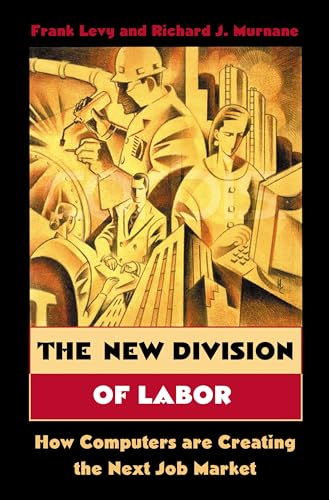
As the current recession ends, many workers will not be returning to the jobs they once held--those jobs are gone. In The New Division of Labor, Frank Levy and Richard Murnane show how computers are changing the employment landscape and how the right kinds of education can ease the transition to the new job market. The book tells stories of people at work--a high-end financial advisor, a customer service representative, a pair of successful chefs, a cardiologist, an automotive mechanic, the author Victor Hugo, floor traders in a London financial exchange. The authors merge these stories with insights from cognitive science, computer science, and economics to show how computers are enhancing productivity in many jobs even as they eliminate other jobs--both directly and by sending work offshore. At greatest risk are jobs that can be expressed in programmable rules--blue collar, clerical, and similar work that requires moderate skills and used to pay middle-class wages. The loss of these jobs leaves a growing division between those who can and cannot earn a good living in the computerized economy. Left unchecked, the division threatens the nation's democratic institutions. The nation's challenge is to recognize this division and to prepare the population for the high-wage/high-skilled jobs that are rapidly growing in number--jobs involving extensive problem solving and interpersonal communication. Using detailed examples--a second grade classroom, an IBM managerial training program, Cisco Networking Academies--the authors describe how these skills can be taught and how our adjustment to the computerized workplace can begin in earnest.
Die Inhaltsangabe kann sich auf eine andere Ausgabe dieses Titels beziehen.
Über die Autorin bzw. den Autor
Frank Levy & Richard J. Murnane
Von der hinteren Coverseite
"A timely contribution. The New Division of Labor adds an important level of understanding to the changes we are witnessing in our labor markets. There is a message regarding the skills that are required by our economy and implications for educational reform and a message as to the political tensions that accompany this transition. The phenomenon described is of global relevance."---John Reed, Interim Chairman of the New York Stock Exchange
"Levy and Murnane go beyond conventional accounts of the effect of automation on the workforce to take a comprehensive and thoughtful look at how increased use of technology is affecting the occupational distribution in the U.S., and precisely what skills are likely to be valued in tomorrow's labor markets. This should be read by all who care about the future of work in America."--Lawrence H. Summers, President, Harvard University
"A fascinating, important book. Levy and Murnane tackle one of the most important questions in contemporary economics, how computers change the way work is organized and how labor markets reward skill. The answer they offer is simple and powerful."--James B. Rebitzer, Case Western Reserve University
"This book, through a wealth of examples, gives the reader a concrete sense of how computers have changed the nature of the workplace."--John Bound, University of Michigan
Auszug. © Genehmigter Nachdruck. Alle Rechte vorbehalten.
The New Division of Labor
How Computers Are Creating the Next Job MarketBy Frank LevyPrinceton University Press
Copyright © 2005 Frank LevyAll right reserved.
ISBN: 9780691124025
Chapter One
NEW DIVISIONS OF LABOR
ON MARCH 22, 1964, THE AD HOC COMMITTEE ON THE TRIPLE Revolution sent a fourteen-page memorandum to President Lyndon Johnson. The signers included chemist Linus Pauling (recipient of two Nobel Prizes), economist Gunnar Myrdal (a future Nobel Prize-winner), and Gerard Piel, publisher of Scientific American. In the memo, the committee warned the president of long-run threats to the nation beginning with the likelihood that computers would soon create mass unemployment.
A new era of production has begun. Its principles of organization are as different from those of the industrial era as those of the industrial era were different from the agricultural. The cybernation revolution has been brought about by the combination of the computer and the automated self-regulating machine. This results in a system of almost unlimited productive capacity which requires progressively less human labor. Cybernation is already reorganizing the economic and social system to meet its own needs.1
In one respect the committee's warning was prophetic. Computers now replace humans in carrying out an ever widening range of tasks-filing, bookkeeping, mortgage underwriting, taking book orders, installing windshields on automobile bodies-the list becomes longer each year. And beyond directly replacing humans, computers have become the infrastructure of the global economy, helping jobs move quickly to sources of cheap labor.
But the Ad Hoc Committee also made a major miscalculation. Like many computer scientists of that time, the committee expected computers would soon replicate all the modes by which humans process information. The expectation was only partly fulfilled, and so the committee's warning was only partly right. Computers have not created mass unemployment, but they have created a major upheaval in the nature of human work.
More than two centuries ago, Adam Smith used the words "division of labor" to describe an earlier upheaval-the way in which the first factory systems had reorganized work and dramatically boosted productivity.2 In today's economy, Smith's words have taken on new meanings. There is a new division of labor between people and computers. And there is a growing division within human labor itself-a divide between those who can and those who cannot do valued work in an economy filled with computers. Bridging this divide involves more than ensuring that the affluent and the poor have access to the same hardware and software. It involves rethinking education and training, beginning with answering four fundamental questions:
- What kinds of tasks do humans perform better than computers?
- What kinds of tasks do computers perform better than humans?
- In an increasingly computerized world, what well-paid work is left for people to do both now and in the future?
- How can people learn the skills to do this work?
Answering these questions is the focus of this book.
HOW WORK HAS CHANGED
One day in June 2003, a General Electric technician made a service call to a suburban house to check on a malfunctioning ice-maker. As he was writing up the receipt for the repair, he apologized for having had to call for directions thirty minutes before he arrived.
I carry maps but the work order didn't even have your street address. It just had "HOUSE" and your phone number. The problem is that they've just switched our call center from India to Costa Rica. They're still learning the procedures down there and they must be having trouble with addresses.
The explanation was plausible-a call center that used operators who read scripts on computer screens moved to a source of even cheaper labor. In fact, however, the work order had not been taken by a human operator but by a computer using speech recognition software. By reading menus to the caller, the software could prompt the caller to identify the problem as being in a refrigerator, specifically, the ice-maker. It could also prompt the caller to choose a time he would be at home from a list of times when technicians were available. The speech recognition software could recognize the caller's phone number and establish that the home address was a "HOUSE" rather than an apartment. While the software was not yet good enough to recognize the home address itself, it had captured enough information to print up a work order and append it to the technician's schedule.
In 1990 that work order would have been taken by an operator sitting somewhere in the United States. That operator's job is now gone. Whether the job was displaced by a computer or a Costa Rican call center is unimportant for the moment. What is important is that the loss of the operator's job is part of a much larger pattern.
As recently as 1970, more than one-half of employed U.S. adults worked in two broad occupational categories: blue-collar jobs and clerical jobs (including the operator who would have written up the work order). Few people got rich in these jobs, but they supported middle- and lower-middle-class living and many were open to high school graduates. Today, less than 40 percent of adults have blue-collar or clerical jobs and many of these jobs require at least some college education. The computerization of work has played a significant role in this change.
Had the rest of the economy remained unchanged, the declining importance of blue-collar and clerical jobs might have resulted in the rising unemployment feared by the Ad Hoc Committee. But computers are Janus-faced, helping to create jobs even as they destroy jobs. As computers have helped channel economic growth, two quite different types of jobs have increased in number, jobs that pay very different wages. Jobs held by the working poor-janitors, cafeteria workers, security guards-have grown in relative importance.3 But the greater job growth has taken place in the upper part of the pay distribution-managers, doctors, lawyers, engineers, teachers, technicians. Three facts about these latter jobs stand out: they pay well, they require extensive skills, and most people in these jobs rely on computers to increase their productivity. This hollowing-out of the occupational structure-more janitors and more managers-is heavily influenced by the computerization of work.
Beneath the level of the job title, computers are rearranging tasks within jobs. The secretary's job provides a prime example. Even as there are relatively fewer secretaries, the job itself is changing. A quarter century ago, the U.S. Department of Labor Occupational Outlook described a secretary's job in this way:
Secretaries relieve their employers of routine duties so they can work on more important matters. Although most secretaries type, take shorthand, and deal with callers, the time spent on these duties varies in different types of organizations.
Compare the description of the same job in today's Occupational Outlook:
As technology continues to expand in offices across the Nation, the role of the secretary has greatly evolved. Office automation and organizational restructuring have led secretaries to assume a wide range of new responsibilities once reserved for managerial and professional...
„Über diesen Titel“ kann sich auf eine andere Ausgabe dieses Titels beziehen.
Suchergebnisse für The New Division of Labor: How Computers Are Creating...

Beispielbild für diese ISBN
The New Division of Labor: How Computers Are Creating the Next Job Market
Verlag:
Princeton University Press (edition ), 2005
ISBN 10: 0691124027
ISBN 13: 9780691124025
Gebraucht
Paperback
Anbieter: BooksRun, Philadelphia, PA, USA
Verkäuferbewertung 5 von 5 Sternen

Paperback. Zustand: Very Good. It's a well-cared-for item that has seen limited use. The item may show minor signs of wear. All the text is legible, with all pages included. It may have slight markings and/or highlighting. Artikel-Nr. 0691124027-8-1
Gebraucht kaufen
EUR 4,88
Versand gratis
Versand innerhalb von USA
Versand innerhalb von USA
Anzahl: 2 verfügbar
Beispielbild für diese ISBN
The New Division of Labor: How Computers Are Creating the Next Job Market
Verlag:
Princeton University Press, 2005
ISBN 10: 0691124027
ISBN 13: 9780691124025
Gebraucht
Paperback
Anbieter: ThriftBooks-Dallas, Dallas, TX, USA
Verkäuferbewertung 5 von 5 Sternen
Paperback. Zustand: Very Good. No Jacket. May have limited writing in cover pages. Pages are unmarked. ~ ThriftBooks: Read More, Spend Less. Artikel-Nr. G0691124027I4N00
Gebraucht kaufen
EUR 6,22
Versand gratis
Versand innerhalb von USA
Versand innerhalb von USA
Anzahl: 1 verfügbar
Beispielbild für diese ISBN
The New Division of Labor: How Computers Are Creating the Next Job Market
Verlag:
Princeton University Press, 2005
ISBN 10: 0691124027
ISBN 13: 9780691124025
Gebraucht
Paperback
Anbieter: ThriftBooks-Dallas, Dallas, TX, USA
Verkäuferbewertung 5 von 5 Sternen
Paperback. Zustand: Good. No Jacket. Pages can have notes/highlighting. Spine may show signs of wear. ~ ThriftBooks: Read More, Spend Less. Artikel-Nr. G0691124027I3N00
Gebraucht kaufen
EUR 6,22
Versand gratis
Versand innerhalb von USA
Versand innerhalb von USA
Anzahl: 1 verfügbar
Beispielbild für diese ISBN
The New Division of Labor : How Computers Are Creating the Next Job Market
Verlag:
Princeton University Press, 2005
ISBN 10: 0691124027
ISBN 13: 9780691124025
Gebraucht
Softcover
Anbieter: Better World Books, Mishawaka, IN, USA
Verkäuferbewertung 5 von 5 Sternen
Zustand: Good. New Ed. Pages intact with minimal writing/highlighting. The binding may be loose and creased. Dust jackets/supplements are not included. Stock photo provided. Product includes identifying sticker. Better World Books: Buy Books. Do Good. Artikel-Nr. 6245138-6
Gebraucht kaufen
EUR 7,21
Versand gratis
Versand innerhalb von USA
Versand innerhalb von USA
Anzahl: 1 verfügbar
Beispielbild für diese ISBN
The New Division of Labor : How Computers Are Creating the Next Job Market
Verlag:
Princeton University Press, 2005
ISBN 10: 0691124027
ISBN 13: 9780691124025
Gebraucht
Softcover
Anbieter: Better World Books: West, Reno, NV, USA
Verkäuferbewertung 5 von 5 Sternen
Zustand: Very Good. New Ed. Pages intact with possible writing/highlighting. Binding strong with minor wear. Dust jackets/supplements may not be included. Stock photo provided. Product includes identifying sticker. Better World Books: Buy Books. Do Good. Artikel-Nr. 9103019-75
Gebraucht kaufen
EUR 7,21
Versand gratis
Versand innerhalb von USA
Versand innerhalb von USA
Anzahl: 1 verfügbar
Beispielbild für diese ISBN
The New Division of Labor: How Computers Are Creating the Next Job Market
Verlag:
Princeton University Press, 2005
ISBN 10: 0691124027
ISBN 13: 9780691124025
Gebraucht
Softcover
Signiert
Anbieter: Wonder Book, Frederick, MD, USA
Verkäuferbewertung 5 von 5 Sternen
Zustand: Good. Signed Copy . Signed/Inscribed by Murnane on front endpage. Writing inside. Artikel-Nr. N00C-02112
Gebraucht kaufen
EUR 23,85
Versand gratis
Versand innerhalb von USA
Versand innerhalb von USA
Anzahl: 1 verfügbar
Foto des Verkäufers
The New Division of Labor. How Computers Are Creating the Next Job Market
Verlag:
Princeton University Press, 2004
ISBN 10: 0691124027
ISBN 13: 9780691124025
Gebraucht
Softcover
Anbieter: Barksdale Books, Almere, Niederlande
Verkäuferbewertung 5 von 5 Sternen
Zustand: Good. Artikel-Nr. 266467
Gebraucht kaufen
EUR 10,00
EUR 20,00 Versand
Versand von Niederlande nach USA
Versand von Niederlande nach USA
Anzahl: 1 verfügbar
Beispielbild für diese ISBN
The New Division of Labor - How Computers Are Creating the Next Job Market
Anbieter: PBShop.store US, Wood Dale, IL, USA
Verkäuferbewertung 5 von 5 Sternen
PAP. Zustand: New. New Book. Shipped from UK. Established seller since 2000. Artikel-Nr. WP-9780691124025
Beispielbild für diese ISBN
The New Division of Labor
Anbieter: PBShop.store UK, Fairford, GLOS, Vereinigtes Königreich
Verkäuferbewertung 5 von 5 Sternen
PAP. Zustand: New. New Book. Shipped from UK. Established seller since 2000. Artikel-Nr. WP-9780691124025
Neu kaufen
EUR 38,05
EUR 4,91 Versand
Versand von Vereinigtes Königreich nach USA
Versand von Vereinigtes Königreich nach USA
Anzahl: 2 verfügbar
Beispielbild für diese ISBN
The New Division of Labor: How Computers Are Creating the Next Job Market
Anbieter: Kennys Bookstore, Olney, MD, USA
Verkäuferbewertung 5 von 5 Sternen
Zustand: New. Shows how computers are changing the employment landscape and how the right kinds of education can ease the transition to the new job market. This book tells stories of people at work - a high-end financial advisor, a customer service representative, a pair of successful chefs, a cardiologist, and an automotive mechanic. Num Pages: 192 pages, 2 halftones. 10 line illus. BIC Classification: KCF; UBJ. Category: (P) Professional & Vocational; (U) Tertiary Education (US: College). Dimension: 236 x 163 x 12. Weight in Grams: 272. . 2005. Paperback. . . . . Books ship from the US and Ireland. Artikel-Nr. V9780691124025
Neu kaufen
EUR 44,50
EUR 9,37 Versand
Versand innerhalb von USA
Versand innerhalb von USA
Anzahl: 1 verfügbar