
Verwandte Artikel zu Why Gender Matters in Economics
Inhaltsangabe
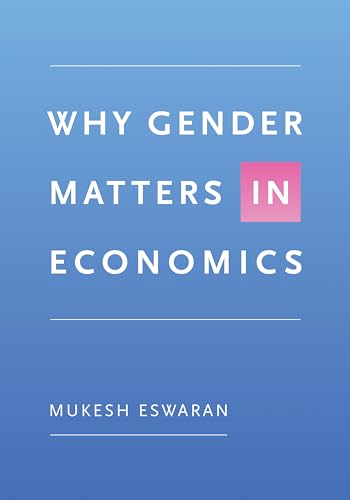
An economic way of thinking about the gender issues confronting women around the world Gender matters in economics-for even with today's technology, fertility choices, market opportunities, and improved social norms, economic outcomes for women remain markedly worse than for men. Drawing on insights from feminism, postmodernism, psychology, evolutionary biology, Marxism, and politics, this textbook provides a rigorous economic look at issues confronting women throughout the world-including nonmarket scenarios, such as marriage, family, fertility choice, and bargaining within households, as well as market areas, like those pertaining to labor and credit markets and globalization. Mukesh Eswaran examines how women's behavioral responses in economic situations and their bargaining power within the household differ from those of men. Eswaran then delves into the far-reaching consequences of these differences in both market and nonmarket domains. The author considers how women may be discriminated against in labor and credit markets, how their family and market circumstances interact, and how globalization has influenced their lives. Eswaran also investigates how women have been empowered through access to education, credit, healthcare, and birth control; changes in ownership laws; the acquisition of suffrage; and political representation. Throughout, Eswaran applies sound economic analysis and new modeling approaches, and each chapter concludes with exercises and discussion questions. This textbook gives readers the necessary tools for thinking about gender from an economic perspective.Addresses economic issues for women throughout the world, in both developed and developing countries Looks at both market and nonmarket domains Requires only a background in basic economic principles Includes the most recent research on the economics of gender in a range of areas Concludes each chapter with exercises and discussion questions
Die Inhaltsangabe kann sich auf eine andere Ausgabe dieses Titels beziehen.
Über die Autorin bzw. den Autor
Mukesh Eswaran is a professor in the Vancouver School of Economics at the University of British Columbia.
Von der hinteren Coverseite
"This thoughtful, energetic, creative, and engaging book does a terrific job reviewing and explaining some of the most interesting economic research on gender in recent years. It fills an important gap in the gender and economics literature."--Nancy Folbre, professor emeritus of economics, University of Massachusetts, Amherst
"Providing a comprehensive view of the economic lives of women, Why Gender Matters in Economics argues that women are systematically disadvantaged relative to men in a number of dimensions and offers policy ideas regarding how women might be more empowered. The book’s approach is novel and synthesizes recent research results."--Joyce P. Jacobsen, Wesleyan University
Aus dem Klappentext
"This thoughtful, energetic, creative, and engaging book does a terrific job reviewing and explaining some of the most interesting economic research on gender in recent years. It fills an important gap in the gender and economics literature."--Nancy Folbre, professor emeritus of economics, University of Massachusetts, Amherst
"Providing a comprehensive view of the economic lives of women, Why Gender Matters in Economics argues that women are systematically disadvantaged relative to men in a number of dimensions and offers policy ideas regarding how women might be more empowered. The books approach is novel and synthesizes recent research results."--Joyce P. Jacobsen, Wesleyan University
Auszug. © Genehmigter Nachdruck. Alle Rechte vorbehalten.
Why Gender Matters in Economics
By Mukesh EswaranPRINCETON UNIVERSITY PRESS
Copyright © 2014 Princeton University Press
All rights reserved.
ISBN: 978-0-691-12173-4All rights reserved.
Contents
Preface, xi,
CHAPTER ONE Introduction, 1,
MODULE ONE Fundamental Matters,
CHAPTER TWO Do Women and Men Behave Differently in Economic Situations?,
CHAPTER THREE What Determines the Balance of Power in a Household?,
MODULE TWO Gender in Markets,
CHAPTER FOUR Are Women Discriminated Against in the Labor Market?,
CHAPTER FIVE How Do Credit Markets Affect the Well-being of Women?,
CHAPTER SIX What Are the Effects of Globalization on Women?,
CHAPTER SEVEN How Do Women Fare in the Institution of Marriage?,
CHAPTER EIGHT Why Are Women the Causes and the Victims of Fertility Decline?,
CHAPTER NINE How Do Women Benefit from Improved Access to Birth Control?,
CHAPTER TEN How Did Women Gain Suffrage, and What Are Its Economic Effects?,
CHAPTER ELEVEN How Can Women Be Empowered?,
Index, 377,
CHAPTER 1
Introduction
This book examines the various ways in which economic outcomes differ for women and men and seeks to identify the reasons for these differences. The fact that economic activities differ by gender has traditionally been attributed—only partly correctly—to the advantages of a sexual division of labor. It has been argued that, because women perhaps have an advantage over men in looking after children when they are young, it has been beneficial for both men and women for the former to engage in paid employment while the latter concentrate on (unpaid) housework. But technology, fertility choices, market opportunities, and social norms have changed all of that in the past few decades. Women now have more freedom and more time available for education, for paid employment, and more generally for careers. Yet outcomes in the household and in the market are often markedly worse for them than for men with similar economic qualifications. In this book we seek to understand why this is so, why gender matters in the economic realm. We shall see how small differences and relatively minor advantages (such as physical strength for men) can be magnified to produce striking differences in outcomes by gender. These have been translated into economic differences. But, as we shall also see, economics is by no means the sole reason for gender disparities. Socialization, culture, biology, history, and religion have played roles in bringing about gender inequities.
Although the subject matter of this book is extremely important, interest in it among mainstream economists has been surprisingly recent. Only in the past few decades have scholars in economics started addressing these issues systematically. It is not the case that there was no interest at all prior to this. Powerful voices in the past brought attention to important gender issues. Ardent feminists such as Mary Wollstonecraft, Harriet Mill and her husband John Stuart Mill, Charlotte Perkins Gilman, Elizabeth Cady Stanton, and Susan B. Anthony, among many others, sought through their writings to level the gender playing field along many dimensions. But mainstream economists did not follow their cue. However, in recent decades—partly under the influence of feminist economists who have questioned male-centered presumptions in economics—the profession has seriously turned its attention to issues pertaining to gender.
As a result, the literature on gender and its role in economics has been transformed. In the early days of formal analysis in this area, the labor supply activity of women was in the foreground and occupied almost the entire scope of the field. Recently, however, many aspects of women's economic lives have been investigated, and it has become clear that their labor supply captures only one facet—though a very important one—of their economic well-being. Today the numerous topics pertaining to the economics of gender that are being investigated almost defy classification. Nevertheless, it is possible to organize the research in a manner that communicates the core factors that determine the well-being of women. Furthermore, although it is impossible to present a single overarching model that addresses all the diverse issues, it is possible to communicate the sort of models that are best suited to analyzing them. These, in fact, are the ultimate twin goals of this book.
The problems confronting women in the developed and the developing worlds can be quite different, and so this book treats the core concerns in both. To a certain extent, some of the problems of women in poor countries today are similar to those that were faced by women in the rich countries when those countries were at the corresponding stage of development. However, culture matters, and so does history. Therefore, the lessons learned from the rich countries cannot be directly applied to poor countries. Nevertheless, at a broad level there are some similarities. For eons, the lives of women the world over have been dominated by decisions made by men—by patriarchy, in other words. In the rich countries patriarchy has certainly been retreating for at least a century, though it has hardly vanished. In the poor countries today, the pace of retreat has been much slower. In this book we shall see how crucially important economic opportunities for women are in undermining patriarchy. However, although economic development certainly improves the condition of women, it cannot by itself eliminate the gender differences in outcomes.
This book is set out in four modules. In the first module ("Fundamental Matters," comprising Chapters 2 and 3), we deal with core mechanisms—the economic, psychological, and social factors that determine gender differences in behavior. In the second ("Gender in Markets," Chapters 4–6), we discuss how gender plays out in market activities. In the third ("Marriage and Fertility," Chapters 7–9), we discuss gender issues pertaining to the economics of marriage and family. And finally, in the last module ("Empowering Women," Chapters 10 and 11), we discuss what enhances the autonomy of women in their struggle for equality with men. In the rest of this chapter, I outline with a broad brush the sorts of issues that are dealt with in depth in the rest of this book.
When economic outcomes are different for women than for men, not all of these may be due to differences in the constraints they face, the skills they possess, or the discrimination they may encounter. It is conceivable that, in similar circumstances, the economic behavior of women may differ from that of men. For example, in the context of negotiations, Linda Babcock and Sara Laschever (2003) have documented the fact that women, in contrast to men, frequently receive less because they don't ask for more. This can have serious long-term consequences. A lower starting salary would contribute to a substantial wage gap in a few decades even if salaries were to subsequently increase at the same rate. Whether women have different attitudes and behaviors in the economic realm and, if so, whether they respond to the way they are viewed and how this works to their disadvantage, is the subject matter of Chapter 2. In particular, we shall discuss the role of nature and nurture (including socialization) in determining behavior.
A large part of the gender gap in average wages is due to the fact that, across the world, the top executive positions are occupied mostly by men; relatively few women find their way to the top. See Figure 1.1...
„Über diesen Titel“ kann sich auf eine andere Ausgabe dieses Titels beziehen.
Suchergebnisse für Why Gender Matters in Economics

Beispielbild für diese ISBN
Why Gender Matters in Economics
Verlag:
Princeton University Press, 2014
ISBN 10: 0691121737
ISBN 13: 9780691121734
Gebraucht
Hardcover
Anbieter: Better World Books, Mishawaka, IN, USA
Verkäuferbewertung 5 von 5 Sternen

Zustand: Good. Former library copy. Pages intact with minimal writing/highlighting. The binding may be loose and creased. Dust jackets/supplements are not included. Includes library markings. Stock photo provided. Product includes identifying sticker. Better World Books: Buy Books. Do Good. Artikel-Nr. 42310700-6
Gebraucht kaufen
EUR 9,00
Versand gratis
Versand innerhalb von USA
Versand innerhalb von USA
Anzahl: 2 verfügbar
Beispielbild für diese ISBN
Why Gender Matters in Economics
Verlag:
Princeton University Press, 2014
ISBN 10: 0691121737
ISBN 13: 9780691121734
Gebraucht
Hardcover
Anbieter: Better World Books, Mishawaka, IN, USA
Verkäuferbewertung 5 von 5 Sternen
Zustand: Very Good. Former library copy. Pages intact with possible writing/highlighting. Binding strong with minor wear. Dust jackets/supplements may not be included. Includes library markings. Stock photo provided. Product includes identifying sticker. Better World Books: Buy Books. Do Good. Artikel-Nr. 42309884-6
Gebraucht kaufen
EUR 9,00
Versand gratis
Versand innerhalb von USA
Versand innerhalb von USA
Anzahl: 1 verfügbar
Beispielbild für diese ISBN
Why Gender Matters in Economics
Verlag:
Princeton University Press, 2014
ISBN 10: 0691121737
ISBN 13: 9780691121734
Gebraucht
Hardcover
Anbieter: Better World Books, Mishawaka, IN, USA
Verkäuferbewertung 5 von 5 Sternen
Zustand: Good. Pages intact with minimal writing/highlighting. The binding may be loose and creased. Dust jackets/supplements are not included. Stock photo provided. Product includes identifying sticker. Better World Books: Buy Books. Do Good. Artikel-Nr. 14922469-6
Gebraucht kaufen
EUR 9,00
Versand gratis
Versand innerhalb von USA
Versand innerhalb von USA
Anzahl: 1 verfügbar
Beispielbild für diese ISBN
Why Gender Matters in Economics
Verlag:
Princeton University Press, 2014
ISBN 10: 0691121737
ISBN 13: 9780691121734
Gebraucht
Hardcover
Anbieter: ThriftBooks-Atlanta, AUSTELL, GA, USA
Verkäuferbewertung 5 von 5 Sternen
Hardcover. Zustand: Fair. No Jacket. Readable copy. Pages may have considerable notes/highlighting. ~ ThriftBooks: Read More, Spend Less. Artikel-Nr. G0691121737I5N00
Gebraucht kaufen
EUR 10,98
Versand gratis
Versand innerhalb von USA
Versand innerhalb von USA
Anzahl: 1 verfügbar
Beispielbild für diese ISBN
Why Gender Matters in Economics
Verlag:
Princeton University Press, 2014
ISBN 10: 0691121737
ISBN 13: 9780691121734
Gebraucht
Hardcover
Anbieter: ThriftBooks-Dallas, Dallas, TX, USA
Verkäuferbewertung 5 von 5 Sternen
Hardcover. Zustand: Fair. No Jacket. Readable copy. Pages may have considerable notes/highlighting. ~ ThriftBooks: Read More, Spend Less. Artikel-Nr. G0691121737I5N00
Gebraucht kaufen
EUR 10,98
Versand gratis
Versand innerhalb von USA
Versand innerhalb von USA
Anzahl: 1 verfügbar
Beispielbild für diese ISBN
Why Gender Matters in Economics
Verlag:
Princeton University Press, 2014
ISBN 10: 0691121737
ISBN 13: 9780691121734
Gebraucht
Hardcover
Anbieter: Cotswolds Rare Books, OXFORDSHIRE, Vereinigtes Königreich
Verkäuferbewertung 5 von 5 Sternen
Hardcover. Zustand: As New. Zustand des Schutzumschlags: As New. Unused copy. Artikel-Nr. B797
Gebraucht kaufen
EUR 15,52
EUR 29,66 Versand
Versand von Vereinigtes Königreich nach USA
Versand von Vereinigtes Königreich nach USA
Anzahl: 1 verfügbar
Beispielbild für diese ISBN
Why Gender Matters in Economics
Anbieter: PBShop.store US, Wood Dale, IL, USA
Verkäuferbewertung 5 von 5 Sternen
HRD. Zustand: New. New Book. Shipped from UK. Established seller since 2000. Artikel-Nr. WP-9780691121734
Beispielbild für diese ISBN
Why Gender Matters in Economics
Anbieter: PBShop.store UK, Fairford, GLOS, Vereinigtes Königreich
Verkäuferbewertung 5 von 5 Sternen
HRD. Zustand: New. New Book. Shipped from UK. Established seller since 2000. Artikel-Nr. WP-9780691121734
Neu kaufen
EUR 53,78
EUR 6,94 Versand
Versand von Vereinigtes Königreich nach USA
Versand von Vereinigtes Königreich nach USA
Anzahl: 1 verfügbar
Beispielbild für diese ISBN
Why Gender Matters in Economics
Anbieter: Majestic Books, Hounslow, Vereinigtes Königreich
Verkäuferbewertung 4 von 5 Sternen

Zustand: New. pp. 416. Artikel-Nr. 126035902
Neu kaufen
EUR 61,91
EUR 7,68 Versand
Versand von Vereinigtes Königreich nach USA
Versand von Vereinigtes Königreich nach USA
Anzahl: 1 verfügbar
Beispielbild für diese ISBN
Why Gender Matters in Economics
Anbieter: Kennys Bookstore, Olney, MD, USA
Verkäuferbewertung 5 von 5 Sternen
Zustand: New. Num Pages: 408 pages, 39 line illus. 12 tables. BIC Classification: JFSJ1; KC. Category: (P) Professional & Vocational; (U) Tertiary Education (US: College). Dimension: 260 x 178 x 33. Weight in Grams: 898. . 2014. Hardcover. . . . . Books ship from the US and Ireland. Artikel-Nr. V9780691121734
Neu kaufen
EUR 66,02
EUR 9,38 Versand
Versand innerhalb von USA
Versand innerhalb von USA
Anzahl: 1 verfügbar