
Verwandte Artikel zu Princeton Companion to Mathematics
Inhaltsangabe
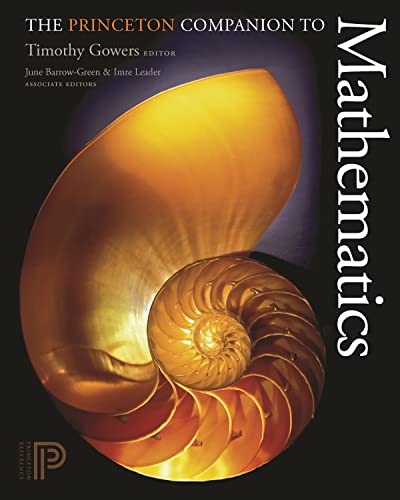
The ultimate mathematics reference book
This is a one-of-a-kind reference for anyone with a serious interest in mathematics. Edited by Timothy Gowers, a recipient of the Fields Medal, it presents nearly two hundred entries—written especially for this book by some of the world's leading mathematicians—that introduce basic mathematical tools and vocabulary; trace the development of modern mathematics; explain essential terms and concepts; examine core ideas in major areas of mathematics; describe the achievements of scores of famous mathematicians; explore the impact of mathematics on other disciplines such as biology, finance, and music—and much, much more.
Unparalleled in its depth of coverage, The Princeton Companion to Mathematics surveys the most active and exciting branches of pure mathematics. Accessible in style, this is an indispensable resource for undergraduate and graduate students in mathematics as well as for researchers and scholars seeking to understand areas outside their specialties.
- Features nearly 200 entries, organized thematically and written by an international team of distinguished contributors
- Presents major ideas and branches of pure mathematics in a clear, accessible style
- Defines and explains important mathematical concepts, methods, theorems, and open problems
- Introduces the language of mathematics and the goals of mathematical research
- Covers number theory, algebra, analysis, geometry, logic, probability, and more
- Traces the history and development of modern mathematics
- Profiles more than ninety-five mathematicians who influenced those working today
- Explores the influence of mathematics on other disciplines
- Includes bibliographies, cross-references, and a comprehensive index
Contributors include:
Graham Allan, Noga Alon, George Andrews, Tom Archibald, Sir Michael Atiyah, David Aubin, Joan Bagaria, Keith Ball, June Barrow-Green, Alan Beardon, David D. Ben-Zvi, Vitaly Bergelson, Nicholas Bingham, Béla Bollobás, Henk Bos, Bodil Branner, Martin R. Bridson, John P. Burgess, Kevin Buzzard, Peter J. Cameron, Jean-Luc Chabert, Eugenia Cheng, Clifford C. Cocks, Alain Connes, Leo Corry, Wolfgang Coy, Tony Crilly, Serafina Cuomo, Mihalis Dafermos, Partha Dasgupta, Ingrid Daubechies, Joseph W. Dauben, John W. Dawson Jr., Francois de Gandt, Persi Diaconis, Jordan S. Ellenberg, Lawrence C. Evans, Florence Fasanelli, Anita Burdman Feferman, Solomon Feferman, Charles Fefferman, Della Fenster, José Ferreirós, David Fisher, Terry Gannon, A. Gardiner, Charles C. Gillispie, Oded Goldreich, Catherine Goldstein, Fernando Q. Gouvêa, Timothy Gowers, Andrew Granville, Ivor Grattan-Guinness, Jeremy Gray, Ben Green, Ian Grojnowski, Niccolò Guicciardini, Michael Harris, Ulf Hashagen, Nigel Higson, Andrew Hodges, F. E. A. Johnson, Mark Joshi, Kiran S. Kedlaya, Frank Kelly, Sergiu Klainerman, Jon Kleinberg, Israel Kleiner, Jacek Klinowski, Eberhard Knobloch, János Kollár, T. W. Körner, Michael Krivelevich, Peter D. Lax, Imre Leader, Jean-François Le Gall, W. B. R. Lickorish, Martin W. Liebeck, Jesper Lützen, Des MacHale, Alan L. Mackay, Shahn Majid, Lech Maligranda, David Marker, Jean Mawhin, Barry Mazur, Dusa McDuff, Colin McLarty, Bojan Mohar, Peter M. Neumann, Catherine Nolan, James Norris, Brian Osserman, Richard S. Palais, Marco Panza, Karen Hunger Parshall, Gabriel P. Paternain, Jeanne Peiffer, Carl Pomerance, Helmut Pulte, Bruce Reed, Michael C. Reed, Adrian Rice, Eleanor Robson, Igor Rodnianski, John Roe, Mark Ronan, Edward Sandifer, Tilman Sauer, Norbert Schappacher, Andrzej Schinzel, Erhard Scholz, Reinhard Siegmund-Schultze, Gordon Slade, David J. Spiegelhalter, Jacqueline Stedall, Arild Stubhaug, Madhu Sudan, Terence Tao, Jamie Tappenden, C. H. Taubes, Rüdiger Thiele, Burt Totaro, Lloyd N. Trefethen, Dirk van Dalen, Richard Weber, Dominic Welsh, Avi Wigderson, Herbert Wilf, David Wilkins, B. Yandell, Eric Zaslow, and Doron Zeilberger
Die Inhaltsangabe kann sich auf eine andere Ausgabe dieses Titels beziehen.
Über die Autorin bzw. den Autor
Edited by Timothy Gowers June Barrow-Green and Imre Leader, associate editors
Von der hinteren Coverseite
"This is a wonderful book. The content is overwhelming. Every practicing mathematician, everyone who uses mathematics, and everyone who is interested in mathematics must have a copy of their own."--Simon A. Levin, Princeton University
"The Princeton Companion to Mathematics fills a vital need. It is the only book of its kind."--Victor J. Katz, professor emeritus, University of the District of Columbia
"I think that this is a wonderful book, completely different from anything that has been written before about mathematics and mathematicians."--Endre Süli, University of Oxford
"The Princeton Companion to Mathematics is a much needed--and will become a much used--reference work. In fact, it will stand alone as the reference work in mathematics."--John J. Watkins, Colorado College
Aus dem Klappentext
"This is a wonderful book. The content is overwhelming. Every practicing mathematician, everyone who uses mathematics, and everyone who is interested in mathematics must have a copy of their own."--Simon A. Levin, Princeton University
"The Princeton Companion to Mathematics fills a vital need. It is the only book of its kind."--Victor J. Katz, professor emeritus, University of the District of Columbia
"I think that this is a wonderful book, completely different from anything that has been written before about mathematics and mathematicians."--Endre Süli, University of Oxford
"The Princeton Companion to Mathematics is a much needed--and will become a much used--reference work. In fact, it will stand alone as the reference work in mathematics."--John J. Watkins, Colorado College
Auszug. © Genehmigter Nachdruck. Alle Rechte vorbehalten.
The Princeton Companion to Mathematics
Princeton University Press
Copyright © 2008 Princeton University PressAll right reserved.
ISBN: 978-0-691-11880-2
Contents
Preface.......................................................ixContributors..................................................xviiIndex.........................................................1015
Chapter One
Part I Introduction
I.1 What Is Mathematics About?
It is notoriously hard to give a satisfactory answer to the question, "What is mathematics?" The approach of this book is not to try. Rather than giving a definition of mathematics, the intention is to give a good idea of what mathematics is by describing many of its most important concepts, theorems, and applications. Nevertheless, to make sense of all this information it is useful to be able to classify it somehow.
The most obvious way of classifying mathematics is by its subject matter, and that will be the approach of this brief introductory section and the longer section entitled SOME FUNDAMENTAL MATHEMATICAL DEFINITIONS [I.3]. However, it is not the only way, and not even obviously the best way. Another approach is to try to classify the kinds of questions that mathematicians like to think about. This gives a usefully different view of the subject: it often happens that two areas of mathematics that appear very different if you pay attention to their subject matter are much more similar if you look at the kinds of questions that are being asked. The last section of part I, entitled the general goals of mathematical research [I.4], looks at the subject from this point of view. At the end of that article there is a brief discussion of what one might regard as a third classification, not so much of mathematics itself but of the content of a typical article in a mathematics journal. As well as theorems and proofs, such an article will contain definitions, examples, lemmas, formulas, conjectures, and so on. The point of that discussion will be to say what these words mean and why the different kinds of mathematical output are important.
1 Algebra, Geometry, and Analysis
Although any classification of the subject matter of mathematics must immediately be hedged around with qualifications, there is a crude division that undoubtedly works well as a first approximation, namely the division of mathematics into algebra, geometry, and analysis. So let us begin with this, and then qualify it later.
1.1 Algebra versus Geometry
Most people who have done some high school mathematics will think of algebra as the sort of mathematics that results when you substitute letters for numbers. Algebra will often be contrasted with arithmetic, which is a more direct study of the numbers themselves. So, for example, the question, "What is 3 x 7?" will be thought of as belonging to arithmetic, while the question, "If x + y = 10 and xy = 21, then what is the value of the larger of x and y?" will be regarded as a piece of algebra. This contrast is less apparent in more advanced mathematics for the simple reason that it is very rare for numbers to appear without letters to keep them company.
There is, however, a different contrast, between algebra and geometry, which is much more important at an advanced level. The high school conception of geometry is that it is the study of shapes such as circles, triangles, cubes, and spheres together with concepts such as rotations, reflections, symmetries, and so on. Thus, the objects of geometry, and the processes that they undergo, have a much more visual character than the equations of algebra.
This contrast persists right up to the frontiers of modern mathematical research. Some parts of mathematics involve manipulating symbols according to certain rules: for example, a true equation remains true if you "do the same to both sides." These parts would typically be thought of as algebraic, whereas other parts are concerned with concepts that can be visualized, and these are typically thought of as geometrical.
However, a distinction like this is never simple. If you look at a typical research paper in geometry, will it be full of pictures? Almost certainly not. In fact, the methods used to solve geometrical problems very often involve a great deal of symbolic manipulation, although good powers of visualization may be needed to find and use these methods and pictures will typically underlie what is going on. As for algebra, is it "mere" symbolic manipulation? Not at all: very often one solves an algebraic problem by finding a way to visualize it.
As an example of visualizing an algebraic problem, consider how one might justify the rule that if a and b are positive integers then ab = ba. It is possible to approach the problem as a pure piece of algebra (perhaps proving it by induction), but the easiest way to convince yourself that it is true is to imagine a rectangular array that consists of a rows with b objects in each row. The total number of objects can be thought of as a lots of b, if you count it row by row, or as b lots of a, if you count it column by column. Therefore, ab = ba. Similar justifications can be given for other basic rules such as a(b + c) = ab + ac and a(bc) = (ab)c.
In the other direction, it turns out that a good way of solving many geometrical problems is to "convert them into algebra." The most famous way of doing this is to use Cartesian coordinates. For example, suppose that you want to know what happens if you reflect a circle about a line L through its center, then rotate it through 40 counterclockwise, and then reflect it once more about the same line L. One approach is to visualize the situation as follows.
Imagine that the circle is made of a thin piece of wood. Then instead of reflecting it about the line you can rotate it through 180 about L (using the third dimension). The result will be upside down, but this does not matter if you simply ignore the thickness of the wood. Now if you look up at the circle from below while it is rotated counterclockwise through 40, what you will see is a circle being rotated clockwise through 40. Therefore, if you then turn it back the right way up, by rotating about L once again, the total effect will have been a clockwise rotation through 40
Mathematicians vary widely in their ability and willingness to follow an argument like that one. If you cannot quite visualize it well enough to see that it is definitely correct, then you may prefer an algebraic approach, using the theory of linear algebra and matrices (which will be discussed in more detail in [I.3 3.2]). To begin with, one thinks of the circle as the set of all pairs of numbers (x,y) such that [x.sup.2] + [y.sup.2] [is less than or equal to] 1. The two transformations, reflection in a line through the center of the circle and rotation through an angle [theta], can both be represented by 2 x 2 matrices, which are arrays of numbers of the form ([MATHEMATICAL EXPRESSION NOT REPRODUCIBLE IN ASCII]). There is a slightly complicated, but purely algebraic, rule for multiplying matrices together, and it is designed to have the property that if matrix A represents a transformation R (such as a reflection) and matrix B represents a transformation T, then the product AB represents the transformation that results when you first do T and then R. Therefore, one can solve the problem above by writing down the matrices that correspond to the...
„Über diesen Titel“ kann sich auf eine andere Ausgabe dieses Titels beziehen.
Suchergebnisse für Princeton Companion to Mathematics

Beispielbild für diese ISBN
The Princeton Companion to Mathematics
Verlag:
Princeton University Press, 2008
ISBN 10: 0691118809
ISBN 13: 9780691118802
Gebraucht
Hardcover
Anbieter: Zubal-Books, Since 1961, Cleveland, OH, USA
Verkäuferbewertung 5 von 5 Sternen

Zustand: Fine. 1034 pp., hardcover, fine in an edge-rubbed dust jacket. - If you are reading this, this item is actually (physically) in our stock and ready for shipment once ordered. We are not bookjackers. Buyer is responsible for any additional duties, taxes, or fees required by recipient's country. Artikel-Nr. ZB1353266
Gebraucht kaufen
EUR 50,95
EUR 4,01 Versand
Versand innerhalb von USA
Versand innerhalb von USA
Anzahl: 1 verfügbar
Beispielbild für diese ISBN
The Princeton Companion to Mathematics
Verlag:
Princeton University Press, 2008
ISBN 10: 0691118809
ISBN 13: 9780691118802
Gebraucht
Hardcover
Anbieter: Better World Books, Mishawaka, IN, USA
Verkäuferbewertung 5 von 5 Sternen
Zustand: Good. Pages intact with minimal writing/highlighting. The binding may be loose and creased. Dust jackets/supplements are not included. Stock photo provided. Product includes identifying sticker. Better World Books: Buy Books. Do Good. Artikel-Nr. 6069848-6
Gebraucht kaufen
EUR 56,72
Versand gratis
Versand innerhalb von USA
Versand innerhalb von USA
Anzahl: 2 verfügbar
Beispielbild für diese ISBN
The Princeton Companion to Mathematics
Verlag:
Princeton University Press, 2008
ISBN 10: 0691118809
ISBN 13: 9780691118802
Gebraucht
Hardcover
Anbieter: Better World Books, Mishawaka, IN, USA
Verkäuferbewertung 5 von 5 Sternen
Zustand: Good. Former library copy. Pages intact with minimal writing/highlighting. The binding may be loose and creased. Dust jackets/supplements are not included. Includes library markings. Stock photo provided. Product includes identifying sticker. Better World Books: Buy Books. Do Good. Artikel-Nr. 8488682-20
Gebraucht kaufen
EUR 56,72
Versand gratis
Versand innerhalb von USA
Versand innerhalb von USA
Anzahl: 1 verfügbar
Beispielbild für diese ISBN
The Princeton Companion to Mathematics
Verlag:
Princeton University Press (edition Illustrated), 2008
ISBN 10: 0691118809
ISBN 13: 9780691118802
Gebraucht
Hardcover
Anbieter: BooksRun, Philadelphia, PA, USA
Verkäuferbewertung 5 von 5 Sternen
Hardcover. Zustand: Very Good. Illustrated. With dust jacket. It's a well-cared-for item that has seen limited use. The item may show minor signs of wear. All the text is legible, with all pages included. It may have slight markings and/or highlighting. Artikel-Nr. 0691118809-11-1-29
Gebraucht kaufen
EUR 60,36
Versand gratis
Versand innerhalb von USA
Versand innerhalb von USA
Anzahl: 1 verfügbar
Beispielbild für diese ISBN
The Princeton Companion to Mathematics
Verlag:
Princeton University Press (edition Illustrated), 2008
ISBN 10: 0691118809
ISBN 13: 9780691118802
Gebraucht
Hardcover
Anbieter: BooksRun, Philadelphia, PA, USA
Verkäuferbewertung 5 von 5 Sternen
Hardcover. Zustand: Very Good. Illustrated. With dust jacket. It's a well-cared-for item that has seen limited use. The item may show minor signs of wear. All the text is legible, with all pages included. It may have slight markings and/or highlighting. Artikel-Nr. 0691118809-8-1-29
Gebraucht kaufen
EUR 61,19
Versand gratis
Versand innerhalb von USA
Versand innerhalb von USA
Anzahl: 1 verfügbar
Beispielbild für diese ISBN
The Princeton Companion to Mathematics
Anbieter: Revaluation Books, Exeter, Vereinigtes Königreich
Verkäuferbewertung 5 von 5 Sternen
Hardcover. Zustand: Brand New. illustrated edition. 1008 pages. 10.50x8.50x2.50 inches. In Stock. Artikel-Nr. 0691118809
Neu kaufen
EUR 91,61
EUR 23,57 Versand
Versand von Vereinigtes Königreich nach USA
Versand von Vereinigtes Königreich nach USA
Anzahl: 1 verfügbar
Beispielbild für diese ISBN
The Princeton Companion to Mathematics
Anbieter: Kennys Bookstore, Olney, MD, USA
Verkäuferbewertung 5 von 5 Sternen
Zustand: New. 2008. Third Printing Used. Hardcover. Presents two hundred entries that introduce basic mathematical tools and vocabulary. This title traces the development of modern mathematics. It explains essential terms and concepts; examines core ideas in major areas of mathematics; and describes the achievements of scores of famous mathematicians. Editor(s): Gowers, Timothy; Barrow-Green, June; Leader, Imre. Num Pages: 1056 pages, Black-and-white illustrations throughout | Cross-references, bibliographies, index. BIC Classification: PB. Category: (P) Professional & Vocational; (U) Tertiary Education (US: College). Dimension: 261 x 213 x 64. Weight in Grams: 2718. . . . . . Books ship from the US and Ireland. Artikel-Nr. V9780691118802
Neu kaufen
EUR 114,07
EUR 9,36 Versand
Versand innerhalb von USA
Versand innerhalb von USA
Anzahl: Mehr als 20 verfügbar
Beispielbild für diese ISBN
The Princeton Companion to Mathematics
Anbieter: Majestic Books, Hounslow, Vereinigtes Königreich
Verkäuferbewertung 4 von 5 Sternen

Zustand: New. pp. 1056 Illus. Artikel-Nr. 8063945
Neu kaufen
EUR 116,99
EUR 7,66 Versand
Versand von Vereinigtes Königreich nach USA
Versand von Vereinigtes Königreich nach USA
Anzahl: 3 verfügbar
Beispielbild für diese ISBN
The Princeton Companion to Mathematics
Anbieter: Revaluation Books, Exeter, Vereinigtes Königreich
Verkäuferbewertung 5 von 5 Sternen
Hardcover. Zustand: Brand New. illustrated edition. 1008 pages. 10.50x8.50x2.50 inches. In Stock. Artikel-Nr. __0691118809
Neu kaufen
EUR 111,67
EUR 23,57 Versand
Versand von Vereinigtes Königreich nach USA
Versand von Vereinigtes Königreich nach USA
Anzahl: 1 verfügbar
Beispielbild für diese ISBN
The Princeton Companion to Mathematics
Anbieter: Ria Christie Collections, Uxbridge, Vereinigtes Königreich
Verkäuferbewertung 5 von 5 Sternen
Zustand: New. In English. Artikel-Nr. ria9780691118802_new
Neu kaufen
EUR 125,75
EUR 22,41 Versand
Versand von Vereinigtes Königreich nach USA
Versand von Vereinigtes Königreich nach USA
Anzahl: Mehr als 20 verfügbar