
Verwandte Artikel zu Hindu Rulers, Muslim Subjects: Islam, Rights, and the...
Inhaltsangabe
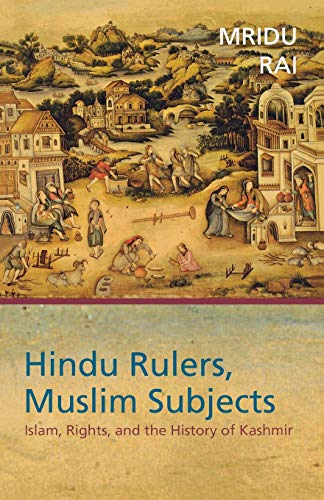
Disputed between India and Pakistan, Kashmir contains a large majority of Muslims subject to the laws of a predominantly Hindu and increasingly "Hinduized" India. How did religion and politics become so enmeshed in defining the protest of Kashmir's Muslims against Hindu rule? This book reaches beyond standard accounts that look to the 1947 partition of India for an explanation. Examining the 100-year period before that landmark event, during which Kashmir was ruled by Hindu Dogra kings under the aegis of the British, Mridu Rai highlights the collusion that shaped a decisively Hindu sovereignty over a subject Muslim populace. Focusing on authority, sovereignty, legitimacy, and community rights, she explains how Kashmir's modern Muslim identity emerged.
Rai shows how the princely state of Jammu and Kashmir was formed as the East India Company marched into India beginning in the late eighteenth century. After the 1857 rebellion, outright annexation was abandoned as the British Crown took over and princes were incorporated into the imperial framework as junior partners. But, Rai argues, scholarship on other regions of India has led to misconceptions about colonialism, not least that a "hollowing of the crown" occurred throughout as Brahman came to dominate over King. In Kashmir the Dogra kings maintained firm control. They rode roughshod over the interests of the vast majority of their Kashmiri Muslim subjects, planting the seeds of a political movement that remains in thrall to a religiosity thrust upon it for the past 150 years.
Die Inhaltsangabe kann sich auf eine andere Ausgabe dieses Titels beziehen.
Über die Autorin bzw. den Autor
Mridu Rai is Assistant Professor of History at Yale University.
Von der hinteren Coverseite
"Hindu Rulers, Muslim Subjects is a brilliant work of historical scholarship that will become indispensable reading for all those interested in the modern history and politics of the subcontinent. It a pioneering historical study of rights, religion, and regional identity in Kashmir that could also inspire future studies on other regions of the subcontinent."--Sugata Bose, Harvard University
"This is a major contribution to Kashmir studies and should set the standard for the next generation of publications on Kashmir. Challenging the existing literature, this work is heady and fresh--and deserves attention."--Alexander Evans, King's College London and the Royal Institute of International Affairs
"Mridu Rai's book reminds us powerfully of the crucial importance of colonial history to the present. She is able to de-essentialize religion and secularism in the Kashmir conflict, which is very useful in light of India's secularist claims and the ways in which some sociologists have theorized those claims. Carefully researched and lucidly conceptualized and written, this book forwards an important thesis on an important topic."--Peter van der Veer, University of Amsterdam
„Über diesen Titel“ kann sich auf eine andere Ausgabe dieses Titels beziehen.
Suchergebnisse für Hindu Rulers, Muslim Subjects: Islam, Rights, and the...

Beispielbild für diese ISBN
Hindu Rulers, Muslim Subjects: Islam, Rights, and the History of Kashmir
Verlag:
Princeton University Press, 2004
ISBN 10: 0691116881
ISBN 13: 9780691116884
Gebraucht
Softcover
Anbieter: Phatpocket Limited, Waltham Abbey, HERTS, Vereinigtes Königreich
Verkäuferbewertung 5 von 5 Sternen

Zustand: Good. Your purchase helps support Sri Lankan Children's Charity 'The Rainbow Centre'. Ex-library, so some stamps and wear, but in good overall condition. Our donations to The Rainbow Centre have helped provide an education and a safe haven to hundreds of children who live in appalling conditions. Artikel-Nr. Z1-R-028-02555
Gebraucht kaufen
EUR 62,17
EUR 12,67 Versand
Versand von Vereinigtes Königreich nach USA
Versand von Vereinigtes Königreich nach USA
Anzahl: 1 verfügbar
Beispielbild für diese ISBN
Hindu Rulers, Muslim Subjects: Islam, Rights, and the History of Kashmir
Anbieter: Revaluation Books, Exeter, Vereinigtes Königreich
Verkäuferbewertung 5 von 5 Sternen
Paperback. Zustand: Brand New. 335 pages. 8.50x5.50x1.25 inches. In Stock. Artikel-Nr. x-0691116881
Neu kaufen
EUR 78,56
EUR 11,91 Versand
Versand von Vereinigtes Königreich nach USA
Versand von Vereinigtes Königreich nach USA
Anzahl: 2 verfügbar
Foto des Verkäufers
Hindu Rulers, Muslim Subjects
Verlag:
Princeton University Press, 2004
ISBN 10: 0691116881
ISBN 13: 9780691116884
Neu
Kartoniert / Broschiert
Anbieter: moluna, Greven, Deutschland
Verkäuferbewertung 5 von 5 Sternen
Kartoniert / Broschiert. Zustand: New. Über den AutorMridu Rai is Assistant Professor of History at Yale University.InhaltsverzeichnisAcknowledgements x Abbreviations xii Introduction 1 CHAPTER 1: Territorializing Sovereignity: The D. Artikel-Nr. 447030396
Neu kaufen
EUR 60,56
EUR 48,99 Versand
Versand von Deutschland nach USA
Versand von Deutschland nach USA
Anzahl: Mehr als 20 verfügbar
Beispielbild für diese ISBN
Hindu Rulers, Muslim Subjects ? Islam: Islam, Rights, and the History of Kashmir
Anbieter: Majestic Books, Hounslow, Vereinigtes Königreich
Verkäuferbewertung 4 von 5 Sternen

Zustand: New. pp. 320. Artikel-Nr. 8063883
Neu kaufen
EUR 103,37
EUR 7,74 Versand
Versand von Vereinigtes Königreich nach USA
Versand von Vereinigtes Königreich nach USA
Anzahl: 1 verfügbar
Foto des Verkäufers
Hindu Rulers, Muslim Subjects : Islam, Rights, and the History of Kashmir
Verlag:
Princeton University Press Jul 2004, 2004
ISBN 10: 0691116881
ISBN 13: 9780691116884
Neu
Taschenbuch
Anbieter: AHA-BUCH GmbH, Einbeck, Deutschland
Verkäuferbewertung 5 von 5 Sternen
Taschenbuch. Zustand: Neu. Neuware - Disputed between India and Pakistan, Kashmir contains a large majority of Muslims subject to the laws of a predominantly Hindu and increasingly 'Hinduized' India. How did religion and politics become so enmeshed in defining the protest of Kashmir's Muslims against Hindu rule This book reaches beyond standard accounts that look to the 1947 partition of India for an explanation. Examining the 100-year period before that landmark event, during which Kashmir was ruled by Hindu Dogra kings under the aegis of the British, Mridu Rai highlights the collusion that shaped a decisively Hindu sovereignty over a subject Muslim populace. Focusing on authority, sovereignty, legitimacy, and community rights, she explains how Kashmir's modern Muslim identity emerged. Rai shows how the princely state of Jammu and Kashmir was formed as the East India Company marched into India beginning in the late eighteenth century. After the 1857 rebellion, outright annexation was abandoned as the British Crown took over and princes were incorporated into the imperial framework as junior partners. But, Rai argues, scholarship on other regions of India has led to misconceptions about colonialism, not least that a 'hollowing of the crown' occurred throughout as Brahman came to dominate over King. In Kashmir the Dogra kings maintained firm control. They rode roughshod over the interests of the vast majority of their Kashmiri Muslim subjects, planting the seeds of a political movement that remains in thrall to a religiosity thrust upon it for the past 150 years. Artikel-Nr. 9780691116884
Neu kaufen
EUR 82,53
EUR 35,00 Versand
Versand von Deutschland nach USA
Versand von Deutschland nach USA
Anzahl: 2 verfügbar