
Verwandte Artikel zu The Stones of Athens (Princeton Legacy Library, 1656)
Inhaltsangabe
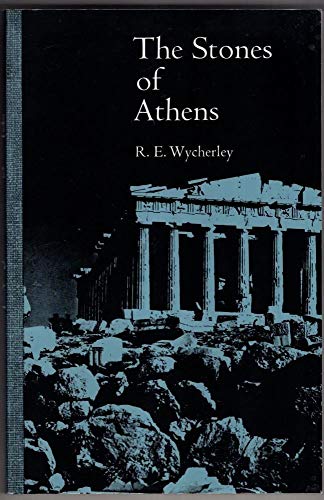
Interpreting the monuments of Athens in light of literature, R. E. Wycherley brings before us the city the ancients knew. Philosophers, statesmen, travelers, dramatists, poets, private citizens—the words of all these suggest how the city looked at various periods, how its monuments came to be built, and how they served the people in daily life. Professor Wycherley concentrates on the classical period, illustrating his work with plans, reconstructions, and photographs.
Originally published in 1978.
The Princeton Legacy Library uses the latest print-on-demand technology to again make available previously out-of-print books from the distinguished backlist of Princeton University Press. These editions preserve the original texts of these important books while presenting them in durable paperback and hardcover editions. The goal of the Princeton Legacy Library is to vastly increase access to the rich scholarly heritage found in the thousands of books published by Princeton University Press since its founding in 1905.
Die Inhaltsangabe kann sich auf eine andere Ausgabe dieses Titels beziehen.
Auszug. © Genehmigter Nachdruck. Alle Rechte vorbehalten.
The Stones of Athens
By R. E. WycherleyPRINCETON UNIVERSITY PRESS
Copyright © 1978 Princeton University Press
All rights reserved.
ISBN: 978-0-691-10059-3All rights reserved.
Contents
Preface, vii,
Illustrations, xii,
Abbreviations, xvii,
Introduction, 3,
I. The Walls, 7,
II. The Agora: Political and Religious Center, 27,
III. The Market, 91,
IV. The Parthenon and Its Setting, 105,
V. The Erechtheion and Its Cults, 143,
VI. The Olympieion and Southeast Athens, 155,
VII. Other Shrines, 175,
VIII. Theaters, 203,
IX. Gymnasia and Philosophical Schools, 219,
X. Houses, Streets, Water Supply, 237,
XI. The Kerameikos and Other Cemeteries, 253,
XII. Peiraeus, 261,
Postscript. The Stones, 267,
General Bibliography, 278,
Index, 281,
CHAPTER 1
The Walls
The history of the walls of Athens is the history of the expansion and contraction of the city in its successive phases of growth and decline, in victory, disaster, and recovery. Construction and destruction mark the great epochs; and an account of the walls will incidentally provide a general historical introduction. What follows is mainly a study of the great Themistoklean circuit of classical Athens, built immediately after the glorious defeat of the Persian invasion of 480 B.C. This was a dominant feature of the city in her greatest days, an object of immense expenditure of effort and resources by the Athenian Demos, a symbol of the power of Athens, and a notable example of Greek military architecture; and, with repeated repair and reconstruction of course, it remained more or less in being for sixteen centuries of varying fortunes, rising again and again after severe dilapidation. At the same time, in the light of modern archaeological investigation, one can put this wall in its place in a series which extends over three thousand years.
In prehistoric Athens, when the Acropolis with its immediate adjuncts was the polis, as Thucydides tells us (2.15.3), the fortification of the Acropolis with its outworks was the city wall. The hill was surrounded by a powerful wall in the Mycenean period, with additional fortifications, of which only slight traces have been found, to protect the main approach on the west. This fortress is probably what was known as the Pelasgikon or Pelargikon, though in certain contexts (notably Thucydides, 2.17.1) the name seems to be used of the western outwork in particular. Naturally the alternative names gave rise to confusion in the minds of the ancients and of the writers of manuscripts. Pelasgikon means "building of the Pelasgi," the very obscure early inhabitants of Attica; Pelargikon means "stork-building." The origin of the name is not known; the stork seems to have been a bird of some significance on the early Acropolis — it is found in the decoration of the cornice of the old temple of Athena. The structure known as Enneapylon, Nine-gated, is commonly thought to be the western approach to the fortress, but this is uncertain.
In modern times the evidence of the massive walls has been supplemented increasingly by other finds; and we can see that Mycenean Athens, though not one of the major centers, was a place of moderate importance.
The Pelasgic wall continued to guard the Acropolis, for seven centuries or more, that is, through the "sub-Mycenean" dark ages, the geometric period (9th and 8th centuries) when the pottery and other finds show that Athens enjoyed a certain degree of culture and prosperity even though as in the rest of Greece architecture had reverted to primitive forms, the archaic period (7th and 6th centuries) when the city made great progress commercially, politically, and artistically, and indeed up to the time of the Persian invasion (480 B.C.).On the northern side little trace of this wall has been found, and it is assumed that it has been obliterated by the post-Persian wall, built by Kimon, which took the same irregular course; there are indications of successive posterngates east and west of the Erechtheion. On the south side, where the straight lines of the wall of Kimon thrust farther outwards, forming a great terrace, massive sections have been preserved, notably south of the Propylaia, southwest of the Parthenon (deep in the terrace fill, forming a kind of intermediate retaining wall) and at the extreme eastern end of the hill, near the modern Museum. At the southwest corner a bastion was constructed to threaten a flank of attackers who advanced as far as the principal gate. The main wall nearby abuts somewhat awkwardly on the south wing of the Propylaia. At this crucial point it is over 5m broad (elsewhere it is somewhat less). The style of the masonry is fine Cyclopean, with huge blocks of the native limestone, roughly worked on the outer face, small blocks filling the interstices, and originally with some use of clay bedding. The inner part was of less careful construction. The old wall now stands here to a height of nearly 4m; but the working of the wall of the Propylaia shows that in the fifth century it was no less than 10m high — an impressive monument to Athens' legendary past. By this time the western extension, farther down the slope, hardly served as a fortification of any kind; but its line still marked a traditionally sacred area. The old tag quoted by Thucydides said, "The Pelargikon is better unworked."
The Cyclopean wall of the Acropolis is solid enough. The very existence of a pre-Persian wall around the whole city, not to speak of its date and its course, is still a matter of dispute. Literary sources are ambiguous and tell us nothing definite and positive. Even more surprising, if there was indeed a wall, is the fact that no certain trace of it has been found, whereas enough is known of the Themistoklean circuit and its gates to determine most of its course. The earlier wall may have been of simple construction, rough stone socle with crude brick superstructure; but even walls of this kind seldom vanish without trace; and some at least of its course must have run through known archaeological areas.
On general grounds, one would not expect Athens to be still unfortified at the beginning of the fifth century; as Travlos points out, walls had already been built at Eleusis. Thucydides' evidence is crucial but interpreted in different ways. After the Persian invasion, he says, "The Athenians set about rebuilding the city and the walls; for only short sections of the circuit (peribolos) were still standing" (1.89.3); and again (93. 2) "the peribolos of the city was extended on all sides." It is somewhat perverse to take the view that Thucydides has in mind the primitive fortifications of the Acropolis and its immediate appendages, and not an outer circuit. Of course he may simply be mistaken; but it is reasonable to assume that he knew what he was talking about, and to let him turn the scale in favor of an early wall.
Another passage (Thuc. 6.57.1-3) is relevant not only to the existence but also to the position of this wall. Finding the tyrant Hippias "outside in the Kerameikos" marshaling the Panathenaic procession, Harmodios and Aristogeiton rushed inside the gates, where they met and killed his brother Hipparchos near the shrine called the Leokorion (in 514 B.C). This probably implies that the wall ran past the northwest corner of the classical agora; and at this point many centuries later Pausanias (1.15.1) saw a gateway which, like such structures in modern cities, e.g., Paris, may have marked the site of a primitive town gate. It has been suggested that the Arch of Hadrian, diagonally...
„Über diesen Titel“ kann sich auf eine andere Ausgabe dieses Titels beziehen.
Suchergebnisse für The Stones of Athens (Princeton Legacy Library, 1656)

Beispielbild für diese ISBN
The Stones of Athens (Princeton Legacy Library)
Verlag:
Princeton University Press, 1978
ISBN 10: 0691100594
ISBN 13: 9780691100593
Gebraucht
Paperback
Anbieter: ThriftBooks-Dallas, Dallas, TX, USA
Verkäuferbewertung 5 von 5 Sternen

Paperback. Zustand: Good. No Jacket. Pages can have notes/highlighting. Spine may show signs of wear. ~ ThriftBooks: Read More, Spend Less. Artikel-Nr. G0691100594I3N00
Gebraucht kaufen
EUR 8,59
Versand gratis
Versand innerhalb von USA
Versand innerhalb von USA
Anzahl: 1 verfügbar
Beispielbild für diese ISBN
The Stones of Athens (Princeton Legacy Library)
Verlag:
Princeton University Press, 1978
ISBN 10: 0691100594
ISBN 13: 9780691100593
Gebraucht
Paperback
Anbieter: ThriftBooks-Dallas, Dallas, TX, USA
Verkäuferbewertung 5 von 5 Sternen
Paperback. Zustand: Very Good. No Jacket. May have limited writing in cover pages. Pages are unmarked. ~ ThriftBooks: Read More, Spend Less. Artikel-Nr. G0691100594I4N00
Gebraucht kaufen
EUR 8,59
Versand gratis
Versand innerhalb von USA
Versand innerhalb von USA
Anzahl: 1 verfügbar
Beispielbild für diese ISBN
The Stones of Athens (Princeton Legacy Library)
Verlag:
Princeton University Press, 1978
ISBN 10: 0691100594
ISBN 13: 9780691100593
Gebraucht
paperback
Anbieter: Roundabout Books, Greenfield, MA, USA
Verkäuferbewertung 4 von 5 Sternen

paperback. Zustand: Near Fine. Condition Notes: Excellent, unmarked copy with little wear and tight binding. We ship in recyclable American-made mailers. 100% money-back guarantee on all orders. Artikel-Nr. 1767169
Gebraucht kaufen
EUR 11,67
Versand gratis
Versand innerhalb von USA
Versand innerhalb von USA
Anzahl: 1 verfügbar
Beispielbild für diese ISBN
THE STONES OF ATHENS
Verlag:
Princeton University Press, 1978
ISBN 10: 0691100594
ISBN 13: 9780691100593
Gebraucht
Softcover
Anbieter: Ancient World Books, Toronto, ON, Kanada
Verkäuferbewertung 5 von 5 Sternen
Softcover. Zustand: Very Good. Wraps are a little rubbed with very light soiling.; 312 pages. Artikel-Nr. 11409
Gebraucht kaufen
EUR 7,34
EUR 6,68 Versand
Versand von Kanada nach USA
Versand von Kanada nach USA
Anzahl: 1 verfügbar
Beispielbild für diese ISBN
THE STONES OF ATHENS
Verlag:
Princeton University Press, 1978
ISBN 10: 0691100594
ISBN 13: 9780691100593
Gebraucht
Softcover
Anbieter: Ancient World Books, Toronto, ON, Kanada
Verkäuferbewertung 5 von 5 Sternen
Softcover. Zustand: Very Good. Wraps have very light edgewear.; 312 pages. Artikel-Nr. 16921
Gebraucht kaufen
EUR 7,34
EUR 6,68 Versand
Versand von Kanada nach USA
Versand von Kanada nach USA
Anzahl: 1 verfügbar
Foto des Verkäufers
The Stones of Athens
Verlag:
Princeton University Press, Princeton, NJ, 1978
ISBN 10: 0691100594
ISBN 13: 9780691100593
Gebraucht
Paperback
Erstausgabe
Anbieter: True Oak Books, Highland, NY, USA
Verkäuferbewertung 5 von 5 Sternen
Paperback. Zustand: Good. Princeton Legacy Library; 293 pages; Ex-Library copy with usual identifiers. B&W illustrations and maps. Light foxing on the top exterior edge of textblock. A couple of minor, faint smudges on the fore-edge. Good condition otherwise. No other noteworthy defects. No markings on text pages.; - Your satisfaction is our priority. We offer free returns and respond promptly to all inquiries. Your item will be packaged with care and ship on the same or next business day. Buy with confidence. 1st Edition (Unstated); No Printing Stated. Artikel-Nr. HVD-80248-A-0
Gebraucht kaufen
EUR 18,35
Versand gratis
Versand innerhalb von USA
Versand innerhalb von USA
Anzahl: 1 verfügbar
Foto des Verkäufers
The Stones of Athens / Richard Ernest Wycherley
Verlag:
Princeton, NJ : Princeton University Press, 1978
ISBN 10: 0691100594
ISBN 13: 9780691100593
Gebraucht
Softcover
Anbieter: MW Books, New York, NY, USA
Verkäuferbewertung 5 von 5 Sternen
5th edition. Fine paperback copy. Particularly well-preserved; tight, bright and clean. Physical description; 314 pages. Notes; Includes bibliographical references and index. Contents; Frontmatter -- Preface -- Contents -- Illustrations -- Abbreviations -- Introduction -- I. The walls -- II. The Agora: political and religious center -- III. The market -- IV. The parthenon and its setting -- V. The erechtheion and its cults -- VI. The Olympieion and Southeast Athens -- VII. Other Shrines -- VIII. Theaters -- IX. Gymnasia and Philosophical Schools -- X. Houses, Streets, Water Supply -- XI. The Kerameikos and Other Cemeteries -- XII. Peiraeus -- Postscript. The Stones -- General Bibliography -- Index -- Backmatter. Subjects; Antiquities. Excavations (Archaeology) Greece Athens. Excavations (Archaeology). Excavations (Archaeology) Modern Athens. 1 Kg. Artikel-Nr. 425081
Gebraucht kaufen
EUR 26,17
Versand gratis
Versand innerhalb von USA
Versand innerhalb von USA
Anzahl: 1 verfügbar
Beispielbild für diese ISBN
The Stones of Athens
Verlag:
Princeton, Princeton University Press, 1978
ISBN 10: 0691100594
ISBN 13: 9780691100593
Gebraucht
Softcover
Anbieter: Pallas Books Antiquarian Booksellers, Leiden, Niederlande
Verkäuferbewertung 4 von 5 Sternen
paperbound, 8vo xviii+293 pp., 78 ills. study of the monuments of Athens in the light of the literature; they bribng before us the Athens that the ancients knew: philosophers, statesmen, travelers, dramatists, poets, building overseers, politicians, private citiziens; very good condition. Artikel-Nr. 23746
Gebraucht kaufen
EUR 15,00
EUR 27,00 Versand
Versand von Niederlande nach USA
Versand von Niederlande nach USA
Anzahl: 1 verfügbar
Foto des Verkäufers
The Stones of Athens.
Verlag:
Princeton University Press, 1978
ISBN 10: 0691100594
ISBN 13: 9780691100593
Gebraucht
Paperback.
Anbieter: Borkert, Schwarz und Zerfaß GbR, Berlin, Deutschland
Verkäuferbewertung 5 von 5 Sternen
Paperback. Zustand: Gut. XVIII, 293 p.: Ill. Lediglich der Einband ist leicht berieben, sonst ein gutes und sauberes Exemplar ohne Anstreichungen / Only the cover is slightly rubbed, otherwise a good and clean copy without annotations. - Contents Preface Illustrations Abbreviations Introduction I. The Walls II. The Agora: Political and Religious Center III. The Market IV. The Parthenon and Its Setting V. The Erechtheion and Its Cults VI. The Olympieion and Southeast Athens VII. Other Shrines VIII. Theaters IX. Gymnasia and Philosophical Schools X. Houses, Streets, Water Supply XI. The Kerameikos and Other Cemeteries XII. Peiraeus Postscript. The Stones General Bibliography Index. ISBN 9780691100593 Sprache: Englisch Gewicht in Gramm: 450. Artikel-Nr. 1221528
Gebraucht kaufen
EUR 15,00
EUR 40,00 Versand
Versand von Deutschland nach USA
Versand von Deutschland nach USA
Anzahl: 1 verfügbar
Foto des Verkäufers
The Stones of Athens.
Verlag:
Princeton, Princeton University Press,, 1978
ISBN 10: 0691100594
ISBN 13: 9780691100593
Gebraucht
Softcover/Paperback
Anbieter: Antiquariat hinter der Stadtmauer, Hann. Münden, Deutschland
Verkäuferbewertung 5 von 5 Sternen
Softcover/Paperback. Zustand: Sehr gut. Limited Paperback Editions. xviii, 293 S., 24x16 cm Broschur, kart. 1 Titelbild, 78 s/w Ill. Seiten minimal gebräunt, Besitzereintrag auf Vorsatz, sehr gutes Exemplar. // Paperback. 1 title image, 78 b/w illustrations. Pages minimally darkened; owner`s name on end paper. Very good copy. Sprache: Englisch Gewicht in Gramm: 540. Artikel-Nr. 11016
Gebraucht kaufen
EUR 15,00
EUR 72,75 Versand
Versand von Deutschland nach USA
Versand von Deutschland nach USA
Anzahl: 1 verfügbar