
Verwandte Artikel zu Collected Works of C.G. Jung, Volume 9 (Part 1): Archetypes...
Collected Works of C.G. Jung, Volume 9 (Part 1): Archetypes and the Collective Unconscious (Princeton/Bollingen Paperbacks, Band 9) - Hardcover
Buch 10 von 27: Jung Extracts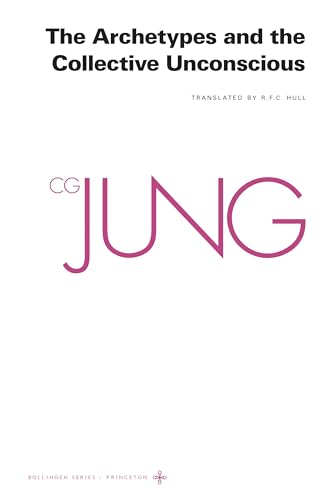
Inhaltsangabe
A collection of some of Jung’s most important essays on the archetypes and the collective unconscious
The Archetypes and the Collective Unconscious features many of Jung’s most important essays describing and elaborating on these two central, related concepts. The contents are:
- Archetypes of the Collective Unconscious (1934)
- The Concept of the Collective Unconscious (1936)
- Concerning the Archetypes, with Special Reference to the Anima Concept (1936)
- Psychological Aspects of the Mother Archetype (1938)
- Concerning Rebirth (1939)
- The Psychology of the Child Archetype (1940)
- The Psychological Aspects of the Kore (1941)
- The Phenomenology of the Spirit in Fairytales (1945)
- On the Psychology of the Trickster-Figure (1954)
- Conscious, Unconscious, and Individuation (1939)
- A Study in the Process of Individuation (1933)
- Concerning Mandala Symbolism (1950)
Die Inhaltsangabe kann sich auf eine andere Ausgabe dieses Titels beziehen.
Über die Autorin bzw. den Autor
C. G. Jung (1875–1961) was one of the most important psychologists of the twentieth century.
Auszug. © Genehmigter Nachdruck. Alle Rechte vorbehalten.
THE ARCHETYPES AND THE COLLECTIVE UNCONSCIOUS
By C. G. JUNG, GERHARD ADLER, R. F. C. HULLPRINCETON UNIVERSITY PRESS
Copyright © 1969 PRINCETON UNIVERSITY PRESS
All rights reserved.
ISBN: 978-0-691-09761-9All rights reserved.
Contents
EDITORIAL NOTE, v,
TRANSLATOR'S NOTE, vi,
LIST OF ILLUSTRATIONS, xi,
I,
Archetypes of the Collective Unconscious, 3,
The Concept of the Collective Unconscious, 42,
Concerning the Archetypes, with Special Reference to the Anima Concept, 54,
II,
Psychological Aspects of the Mother Archetype, 75,
III,
Concerning Rebirth, 113,
IV,
The Psychology of the Child Archetype, 151,
The Psychological Aspects of the Kore, 182,
V,
The Phenomenology of the Spirit in Fairytales, 207,
On the Psychology of the Trickster-Figure, 255,
VI,
Conscious, Unconscious, and Individuation, 275,
A Study in the Process of Individuation, 290,
Concerning Mandala Symbolism, 355,
APPENDIX: Mandalas, 385,
BIBLIOGRAPHY, 391,
INDEX, 419,
CHAPTER 1
ARCHETYPES OF THE COLLECTIVE UNCONSCIOUS
1 The hypothesis of a collective unconscious belongs to the class of ideas that people at first find strange but soon come to possess and use as familiar conceptions. This has been the case with the concept of the unconscious in general. After the philosophical idea of the unconscious, in the form presented chiefly by Carus and von Hartmann, had gone down under the overwhelming wave of materialism and empiricism, leaving hardly a ripple behind it, it gradually reappeared in the scientific domain of medical psychology.
2 At first the concept of the unconscious was limited to denoting the state of repressed or forgotten contents. Even with Freud, who makes the unconscious—at least metaphorically—take the stage as the acting subject, it is really nothing but the gathering place of forgotten and repressed contents, and has a functional significance thanks only to these. For Freud, accordingly, the unconscious is of an exclusively personal nature, although he was aware of its archaic and mythological thought-forms.
3 A more or less superficial layer of the unconscious is undoubtedly personal. I call it the personal unconscious. But this personal unconscious rests upon a deeper layer, which does not derive from personal experience and is not a personal acquisition but is inborn. This deeper layer I call the collective unconscious. I have chosen the term "collective" because this part of the unconscious is not individual but universal; in contrast to the personal psyche, it has contents and modes of behaviouT that are more or less the same everywhere and in all individuals. It is, in other words, identical in all men and thus constitutes a common psychic substrate of a suprapersonal nature which is present in every one of us.
4 Psychic existence can be recognized only by the presence of contents that are capable of consciousness. We can therefore speak of an unconscious only in so far as we are able to demonstrate its contents. The contents of the personal unconscious are chiefly the feeling-toned complexes, as they are called; they constitute the personal and private side of psychic life. The contents of the collective unconscious, on the other hand, are known as archetypes.
5 The term "archetype" occurs as early as Philo Judaeus, with reference to the Imago Dei (God-image) in man. It can also be found in Irenaeus, who says: "The creator of the world did not fashion these things directly from himself but copied them from archetypes outside himself." In the Corpus Hermeticum, God is called [TEXT NOT REPRODUCIBLE IN ASCII] (archetypal light). The term occurs several times in Dionysius the Areopagite, as for instance in De caelesti hierarchia, II, 4: "immaterial Archetypes," and in De divinis nominibus, I, 6: "Archetypal stone." The term "archetype" is not found in St. Augustine, but the idea of it is. Thus in De diversis quaestionibus LXXXIII he speaks of "ideae principales, 'which are themselves not formed ... but are contained in the divine understanding.'" "Archetype" is an explanatory paraphrase of the Platonic [TEXT NOT REPRODUCIBLE IN ASCII]. For our purposes this term is apposite and helpful, because it tells us that so far as the collective unconscious contents are concerned we are dealing with archaic or—I would say—primordial types, that is, with universal images that have existed since the remotest times. The term "representations collectives," used by Lévy-Bruhl to denote the symbolic figures in the primitive view of the world, could easily be applied to unconscious contents as well, since it means practically the same thing. Primitive tribal lore is concerned with archetypes that have been modified in a special way. They are no longer contents of the unconscious, but have already been changed into conscious formulae taught according to tradition, generally in the form of esoteric teaching. This last is a typical means of expression for the transmission of collective contents originally derived from the unconscious.
6 Another well-known expression of the archetypes is myth and fairytale. But here too we are dealing with forms that have received a specific stamp and have been handed down through long periods of time. The term "archetype" thus applies only indirectly to the "representations collectives," since it designates only those psychic contents which have not yet been submitted to conscious elaboration and are therefore an immediate datum of psychic experience. In this sense there is a considerable difference between the archetype and the historical formula that has evolved. Especially on the higher levels of esoteric teaching the archetypes appear in a form that reveals quite unmistakably the critical and evaluating influence of conscious elaboration. Their immediate manifestation, as we encounter it in dreams and visions, is much more individual, less understandable, and more naive than in myths, for example. The archetype is essentially an unconscious content that is altered by becoming conscious and by being perceived, and it takes its colour from the individual consciousness in which it happens to appear.
7 What the word "archetype" means in the nominal sense is clear enough, then, from its relations with myth, esoteric teaching, and fairytale. But if we try to establish what an archetype is psychologically, the matter becomes more complicated. So far mythologists have always helped themselves out with solar, lunar, meteorological, vegetal, and other ideas of the kind. The fact that myths are first and foremost psychic phenomena that reveal the nature of the soul is something they have absolutely refused to see until now. Primitive man is not much interested in objective explanations of the obvious, but he has an imperative need—or rather, his unconscious psyche has an irresistible urge—to assimilate all outer sense experiences to inner, psychic events. It is not enough for the primitive to see the sun rise and set; this external observation must at the same time be a psychic happening: the sun in its course must represent the fate of a god or hero who, in the last analysis, dwells nowhere except in the soul of man. All the mythologized processes of nature, such as summer and winter, the phases of the moon, the rainy seasons, and so forth, are in no sense allegories of these objective occurrences; rather they are symbolic expressions of the inner, unconscious drama of the psyche which becomes accessible...
„Über diesen Titel“ kann sich auf eine andere Ausgabe dieses Titels beziehen.
Suchergebnisse für Collected Works of C.G. Jung, Volume 9 (Part 1): Archetypes...

Beispielbild für diese ISBN
The Collected Works of C. G. Jung, Volume 9 (Part 1) : Archetypes and the Collective Unconscious
Verlag:
Princeton University Press, 1969
ISBN 10: 0691097615
ISBN 13: 9780691097619
Gebraucht
Hardcover
Anbieter: Better World Books, Mishawaka, IN, USA
Verkäuferbewertung 5 von 5 Sternen

Zustand: Very Good. Former library copy. Pages intact with possible writing/highlighting. Binding strong with minor wear. Dust jackets/supplements may not be included. Includes library markings. Stock photo provided. Product includes identifying sticker. Better World Books: Buy Books. Do Good. Artikel-Nr. 16835474-75
Gebraucht kaufen
EUR 58,67
Versand gratis
Versand innerhalb von USA
Versand innerhalb von USA
Anzahl: 1 verfügbar
Beispielbild für diese ISBN
The Collected Works of C. G. Jung, Vol. 9, Part 1: The Archetypes and the Collective Unconscious (Bollingen Series, No. 20)
Anbieter: Labyrinth Books, Princeton, NJ, USA
Verkäuferbewertung 5 von 5 Sternen
Zustand: New. Artikel-Nr. 133838
Neu kaufen
EUR 84,56
EUR 4,02 Versand
Versand innerhalb von USA
Versand innerhalb von USA
Anzahl: 10 verfügbar
Beispielbild für diese ISBN
Collected Works of C. G. Jung, Volume 9 (Part 1) Archetypes and the Collective Unconscious
Anbieter: Revaluation Books, Exeter, Vereinigtes Königreich
Verkäuferbewertung 5 von 5 Sternen
Hardcover. Zustand: Brand New. 2nd edition. 451 pages. 9.50x6.50x1.50 inches. In Stock. Artikel-Nr. 0691097615
Neu kaufen
EUR 150,04
EUR 14,77 Versand
Versand von Vereinigtes Königreich nach USA
Versand von Vereinigtes Königreich nach USA
Anzahl: 1 verfügbar