
Verwandte Artikel zu Plato: The Collected Dialogues Including the Letters...
Inhaltsangabe
A landmark one-volume edition of the complete Plato in classic modern translations
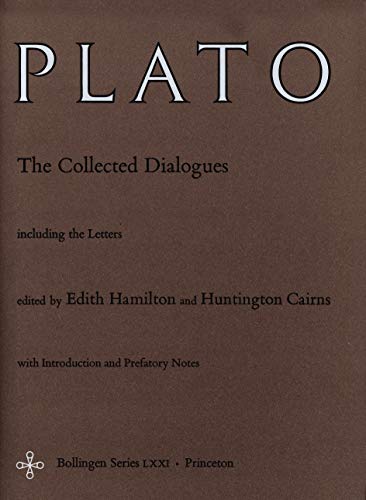
All the writings of Plato generally considered to be authentic are here presented in the only complete one-volume Plato available in English. The editors set out to choose the contents of this collected edition from the work of the best modern British and American translators. The volume contains prefatory notes to each dialogue, by Edith Hamilton; an introductory essay on Plato's philosophy and writings, by Huntington Cairns; and a comprehensive index with cross references to assist the reader with the philosophical vocabulary of the different translators.
Die Inhaltsangabe kann sich auf eine andere Ausgabe dieses Titels beziehen.
Über die Autorin bzw. den Autor
Edith Hamilton (1867–1963) was perhaps the most famous and influential classicist of the twentieth century. Her bestselling Mythology remains a standard version of the stories of the ancient world. Huntington Cairns (1904–1985) was a writer and lawyer who worked at different times for the U.S. Treasury, the National Gallery of Art in Washington, DC, and Johns Hopkins University.
Von der hinteren Coverseite
All the writings of Plato generally considered to be authentic are here presented in a single volume--the only complete one-volume Plato available in English. A comprehensive index is included.
Auszug. © Genehmigter Nachdruck. Alle Rechte vorbehalten.
The Collected Dialogues of Plato Including the Letters
By Edith Hamilton, Huntington CairnsPRINCETON UNIVERSITY PRESS
Copyright © 1961 John Clive Graves Rouse
All rights reserved.
ISBN: 978-0-691-09718-3All rights reserved.
Contents
EDITORIAL NOTE, xi,
INTRODUCTION, by Huntington Cairns, xiii,
SOCRATES' DEFENSE (APOLOGY), 3,
CRITO, 27,
PHAEDO, 40,
CHARMIDES, 99,
LACHES, 123,
LYSIS, 145,
EUTHYPHRO, 169,
MENEXENUS, 186,
LESSER HIPPIAS, 200,
ION, 215,
GORGIAS, 229,
PROTAGORAS, 308,
MENO, 353,
EUTHYDEMUS, 385,
CRATYLUS, 421,
PHAEDRUS, 475,
SYMPOSIUM, 526,
REPUBLIC, 575,
THEAETETUS, 845,
PARMENIDES, 920,
SOPHIST, 957,
STATESMAN, 1018,
PHILEBUS, 1086,
TIMAEUS, 1151,
CRITIAS, 1212,
LAWS, 1225,
APPENDIX,
EPINOMIS, 1517,
GREATER HIPPIAS, 1534,
LETTERS, 1560,
INDEX, 1607,
CHAPTER 1
SOCRATES' DEFENSE (APOLOGY)
The first three dialogues given here are an account of the last days and the death of Socrates. In what order Plato wrote the dialogues we do not know, but in reading them there is a good reason for beginning with those that center in the death of the chief personage. Only in them, is Socrates himself the subject. In the others, although almost always the main speaker, he rarely speaks of himself. Indeed, in two of the three latest dialogues he is only a listener, and in the last he does not even appear. But in these first three he talks at length about his life and his beliefs.
In his Defense, Socrates explains himself to his fellow citizens when he is brought before an Athenian court On a most serious charge. "Socrates is guilty of corrupting the minds of the young, and of believing in deities of his own invention instead of the gods recognized by the state." In the Apology, as it is generally known, he gives a detailed account of the way he has lived and the convictions he has reached.
At the end, when he is condemned to death, the few words in which he accepts the sentence are in themselves a vivid picture of the man he was, unlike any other there has ever been. Great spiritual leaders and great saints adorn the pages of history, but Socrates is not like, any of them. He is, indeed, the servant of the divine power, living in complete obedience to God; yet he always views the world of men with a bit of humor, a touch of irony. He spends his life in the effort to kindle into a flame the spark of good in every man, but when he fails, when he comes up against blind obstinacy or stupid conceit or the indifference of egotism, or when he draws down on himself bitter enmity, then along with his regret—because he cares for everyone—is mingled a little amusement, a feeling, as it were, of rueful sympathy, as it he said to himself, "What silly children we are." Socrates never condemned.
This significant clue to what he was is given most clearly in Socrates' Defense.
I do not know what effect my accusers have had upon you, gentlemen, but for my own part I was almost carried away by them—their arguments were so convincing. On the other hand, scarcely a word of what they said was true. I was especially astonished at one of their many misrepresentations; I mean when they told you that you must be careful not to let me deceive you—the implication being that I am a skillful speaker. I thought that it was peculiarly brazen of them to tell you this without a blush, since they must know that they will soon be effectively confuted, when it becomes obvious that I have not the slightest skill as a speaker—unless, of course, by a skillful speaker they mean one who speaks the truth. If that is what they mean, I would agree that I am an orator, though not after their pattern.
My accusers, then, as I maintain, have said little or nothing that is true, but from me you shall hear the whole truth—not, I can assure you, gentlemen, in flowery language like theirs, decked out with fine words and phrases. No, what you will hear will be a, straightforward speech in the first words that occur to me, confident as I am in the justice of my cause, and I do not want any of you to expect anything different. It would hardly be suitable, gentlemen, for a man of my age to address you in the artificial language of a schoolboy orator. One thing, however, I do most earnestly beg and entreat of you. If you hear me defending myself in the same language which it has been my habit to use, both in the open spaces of this city—where many of you have heard me—and elsewhere, do not be surprised, and do not interrupt. Let me remind you of my position. This is my first appearance in a court of law, at the age of seventy, and so I am a complete stranger to the language of this place. Now if I were really from another country, you would naturally excuse me if I spoke in the manner and dialect in which I had been brought up, and so in the present case I make this request of you, which I think is only reasonable, to disregard the manner of my speech—it may be better or it may be worse —and to consider and concentrate your attention upon this one question, whether my claims are fair or not. That is the first duty of the juryman, just as it is the pleader's duty to speak the truth.
The proper course for me, gentlemen of the jury, is to deal first with the earliest charges that have been falsely brought against me, and with my earliest accusers, and then with the later ones. I make this distinction because I have already been accused in your hearing by a great many people for a great many years, though without a word of truth, and I am more afraid of those people than I am of Anytus and his colleagues, although they are formidable enough. But the others are still more formidable. I mean the people who took hold of so many of you when you were children and tried to fill your minds with untrue accusations against me, saying, There is a wise man called Socrates who has theories about the heavens and has investigated everything below the earth, and can make the weaker argument defeat the stronger. ,
It is these people, gentlemen, the disseminators of these rumors, who are my dangerous accusers, because those who hear them suppose that anyone who inquires into such matters must be an atheist. Besides, there are a great many of these accusers, and they have been accusing me now for a great many years. And what is more, they approached you at the most impressionable age, when some of you were ,children or adolescents, and they literally won their case by default, because there was no one to defend me. And the most fantastic thing of; all is that it is impossible for me even to know and tell you their names, unless one of them happens to be a playwright. All these people, who have tried to set you against me out of envy and love of slander—and some too merely passing on what they have been told by others—all these are very difficult to deal with. It is impossible to bring them here for cross-examination; one simply has to conduct one's defense and argue one's case against an invisible opponent, because there is no one to answer. So I ask you to accept my statement that my critics fall into two classes, on the one hand my immediate accusers, and on the other those earlier ones whom I have mentioned, and you must suppose that I have first to defend myself against the latter. After all, you heard them abusing me longer ago and much more violently than these more recent accusers.
Very well, then, I must begin my defense,...
„Über diesen Titel“ kann sich auf eine andere Ausgabe dieses Titels beziehen.
Suchergebnisse für Plato: The Collected Dialogues Including the Letters...

Beispielbild für diese ISBN
The Collected Dialogues of Plato
Verlag:
Princeton University Press, 1961
ISBN 10: 0691097186
ISBN 13: 9780691097183
Gebraucht
Hardcover
Anbieter: World of Books (was SecondSale), Montgomery, IL, USA
Verkäuferbewertung 5 von 5 Sternen

Hardback. Zustand: Fair. All the writings of Plato generally considered to be authentic are here presented in the only complete one-volume Plato available in English. The editors set out to choose the contents of this collected edition from the work of the best British and American translators of the last 100 years, ranging from Jowett (1871) to scholars of the present day. The volume contains prefatory notes to each dialogue, by Edith Hamilton; an introductory essay on Plato's philosophy and writings, by Huntington Cairns; and a comprehensive index which seeks, by means of cross references, to assist the reader with the philosophical vocabulary of the different translators. Artikel-Nr. 00105332596
Gebraucht kaufen
EUR 13,12
Versand gratis
Versand innerhalb von USA
Versand innerhalb von USA
Anzahl: 3 verfügbar
Beispielbild für diese ISBN
The Collected Dialogues of Plato
Verlag:
Princeton University Press, 1961
ISBN 10: 0691097186
ISBN 13: 9780691097183
Gebraucht
Hardcover
Anbieter: Better World Books, Mishawaka, IN, USA
Verkäuferbewertung 5 von 5 Sternen
Zustand: Good. Pages intact with minimal writing/highlighting. The binding may be loose and creased. Dust jackets/supplements are not included. Stock photo provided. Product includes identifying sticker. Better World Books: Buy Books. Do Good. Artikel-Nr. 3984315-20
Gebraucht kaufen
EUR 17,09
Versand gratis
Versand innerhalb von USA
Versand innerhalb von USA
Anzahl: 1 verfügbar
Beispielbild für diese ISBN
The Collected Dialogues of Plato, Including the Letters
Anbieter: Magers and Quinn Booksellers, Minneapolis, MN, USA
Verkäuferbewertung 5 von 5 Sternen
hardcover. Zustand: Acceptable. May have underlining, highlighting, margin notes, remainder marks, inscriptions, book plates, tears, significant wear, and/or a missing dust jacket, box, or discs. Damaged item. Artikel-Nr. 1460508
Gebraucht kaufen
EUR 13,72
EUR 3,55 Versand
Versand innerhalb von USA
Versand innerhalb von USA
Anzahl: 2 verfügbar
Beispielbild für diese ISBN
The Collected Dialogues of Plato: Including the Letters (Bollingen Series LXXI)
Anbieter: Zubal-Books, Since 1961, Cleveland, OH, USA
Verkäuferbewertung 5 von 5 Sternen
Zustand: Very Good. 1989 printing; 1776 pp., Hardcover, very good in a lightly chipped and worn dust jacket that has some clear tape reinforcement to its spine panel. - If you are reading this, this item is actually (physically) in our stock and ready for shipment once ordered. We are not bookjackers. Buyer is responsible for any additional duties, taxes, or fees required by recipient's country. Artikel-Nr. ZB1355835
Gebraucht kaufen
EUR 18,16
EUR 4,00 Versand
Versand innerhalb von USA
Versand innerhalb von USA
Anzahl: 1 verfügbar
Beispielbild für diese ISBN
Plato. The Collected Dialogues incluiding the Letters
Anbieter: Librería 7 Colores, Madrid, M, Spanien
Verkäuferbewertung 5 von 5 Sternen
Tapa Dura. Zustand: Casi Nuevo. Artikel-Nr. 813336
Gebraucht kaufen
EUR 13,00
EUR 14,50 Versand
Versand von Spanien nach USA
Versand von Spanien nach USA
Anzahl: 1 verfügbar
Foto des Verkäufers
The Collected Dialogues of Plato: Including the Letters (Bollingen Series LXXI)
Verlag:
Princeton University Press, 1978
ISBN 10: 0691097186
ISBN 13: 9780691097183
Gebraucht
Hardcover
Anbieter: THE BOOK BROTHERS, CHATHAM, ON, Kanada
Verkäuferbewertung 4 von 5 Sternen

Hardcover. Zustand: Very Good +. Zustand des Schutzumschlags: Very Good -. Very good + copy. (see picture) 1743 pages including index. All clean and tight. Some very mild wear.Dustjacket in Brodart has some mild wear on the edges. Artikel-Nr. 019364
Gebraucht kaufen
EUR 45,08
EUR 9,33 Versand
Versand von Kanada nach USA
Versand von Kanada nach USA
Anzahl: 1 verfügbar
Beispielbild für diese ISBN
The Collected Dialogues of Plato: The Collected Dialogues Including the Letters: 18 (Bollingen Series)
Verlag:
Princeton University Press, 1992
ISBN 10: 0691097186
ISBN 13: 9780691097183
Gebraucht
Hardcover
Anbieter: Sell Books, Elland, YORKS, Vereinigtes Königreich
Verkäuferbewertung 5 von 5 Sternen
hardcover. Zustand: Acceptable. Please see the condition note after this for details, if this is missing please consider Acceptable to mean poor quality that could include major staining, water damage, writing, missing dustjacket, etc etc. Our books are dispatched from a Yorkshire former cotton mill. We list via barcode/ISBN so please note that the images are stock images and may not be the exact copy you receive, furthermore the details about edition and year might not be accurate as many publishers reuse the same ISBN for multiple editions and as we simply scan a barcode or enter an ISBN we do not check the validity of the edition data when listing. If you're looking for an exact edition please don't order (at least not without checking with us first, although we don't always have time to check). We aim to dispatch prompty, the service used will depend on order value and book size. We can ship to most countries, see our shipping policies. Payment is via Abe only. Artikel-Nr. P-BDF00372-RAG-20250627-A
Gebraucht kaufen
EUR 43,33
EUR 14,32 Versand
Versand von Vereinigtes Königreich nach USA
Versand von Vereinigtes Königreich nach USA
Anzahl: 1 verfügbar
Beispielbild für diese ISBN
The Collected Dialogues. Including Letters
ISBN 10: 0691097186
ISBN 13: 9780691097183
Gebraucht
Hardcover
Anbieter: Librairie de l'Avenue - Henri Veyrier, Saint-Ouen, FR, Frankreich
Verkäuferbewertung 5 von 5 Sternen
Couverture rigide. Zustand: Bon état. Zustand des Schutzumschlags: Satisfaisant. Livre en anglais. In-8 reliure éd. sous jaquette 22,8 cm sur 16. 1743 pages. Jaquette légèrement passée et effrangée, intérieur frais. Jaquette en état satisfaisant. Bon état d'occasion. Twelfth printing. Edited by Edith Hamilton and Huntington Cairns in-8°. Artikel-Nr. 123252
Gebraucht kaufen
EUR 31,00
EUR 35,00 Versand
Versand von Frankreich nach USA
Versand von Frankreich nach USA
Anzahl: 1 verfügbar
Foto des Verkäufers
The Collected Dialogues of Plato Including the Letters
Verlag:
Princeton University Press, Princeton, 1985
ISBN 10: 0691097186
ISBN 13: 9780691097183
Gebraucht
Hardcover
Anbieter: Main Street Fine Books & Mss, ABAA, Galena, IL, USA
Verkäuferbewertung 5 von 5 Sternen
Hardcover. Edited by Edith Hamilton and Huntington Cairns. 8vo. Green cloth with gilt spine lettering, dust jacket. xxv, 1742pp. Near fine/very good. Quite minor jacket edgewear only. Handsome and tight twelfth printing of Bollingen Series LXXI, a massive tome first published in 1961. Artikel-Nr. 51951
Gebraucht kaufen
EUR 68,65
EUR 5,33 Versand
Versand innerhalb von USA
Versand innerhalb von USA
Anzahl: 1 verfügbar
Foto des Verkäufers
Plato _ The Collected Dialogues _ Including the Letters
Verlag:
Bollingen Series LXXI, Princeton, 1989
ISBN 10: 0691097186
ISBN 13: 9780691097183
Gebraucht
Hardcover
Anbieter: San Francisco Book Company, Paris, Frankreich
Verkäuferbewertung 5 von 5 Sternen
Hardcover. Zustand: Very good. Zustand des Schutzumschlags: very good. Hardcover Duodecimo. green boards, gilt lettering, dust jacket, 1738 pp. Artikel-Nr. 116224
Gebraucht kaufen
EUR 40,00
EUR 45,00 Versand
Versand von Frankreich nach USA
Versand von Frankreich nach USA
Anzahl: 1 verfügbar