
Verwandte Artikel zu The computer from Pascal to von Neumann
Inhaltsangabe
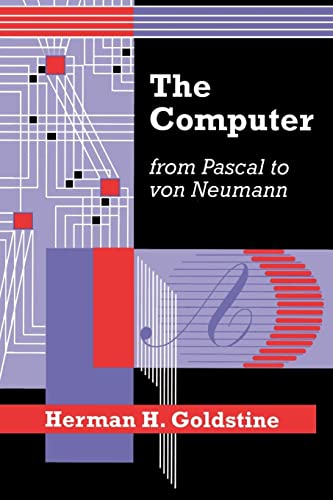
In 1942, Lt. Herman H. Goldstine, a former mathematics professor, was stationed at the Moore School of Electrical Engineering at the University of Pennsylvania. It was there that he assisted in the creation of the ENIAC, the first electronic digital computer. The ENIAC was operational in 1945, but plans for a new computer were already underway. The principal source of ideas for the new computer was John von Neumann, who became Goldstine's chief collaborator. Together they developed EDVAC, successor to ENIAC. After World War II, at the Institute for Advanced Study, they built what was to become the prototype of the present-day computer. Herman Goldstine writes as both historian and scientist in this first examination of the development of computing machinery, from the seventeenth century through the early 1950s. His personal involvement lends a special authenticity to his narrative, as he sprinkles anecdotes and stories liberally through his text.
Die Inhaltsangabe kann sich auf eine andere Ausgabe dieses Titels beziehen.
Über die Autorin bzw. den Autor
Herman H. Goldstine is currently Executive Officer of the American Philosophical Society.
Auszug. © Genehmigter Nachdruck. Alle Rechte vorbehalten.
The Computer from Pascal to von Neumaun
By Herman H. GoldstinePrinceton University Press
Copyright © 1972 Princeton University PressAll right reserved.
ISBN: 978-0-691-08104-5
Contents
Preface (1993)..................................................................................................ixPreface.........................................................................................................xiPART ONE: The Historical Background up to World War II..........................................................11. Beginnings...................................................................................................32. Charles Babbage and His Analytical Engine....................................................................103. The Astronomical Ephemeris...................................................................................274. The Universities: Maxwell and Boole..........................................................................315. Integrators and Planimeters..................................................................................396. Michelson, Fourier Coefficients, and the Gibbs Phenomenon....................................................527. Boolean Algebra: x2 = xx = x......................................................................608. Billings, Hollerith, and the Census..........................................................................659. Ballistics and the Rise of the Great Mathematicians..........................................................7210. Bush's Differential Analyzer and Other Analog Devices.......................................................8411. Adaptation to Scientific Needs..............................................................................10612. Renascence and Triumph of Digital Means of Computation......................................................115PART TWO: Wartime Developments: ENIAC and EDVAC.................................................................1211. Electronic. Efforts prior to the ENIAC.......................................................................1232. The Ballistic Research Laboratory............................................................................1273. Differences between Analog and Digital Machines..............................................................1404. Beginnings of the ENIAC......................................................................................1485. The ENIAC: as a Mathematical Instrument......................................................................1576. John von Neumann and. the Computer...........................................................................1677. Beyond the ENIAC.............................................................................................1848. The Structure of the EDVAC...................................................................................2049. The Spread of Ideas..........................................................................................21110. First Calculations on the ENIAC.............................................................................225PART THREE: Post-World War II: The von Neumann Machine and The Institute for Advanced Study.....................2371. Post–EDVAC Days........................................................................................2392. The Institute for Advanced Study Computer....................................................................2523. Automata Theory and Logic Machines...........................................................................2714. Numerical Mathematics........................................................................................2865. Numerical Meteorology........................................................................................3006. Engineering Activities and Achievements......................................................................3067. The Computer and UNESCO......................................................................................3218. The Early Industrial Scene...................................................................................3259. Programming Languages........................................................................................33310. Conclusions.................................................................................................342APPENDIX: World-Wide Developments...............................................................................349Index...........................................................................................................363
Chapter One
Beginnings
There is of course never an initial point for any history prior to which nothing of relevance happened and subsequent to which it did. It seems to be the nature of man's intellectual activity that in most fields one can. always find by sufficiently diligent search a more or less unending regression back in time of. early efforts to study a problem or at least: to give it some very tentative dimensions. So it is with our field.
Since this is the case, I have chosen somewhat arbitrarily to make only passing references to the history of computers prior to 1600 and to say only the briefest word about the period before 1800. In fact, the only remarks I wish to make about this period are largely anticipatory ones to my main theme which concerns the early electronic digital calculators. The only excuse for this arbitrariness is that to say more on these earlier periods would add very little to our total knowledge of the electronic computer. I shall digress on a few occasions because of the colorfulness of one or another of the intellectual figures involved or because it seems desirable to establish in our minds some feeling for the intellectual, cultural, or social background of a givers period.
Perhaps, however, this choice is not completely arbitrary. If we accept the quite reasonable point of view of scholars such as Needham, we see that in a real sense the date of 1600 may be viewed as a watershed in scientific history. Prior to Galileo (1564–1642) there were of course intellectual giants, but his great contribution was to mathematicize the physical sciences. Ma"y great scientists before him had investigated nature and made measurements, but the world needed Galileo to give these data "the magic touch of mathematical formulation."
It is worth recalling that prior to this time the state of mathematics in. Europe was not substantially more advanced than that in the Arab world, based as it was on European and Chinese ideas and concepts. Then suddenly, as a result of a bringing together of mathematics and physics, something happened in Europe that started science on the path that led from Galileo to Newton. This melding of practical and empirical knowledge with mathematics was the magic touchstone. In about 1580 Francois Vieta (1540–1603) in an earth-shaking discovery introduced the use of letters for unknowns or general parameters into mathematics. The subjects we now call algebra and arithmetic were called by him logistica speciosa and logistica numerosa, respectively. He was followed, from our point of view, by John Napier, Laird of Merchiston (1550–1617), who in 1614 invented logarithms and who also was perhaps the first man to understand, in his Rabdologia in 1617, the use of the decimal point in arithmetical operations; and by Edmund Gunter (1581–1626), who in 1620 invented a forerunner of the slide rule, which was actually invented...
„Über diesen Titel“ kann sich auf eine andere Ausgabe dieses Titels beziehen.
Suchergebnisse für The computer from Pascal to von Neumann

Beispielbild für diese ISBN
The Computer from Pascal to von Neumann
Verlag:
Princeton University Press, 1972
ISBN 10: 0691081042
ISBN 13: 9780691081045
Gebraucht
Hardcover
Anbieter: World of Books (was SecondSale), Montgomery, IL, USA
Verkäuferbewertung 5 von 5 Sternen

Hardback. Zustand: Fair. In 1942, Lt. Herman H. Goldstine, a former mathematics professor, was stationed at the Moore School of Electrical Engineering at the University of Pennsylvania. It was there that he assisted in the creation of the ENIAC, the first electronic digital computer. The ENIAC was operational in 1945, but plans for a new computer were already underway. The principal source of ideas for the new computer was John von Neumann, who became Goldstine's chief collaborator. Together they developed EDVAC, successor to ENIAC. After World War II, at the Institute for Advanced Study, they built what was to become the prototype of the present-day computer. Herman Goldstine writes as both historian and scientist in this first examination of the development of computing machinery, from the seventeenth century through the early 1950s. His personal involvement lends a special authenticity to his narrative, as he sprinkles anecdotes and stories liberally through his text. Artikel-Nr. CIN0691081042A
Gebraucht kaufen
EUR 4,85
Versand gratis
Versand innerhalb von USA
Versand innerhalb von USA
Anzahl: 1 verfügbar
Beispielbild für diese ISBN
The Computer from Pascal to von Neumann
Verlag:
Princeton University Press, 1972
ISBN 10: 0691081042
ISBN 13: 9780691081045
Gebraucht
Hardcover
Anbieter: Better World Books, Mishawaka, IN, USA
Verkäuferbewertung 5 von 5 Sternen
Zustand: Good. Former library copy. Pages intact with minimal writing/highlighting. The binding may be loose and creased. Dust jackets/supplements are not included. Includes library markings. Stock photo provided. Product includes identifying sticker. Better World Books: Buy Books. Do Good. Artikel-Nr. GRP70281189
Gebraucht kaufen
EUR 7,57
Versand gratis
Versand innerhalb von USA
Versand innerhalb von USA
Anzahl: 2 verfügbar
Beispielbild für diese ISBN
The Computer from Pascal to Von Neumann
Verlag:
Princeton University Press, 1972
ISBN 10: 0691081042
ISBN 13: 9780691081045
Gebraucht
Hardcover
Anbieter: ThriftBooks-Dallas, Dallas, TX, USA
Verkäuferbewertung 5 von 5 Sternen
Hardcover. Zustand: Good. No Jacket. Pages can have notes/highlighting. Spine may show signs of wear. ~ ThriftBooks: Read More, Spend Less. Artikel-Nr. G0691081042I3N00
Gebraucht kaufen
EUR 8,52
Versand gratis
Versand innerhalb von USA
Versand innerhalb von USA
Anzahl: 1 verfügbar
Beispielbild für diese ISBN
The Computer from Pascal to von Neumann
Verlag:
Princeton University Press, 1972
ISBN 10: 0691081042
ISBN 13: 9780691081045
Gebraucht
Hardcover
Anbieter: Wonder Book, Frederick, MD, USA
Verkäuferbewertung 5 von 5 Sternen
Zustand: Good. Good condition. Good dust jacket. A copy that has been read but remains intact. May contain markings such as bookplates, stamps, limited notes and highlighting, or a few light stains. Artikel-Nr. D03OS-00013
Gebraucht kaufen
EUR 24,74
Versand gratis
Versand innerhalb von USA
Versand innerhalb von USA
Anzahl: 2 verfügbar
Beispielbild für diese ISBN
The Computer from Pascal to von Neumann
Verlag:
Princeton University Press, 1972
ISBN 10: 0691081042
ISBN 13: 9780691081045
Gebraucht
Hardcover
Anbieter: Wonder Book, Frederick, MD, USA
Verkäuferbewertung 5 von 5 Sternen
Zustand: Fair. Acceptable condition. Acceptable dust jacket. A readable, intact copy that may have noticeable tears and wear to the spine. All pages of text are present, but they may include extensive notes and highlighting or be heavily stained. Includes reading copy only books. Artikel-Nr. V03OS-00045
Gebraucht kaufen
EUR 27,49
Versand gratis
Versand innerhalb von USA
Versand innerhalb von USA
Anzahl: 2 verfügbar
Beispielbild für diese ISBN
Goldstine: The Computer from Pascal to Von Neumann (Cloth)
Verlag:
Princeton University Press, 1973
ISBN 10: 0691081042
ISBN 13: 9780691081045
Gebraucht
Hardcover
Anbieter: Anybook.com, Lincoln, Vereinigtes Königreich
Verkäuferbewertung 5 von 5 Sternen
Zustand: Fair. This is an ex-library book and may have the usual library/used-book markings inside.This book has hardback covers. Book contains pencil markings. In fair condition, suitable as a study copy. No dust jacket. Please note the Image in this listing is a stock photo and may not match the covers of the actual item,800grams, ISBN:0691081042. Artikel-Nr. 8764300
Gebraucht kaufen
EUR 29,73
EUR 15,53 Versand
Versand von Vereinigtes Königreich nach USA
Versand von Vereinigtes Königreich nach USA
Anzahl: 1 verfügbar
Beispielbild für diese ISBN
THE COMPUTER FROM PASCAL TO VON NEUMANN
Verlag:
Princeton University Press, Princeton, NJ, 1972
ISBN 10: 0691081042
ISBN 13: 9780691081045
Gebraucht
Hardcover
Erstausgabe
Anbieter: J. Wyatt Books, Ottawa, ON, Kanada
Verkäuferbewertung 5 von 5 Sternen
Hardcover. Zustand: VG+. Zustand des Schutzumschlags: VG-. First Edition. 378 pages in very good condition. Illustrated. Previous owner's small stamp on the ffep and top edge. Black hardcovers with silver titles on the spine. Corners not bumped. White/black, illustrated DJ with black titles. Light wear on corners and edges, small stains on the upper jacket. VG+/VG-. Book. Artikel-Nr. 215778
Gebraucht kaufen
EUR 36,93
EUR 20,49 Versand
Versand von Kanada nach USA
Versand von Kanada nach USA
Anzahl: 1 verfügbar
Foto des Verkäufers
The Computer from Pascal to von Neumann
Verlag:
Princeton University Press, 1972
ISBN 10: 0691081042
ISBN 13: 9780691081045
Gebraucht
Hardcover
Erstausgabe
Anbieter: Arroyo Seco Books, Pasadena, Member IOBA, Pasadena, CA, USA
Verkäuferbewertung 4 von 5 Sternen

Hardcover. Zustand: Near Fine. Zustand des Schutzumschlags: Very Good + Jacket. 1st Edition. Xi, 378 Pp. Black Cloth. First Printing. No Wear But Faint Rippling To Top Of Pages In Later Third Of Book. Dust Jacket Priced $12.95, Slight Usage, Wear To Upper Front Spine Edge. Artikel-Nr. 056572
Gebraucht kaufen
EUR 94,49
EUR 8,02 Versand
Versand innerhalb von USA
Versand innerhalb von USA
Anzahl: 1 verfügbar