
Verwandte Artikel zu The Poetry of Rimbaud (Princeton Legacy Library, 1318)
Inhaltsangabe
In this interpretative analysis of the poetry of Rimbaud, Robert Greer Cohn first introduces the reader to the work of Rimbaud and outlines the poet's precocious, meteoric career. He then integrates the various aspects of the poetry into a coherent view, one which avoids a tendentious or reductive approach and does not fit some of the poems into a system and omit the rest. The early poems are given their due importance, and the difficult Illuminations are at last made accessible.
This will be the standard book on the subject, one which will long be read and consulted by teachers and students of Rimbaud's poetry. It provides analyses of key passages of the poems, with detailed clarifications of difficult lines and even words. The author reaches many sound fresh conclusions, often by confronting resistant passages with similar ones from other works or with the work of other poets close to him in spirit.
This is an intelligent and serious book which faces the direct beauty of the text and tries with honesty to explain all the difficulties while further enhancing the reader's sense of mystery.
Originally published in 1974.
The Princeton Legacy Library uses the latest print-on-demand technology to again make available previously out-of-print books from the distinguished backlist of Princeton University Press. These editions preserve the original texts of these important books while presenting them in durable paperback and hardcover editions. The goal of the Princeton Legacy Library is to vastly increase access to the rich scholarly heritage found in the thousands of books published by Princeton University Press since its founding in 1905.
Die Inhaltsangabe kann sich auf eine andere Ausgabe dieses Titels beziehen.
Auszug. © Genehmigter Nachdruck. Alle Rechte vorbehalten.
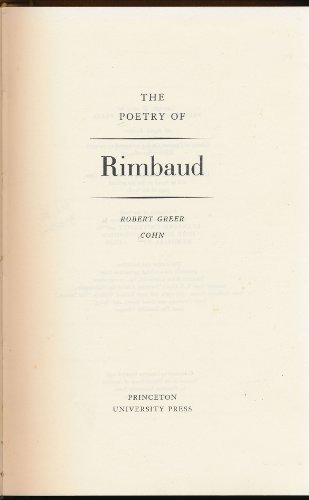
The Poetry of Rimbaud
By Robert Greer CohnPRINCETON UNIVERSITY PRESS
Copyright © 1973 PRINCETON UNIVERSITY PRESS
All rights reserved.
ISBN: 978-0-691-06244-0All rights reserved.
Contents
PREFACE, XI,
INTRODUCTION, 3,
I THE EARLY POEMS,
Les Étrennes des orphelins, 31,
Sensation, 37,
Soleil et chair, 38,
Ophélie, 44,
Bal des Pendus, 47,
Le Châtiment de Tartufe, 49,
Le Forgeron, 49,
Morts de Quatre-vingt-douze ..., 53,
Àla musique, 53,
Vénus Anadyomène, 56,
Première Soirée, 57,
Les Reparties de Nina, 59,
Les Effarés, 65,
Roman, 70,
Le Mal, 73,
Rages de Césars, 73,
Rêvé pour l'hiver, 73,
Le Dormeur du val, 74,
Au Cabaret-Vert, 76,
La Maline, 78,
L'Éclatante victoire de Saarebruck, 78,
Le Buffet, 79,
Ma Bohème, 81,
Les Corbeaux, 84,
Les Assis, 87,
Tête de faune, 90,
Les Douaniers, 91,
Oraison du soir, 92,
Chant de guerre parisien, 94,
Mes petites amoureuses, 94,
Accroupissements Bonne pensee du matin, 96,
Les Poètes de sept ans, 97,
Les Pauvres à l'église, 106,
Le Creur volé, 109,
L'Orgie parisienne ou Paris se repeuple, 111,
Les Mains de Jeanne-Marie, 114,
Les Soeurs de charité, 119,
Voyelles, 126,
L'Étoile a pleure rose, 133,
Ce qu'on dit au poete apropos de fleurs, 139,
Les Premières Communions, 146,
Les Chercheuses de poux, 153,
Le Bateau ivre, 156,
II DENIERS VERS,
Introductory Note, 175,
Larme, 176,
La Rivière de Cassis, 180,
Comédie de la soif, 183,
Bonne pensée du matin, 191,
Fêtes de la patience:, 194,
Bannières de mai, 194,
Chanson de la plus haute tour, 198,
L'Éternité, 201,
Age d'or, 204,
Jeune ménage, 208,
Bruxelles, 212,
Est-elle almée?, 215,
Fetes de la faim, 216,
Qu'est-ce pour nous, mon caur ..., 220,
Entends comme brame, 223,
Michel et Christine, 225,
Honte, 228,
Mémoire, 230,
O Saisons, ô chateaux ..., 236,
Le loup criait sous les feuilles ..., 240,
III ILLUMINATIONS,
Introductory Note, 245,
Après le déluge, 246,
Enfance, 253,
Conte, 266,
Parade, 270,
Antique, 275,
Being beauteous, 276,
Vies, 280,
Départ, 285,
Royauté, 287,
À une raison, 287,
Matinée d'ivresse, 290,
Phrases, 294,
Ouvriers, 299,
Les Ponts, 301,
Ville, 304,
Ornières, 305,
Villes, I, 307,
Vagabonds, 314,
Villés, II, 316,
Veillees, 321,
Mystique, 326,
Aube, 329,
Fleurs, 333,
Nocturne vulgaire, 336,
Marine, 340,
Fête d'hiver, 341,
Angoisse, 343,
Métropolitain, 346,
Barbare, 350,
Solde, 354,
Fairy, 357,
Guerre, 360,
Jeunesse, 362,
Promontoire, 368,
Scènes, 371,
Soir historique, 374,
Bottom, 377,
H., 380,
Mouvement, 381,
Dévotion, 385,
Démocratie, 389,
Génie, 390,
IV SAISON EN ENFER,
Introductory Synopsis, 401,
Jadis, si je me souviens bien ..., 413,
Mauwais sang, 414,
Nuit de l'enfer, 420,
Délires I: Vierge folle, 423,
Délires II: Alchimie du verbe, 425,
L'Impossible, 429,
L'Eclair, 431,
Matin, 433,
Adieu, 435,
Bibliography, 439,
Index, 443,
CHAPTER 1
THE EARLY POEMS
Les Etrennes des Orphelins
This is the earliest of Rimbaud's published poems and the first poem in verse we have of his aside from the Latin exercises. It appeared in the Revue pour tous in January 1870, having been written in Rimbaud's fourteenth or fif teenth year. Various influences have been discovered: Reboul's "L'Ange et l'enfant" (which was the subject given in his school for a Latin verse-composition: Rimbaud's "Ver erat") ; Coppée's "Enfants trouvés," Hugo's "Pauvres gens." The following lines from Hugo's "La Prière pour tous" (Les Feuilles d'automne ) seem to me to have impressed young Rimbaud even more:
C'est l'heure où les enfants parlent avec les anges
* * *
Et puis ils dormiront. — Alors, épars clans l'ombre,
Les rêves d'or, essaim tumultueux, sans nombre,
Qui naî't aux derniers bruits du jour à son déclin
* * *
Viendront s'abattre en foule à leurs rideaux de lin.
* * *
Ainsi que l'oiseau met sa tete sous son aile,
L'enfant clans la prière enclort son jeune esprit.
The poem has been described as a pastiche (of Coppée, among others), but the self-pitying sincerity of it strikes one even more than whatever ironic intention. This is the earliest of the many references Rimbaud makes to his abandoned state. It is a typical fantasy of nostalgia for nest- or womb-warmth and the lost "happy family" — one is aware of many such sentimental evocations in literature, for example, Dickens' David Copperfield, Charles Kingsley's Water Babies. Whether we regard it as shallow, sentimental pathos or the expression of tragically profound deprivation may depend on how defensive we ourselves are: knowing what was behind it, in Rimbaud's case, I find it suggestive of genuine pain in certain passages.
The poem is useful to us because it presents numerous important themes in simple forms which can help us to see through some very complex imageries.
2. De deux enfants le triste et doux chuchotement.
The presence of two conspiratorial children lightens the orphan burden somewhat, puts the poem in the realm of gentle pathos, the mood of "triste et doux." Richard would call this fadeur — I find that to be a too systematic and condescending approach to such Verlainian moods.
4. Sous le long rideau blanc qui tremble et se soulève ...
The "rideau" is the bed-curtain, by context; like the lovely presence of air lifting and billowing out window-curtains, the "tremble et se souleve" delicately hints at the ghostly hovering of absent and dreamed-of ("reve" in line 3) parents or of some such consoling notion: "il y avait des visions derriere la gaze des rideaux" (second "Lettre du voyant").
5. — Au dehors les oiseaux se rapprochent frileux; Leur aile s'engourdit sous le ton gris des cieux;
As in "Les Effarês," there is an ambivalent tone of warmth and cold which dominates the poem; it exists mainly in a mid-realm-something like a delightful shiver-between the pleasure of nostalgia and indoor snugness versus deprivation and external cold. The birds, victims of the outer chill, are associated with the deprivation as are the poor worker's children in "Les Poètes de sept ans," "Les Effarés." The double mood is carried on in:
9. Sourit avec les pleurs, et chante en grelottant ...
12. Ils ecoutent, pensifs, comme un lointain murmure ...
Ils tressaillent souvent a la claire voix d'or
Du timbre matinal, qui frappe et frappe encor
Son refrain...
„Über diesen Titel“ kann sich auf eine andere Ausgabe dieses Titels beziehen.
Suchergebnisse für The Poetry of Rimbaud (Princeton Legacy Library, 1318)

Beispielbild für diese ISBN
The Poetics of Indeterminacy: Rimbaud to Cage.
Verlag:
Evanston, Illinois: Northwestern University Press., 1983
ISBN 10: 0691062447
ISBN 13: 9780691062440
Gebraucht
Softcover
Anbieter: Wittenborn Art Books, San Francisco, CA, USA
Verkäuferbewertung 5 von 5 Sternen

Zustand: Good. 8vo. 346 pp., Very Good, Trade Paperback, some sun-fading, staining, rubbing, and edge wear on covers; minor staining on edges of text block; shelf wear. Photographs. First Northwestern University Press Printing. Artikel-Nr. 16-2240
Gebraucht kaufen
EUR 32,18
EUR 8,93 Versand
Versand innerhalb von USA
Versand innerhalb von USA
Anzahl: 1 verfügbar
Beispielbild für diese ISBN
The Poetry of Rimbaud (Princeton Legacy Library)
Anbieter: Labyrinth Books, Princeton, NJ, USA
Verkäuferbewertung 5 von 5 Sternen
Zustand: New. Artikel-Nr. 278111
Neu kaufen
EUR 42,27
EUR 4,02 Versand
Versand innerhalb von USA
Versand innerhalb von USA
Anzahl: 1 verfügbar
Beispielbild für diese ISBN
The Poetry of Rimbaud
Verlag:
Princeton University Press, 1973
ISBN 10: 0691062447
ISBN 13: 9780691062440
Gebraucht
Hardcover
Anbieter: Anybook.com, Lincoln, Vereinigtes Königreich
Verkäuferbewertung 5 von 5 Sternen
Zustand: Fair. This is an ex-library book and may have the usual library/used-book markings inside.This book has hardback covers. Book contains pencil markings. In fair condition, suitable as a study copy. Re-bound by library. Please note the Image in this listing is a stock photo and may not match the covers of the actual item,850grams, ISBN:0691062447. Artikel-Nr. 4946156
Gebraucht kaufen
EUR 33,55
EUR 15,41 Versand
Versand von Vereinigtes Königreich nach USA
Versand von Vereinigtes Königreich nach USA
Anzahl: 1 verfügbar
Beispielbild für diese ISBN
The Poetry of Rimbaud
Verlag:
Princeton University Press, 1974
ISBN 10: 0691062447
ISBN 13: 9780691062440
Gebraucht
Hardcover
Anbieter: Anybook.com, Lincoln, Vereinigtes Königreich
Verkäuferbewertung 5 von 5 Sternen
Zustand: Poor. This is an ex-library book and may have the usual library/used-book markings inside.This book has hardback covers. In poor condition, suitable as a reading copy. Please note the Image in this listing is a stock photo and may not match the covers of the actual item,950grams, ISBN:0691062447. Artikel-Nr. 3945876
Gebraucht kaufen
EUR 36,51
EUR 15,41 Versand
Versand von Vereinigtes Königreich nach USA
Versand von Vereinigtes Königreich nach USA
Anzahl: 1 verfügbar
Beispielbild für diese ISBN
The Poetry of Rimbaud (Princeton Legacy Library)
Verlag:
Princeton University Press, 1974
ISBN 10: 0691062447
ISBN 13: 9780691062440
Gebraucht
Hardcover
Anbieter: Buchpark, Trebbin, Deutschland
Verkäuferbewertung 5 von 5 Sternen
Zustand: Gut. Zustand: Gut | Seiten: 462 | Sprache: Englisch | Produktart: Bücher | Keine Beschreibung verfügbar. Artikel-Nr. 39671496/203
Gebraucht kaufen
EUR 22,56
EUR 105,00 Versand
Versand von Deutschland nach USA
Versand von Deutschland nach USA
Anzahl: 1 verfügbar
Foto des Verkäufers
The Poetics of Indeterminacy: Rimbaud to Cage
Verlag:
Princeton University Press, Princeton, New Jersey, 1981
ISBN 10: 0691062447
ISBN 13: 9780691062440
Gebraucht
Hardcover
Erstausgabe
Signiert
Anbieter: Between the Covers-Rare Books, Inc. ABAA, Gloucester City, NJ, USA
Verkäuferbewertung 5 von 5 Sternen
Hardcover. Zustand: Very Good. Zustand des Schutzumschlags: Good. First edition. 346pp. Pen marginalia and underlining throughout, spine ends and corners lightly bumped, very good in a good only dust jacket with internal foxing and tape repair, two-inch creased tear on front panel bottom edge. Warmly Inscribed by Perloff to author and translator Bertrand Mathieu on the half-title and Signed by Bertrand Mathieu on the front fly. Additionally laid in is a typed letter address to "Bert" and Signed by "Marjorie.". Artikel-Nr. 610353
Gebraucht kaufen
EUR 137,89
EUR 4,91 Versand
Versand innerhalb von USA
Versand innerhalb von USA
Anzahl: 1 verfügbar