
Verwandte Artikel zu Learning and Expectations in Macroeconomics (Frontiers...
Learning and Expectations in Macroeconomics (Frontiers of Economic Research) - Hardcover
Buch 2 von 4: Frontiers of Economic Research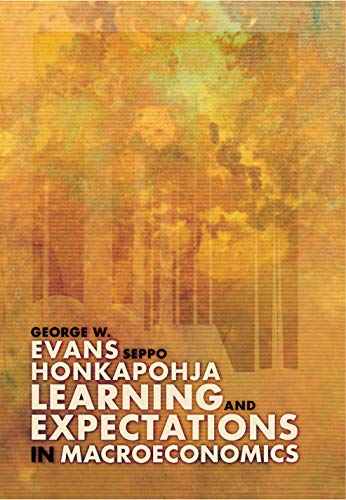
Inhaltsangabe
A crucial challenge for economists is figuring out how people interpret the world and form expectations that will likely influence their economic activity. Inflation, asset prices, exchange rates, investment, and consumption are just some of the economic variables that are largely explained by expectations. Here George Evans and Seppo Honkapohja bring new explanatory power to a variety of expectation formation models by focusing on the learning factor. Whereas the rational expectations paradigm offers the prevailing method to determining expectations, it assumes very theoretical knowledge on the part of economic actors. Evans and Honkapohja contribute to a growing body of research positing that households and firms learn by making forecasts using observed data, updating their forecast rules over time in response to errors. This book is the first systematic development of the new statistical learning approach.
Depending on the particular economic structure, the economy may converge to a standard rational-expectations or a "rational bubble" solution, or exhibit persistent learning dynamics. The learning approach also provides tools to assess the importance of new models with expectational indeterminacy, in which expectations are an independent cause of macroeconomic fluctuations. Moreover, learning dynamics provide a theory for the evolution of expectations and selection between alternative equilibria, with implications for business cycles, asset price volatility, and policy. This book provides an authoritative treatment of this emerging field, developing the analytical techniques in detail and using them to synthesize and extend existing research.
Die Inhaltsangabe kann sich auf eine andere Ausgabe dieses Titels beziehen.
Über die Autorin bzw. den Autor
George W. Evans is John B. Hamacher Professor of Economics at the University of Oregon and has held positions at the London School of Economics, Stanford University, and the University of Edinburgh. Seppo Honkapohja is Professor of Economics at the University of Helsinki, where he has currently been appointed Academy Professor. Professors Evans and Honkapohja have published extensively in economic journals, and each is best known for his respective research on expectations and learning in dynamic models. This book is the outgrowth of over fifteen years of collaboration between them.
Von der hinteren Coverseite
"This excellent book brings together and extends two decades of work on learning in self-referential equilibrium models in macroeconomics. The discussions presented by George Evans and Seppo Honkapohja are technically superb, well written, and well motivated in terms of content."--Thomas Sargent, Stanford University and Hoover Institution
"An important methodological and technical achievement that will set the standard against which all other macroeconomic learning analyses must be measured. Economists need to know how to analyze systems under the recursive learning assumption and what kind of results can be obtained. Evans and Honkapohja have fully worked out methods to analyze the resulting dynamics."--James Bullard, Assistant Vice President and Economist, Federal Reserve Bank of St. Louis
Aus dem Klappentext
"This excellent book brings together and extends two decades of work on learning in self-referential equilibrium models in macroeconomics. The discussions presented by George Evans and Seppo Honkapohja are technically superb, well written, and well motivated in terms of content."--Thomas Sargent, Stanford University and Hoover Institution
"An important methodological and technical achievement that will set the standard against which all other macroeconomic learning analyses must be measured. Economists need to know how to analyze systems under the recursive learning assumption and what kind of results can be obtained. Evans and Honkapohja have fully worked out methods to analyze the resulting dynamics."--James Bullard, Assistant Vice President and Economist, Federal Reserve Bank of St. Louis
„Über diesen Titel“ kann sich auf eine andere Ausgabe dieses Titels beziehen.
Suchergebnisse für Learning and Expectations in Macroeconomics (Frontiers...

Foto des Verkäufers
Learning and Expectations in Macroeconomics. Frontiers of Economic Research.
Verlag:
Princeton University Press, 2001
ISBN 10: 0691049211
ISBN 13: 9780691049212
Gebraucht
Hardcover
Anbieter: books4less (Versandantiquariat Petra Gros GmbH & Co. KG), Welling, Deutschland
Verkäuferbewertung 5 von 5 Sternen

gebundene Ausgabe. Zustand: Gut. 421 Seiten Das hier angebotene Buch stammt aus einer teilaufgelösten Bibliothek und kann die entsprechenden Kennzeichnungen aufweisen (Rückenschild, Instituts-Stempel.); der Buchzustand ist ansonsten ordentlich und dem Alter entsprechend gut. In ENGLISCHER Sprache. Sprache: Englisch Gewicht in Gramm: 780. Artikel-Nr. 2280901
Gebraucht kaufen
EUR 48,95
EUR 15,95 Versand
Versand von Deutschland nach USA
Versand von Deutschland nach USA
Anzahl: 1 verfügbar
Beispielbild für diese ISBN
Learning and Expectations in Macroeconomics
Verlag:
Princeton University Press, 2001
ISBN 10: 0691049211
ISBN 13: 9780691049212
Gebraucht
Hardcover
Anbieter: Better World Books, Mishawaka, IN, USA
Verkäuferbewertung 5 von 5 Sternen
Zustand: Good. Former library copy. Pages intact with minimal writing/highlighting. The binding may be loose and creased. Dust jackets/supplements are not included. Includes library markings. Stock photo provided. Product includes identifying sticker. Better World Books: Buy Books. Do Good. Artikel-Nr. GRP9909975
Gebraucht kaufen
EUR 75,30
Versand gratis
Versand innerhalb von USA
Versand innerhalb von USA
Anzahl: 1 verfügbar
Beispielbild für diese ISBN
Learning And Expectations In Macroeconomics (frontiers Of Economic Research
Anbieter: Romtrade Corp., STERLING HEIGHTS, MI, USA
Verkäuferbewertung 5 von 5 Sternen
Zustand: New. This is a Brand-new US Edition. This Item may be shipped from US or any other country as we have multiple locations worldwide. Artikel-Nr. ABBB-141415
Beispielbild für diese ISBN
Learning and Expectations in Macroeconomics
Anbieter: PBShop.store US, Wood Dale, IL, USA
Verkäuferbewertung 5 von 5 Sternen
HRD. Zustand: New. New Book. Shipped from UK. Established seller since 2000. Artikel-Nr. WP-9780691049212
Beispielbild für diese ISBN
Learning and Expectations in Macroeconomics
Anbieter: PBShop.store UK, Fairford, GLOS, Vereinigtes Königreich
Verkäuferbewertung 5 von 5 Sternen
HRD. Zustand: New. New Book. Shipped from UK. Established seller since 2000. Artikel-Nr. WP-9780691049212
Neu kaufen
EUR 84,67
EUR 6,82 Versand
Versand von Vereinigtes Königreich nach USA
Versand von Vereinigtes Königreich nach USA
Anzahl: 1 verfügbar
Beispielbild für diese ISBN
Learning and Expectations in Macroeconomics
Anbieter: Kennys Bookstore, Olney, MD, USA
Verkäuferbewertung 5 von 5 Sternen
Zustand: New. Inflation, asset prices, exchange rates, investment, and consumption are just some of the economic variables that are largely explained by expectations. This title explains a variety of expectation formation models by focusing on the learning factor. It develops analytical techniques and uses them to synthesize and extend research. Series: Frontiers of Economic Research. Num Pages: 424 pages, 1, black & white illustrations. BIC Classification: KCA; KCB. Category: (P) Professional & Vocational; (U) Tertiary Education (US: College). Dimension: 243 x 166 x 32. Weight in Grams: 788. . 2001. Hardcover. . . . . Books ship from the US and Ireland. Artikel-Nr. V9780691049212
Neu kaufen
EUR 111,05
EUR 9,23 Versand
Versand innerhalb von USA
Versand innerhalb von USA
Anzahl: 1 verfügbar
Beispielbild für diese ISBN
Learning and Expectations in Macroeconomics (Frontiers of Economic Research)
Anbieter: Ria Christie Collections, Uxbridge, Vereinigtes Königreich
Verkäuferbewertung 5 von 5 Sternen
Zustand: New. In English. Artikel-Nr. ria9780691049212_new
Neu kaufen
EUR 114,96
EUR 13,13 Versand
Versand von Vereinigtes Königreich nach USA
Versand von Vereinigtes Königreich nach USA
Anzahl: 1 verfügbar
Foto des Verkäufers
Learning and Expectations in Macroeconomics
Anbieter: moluna, Greven, Deutschland
Verkäuferbewertung 5 von 5 Sternen
Gebunden. Zustand: New. Inflation, asset prices, exchange rates, investment, and consumption are just some of the economic variables that are largely explained by expectations. This title explains a variety of expectation formation models by focusing on the learning factor. It dev. Artikel-Nr. 447029630
Neu kaufen
EUR 126,22
EUR 48,99 Versand
Versand von Deutschland nach USA
Versand von Deutschland nach USA
Anzahl: Mehr als 20 verfügbar
Beispielbild für diese ISBN
Learning and Expectations in Macroeconomics (Frontiers of Economic Research)
Anbieter: Revaluation Books, Exeter, Vereinigtes Königreich
Verkäuferbewertung 5 von 5 Sternen
Hardcover. Zustand: Brand New. 421 pages. 9.25x6.25x1.25 inches. In Stock. Artikel-Nr. x-0691049211
Neu kaufen
EUR 168,25
EUR 14,53 Versand
Versand von Vereinigtes Königreich nach USA
Versand von Vereinigtes Königreich nach USA
Anzahl: 2 verfügbar
Foto des Verkäufers
Learning and Expectations in Macroeconomics
Verlag:
Princeton University Press Jan 2001, 2001
ISBN 10: 0691049211
ISBN 13: 9780691049212
Neu
Hardcover
Anbieter: AHA-BUCH GmbH, Einbeck, Deutschland
Verkäuferbewertung 5 von 5 Sternen
Buch. Zustand: Neu. Neuware - A crucial challenge for economists is figuring out how people interpret the world and form expectations that will likely influence their economic activity. Inflation, asset prices, exchange rates, investment, and consumption are just some of the economic variables that are largely explained by expectations. Here George Evans and Seppo Honkapohja bring new explanatory power to a variety of expectation formation models by focusing on the learning factor. Whereas the rational expectations paradigm offers the prevailing method to determining expectations, it assumes very theoretical knowledge on the part of economic actors. Evans and Honkapohja contribute to a growing body of research positing that households and firms learn by making forecasts using observed data, updating their forecast rules over time in response to errors. This book is the first systematic development of the new statistical learning approach. Depending on the particular economic structure, the economy may converge to a standard rational-expectations or a 'rational bubble' solution, or exhibit persistent learning dynamics. The learning approach also provides tools to assess the importance of new models with expectational indeterminacy, in which expectations are an independent cause of macroeconomic fluctuations. Moreover, learning dynamics provide a theory for the evolution of expectations and selection between alternative equilibria, with implications for business cycles, asset price volatility, and policy. This book provides an authoritative treatment of this emerging field, developing the analytical techniques in detail and using them to synthesize and extend existing research. Artikel-Nr. 9780691049212
Neu kaufen
EUR 174,06
EUR 35,00 Versand
Versand von Deutschland nach USA
Versand von Deutschland nach USA
Anzahl: 1 verfügbar