
Verwandte Artikel zu Making Democracy Work: Civic Traditions in Modern Italy...
Inhaltsangabe
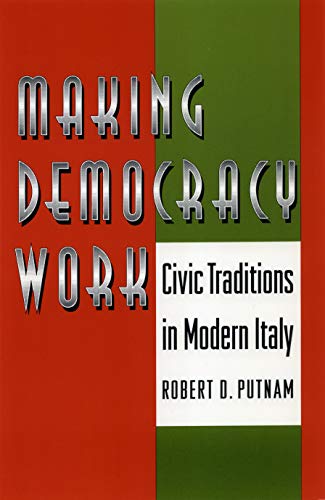
"A classic."—New York Times "Seminal, epochal, path-breaking . . . a Democracy in America for our times."—The Nation From the bestselling author of Bowling Alone, a landmark account of the secret of successful democracies Why do some democratic governments succeed and others fail? In a book that has received attention from policymakers and civic activists in America and around the world, acclaimed political scientist and bestselling author Robert Putnam and his collaborators offer empirical evidence for the importance of "civic community" in developing successful institutions. Their focus is on a unique experiment begun in 1970, when Italy created new governments for each of its regions. After spending two decades analyzing the efficacy of these governments in such fields as agriculture, housing, and healthcare, they reveal patterns of associationism, trust, and cooperation that facilitate good governance and economic prosperity. The result is a landmark book filled with crucial insights about how to make democracy work.
Die Inhaltsangabe kann sich auf eine andere Ausgabe dieses Titels beziehen.
Über die Autorin bzw. den Autor
Robert D. Putnam With Robert Leonardi and Raffaella Y. Nanetti
Von der hinteren Coverseite
Why do some democratic governments succeed and others fail? In a world full of hope for democratization but wary of government failure, this book offers empirical evidence for the importance of civic community in developing successful institutions. As part of a unique experiment begun in 1970 when Italy created new governments for each of its regions - regions that vary greatly from the standpoint of wealth, social structure, and political leanings - Robert Putnam and his collaborators spent two decades evaluating the performance of these governments in such fields as agriculture, housing, and health services. Their findings were surprising: regions that enjoy effective government in the 1990s have inherited a legacy of civic engagement that can be traced back to the early Middle Ages. Just as Tocqueville traveled to America to try to understand democracy, Putnam and his colleagues draw broad lessons for democratic theory from their twenty-year journey through Italy. Their conclusions challenge the simple-minded thesis of the primacy of economics and the easy optimism of social engineers. Based on dozens of case studies and thousands of interviews with politicians, community leaders, and ordinary citizens, this book illuminates patterns of associationism, trust, and cooperation that facilitate good governance and economic prosperity. It also contributes to the discussion of democracy in the newly freed lands of Eurasia and the developing world and to the gathering debate about how to revitalize democracy in America.
„Über diesen Titel“ kann sich auf eine andere Ausgabe dieses Titels beziehen.
Suchergebnisse für Making Democracy Work: Civic Traditions in Modern Italy...

Beispielbild für diese ISBN
Making Democracy Work: Civic Traditions in Modern Italy
Verlag:
Princeton University Press, 1994
ISBN 10: 0691037388
ISBN 13: 9780691037387
Gebraucht
Softcover
Anbieter: World of Books (was SecondSale), Montgomery, IL, USA
Verkäuferbewertung 5 von 5 Sternen

Zustand: Good. Item in good condition. Textbooks may not include supplemental items i.e. CDs, access codes etc. Artikel-Nr. 00108347941
Gebraucht kaufen
EUR 4,34
Versand gratis
Versand innerhalb von USA
Versand innerhalb von USA
Anzahl: 2 verfügbar
Beispielbild für diese ISBN
Making Democracy Work: Civic Traditions in Modern Italy
Verlag:
Princeton University Press, 1994
ISBN 10: 0691037388
ISBN 13: 9780691037387
Gebraucht
Softcover
Anbieter: World of Books (was SecondSale), Montgomery, IL, USA
Verkäuferbewertung 5 von 5 Sternen
Zustand: Very Good. Item in very good condition! Textbooks may not include supplemental items i.e. CDs, access codes etc. Artikel-Nr. 00108293243
Gebraucht kaufen
EUR 4,34
Versand gratis
Versand innerhalb von USA
Versand innerhalb von USA
Anzahl: 1 verfügbar
Beispielbild für diese ISBN
Making Democracy Work: Civic Traditions in Modern Italy
Verlag:
Princeton University Press, 1994
ISBN 10: 0691037388
ISBN 13: 9780691037387
Gebraucht
Softcover
Anbieter: World of Books (was SecondSale), Montgomery, IL, USA
Verkäuferbewertung 5 von 5 Sternen
Zustand: Acceptable. Item in acceptable condition! Textbooks may not include supplemental items i.e. CDs, access codes etc. Artikel-Nr. 00107675460
Gebraucht kaufen
EUR 4,34
Versand gratis
Versand innerhalb von USA
Versand innerhalb von USA
Anzahl: 1 verfügbar
Beispielbild für diese ISBN
Making Democracy Work: Civic Traditions in Modern Italy
Verlag:
Princeton University Press (edition ), 1994
ISBN 10: 0691037388
ISBN 13: 9780691037387
Gebraucht
Paperback
Anbieter: BooksRun, Philadelphia, PA, USA
Verkäuferbewertung 5 von 5 Sternen
Paperback. Zustand: Fair. The item might be beaten up but readable. May contain markings or highlighting, as well as stains, bent corners, or any other major defect, but the text is not obscured in any way. Artikel-Nr. 0691037388-7-1
Gebraucht kaufen
EUR 5,25
Versand gratis
Versand innerhalb von USA
Versand innerhalb von USA
Anzahl: 1 verfügbar
Beispielbild für diese ISBN
Making Democracy Work: Civic Traditions in Modern Italy
Verlag:
Princeton University Press, 1994
ISBN 10: 0691037388
ISBN 13: 9780691037387
Gebraucht
Paperback
Anbieter: ThriftBooks-Reno, Reno, NV, USA
Verkäuferbewertung 5 von 5 Sternen
Paperback. Zustand: Good. No Jacket. Pages can have notes/highlighting. Spine may show signs of wear. ~ ThriftBooks: Read More, Spend Less. Artikel-Nr. G0691037388I3N00
Gebraucht kaufen
EUR 6,71
Versand gratis
Versand innerhalb von USA
Versand innerhalb von USA
Anzahl: 2 verfügbar
Beispielbild für diese ISBN
Making Democracy Work: Civic Traditions in Modern Italy
Verlag:
Princeton University Press, 1994
ISBN 10: 0691037388
ISBN 13: 9780691037387
Gebraucht
Paperback
Anbieter: ThriftBooks-Phoenix, Phoenix, AZ, USA
Verkäuferbewertung 5 von 5 Sternen
Paperback. Zustand: Fair. No Jacket. Readable copy. Pages may have considerable notes/highlighting. ~ ThriftBooks: Read More, Spend Less. Artikel-Nr. G0691037388I5N00
Gebraucht kaufen
EUR 6,71
Versand gratis
Versand innerhalb von USA
Versand innerhalb von USA
Anzahl: 1 verfügbar
Beispielbild für diese ISBN
Making Democracy Work: Civic Traditions in Modern Italy
Verlag:
Princeton University Press, 1994
ISBN 10: 0691037388
ISBN 13: 9780691037387
Gebraucht
Paperback
Anbieter: ThriftBooks-Reno, Reno, NV, USA
Verkäuferbewertung 5 von 5 Sternen
Paperback. Zustand: Fair. No Jacket. Readable copy. Pages may have considerable notes/highlighting. ~ ThriftBooks: Read More, Spend Less. Artikel-Nr. G0691037388I5N00
Gebraucht kaufen
EUR 6,71
Versand gratis
Versand innerhalb von USA
Versand innerhalb von USA
Anzahl: 1 verfügbar
Beispielbild für diese ISBN
Making Democracy Work: Civic Traditions in Modern Italy
Verlag:
Princeton University Press, 1994
ISBN 10: 0691037388
ISBN 13: 9780691037387
Gebraucht
Paperback
Anbieter: ThriftBooks-Phoenix, Phoenix, AZ, USA
Verkäuferbewertung 5 von 5 Sternen
Paperback. Zustand: Good. No Jacket. Pages can have notes/highlighting. Spine may show signs of wear. ~ ThriftBooks: Read More, Spend Less. Artikel-Nr. G0691037388I3N00
Gebraucht kaufen
EUR 6,71
Versand gratis
Versand innerhalb von USA
Versand innerhalb von USA
Anzahl: 2 verfügbar
Beispielbild für diese ISBN
Making Democracy Work : Civic Traditions in Modern Italy
Verlag:
Princeton University Press, 1994
ISBN 10: 0691037388
ISBN 13: 9780691037387
Gebraucht
Softcover
Anbieter: Better World Books, Mishawaka, IN, USA
Verkäuferbewertung 5 von 5 Sternen
Zustand: Good. work Edition. Pages intact with minimal writing/highlighting. The binding may be loose and creased. Dust jackets/supplements are not included. Stock photo provided. Product includes identifying sticker. Better World Books: Buy Books. Do Good. Artikel-Nr. 4349586-6
Gebraucht kaufen
EUR 6,76
Versand gratis
Versand innerhalb von USA
Versand innerhalb von USA
Anzahl: 2 verfügbar
Beispielbild für diese ISBN
Making Democracy Work : Civic Traditions in Modern Italy
Verlag:
Princeton University Press, 1994
ISBN 10: 0691037388
ISBN 13: 9780691037387
Gebraucht
Softcover
Anbieter: Better World Books, Mishawaka, IN, USA
Verkäuferbewertung 5 von 5 Sternen
Zustand: Good. work Edition. Former library copy. Pages intact with minimal writing/highlighting. The binding may be loose and creased. Dust jackets/supplements are not included. Includes library markings. Stock photo provided. Product includes identifying sticker. Better World Books: Buy Books. Do Good. Artikel-Nr. 4835273-6
Gebraucht kaufen
EUR 6,76
Versand gratis
Versand innerhalb von USA
Versand innerhalb von USA
Anzahl: 2 verfügbar