
Verwandte Artikel zu Investment under Uncertainty
Inhaltsangabe
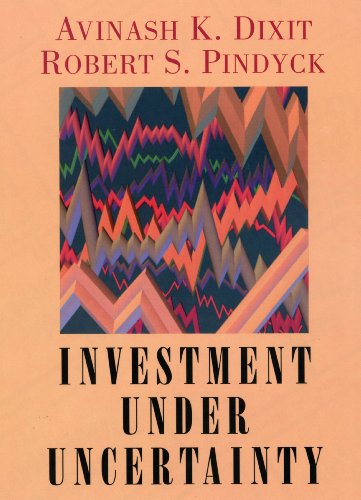
How should firms decide whether and when to invest in new capital equipment, additions to their workforce, or the development of new products? Why have traditional economic models of investment failed to explain the behavior of investment spending in the United States and other countries? In this book, Avinash Dixit and Robert Pindyck provide the first detailed exposition of a new theoretical approach to the capital investment decisions of firms, stressing the irreversibility of most investment decisions, and the ongoing uncertainty of the economic environment in which these decisions are made. In so doing, they answer important questions about investment decisions and the behavior of investment spending.
This new approach to investment recognizes the option value of waiting for better (but never complete) information. It exploits an analogy with the theory of options in financial markets, which permits a much richer dynamic framework than was possible with the traditional theory of investment. The authors present the new theory in a clear and systematic way, and consolidate, synthesize, and extend the various strands of research that have come out of the theory. Their book shows the importance of the theory for understanding investment behavior of firms; develops the implications of this theory for industry dynamics and for government policy concerning investment; and shows how the theory can be applied to specific industries and to a wide variety of business problems.
Die Inhaltsangabe kann sich auf eine andere Ausgabe dieses Titels beziehen.
Über die Autorin bzw. den Autor
Avinash K. Dixit is John J. F. Sherrerd '52 University Professor of Economics at Princeton University. His most recent book is Thinking Strategically, with Barry Nalebuff (Norton). Robert S. Pindyck is Mitsubishi Bank Professor of Economics at the Sloan School of Management, MIT. His books include Econometric Models and Economic Forecasts, with Daniel L. Rubinfeld (McGraw-Hill).
Von der hinteren Coverseite
"[The authors'] approach has powerful implications for investors in marketable assets as well. No investment professional or CFO can afford to ignore this brilliant new book."--Peter L. Bernstein, author ofCapital Ideas: The Improbable Origins of Modern Wall Street
"Avinash Dixit and Robert Pindyck have successfully applied to capital budgeting the ideas and techniques of option pricing that have so enriched our understanding of financial markets."--Merton H. Miller, Nobel Laureate in Economics
Aus dem Klappentext
"[The authors'] approach has powerful implications for investors in marketable assets as well. No investment professional or CFO can afford to ignore this brilliant new book."--Peter L. Bernstein, author ofCapital Ideas: The Improbable Origins of Modern Wall Street
"Avinash Dixit and Robert Pindyck have successfully applied to capital budgeting the ideas and techniques of option pricing that have so enriched our understanding of financial markets."--Merton H. Miller, Nobel Laureate in Economics
Auszug. © Genehmigter Nachdruck. Alle Rechte vorbehalten.
Investment under Uncertainty
By Avinash K. Dixit Robert S. PindyckPrinceton University Press
Copyright © 1994 Princeton University PressAll right reserved.
ISBN: 978-0-691-03410-2
Contents
Preface.................................................................xi1 A New View of Investment..............................................32 Developing the Concepts Through Simple Examples.......................263 Stochastic Processes and Ito's Lemma..................................594 Dynamic Optimization under Uncertainty................................935 Investment Opportunities and Investment Timing........................1356 The Value of a Project and the Decision to Invest.....................1757 Entry, Exit, Lay-Up, and Scrapping....................................2138 Dynamic Equilibrium in a Competitive Industry.........................2479 Policy Intervention and Imperfect Competition.........................28210 Sequential Investment................................................31911 Incremental Investment and Capacity Choice...........................35712 Applications and Empirical Research..................................394References..............................................................429Symbol Glossary.........................................................445
Chapter One
A New View of Investment
Economics defines investment as the act of incurring an immediate cost in the expectation of future rewards. Firms that construct plants and install equipment, merchants who lay in a stock of goods for sale, and persons who spend time on vocational education are all investors in this sense. Somewhat less obviously, a firm that shuts down a loss-making plant is also "investing": the payments it must make to extract itself from contractual commitments, including severance payments to labor, are the initial expenditure, and the prospective reward is the reduction in future losses.
Viewed from this perspective, investment decisions are ubiquitous. Your purchase of this book was an investment. The reward, we hope, will be an improved understanding of investment decisions if you are an economist, and an improved ability to make such decisions in the course of your future career if you are a business school student.
Most investment decisions share three important characteristics in varying degrees. First, the investment is partially or completely irreversible. In other words, the initial cost of investment is at least partially sunk; you cannot recover it all should you change your mind. Second, there is uncertainty over the future rewards from the investment. The best you can do is to assess the probabilities of the alternative outcomes that can mean greater or smaller profit (or loss) for your venture. Third, you have some leeway about the timing of your investment. You can postpone action to get more information (but never, of course, complete certainty) about the future.
These three characteristics interact to determine the optimal decisions of investors. This interaction is the focus of this book. We develop the theory of irreversible investment under uncertainty, and illustrate it with some practical applications.
The orthodox theory of investment has not recognized the important qualitative and quantitative implications of the interaction between irreversibility, uncertainty, and the choice of timing. We will argue that this neglect explains some of the failures of that theory. For example, compared to the predictions of most earlier models, real world investment seems much less sensitive to interest rate changes and tax policy changes, and much more sensitive to volatility and uncertainty over the economic environment. We will show how the new view resolves these anomalies, and in the process offers some guidance for designing more effective public policies concerning investment.
Some seemingly noneconomic personal decisions also have the characteristics of an investment. To give just one example, marriage involves an up-front cost of courtship, with uncertain future happiness or misery. It may be reversed by divorce, but only at a substantial cost. Many public policy decisions also have similar features. For instance, public opinion about the relative importance of civil rights of the accused and of social order fluctuates through time, and it is costly to make or change laws that embody a particular relative weight for the two. Of course the costs and benefits of such noneconomic decisions are difficult or even impossible to quantify, but our general theory will offer some qualitative insights for them, too.
1 The Orthodox Theory
How should a firm, facing uncertainty over future market conditions, decide whether to invest in a new factory? Most economics and business school students are taught a simple rule to apply to problems of this sort. First, calculate the present value of the expected stream of profits that this factory will generate. Second, calculate the present value of the stream of expenditures required to build the factory. Finally, determine whether the difference between the two—the net present value (NPV) of the investment—is greater than zero. If it is, go ahead and invest.
Of course, there are issues that arise in calculating this net present value. Just how should the expected stream of profits from a new factory be estimated? How should inflation be treated? And what discount rate (or rates) should be used in calculating the present values? Resolving issues like these are important topics in courses in corporate finance, and especially capital budgeting, but the basic principle is fairly simple—calculate the NPV of an investment project and see whether it is positive.
The net present value rule is also the basis for the neoclassical theory of investment as taught to undergraduate and graduate students of economics. Here we find the rule expressed using the standard incremental or marginal approach of the economist: invest until the value of an incremental unit of capital is just equal to its cost. Again, issues arise in determining the value of an incremental unit of capital, and in determining its cost. For example, what production structure should be posited? How should taxes and depreciation be treated?
Much of the theoretical and empirical literature on the economics of investment deals with issues of this sort. We find two essentially equivalent approaches. One, following Jorgenson (1963), compares the per-period value of an incremental unit of capital (its marginal product) and an "equivalent per-period rental cost" or "user cost" that can be computed from the purchase price, the interest and depreciation rates, and applicable taxes. The firm's desired stock of capital is found by equating the marginal product and the user cost. The actual stock is assumed to adjust to the ideal, either as an ad hoc lag process, or as the optimal response to an explicit cost of adjustment. The book by Nickell (1978) provides a particularly good exposition of developments of this approach.
The other formulation, due to Tobin (1969), compares the capitalized value of the marginal investment to its purchase cost. The value can be observed directly if the ownership of the investment can be traded in a secondary market; otherwise it is an imputed value computed as the expected present value of the stream of profits it would yield. The ratio of this to the purchase price (replacement cost) of the unit, called Tobin's q, governs the investment...
„Über diesen Titel“ kann sich auf eine andere Ausgabe dieses Titels beziehen.
Suchergebnisse für Investment under Uncertainty

Foto des Verkäufers
Investment under Uncertainty
Verlag:
Princeton University Press, 1994
ISBN 10: 0691034109
ISBN 13: 9780691034102
Gebraucht
Hardcover
Anbieter: Dream Books Co., Denver, CO, USA
Verkäuferbewertung 5 von 5 Sternen

Zustand: good. Gently used with minimal wear on the corners and cover. A few pages may contain light highlighting or writing, but the text remains fully legible. Dust jacket may be missing, and supplemental materials like CDs or codes may not be included. May be ex-library with library markings. Ships promptly! Artikel-Nr. DBV.0691034109.G
Gebraucht kaufen
EUR 5,49
Versand gratis
Versand innerhalb von USA
Versand innerhalb von USA
Anzahl: 1 verfügbar
Beispielbild für diese ISBN
Investment Under Uncertainty
Verlag:
Princeton University Press, 1994
ISBN 10: 0691034109
ISBN 13: 9780691034102
Gebraucht
Hardcover
Anbieter: ThriftBooks-Atlanta, AUSTELL, GA, USA
Verkäuferbewertung 5 von 5 Sternen
Hardcover. Zustand: Fair. No Jacket. Readable copy. Pages may have considerable notes/highlighting. ~ ThriftBooks: Read More, Spend Less. Artikel-Nr. G0691034109I5N00
Gebraucht kaufen
EUR 5,88
Versand gratis
Versand innerhalb von USA
Versand innerhalb von USA
Anzahl: 1 verfügbar
Beispielbild für diese ISBN
Investment under Uncertainty
Verlag:
Princeton University Press, 1994
ISBN 10: 0691034109
ISBN 13: 9780691034102
Gebraucht
Hardcover
Anbieter: Better World Books: West, Reno, NV, USA
Verkäuferbewertung 5 von 5 Sternen
Zustand: Good. Pages intact with minimal writing/highlighting. The binding may be loose and creased. Dust jackets/supplements are not included. Stock photo provided. Product includes identifying sticker. Better World Books: Buy Books. Do Good. Artikel-Nr. 7800810-20
Gebraucht kaufen
EUR 8,44
Versand gratis
Versand innerhalb von USA
Versand innerhalb von USA
Anzahl: 1 verfügbar
Beispielbild für diese ISBN
Investment under Uncertainty
Verlag:
Princeton University Press, 1994
ISBN 10: 0691034109
ISBN 13: 9780691034102
Gebraucht
Hardcover
Anbieter: Better World Books, Mishawaka, IN, USA
Verkäuferbewertung 5 von 5 Sternen
Zustand: Good. Pages intact with minimal writing/highlighting. The binding may be loose and creased. Dust jackets/supplements are not included. Stock photo provided. Product includes identifying sticker. Better World Books: Buy Books. Do Good. Artikel-Nr. 7800810-20
Gebraucht kaufen
EUR 8,44
Versand gratis
Versand innerhalb von USA
Versand innerhalb von USA
Anzahl: 2 verfügbar
Beispielbild für diese ISBN
Investment under Uncertainty
ISBN 10: 0691034109
ISBN 13: 9780691034102
Gebraucht
Hardcover
Anbieter: BooksRun, Philadelphia, PA, USA
Verkäuferbewertung 5 von 5 Sternen
Hardcover. Zustand: Very Good. Text is Free of Markings. With dust jacket. It's a well-cared-for item that has seen limited use. The item may show minor signs of wear. All the text is legible, with all pages included. It may have slight markings and/or highlighting. Artikel-Nr. 0691034109-11-1-29
Gebraucht kaufen
EUR 8,89
Versand gratis
Versand innerhalb von USA
Versand innerhalb von USA
Anzahl: 1 verfügbar
Beispielbild für diese ISBN
Investment under Uncertainty
Anbieter: AwesomeBooks, Wallingford, Vereinigtes Königreich
Verkäuferbewertung 5 von 5 Sternen
Hardcover. Zustand: Very Good. Investment under Uncertainty This book is in very good condition and will be shipped within 24 hours of ordering. The cover may have some limited signs of wear but the pages are clean, intact and the spine remains undamaged. This book has clearly been well maintained and looked after thus far. Money back guarantee if you are not satisfied. See all our books here, order more than 1 book and get discounted shipping. Artikel-Nr. 7719-9780691034102
Gebraucht kaufen
EUR 5,73
EUR 4,82 Versand
Versand von Vereinigtes Königreich nach USA
Versand von Vereinigtes Königreich nach USA
Anzahl: 2 verfügbar
Beispielbild für diese ISBN
Investment under Uncertainty
Anbieter: Bahamut Media, Reading, Vereinigtes Königreich
Verkäuferbewertung 5 von 5 Sternen
Hardcover. Zustand: Very Good. This book is in very good condition and will be shipped within 24 hours of ordering. The cover may have some limited signs of wear but the pages are clean, intact and the spine remains undamaged. This book has clearly been well maintained and looked after thus far. Money back guarantee if you are not satisfied. See all our books here, order more than 1 book and get discounted shipping. Artikel-Nr. 6545-9780691034102
Gebraucht kaufen
EUR 5,73
EUR 8,16 Versand
Versand von Vereinigtes Königreich nach USA
Versand von Vereinigtes Königreich nach USA
Anzahl: 2 verfügbar
Beispielbild für diese ISBN
Investment under Uncertainty
Verlag:
Princeton University Press, 1994
ISBN 10: 0691034109
ISBN 13: 9780691034102
Gebraucht
Hardcover
Anbieter: Sell Books, Elland, YORKS, Vereinigtes Königreich
Verkäuferbewertung 5 von 5 Sternen
hardcover. Zustand: Good. Our good condition books are generally good for reading but not for gifting or collecting. They could have imperfections such as creasing, fanning, inscriptions, margin notes, yellowing, staining on edge or cover or pages, bumps, scuffs, etc etc (sometimes multiple of these). It's a wide category that encompasses anything that isn't almost-new down to anything that is slightly better than poor. We would NOT recommend gifting Good books - these should be considered reading copies. Our books are dispatched from a Yorkshire former cotton mill. We list via barcode/ISBN so please note that the images are stock images and may not be the exact copy you receive, furthermore the details about edition and year might not be accurate as many publishers reuse the same ISBN for multiple editions and as we simply scan a barcode or enter an ISBN we do not check the validity of the edition data when listing. If you're looking for an exact edition please don't order (at least not without checking with us first, although we don't always have time to check). We aim to dispatch prompty, the service used will depend on order value and book size. We can ship to most countries, see our shipping policies. Payment is via Abe only. Artikel-Nr. mon0000122996
Gebraucht kaufen
EUR 19,36
EUR 14,20 Versand
Versand von Vereinigtes Königreich nach USA
Versand von Vereinigtes Königreich nach USA
Anzahl: 1 verfügbar
Beispielbild für diese ISBN
Investment under Uncertainty
Verlag:
Princeton University Press, Princeton, 1994
ISBN 10: 0691034109
ISBN 13: 9780691034102
Gebraucht
Hardcover
Erstausgabe
Anbieter: Bookplate, Chestertown, MD, USA
Verkäuferbewertung 4 von 5 Sternen

Hardcover. Zustand: Very Good. 1st Edition. Clean, unmarked copy with DJ in Good condition. TM/Misc. Artikel-Nr. ABE-1601870022243
Gebraucht kaufen
EUR 35,29
EUR 7,28 Versand
Versand innerhalb von USA
Versand innerhalb von USA
Anzahl: 1 verfügbar
Beispielbild für diese ISBN
Investment under Uncertainty
Anbieter: PBShop.store UK, Fairford, GLOS, Vereinigtes Königreich
Verkäuferbewertung 5 von 5 Sternen
HRD. Zustand: New. New Book. Shipped from UK. Established seller since 2000. Artikel-Nr. WP-9780691034102
Neu kaufen
EUR 59,44
EUR 6,86 Versand
Versand von Vereinigtes Königreich nach USA
Versand von Vereinigtes Königreich nach USA
Anzahl: 15 verfügbar