
Verwandte Artikel zu Collected Works of C. G. Jung, Volume 9 (Part 2): Aion:...
Collected Works of C. G. Jung, Volume 9 (Part 2): Aion: Researches into the Phenomenology of the Self - Softcover
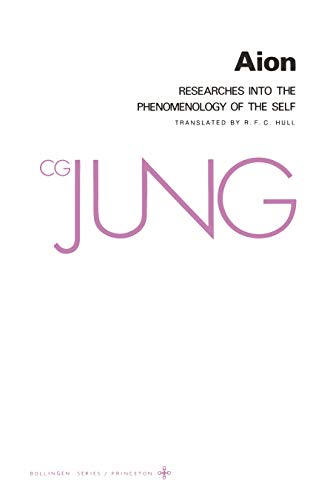
Inhaltsangabe
An investigation of the symbolism of the self Aion, originally published in German in 1951, is one of the major works of Jung’s later years. The central theme of the volume is the symbolic representation of the psychic totality through the concept of the Self, whose traditional historical equivalent is the figure of Christ. Jung demonstrates his thesis by an investigation of the Allegoria Christi, especially the fish symbol, but also of Gnostic and alchemical symbolism, which he treats as phenomena of cultural assimilation. The first three chapters—on the ego, the shadow, and the anima and animus—provide a valuable summation of these key concepts in Jung’s system of psychology.
Die Inhaltsangabe kann sich auf eine andere Ausgabe dieses Titels beziehen.
Über die Autorin bzw. den Autor
C. G. Jung Translated by R.F.C. Hull
Auszug. © Genehmigter Nachdruck. Alle Rechte vorbehalten.
AION
RESEARCHES INTO THE PHENOMENOLOGY OF THE SELF
By C. G. JUNG, GERHARD ADLER, R. F. C. HULLPRINCETON UNIVERSITY PRESS
Copyright © 1959 BOLLINGEN FOUNDATION INC.
All rights reserved.
ISBN: 978-0-691-01826-3All rights reserved.
Contents
EDITORIAL NOTES, v,
TRANSLATOR'S NOTE, vi,
LIST OF PLATES, viii,
FOREWORD, ix,
I. The Ego, 3,
II. The Shadow, 8,
III. The Syzygy: Anima and Animus, 11,
IV. The Self, 23,
V. Christ, a Symbol of the Self, 36,
VI. The Sign of the Fishes, 72,
VII. The Prophecies of Nostradamus, 95,
VIII. The Historical Significance of the Fish, 103,
IX. The Ambivalence of the Fish Symbol, 118,
X. The Fish in Alchemy, 126,
XI. The Alchemical Interpretation of the Fish, 154,
XII. Background to the Psychology of Christian Alchemical Symbolism, 173,
XIII. Gnostic Symbols of the Self, 184,
XIV. The Structure and Dynamics of the Self, 222,
XV. Conclusion, 266,
BIBLIOGRAPHY, 271,
INDEX, 301,
CHAPTER 1
THE EGO
1 Investigation of the psychology of the unconscious confronted me with facts which required the formulation of new concepts. One of these concepts is the self. The entity so denoted is not meant to take the place of the one that has always been known as the ego, but includes it in a supraordinate concept. We understand the ego as the complex factor to which all conscious contents are related. It forms, as it were, the centre of the field of consciousness; and, in so far as this comprises the empirical personality, the ego is the subject of all personal acts of consciousness. The relation of a psychic content to the ego forms the criterion of its consciousness, for no content can be conscious unless it is represented to a subject.
2 With this definition we have described and delimited the scope of the subject. Theoretically, no limits can be set to the field of consciousness, since it is capable of indefinite extension. Empirically, however, it always finds its limit when it comes up against the unknown. This consists of everything we do not know, which, therefore, is not related to the ego as the centre of the field of consciousness. The unknown falls into two groups of objects: those which are outside and can be experienced by the senses, and those which are inside and are experienced immediately. The first group comprises the unknown in the outer world; the second the unknown in the inner world. We call this latter territory the unconscious.
3 The ego, as a specific content of consciousness, is not a simple or elementary factor but a complex one which, as such, cannot be described exhaustively. Experience shows that it rests on two seemingly different bases: the somatic and the psychic. The somatic basis is inferred from the totality of endosomatic perceptions, which for their part are already of a psychic nature and are associated with the ego, and are therefore conscious. They are produced by endosomatic stimuli, only some of which cross the threshold of consciousness. A considerable proportion of these stimuli occur unconsciously, that is, subliminally. The fact that they are subliminal does not necessarily mean that their status is merely physiological, any more than this would be true of a psychic content. Sometimes they are capable of crossing the threshold, that is, of becoming perceptions. But there is no doubt that a large proportion of these endosomatic stimuli are simply incapable of consciousness and are so elementary that there is no reason to assign them a psychic nature—unless of course one favours the philosophical view that all life-processes are psychic anyway. The chief objection to this hardly demonstrable hypothesis is that it enlarges the concept of the psyche beyond all bounds and interprets the life-process in a way not absolutely warranted by the facts. Concepts that are too broad usually prove to be unsuitable instruments because they are too vague and nebulous. I have therefore suggested that the term "psychic" be used only where there is evidence of a will capable of modifying reflex or instinctual processes. Here I must refer the reader to my paper "On the Nature of the Psyche," where I have discussed this definition of the "psychic" at somewhat greater length.
4 The somatic basis of the ego consists, then, of conscious and unconscious factors. The same is true of the psychic basis: on the one hand the ego rests on the total field of consciousness, and on the other, on the sum total of unconscious contents. These fall into three groups: first, temporarily subliminal contents that can be reproduced voluntarily (memory); second, unconscious contents that cannot be reproduced voluntarily; third, contents that are not capable of becoming conscious at all. Group two can be inferred from the spontaneous irruption of subliminal contents into consciousness. Group three is hypothetical; it is a logical inference from the facts underlying group two. It contains contents which have not yet irrupted into consciousness, or which never will.
5 When I said that the ego "rests" on the total field of consciousness I do not mean that it consists of this. Were that so, it would be indistinguishable from the field of consciousness as a whole. The ego is only the latter's point of reference, grounded on and limited by the somatic factor described above.
6 Although its bases are in themselves relatively unknown and unconscious, the ego is a conscious factor par excellence. It is even acquired, empirically speaking, during the individual's lifetime. It seems to arise in the first place from the collision between the somatic factor and the environment, and, once established as a subject, it goes on developing from further collisions with the outer world and the inner.
7 Despite the unlimited extent of its bases, the ego is never more and never less than consciousness as a whole. As a conscious factor the ego could, theoretically at least, be described completely. But this would never amount to more than a picture of the conscious personality; all those features which are unknown or unconscious to the subject would be missing. A total picture would have to include these. But a total description of the personality is, even in theory, absolutely impossible, because the unconscious portion of it cannot be grasped cognitively. This unconscious portion, as experience has abundantly shown, is by no means unimportant. On the contrary, the most decisive qualities in a person are often unconscious and can be perceived only by others, or have to be laboriously discovered with outside help.
8 Clearly, then, the personality as a total phenomenon does not coincide with the ego, that is, with the conscious personality, but forms an entity that has to be distinguished from the ego. Naturally the need to do this is incumbent only on a psychology that reckons with the fact of the unconscious, but for such a psychology the distinction is of paramount importance. Even for jurisprudence it should be of some importance whether certain psychic facts are conscious or not—for instance, in adjudging the question of responsibility.
9 I have suggested calling the total personality which, though present, cannot be fully known, the self. The ego is, by definition, subordinate to the self and is related to it like a part to the whole. Inside the field of consciousness it has, as we say, free will. By this I do not mean anything philosophical, only the well-known psychological fact of "free...
„Über diesen Titel“ kann sich auf eine andere Ausgabe dieses Titels beziehen.
Suchergebnisse für Collected Works of C. G. Jung, Volume 9 (Part 2): Aion:...

Beispielbild für diese ISBN
Aion: Researches into the Phenomenology of the Self (Collected Works of C.G. Jung Vol.9 Part 2)
Verlag:
Princeton University Press, 1979
ISBN 10: 069101826X
ISBN 13: 9780691018263
Gebraucht
Paperback
Anbieter: Books From California, Simi Valley, CA, USA
Verkäuferbewertung 4 von 5 Sternen

Paperback. Zustand: Good. Some underlining and markings throughout. Artikel-Nr. mon0004217419
Gebraucht kaufen
EUR 10,62
EUR 4,33 Versand
Versand innerhalb von USA
Versand innerhalb von USA
Anzahl: 1 verfügbar
Beispielbild für diese ISBN
Aion: Researches into the Phenomenology of the Self (Collected Works of C.G. Jung Vol.9 Part 2)
Verlag:
Princeton University Press (edition 2nd ed.), 1979
ISBN 10: 069101826X
ISBN 13: 9780691018263
Gebraucht
Paperback
Anbieter: BooksRun, Philadelphia, PA, USA
Verkäuferbewertung 5 von 5 Sternen

Paperback. Zustand: Fair. 2nd ed. The item might be beaten up but readable. May contain markings or highlighting, as well as stains, bent corners, or any other major defect, but the text is not obscured in any way. Artikel-Nr. 069101826X-7-1
Gebraucht kaufen
EUR 16,78
Versand gratis
Versand innerhalb von USA
Versand innerhalb von USA
Anzahl: 1 verfügbar
Beispielbild für diese ISBN
Collected Works of C. G. Jung, Volume 9 (Part 2) : Aion: Researches into the Phenomenology of the Self
Verlag:
Princeton University Press, 1979
ISBN 10: 069101826X
ISBN 13: 9780691018263
Gebraucht
Softcover
Anbieter: Better World Books, Mishawaka, IN, USA
Verkäuferbewertung 5 von 5 Sternen
Zustand: Good. Pages intact with minimal writing/highlighting. The binding may be loose and creased. Dust jackets/supplements are not included. Stock photo provided. Product includes identifying sticker. Better World Books: Buy Books. Do Good. Artikel-Nr. 4272876-6
Gebraucht kaufen
EUR 20,73
Versand gratis
Versand innerhalb von USA
Versand innerhalb von USA
Anzahl: 1 verfügbar
Beispielbild für diese ISBN
Collected Works of C.G. Jung, Volume 9 (Part 2) â" Aion â" Researches into the Phenomenology of the Self
Verlag:
Princeton University Press, 1979
ISBN 10: 069101826X
ISBN 13: 9780691018263
Gebraucht
Paperback
Anbieter: WorldofBooks, Goring-By-Sea, WS, Vereinigtes Königreich
Verkäuferbewertung 5 von 5 Sternen
Paperback. Zustand: Very Good. The book has been read, but is in excellent condition. Pages are intact and not marred by notes or highlighting. The spine remains undamaged. Artikel-Nr. GOR002288947
Gebraucht kaufen
EUR 34,28
EUR 6,54 Versand
Versand von Vereinigtes Königreich nach USA
Versand von Vereinigtes Königreich nach USA
Anzahl: 1 verfügbar
Beispielbild für diese ISBN
Collected Works of C. G. Jung, Volume 9 (Part 2) Aion Researches into the Phenomenology of the Self
Anbieter: Revaluation Books, Exeter, Vereinigtes Königreich
Verkäuferbewertung 5 von 5 Sternen
Paperback. Zustand: Brand New. 1st edition. 353 pages. 9.00x6.00x1.00 inches. In Stock. Artikel-Nr. x-069101826X
Neu kaufen
EUR 34,54
EUR 14,60 Versand
Versand von Vereinigtes Königreich nach USA
Versand von Vereinigtes Königreich nach USA
Anzahl: 2 verfügbar