
Verwandte Artikel zu The Nude: A Study in Ideal Form (Bollingen Series,...
Inhaltsangabe
A landmark study of the nude in art—from the ancient Greeks to Henry Moore—by a towering figure in art history
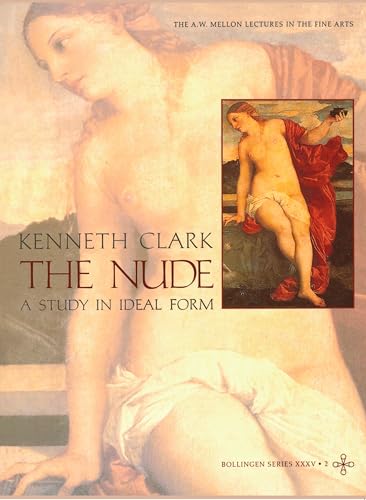
In this classic book, Kenneth Clark, one of the most eminent art historians of the twentieth century, examines the ever-changing fashion in what constitutes the ideal nude as a basis of humanist form, from the art of the ancient Greeks to that of Renoir, Matisse, and Henry Moore. The Nude reveals the sensitivity of aesthetic theory to fashion, what distinguishes the naked from the nude, and just why the nude has played such an important role in art history. As Clark writes, “The nude gains its enduring value from the fact that it reconciles several contrary states. It takes the most sensual and immediately interesting object, the human body, and puts it out of reach of time and desire; it takes the most purely rational concept of which man is capable, mathematical order, and makes it a delight to the senses; and it takes the vague fears of the unknown and sweetens them by showing that the gods are like men and may be worshipped for their life-giving beauty rather than their death-dealing powers.”
Die Inhaltsangabe kann sich auf eine andere Ausgabe dieses Titels beziehen.
Über die Autorin bzw. den Autor
Kenneth Clark (1903–1983) was one of leading art historians of the twentieth century. Over the course of his career, he was director of the National Gallery in London, Slade Professor of Fine Arts at the University of Oxford, and chair of the Arts Council of Great Britain. He was the author of many books and was the presenter of the acclaimed BBC television series, Civilisation.
Auszug. © Genehmigter Nachdruck. Alle Rechte vorbehalten.
The Nude
A Study in Ideal Form
By Kenneth ClarkPRINCETON UNIVERSITY PRESS
Copyright © 1956 Trustees of the National Gallery of Art
All rights reserved.
ISBN: 978-0-691-01788-4All rights reserved.
Contents
Preface, vii,
Acknowledgments, ix,
List of Illustrations, xiii,
I. THE NAKED AND THE NUDE, 3,
II. APOLLO, 30,
III. VENUS I, 71,
IV. VENUS II, 118,
V. ENERGY, 173,
VI. PATHOS, 225,
VII. ECSTASY, 273,
VIII. THE ALTERNATIVE CONVENTION, 308,
IX. THE NUDE AS AN END IN ITSELF, 348,
Notes, 371,
List of Works Cited, 415,
Index, 423,
CHAPTER 1
THE NAKED AND THE NUDE
THE ENGLISH language, with its elaborate generosity, distinguishes between the naked and the nude. To be naked is to be deprived of our clothes, and the word implies some of the embarrassment most of us feel in that condition. The word "nude," on the other hand, carries, in educated usage, no uncomfortable overtone. The vague image it projects into the mind is not of a huddled and defenseless body, but of a balanced, prosperous, and confident body: the body re-formed. In fact, the word was forced into our vocabulary by critics of the early eighteenth century to persuade the artless islanders that, in countries where painting and sculpture were practiced and valued as they should be, the naked human body was the central subject of art.
For this belief there is a quantity of evidence. In the greatest age of painting, the nude inspired the greatest works; and even when it ceased to be a compulsive subject it held its position as an academic exercise and a demonstration of mastery. Velásquez, living in the prudish and corseted court of Philip IV and admirably incapable of idealization, yet felt bound to paint the Rokeby Venus Sir Joshua Reynolds, wholly without the gift of formal draftsmanship, set great store by his Cymon and Iphigenia. And in our own century, when we have shaken off one by one those inheritances of Greece which were revived at the Renaissance, discarded the antique armor, forgotten the subjects of mythology, and disputed the doctrine of imitation, the nude alone has survived. It may have suffered some curious transformations, but it remains our chief link with the classic disciplines. When we wish to prove to the Philistine that our great revolutionaries are really respectable artists in the tradition of European painting, 'we point to their drawings of the nude. Picasso has often exempted it from that savage metamorphosis which he has inflicted on the visible world and has produced a series of nudes that might have walked unaltered off the back of a Greek mirror; and Henry Moore, searching in stone for the ancient laws of its material and seeming to find there some of those elementary creatures of whose fossilized bones it is composed, yet gives to his constructions the same fundamental character that was invented by the sculptors of the Parthenon in the fifth century before Christ.
These comparisons suggest a short answer to the question, "What is the nude?" It is an art form invented by the Greeks in the fifth century, just as opera is an art form invented in seventeenth-century Italy. The conclusion is certainly too abrupt, but it has the merit of emphasizing that the nude is not the subject of art, but a form of art.
It is widely supposed that the naked human body is in itself an object upon which the eye dwells with pleasure and which we are glad to see depicted. But anyone who has frequented art schools and seen the shapeless, pitiful model that the students are industriously drawing will know this is an illusion. The body is not one of those subjects which can be made into art by direct transcription — like a tiger or a snowy landscape. Often in looking at the natural and animal world we joyfully identify ourselves with what we see arid from this happy union create a work of art. This is the process students of aesthetics call empathy, and it is at the opposite pole of creative activity to the state of mind that has produced the nude. A mass of naked figures does not move us to empathy, but to disillusion and dismay. We do not wish to imitate; we wish to perfect. We become, in the physical sphere, like Diogenes with his lantern looking for an honest man; and, like him, we may never be rewarded. Photographers of the nude are presumably engaged in this search, with every advantage; and having found a model who pleases them, they are free to pose and light her in conformity with their notions of beauty; finally, they can tone down and accentuate by retouching. But in spite of all their taste and skill, the result is hardly ever satisfactory to those whose eyes have grown accustomed to the harmonious simplifications of antiquity. We are immediately disturbed by wrinkles, pouches, and other small imperfections, which, in the classical scheme, are eliminated. By long habit we do not judge it as a living organism, but as a design; and we discover that the transitions are inconclusive, the outline is faltering. We are bothered because the various parts of the body cannot be perceived as simple units and have no clear relationship to one another. In almost every detail the body is not the shape that art had led us to believe it should be. Yet we can look with pleasure at photographs of trees and animals, where the canon of perfection is less strict. Consciously or unconsciously, photographers have usually recognized that in a photograph of the nude their real object is not to reproduce the naked body, but to imitate some artist's view of what the naked body should be. Rejlander was the most Philistine of the early photographers, but, perhaps without knowing it, he was a contemporary of Courbet, and with this splendid archetype somewhere in the background he produced one of the finest (as well as one of the first) photographs of the nude. He succeeded partly because his unconscious archetype was a realist. The more nearly ideal the model, the more unfortunate the photographs that try to imitate it — as those in the style of Ingres or Whistler prove.
So that although the naked body is no more than the point of departure for a work of art, it is a pretext of great importance. In the history of art, the subjects that men have chosen as nuclei, so to say, of their sense of order have often been in themselves unimportant. For hundreds of years, and over an area stretching from Ireland to China, the most vital expression of order was an imaginary animal biting its own tail. In the Middle Ages drapery took on a life of its own, the same life that had inhabited the twisting animal, and became the vital pattern of Romanesque art. In neither case had the subject any independent existence. But the human body, as a nucleus, is rich in associations, and when it is turned into art these associations are not entirely lost. For this reason it seldom achieves the concentrated aesthetic shock of animal ornament, but it can be made expressive of a far wider and more civilizing experience. It is ourselves and arouses memories of all the things we wish to do with ourselves; and first of all we wish to perpetuate ourselves.
This is an aspect of the subject so obvious that I need hardly dwell on it; and yet some wise men have tried to close their eyes to it. "If the nude," says Professor Alexander, "is so treated that it raises in the spectator ideas or desires appropriate to the material subject, it is false art, and bad morals." This high-minded theory is contrary to experience. In the mixture of memories and sensations aroused by Rubens' Andromeda...
„Über diesen Titel“ kann sich auf eine andere Ausgabe dieses Titels beziehen.
Suchergebnisse für The Nude: A Study in Ideal Form (Bollingen Series,...

Beispielbild für diese ISBN
The Nude: A Study in Ideal Form
Verlag:
Princeton University Press, 1972
ISBN 10: 0691017883
ISBN 13: 9780691017884
Gebraucht
Paperback
Anbieter: World of Books (was SecondSale), Montgomery, IL, USA
Verkäuferbewertung 5 von 5 Sternen

Paperback. Zustand: Good. From the art of the Greeks to that of Renoir and Moore, this work surveys the ever-changing fashions in what has constituted the ideal nude as a basis of humanist form. Artikel-Nr. 00103787293
Gebraucht kaufen
EUR 4,86
Versand gratis
Versand innerhalb von USA
Versand innerhalb von USA
Anzahl: 4 verfügbar
Beispielbild für diese ISBN
The Nude: A Study in Ideal Form
Verlag:
Princeton University Press, 1972
ISBN 10: 0691017883
ISBN 13: 9780691017884
Gebraucht
Paperback
Anbieter: World of Books (was SecondSale), Montgomery, IL, USA
Verkäuferbewertung 5 von 5 Sternen
Paperback. Zustand: Fair. From the art of the Greeks to that of Renoir and Moore, this work surveys the ever-changing fashions in what has constituted the ideal nude as a basis of humanist form. Artikel-Nr. 00108299700
Gebraucht kaufen
EUR 4,86
Versand gratis
Versand innerhalb von USA
Versand innerhalb von USA
Anzahl: 2 verfügbar
Beispielbild für diese ISBN
The Nude: A Study in Ideal Form
Verlag:
Princeton University Press, 1972
ISBN 10: 0691017883
ISBN 13: 9780691017884
Gebraucht
Paperback
Anbieter: World of Books (was SecondSale), Montgomery, IL, USA
Verkäuferbewertung 5 von 5 Sternen
Paperback. Zustand: Very Good. From the art of the Greeks to that of Renoir and Moore, this work surveys the ever-changing fashions in what has constituted the ideal nude as a basis of humanist form. Artikel-Nr. CIN0691017883VG
Gebraucht kaufen
EUR 4,86
Versand gratis
Versand innerhalb von USA
Versand innerhalb von USA
Anzahl: 1 verfügbar
Beispielbild für diese ISBN
The Nude: A Study in Ideal Form
Verlag:
Princeton University Press, 1972
ISBN 10: 0691017883
ISBN 13: 9780691017884
Gebraucht
Softcover
Anbieter: Wonder Book, Frederick, MD, USA
Verkäuferbewertung 5 von 5 Sternen
Zustand: Good. Good condition. A copy that has been read but remains intact. May contain markings such as bookplates, stamps, limited notes and highlighting, or a few light stains. Artikel-Nr. K02A-01367
Gebraucht kaufen
EUR 6,67
Versand gratis
Versand innerhalb von USA
Versand innerhalb von USA
Anzahl: 1 verfügbar
Beispielbild für diese ISBN
The Nude: A Study in Ideal Form
Verlag:
Princeton University Press, 1972
ISBN 10: 0691017883
ISBN 13: 9780691017884
Gebraucht
Paperback
Anbieter: ThriftBooks-Reno, Reno, NV, USA
Verkäuferbewertung 5 von 5 Sternen
Paperback. Zustand: Good. No Jacket. Pages can have notes/highlighting. Spine may show signs of wear. ~ ThriftBooks: Read More, Spend Less. Artikel-Nr. G0691017883I3N00
Gebraucht kaufen
EUR 6,74
Versand gratis
Versand innerhalb von USA
Versand innerhalb von USA
Anzahl: 1 verfügbar
Beispielbild für diese ISBN
The Nude: A Study in Ideal Form
Verlag:
Princeton University Press, 1972
ISBN 10: 0691017883
ISBN 13: 9780691017884
Gebraucht
Paperback
Anbieter: ThriftBooks-Atlanta, AUSTELL, GA, USA
Verkäuferbewertung 5 von 5 Sternen
Paperback. Zustand: Fair. No Jacket. Former library book; Readable copy. Pages may have considerable notes/highlighting. ~ ThriftBooks: Read More, Spend Less. Artikel-Nr. G0691017883I5N10
Gebraucht kaufen
EUR 6,76
Versand gratis
Versand innerhalb von USA
Versand innerhalb von USA
Anzahl: 1 verfügbar
Beispielbild für diese ISBN
The Nude: A Study in Ideal Form
Verlag:
Princeton University Press, 1972
ISBN 10: 0691017883
ISBN 13: 9780691017884
Gebraucht
Paperback
Anbieter: ThriftBooks-Dallas, Dallas, TX, USA
Verkäuferbewertung 5 von 5 Sternen
Paperback. Zustand: Fair. No Jacket. Former library book; Readable copy. Pages may have considerable notes/highlighting. ~ ThriftBooks: Read More, Spend Less. Artikel-Nr. G0691017883I5N10
Gebraucht kaufen
EUR 6,76
Versand gratis
Versand innerhalb von USA
Versand innerhalb von USA
Anzahl: 1 verfügbar
Beispielbild für diese ISBN
The Nude: A Study in Ideal Form
Verlag:
Princeton University Press, 1972
ISBN 10: 0691017883
ISBN 13: 9780691017884
Gebraucht
Paperback
Anbieter: ThriftBooks-Dallas, Dallas, TX, USA
Verkäuferbewertung 5 von 5 Sternen
Paperback. Zustand: Very Good. No Jacket. Former library book; Missing dust jacket; May have limited writing in cover pages. Pages are unmarked. ~ ThriftBooks: Read More, Spend Less. Artikel-Nr. G0691017883I4N11
Gebraucht kaufen
EUR 6,76
Versand gratis
Versand innerhalb von USA
Versand innerhalb von USA
Anzahl: 1 verfügbar
Beispielbild für diese ISBN
The Nude: A Study in Ideal Form
Verlag:
Princeton University Press, 1972
ISBN 10: 0691017883
ISBN 13: 9780691017884
Gebraucht
Paperback
Anbieter: ThriftBooks-Dallas, Dallas, TX, USA
Verkäuferbewertung 5 von 5 Sternen
Paperback. Zustand: Fair. No Jacket. Readable copy. Pages may have considerable notes/highlighting. ~ ThriftBooks: Read More, Spend Less. Artikel-Nr. G0691017883I5N00
Gebraucht kaufen
EUR 6,76
Versand gratis
Versand innerhalb von USA
Versand innerhalb von USA
Anzahl: 1 verfügbar
Beispielbild für diese ISBN
The Nude: A Study in Ideal Form
Verlag:
Princeton University Press, 1972
ISBN 10: 0691017883
ISBN 13: 9780691017884
Gebraucht
Paperback
Anbieter: ThriftBooks-Atlanta, AUSTELL, GA, USA
Verkäuferbewertung 5 von 5 Sternen
Paperback. Zustand: Good. No Jacket. Pages can have notes/highlighting. Spine may show signs of wear. ~ ThriftBooks: Read More, Spend Less. Artikel-Nr. G0691017883I3N00
Gebraucht kaufen
EUR 6,76
Versand gratis
Versand innerhalb von USA
Versand innerhalb von USA
Anzahl: 1 verfügbar