
Verwandte Artikel zu Collected Works of C. G. Jung, Volume 15: Spirit in...
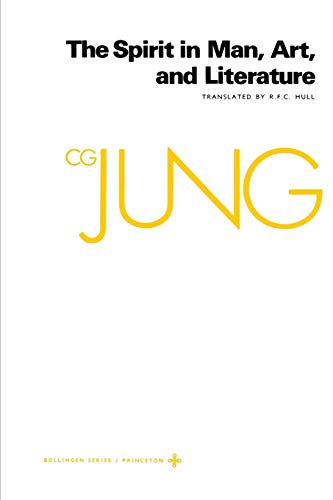
Collected Works of C. G. Jung, Volume 15: Spirit in Man, Art, And Literature (The Collected Works of C. J. Jung, 15, Band 15) - Softcover
Inhaltsangabe
Nine essays, written between 1922 and 1941, on Paracelsus, Freud, Picasso, the sinologist Richard Wilhelm, Joyce's Ulysses, artistic creativity generally, and the source of artistic creativity in archetypal structures.
Die Inhaltsangabe kann sich auf eine andere Ausgabe dieses Titels beziehen.
Über die Autorin bzw. den Autor
C. G. Jung Translated by R.F.C. Hull
Von der hinteren Coverseite
In the nine essays that comprise this volume, written between 1922 and 1941, Jung's attention was directed mainly to the qualities of personality that enable the creative spirit to introduce radical innovations into realms as diverse as medicine, Oriental studies, the visual arts, and literature.
Auszug. © Genehmigter Nachdruck. Alle Rechte vorbehalten.
THE SPIRIT IN MAN, ART, AND LITERATURE
By C. G. JUNG, GERHARD ADLER, R. F. C. HULLPRINCETON UNIVERSITY PRESS
Copyright © 1966 BOLLINGEN FOUNDATION
All rights reserved.
ISBN: 978-0-691-01775-4All rights reserved.
Contents
EDITORIAL NOTE, v,
I,
Paracelsus, 3,
Paracelsus the Physician, 13,
II,
Sigmund Freud in His Historical Setting, 33,
In Memory of Sigmund Freud, 41,
III,
Richard Wilhelm: In Memoriam, 53,
IV,
On the Relation of Analytical Psychology to Poetry, 65,
Psychology and Literature, 84,
V,
"Ulysses": A Monologue, 109,
Picasso, 135,
BIBLIOGRAPHY, 143,
INDEX, 151,
CHAPTER 1
PARACELSUS
1 That remarkable man, Philippus Aureolus Bombast von Hohenheim, known as Theophrastus Paracelsus, was born in this house on November 10, 1493. His medieval mind and questing spirit would not take it amiss if, in respectful remembrance of the customs of his day, we first glance at the position of the sun at the time of his birth. It stood in the sign of Scorpio, a sign that, according to ancient tradition, was favourable to physicians, the ministers of poisons and of healing. The ruler of Scorpio is the proud and bellicose Mars, who endows the strong with warlike courage and the weak with a quarrelsome and irascible disposition. The course of Paracelsus's life certainly did not belie his nativity.
2 Turning now from the heavens to the earth on which he was born, we see his parents' house embedded in a deep, lonely valley, darkly overhung by woods, and surrounded by the sombre towering mountains that shut in the moorlike slopes of the hills and declivities round about melancholy Einsiedeln. The great peaks of the Alps rise up menacingly close, the might of the earth visibly dwarfs the will of man; threateningly alive, it holds him fast in its hollows and forces its will upon him. Here, where nature is mightier than man, none escapes her influence; the chill of water, the starkness of rock, the gnarled, jutting roots of trees and precipitous cliffs—all this generates in the soul of anyone born there something that can never be extirpated, lending him that characteristically Swiss obstinacy, doggedness, stolidity, and innate pride which have been interpreted in various ways—favourably as self-reliance, unfavourably as dour pigheadedness. "The Swiss are characterized by a noble spirit of liberty, but also by a certain coldness which is less agreeable," a Frenchman once wrote.
3 Father Sun and Mother Earth seem to have been more truly the begetters of his character than were Paracelsus's own begetters by blood. For, at any rate on his father's side, Paracelsus was not a Swiss but a Swabian, a son of Wilhelm Bombast, the illegitimate offspring of Georg Bombast of Hohenheim, Grand Master of the Order of the Knights of St. John. But, born under the spell of the Alps, in the lap of a more potent earth that, regardless of his blood, had made him her own, Paracelsus came into the world by character a Swiss, in accordance with the unknown topographical law that rules a man's disposition.
4 His mother came from Einsiedeln, and nothing is known of her influence. His father, on the other hand, was something of a problem. He had wandered into the country as a doctor and had settled down in that out-of-the-way spot along the pilgrims' route. What right had he, born illegitimate, to bear his father's noble name? One surmises the tragedy in the soul of the illegitimate child: a grim, lonely man shorn of his birthright, nursing resentment against his homeland in the seclusion of his wooded valley, and yet, with unconfessed longing, receiving news from pilgrims of the world outside to which he will never return. Aristocratic living and the pleasures of cosmopolitanism were in his blood, and remained buried there. Nothing exerts a stronger psychic effect upon the human environment, and especially upon children, than the life which the parents have not lived. So we may expect this father to have exerted the most powerful influence on the young Paracelsus, who will have reacted in just the opposite way.
5 A great love—indeed, his only love—bound him to his father. This was the only man he remembered with love. A loyal son like this will make amends for his father's guilt. All the father's resignation will turn into consuming ambition in the son. The father's resentment and inevitable feelings of inferiority will make the son an avenger of his father's wrongs. He will wield his sword against all authority, and will do battle with everything that lays claim to the potestas patris, as if it were his own father's adversary. What the father lost or had to relinquish—success, fame, a free-roving life in the great world—he will have to win back again. And, following a tragic law, he must also fall out with his friends, as the predestined consequence of the fateful bond with his only friend, his father—for psychic endogamy is attended by heavy punishments.
6 As is not uncommon, nature equipped him very badly for the role of avenger. Instead of an heroic figure fit for a rebel, she gave him a stature of a mere five feet, an unhealthy appearance, an upper lip that was too short and did not quite cover his teeth (often the distinguishing mark of nervous people), and, so it seems, a pelvis that struck everybody by its femininity when, in the nineteenth century, his bones were exhumed in Salzburg. There is even a legend that he was a eunuch, though to my knowledge there is no further evidence of this. At all events, love seems never to have woven her roses into his earthly life, and he had no need of their thorns, since his character was prickly enough as it was.
7 Hardly had he reached an age to bear arms than the little man buckled on a sword much too big for him, from which he seldom let himself be parted, the less so because, in its ball-shaped pommel, he kept his laudanum pills, which were his true arcanum. Thus accoutred, a figure not entirely lacking in comedy, he set forth into the wide world on his amazing and hazardous journeys which took him to Germany, France, Italy, the Netherlands, Denmark, Sweden, and Russia. An eccentric thaumaturge, almost a second Apollonius of Tyana, he is supposed, according to legend, to have travelled to Africa and Asia, where he discovered the greatest secrets. He never undertook any regular studies, as submission to authority was taboo to him. He was a self-made man, who devised for himself the apt motto Alterius non sit, qui suus esse potest, a right and proper Swiss sentiment. All that befell Paracelsus on his endless journeys must remain forever in the realm of conjecture, but probably it was a constant repetition of what happened to him in Basel. In. 1525, already famed as a physician, he was summoned to Basel by the town council, the latter evidently acting in one of those rare fits of clear-headedness which now and then occur in the course of history, as the appointment of the youthful Nietzsche also shows. The appointment of Paracelsus had a somewhat distressing background, as Europe at that time was suffering under an unexampled epidemic of syphilis which had broken out after the Neapolitan campaign. Paracelsus occupied the post of a town physician, but he comported himself with a lack of dignity not at all to the taste of the university or of the worshipful public. He scandalized the former by giving his lectures in the language of stable-boys and scullions, that is, in German; the latter he outraged by appearing in the street, not in his robe of office, but in a labourer's jerkin. Among his colleagues...
„Über diesen Titel“ kann sich auf eine andere Ausgabe dieses Titels beziehen.
Suchergebnisse für Collected Works of C. G. Jung, Volume 15: Spirit in...

Beispielbild für diese ISBN
The Spirit in Man, Art, & Literature (Collected Works of Jung Vol. 15)
Verlag:
Princeton University Press, 1971
ISBN 10: 0691017751
ISBN 13: 9780691017754
Gebraucht
Softcover
Anbieter: Wonder Book, Frederick, MD, USA
Verkäuferbewertung 5 von 5 Sternen

Zustand: Good. Good condition. Volume 15. A copy that has been read but remains intact. May contain markings such as bookplates, stamps, limited notes and highlighting, or a few light stains. Artikel-Nr. D11M-00847
Gebraucht kaufen
EUR 6,24
Versand gratis
Versand innerhalb von USA
Versand innerhalb von USA
Anzahl: 1 verfügbar
Beispielbild für diese ISBN
Collected Works of C. G. Jung, Volume 15: Spirit in Man, Art, and Literature
Verlag:
Princeton University Press, 1971
ISBN 10: 0691017751
ISBN 13: 9780691017754
Gebraucht
Paperback
Anbieter: ThriftBooks-Dallas, Dallas, TX, USA
Verkäuferbewertung 5 von 5 Sternen
Paperback. Zustand: Good. No Jacket. Pages can have notes/highlighting. Spine may show signs of wear. ~ ThriftBooks: Read More, Spend Less. Artikel-Nr. G0691017751I3N00
Gebraucht kaufen
EUR 6,56
Versand gratis
Versand innerhalb von USA
Versand innerhalb von USA
Anzahl: 1 verfügbar
Beispielbild für diese ISBN
Collected Works of C. G. Jung, Volume 15: Spirit in Man, Art, and Literature
Verlag:
Princeton University Press, 1971
ISBN 10: 0691017751
ISBN 13: 9780691017754
Gebraucht
Paperback
Anbieter: ThriftBooks-Reno, Reno, NV, USA
Verkäuferbewertung 5 von 5 Sternen
Paperback. Zustand: Fair. No Jacket. Readable copy. Pages may have considerable notes/highlighting. ~ ThriftBooks: Read More, Spend Less. Artikel-Nr. G0691017751I5N00
Gebraucht kaufen
EUR 6,56
Versand gratis
Versand innerhalb von USA
Versand innerhalb von USA
Anzahl: 1 verfügbar
Beispielbild für diese ISBN
Collected Works of C. G. Jung, Volume 15: Spirit in Man, Art, and Literature
Verlag:
Princeton University Press, 1971
ISBN 10: 0691017751
ISBN 13: 9780691017754
Gebraucht
Paperback
Anbieter: ThriftBooks-Atlanta, AUSTELL, GA, USA
Verkäuferbewertung 5 von 5 Sternen
Paperback. Zustand: Fair. No Jacket. Readable copy. Pages may have considerable notes/highlighting. ~ ThriftBooks: Read More, Spend Less. Artikel-Nr. G0691017751I5N00
Gebraucht kaufen
EUR 6,56
Versand gratis
Versand innerhalb von USA
Versand innerhalb von USA
Anzahl: 1 verfügbar
Beispielbild für diese ISBN
Collected Works of C. G. Jung, Volume 15: Spirit in Man, Art, and Literature
Verlag:
Princeton University Press, 1971
ISBN 10: 0691017751
ISBN 13: 9780691017754
Gebraucht
Paperback
Anbieter: ThriftBooks-Dallas, Dallas, TX, USA
Verkäuferbewertung 5 von 5 Sternen
Paperback. Zustand: Fair. No Jacket. Readable copy. Pages may have considerable notes/highlighting. ~ ThriftBooks: Read More, Spend Less. Artikel-Nr. G0691017751I5N00
Gebraucht kaufen
EUR 6,56
Versand gratis
Versand innerhalb von USA
Versand innerhalb von USA
Anzahl: 1 verfügbar
Beispielbild für diese ISBN
Collected Works of C. G. Jung, Volume 15: Spirit in Man, Art, and Literature
Verlag:
Princeton University Press, 1971
ISBN 10: 0691017751
ISBN 13: 9780691017754
Gebraucht
Paperback
Anbieter: ThriftBooks-Atlanta, AUSTELL, GA, USA
Verkäuferbewertung 5 von 5 Sternen
Paperback. Zustand: Good. No Jacket. Former library book; Pages can have notes/highlighting. Spine may show signs of wear. ~ ThriftBooks: Read More, Spend Less. Artikel-Nr. G0691017751I3N10
Gebraucht kaufen
EUR 6,56
Versand gratis
Versand innerhalb von USA
Versand innerhalb von USA
Anzahl: 1 verfügbar
Beispielbild für diese ISBN
The Spirit in Man, Art, & Literature (Collected Works of Jung Vol. 15)
ISBN 10: 0691017751
ISBN 13: 9780691017754
Gebraucht
Paperback
Anbieter: BooksRun, Philadelphia, PA, USA
Verkäuferbewertung 5 von 5 Sternen
Paperback. Zustand: Very Good. First Princeton/Boll. It's a well-cared-for item that has seen limited use. The item may show minor signs of wear. All the text is legible, with all pages included. It may have slight markings and/or highlighting. Artikel-Nr. 0691017751-11-1
Gebraucht kaufen
EUR 10,90
Versand gratis
Versand innerhalb von USA
Versand innerhalb von USA
Anzahl: 1 verfügbar
Beispielbild für diese ISBN
Collected Works of C. G. Jung, Volume 15 Spirit in Man, Art, And Literature
Anbieter: Revaluation Books, Exeter, Vereinigtes Königreich
Verkäuferbewertung 5 von 5 Sternen
Paperback. Zustand: Brand New. 178 pages. 9.00x6.25x0.50 inches. In Stock. Artikel-Nr. x-0691017751
Neu kaufen
EUR 28,01
EUR 11,68 Versand
Versand von Vereinigtes Königreich nach USA
Versand von Vereinigtes Königreich nach USA
Anzahl: 2 verfügbar
Beispielbild für diese ISBN
Collected Works of C.G. Jung: volume 17- Spirit in Man, Art, and Literature
Verlag:
Princeton University Press, 1992
ISBN 10: 0691017751
ISBN 13: 9780691017754
Gebraucht
Soft cover
Anbieter: AproposBooks&Comics, London, Vereinigtes Königreich
Verkäuferbewertung 4 von 5 Sternen

Soft cover. Zustand: Fine. Artikel-Nr. 060325/vicbethking/4544564
Gebraucht kaufen
EUR 27,36
EUR 17,46 Versand
Versand von Vereinigtes Königreich nach USA
Versand von Vereinigtes Königreich nach USA
Anzahl: 1 verfügbar