
Verwandte Artikel zu A Tale of Two Continents: A Physicist's Life in...
Inhaltsangabe
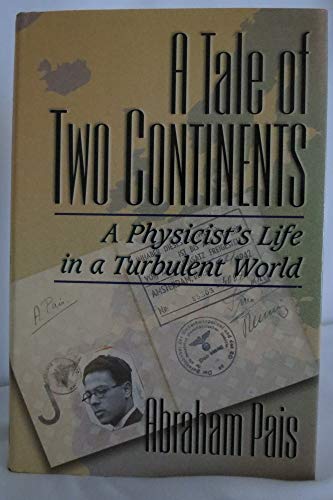
"People like myself, who truly feel at home in several countries, are not strictly at home anywhere," writes Abraham Pais, one of the world's leading theoretical physicists, near the beginning of this engrossing chronicle of his life on two continents. The author of an immensely popular biography of Einstein, Subtle Is the Lord, Pais writes engagingly for a general audience. His "tale" describes his period of hiding in Nazi-occupied Holland (he ended the war in a Gestapo prison) and his life in America, particularly at the newly organized Institute for Advanced Study in Princeton, then directed by the brilliant and controversial physicist Robert Oppenheimer. Pais tells fascinating stories about Oppenheimer, Einstein, Bohr, Sakharov, Dirac, Heisenberg, and von Neumann, as well as about nonscientists like Chaim Weizmann, George Kennan, Erwin Panofsky, and Pablo Casals. His enthusiasm about science and life in general pervades a book that is partly a memoir, partly a travel commentary, and partly a history of science.
Pais's charming recollections of his years as a university student become somber with the German invasion of the Netherlands in 1940. He was presented with an unusual deadline for his graduate work: a German decree that July 14, 1941, would be the final date on which Dutch Jews could be granted a doctoral degree. Pais received the degree, only to be forced into hiding from the Nazis in 1943, practically next door to Anne Frank. After the war, he went to the Institute of Theoretical Physics in Copenhagen to work with Niels Bohr. 1946 began his years at the Institute for Advanced Study, where he worked first as a Fellow and then as a Professor until his move to Rockefeller University in 1963. Combining his understanding of disparate social and political worlds, Pais comments just as insightfully on Oppenheimer's ordeals during the McCarthy era as he does on his own and his European colleagues' struggles during World War II.
Originally published in 1997.
The Princeton Legacy Library uses the latest print-on-demand technology to again make available previously out-of-print books from the distinguished backlist of Princeton University Press. These editions preserve the original texts of these important books while presenting them in durable paperback and hardcover editions. The goal of the Princeton Legacy Library is to vastly increase access to the rich scholarly heritage found in the thousands of books published by Princeton University Press since its founding in 1905.
Die Inhaltsangabe kann sich auf eine andere Ausgabe dieses Titels beziehen.
Von der hinteren Coverseite
"A brilliant and charming autobiography from a brilliant and charming physicist who worked with such greats as Bohr, Einstein, and Oppenheimer. They admired and respected him. So do I."--Richard Rhodes, author ofThe Making of the Atomic Bomb
"Pais renders observation and judgment from the world-view of a person of deeply engaged passion, and of one outwardly removed in critical reflection. Ranging between warmly playful and acerbic, exceptional events of this century appear in fascinating, multi-faceted substance. I love it!"--Mitchell J. Feigenbaum, professor, Rockefeller University
Auszug. © Genehmigter Nachdruck. Alle Rechte vorbehalten.
A Tale of Two Continents
A Physicist's Life in a Turbulent World
By Abraham PaisPRINCETON UNIVERSITY PRESS
Copyright © 1997 Princeton University Press
All rights reserved.
ISBN: 978-0-691-01243-8All rights reserved.
Contents
Acknowledgments, xi,
Prologue, xiii,
BOOK THE FIRST: EUROPE,
1 Descent, 3,
2 Early Years, 7,
3 Bachelor's Degrees in Amsterdam, 15,
4 Of Music, Films, and Other Diversions, 20,
5 First Contacts with Zionism, 24,
6 Utrecht: M.Sc. and Ph.D., 31,
7 War, 44,
8 Occupation of Holland, 52,
9 Sho'ah, 66,
10 Wartime Experiences of My Family and Me, 88,
11 War's Aftermath: A Last Lesson in Dutch History, 126,
12 My Final Months in Holland, 136,
13 Getting to Know Niels Bohr, 149,
BOOK THE SECOND: AMERICA,
14 It Is Time to Speak of America, 181,
15 The State of the Union 1946: The U.S., Princeton, and the Institute for Advanced Study, 191,
16 Enter Einstein and Other Interesting New Acquaintances, 200,
17 In Which Oppenheimer Becomes Director and I a Long-Term Member of the Institute, 219,
18 Oppenheimer: Glimpses of a Complex Man, 235,
19 My Career Unfolds, 244,
20 About Unexpected New Physics, Old Friends, and a Grand Tour, 265,
21 Of the Beginnings of Theoretical Particle Physics, Some Baseball History, and Two Long Summer Journeys, 284,
22 Of Symmetry and My Longest Journey, 302,
23 Greenwich Village, American Citizenship, and the Oppenheimer Affair, 321,
24 Of My Best Work and a Year's Leave of Absence. Death of Einstein, 333,
25 My First Trip to Russia and My First Marriage, 349,
26 Enter Joshua. The 1950s, Concluded, 358,
27 Times of Great Change: The Early 1960s, 369,
28 Changing My Workplace from Princeton to New York, 385,
29 What Befell Me in the Late 1960s, 399,
30 The 1970s, 408,
31 A Career Change, 425,
32 My Final Years—So Far, 446,
33 Approaching the Millennium, 467,
Notes and References, 477,
Onomasticon, 505,
CHAPTER 1
Descent
I, ABRAHAM (friends call me Bram), am the son of Jesaja, son of Abraham, who was a diamond cutter, son of Jesayas, also a diamond cutter, son of Benjamin Pays—who was married twice and had eleven children from his first and seven from his second marriage—son of Nathan Pais, son of Benjamin Paes, son of Nathan Paes. All of these ancestors, as well as I myself, were born in Amsterdam.
The reason I can trace my paternal ancestry that far back is that all of these Paises belonged to the Portuguese-Israelitic, also called the Sephardic, congregation Talmud Torah of Amsterdam and were registered in its record books, which have been preserved.
I have not been able to follow my lineage to still earlier times. It is certain, however, that my ancestors came to Amsterdam from the Iberian peninsula at some time after the 1590s, when the first Sephardic Jews reached the Low Lands (now the Netherlands and Belgium) via the Friesian town of Emden, most probably from Portugal. (The early spelling "Paes" perhaps indicates earlier Spanish origins.) Many Sephardim fled from Spain to Portugal after the Inquisition began. To this day the telephone book of Lisbon shows a long list of Paises, a name which in Portugal dates back to medieval times. In 1160, a Gualdim Pais established the Templar Order of Christ near where, in 1345, the town of Tomar was founded—by a Dom Pais, according to an inscription on his statue in the town's main square. I do not think that these gentlemen are ancestors of mine, however.
The arrival of Sephardim in the northern Netherlands marked the founding of the oldest emancipated post-Renaissance Jewish community in the Western world. Later it would sometimes be called the Jerusalem of the North.
In 1519, the humanist and scholar Erasmus of Rotterdam wrote in a letter: "If it is Christian to hate the Jews, then we are all of us outstanding Christians." Nothing unusual about that. There were only a few Jews to hate in his environs, however. Before 1500, one finds only scarce and scattered references to the presence (and persecution) of Jews in the area now known as the Netherlands. Of the few Jews who lived there, most disappeared after 1544, when Emperor Charles V, king of Spain, who also ruled over the Netherlands, issued a decree ordering their expulsion from the region. By that time they had already suffered a similar fate in Spain.
The Spanish Inquisition, initiated in 1478, "had been originally devised for Jews and Moors, whom the Christianity of the time did not regard as human beings." It brought to an irrevocable end the golden age—the thirteenth and fourteenth centuries—for Jews and Arabs living in Spain; many Spanish Jews converted to Catholicism in order to escape horrible brutality. These neo-Christians were known as Marranos, which is Spanish for swine. Most remained secretly faithful to Judaism, however; thousands were caught and lost their lives at the stake. Those who continued openly to profess Judaism were expelled from Spain by the royal edict of March 31, 1492, four months before Columbus set sail on his first voyage of discovery of the New World. Many fled to Portugal where, shortly afterward, they were again forced to renounce their faith. In 1536, the rule of Inquisition was also introduced in Portugal, causing some to flee, others once again to become Marranos.
Meanwhile, the Inquisition had extended its activities to the persecution of Christian heretics. Recall that the sixteenth century was the age of the great religious and political revolution known as the Reformation, spearheaded by men such as Martin Luther and Johannes Calvin. The new Protestantism found a large following in the Netherlands; the Inquisition reacted there accordingly, ably sustained by Philip II, son and heir of Charles V, with its customary cruel tortures and executions. These events caused the peoples of the Low Lands to rise up in arms, led by William (the "Silent"), count of Nassau, prince of Orange. In 1568, the eighty-year war with Spain began. Up till then the Low Lands had been an agglomerate of regions ruled by counts, barons, and other nobles. Now it became one nation, "the Netherlands," which initially comprised both Holland and Belgium. William, known to the Dutch as "the Father of the Fatherland," wrote that he was prepared to stake "his person and all that is in his power to commence and maintain the liberty of religion and of the fatherland."
In this favorable climate the first Sephardim settled in Amsterdam, from where the Spaniards had meanwhile been expelled. By 1612 about 500 were already living there. In 1618 they inaugurated their enlarged synagogue on the Houtgracht. It was there that in 1642 Rabbi Manasseh ben Israel welcomed William's son, Prince Frederick Henry, who was accompanied by the queen of England; also here, on July 27, 1656, the infamous ban on the Sephardi Baruch Spinoza was pronounced. Rabbi ben Israel played an active role in the readmission of Jews to England—from where they had been expelled since 1290—when in 1655 he visited London at Cromwell's invitation. Sephardim were also the first Jewish settlers in New York (in 1654).
The Portuguese synagogue of Amsterdam, inaugurated in 1675, unharmed by war and occupation, stands today as one of the world's most renowned synagogue buildings. Its services are still held in a Hebrew that, apart from small variants, is identical to the Iwrith now spoken in Israel. As I remember from my...
„Über diesen Titel“ kann sich auf eine andere Ausgabe dieses Titels beziehen.
Suchergebnisse für A Tale of Two Continents: A Physicist's Life in...

Beispielbild für diese ISBN
A Tale of Two Continents (Princeton Legacy Library (355))
Verlag:
Princeton University Press, 1997
ISBN 10: 0691012431
ISBN 13: 9780691012438
Gebraucht
Hardcover
Anbieter: World of Books (was SecondSale), Montgomery, IL, USA
Verkäuferbewertung 5 von 5 Sternen

Zustand: Good. Item in good condition. Textbooks may not include supplemental items i.e. CDs, access codes etc. Artikel-Nr. 00109514261
Gebraucht kaufen
EUR 4,94
Versand gratis
Versand innerhalb von USA
Versand innerhalb von USA
Anzahl: 1 verfügbar
Beispielbild für diese ISBN
A Tale of Two Continents (Princeton Legacy Library (355))
Verlag:
Princeton University Press, 1997
ISBN 10: 0691012431
ISBN 13: 9780691012438
Gebraucht
Hardcover
Anbieter: Wonder Book, Frederick, MD, USA
Verkäuferbewertung 5 von 5 Sternen
Zustand: Good. Good condition. Very Good dust jacket. A copy that has been read but remains intact. May contain markings such as bookplates, stamps, limited notes and highlighting, or a few light stains. Artikel-Nr. K07U-00229
Gebraucht kaufen
EUR 10,34
Versand gratis
Versand innerhalb von USA
Versand innerhalb von USA
Anzahl: 1 verfügbar
Beispielbild für diese ISBN
A Tale of Two Continents : A Physicist's Life in a Turbulent World
Verlag:
Princeton University Press, 1997
ISBN 10: 0691012431
ISBN 13: 9780691012438
Gebraucht
Hardcover
Anbieter: Better World Books: West, Reno, NV, USA
Verkäuferbewertung 5 von 5 Sternen
Zustand: Very Good. First. Former library copy. Pages intact with possible writing/highlighting. Binding strong with minor wear. Dust jackets/supplements may not be included. Includes library markings. Stock photo provided. Product includes identifying sticker. Better World Books: Buy Books. Do Good. Artikel-Nr. 4122193-20
Gebraucht kaufen
EUR 10,67
Versand gratis
Versand innerhalb von USA
Versand innerhalb von USA
Anzahl: 1 verfügbar
Beispielbild für diese ISBN
A Tale of Two Continents : A Physicist's Life in a Turbulent World
Verlag:
Princeton University Press, 1997
ISBN 10: 0691012431
ISBN 13: 9780691012438
Gebraucht
Hardcover
Anbieter: Better World Books, Mishawaka, IN, USA
Verkäuferbewertung 5 von 5 Sternen
Zustand: Good. First. Former library copy. Pages intact with minimal writing/highlighting. The binding may be loose and creased. Dust jackets/supplements are not included. Includes library markings. Stock photo provided. Product includes identifying sticker. Better World Books: Buy Books. Do Good. Artikel-Nr. GRP71336506
Gebraucht kaufen
EUR 10,67
Versand gratis
Versand innerhalb von USA
Versand innerhalb von USA
Anzahl: 2 verfügbar
Foto des Verkäufers
A Tale of Two Continents: A Physicist's Life in a Turbulent World
Verlag:
Princeton University Press, New Jersey, 1997
ISBN 10: 0691012431
ISBN 13: 9780691012438
Gebraucht
Hardcover
Erstausgabe
Anbieter: Between the Covers-Rare Books, Inc. ABAA, Gloucester City, NJ, USA
Verkäuferbewertung 5 von 5 Sternen
Hardcover. Zustand: Fine. Zustand des Schutzumschlags: Fine. First edition. Illustrated with black and white photographs. Fine in fine dustwrapper. Artikel-Nr. 104587
Gebraucht kaufen
EUR 40,39
EUR 4,79 Versand
Versand innerhalb von USA
Versand innerhalb von USA
Anzahl: 1 verfügbar