
Verwandte Artikel zu The Politics of Retribution in Europe: World War II...
Inhaltsangabe
Hannah Arendt's rich and varied political thought is more influential today than ever before, due in part to the collapse of communism and the need for ideas that move beyond the old ideologies of the Cold War. As Dana Villa shows, however, Arendt's thought is often poorly understood, both because of its complexity and because her fame has made it easy for critics to write about what she is reputed to have said rather than what she actually wrote. Villa sets out to change that here, explaining clearly, carefully, and forcefully Arendt's major contributions to our understanding of politics, modernity, and the nature of political evil in our century. Villa begins by focusing on some of the most controversial aspects of Arendt's political thought. He shows that Arendt's famous idea of the banality of evil-inspired by the trial of Adolf Eichmann-does not, as some have maintained, lessen the guilt of war criminals by suggesting that they are mere cogs in a bureaucratic machine. He examines what she meant when she wrote that terror was the essence of totalitarianism, explaining that she believed Nazi and Soviet terror served above all to reinforce the totalitarian idea that humans are expendable units, subordinate to the all-determining laws of Nature or History. Villa clarifies the personal and philosophical relationship between Arendt and Heidegger, showing how her work drew on his thought while providing a firm repudiation of Heidegger's political idiocy under the Nazis. Less controversially, but as importantly, Villa also engages with Arendt's ideas about the relationship between political thought and political action. He explores her views about the roles of theatricality, philosophical reflection, and public-spiritedness in political life. And he explores what relationship
Die Inhaltsangabe kann sich auf eine andere Ausgabe dieses Titels beziehen.
Über die Autorin bzw. den Autor
Edited by István Deák, Jan T. Gross, & Tony Judt
Von der hinteren Coverseite
"This volume will contribute greatly to the reconfiguration of our understanding of Europe in the last fifty years and is of great help in stimulating an understanding of why it took so long for the democratic ideal to triumph over the whole of the continent."--Antony Polonsky, Brandeis University
Auszug. © Genehmigter Nachdruck. Alle Rechte vorbehalten.
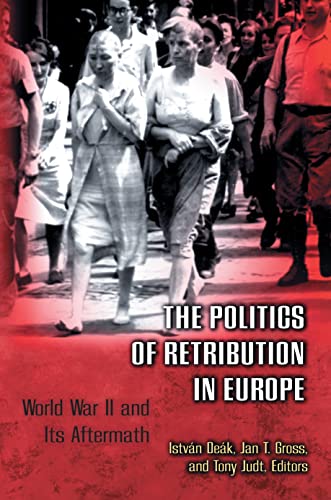
THE POLITICS OF RETRIBUTION IN EUROPE
WORLD WAR II AND ITS AFTERMATHPRINCETON UNIVERSITY PRESS
Copyright © 2000 Princeton University PressAll right reserved.
ISBN: 978-0-691-00954-4
Contents
Preface Tony Judt.....................................................................................................................................viiPART I: PRELIMINARIES..................................................................................................................................1Introduction Istvn Dek..............................................................................................................................3Themes for a Social History of War Experience and Collaboration Jan T. Gross..........................................................................15PART II: THE EXPERIENCE OF WAR.........................................................................................................................37A Fatal Compromise? The Debate over Collaboration and Resistance in Hungary Istvn Dek...............................................................39A Tangled Web: Confronting Stereotypes Concerning Relations between Poles, Germans, Jews, and Communists Jan T. Gross.................................74PART III: TRIALS AND POLITICAL EXPEDIENCY..............................................................................................................131Justice in Postwar Belgium: Popular Passions and Political Realities Martin Conway....................................................................133The Criminal Justice System As a Political Actor in Regime Transitions: The Case of Belgium, 1944-50 Luc Huyse........................................157"Restoration of Confidence": The Purge of Local Government in the Netherlands As a Problem of Postwar Reconstruction Peter Romijn.....................173Postwar Justice in France: Bordeaux 1953 Sarah Farmer.................................................................................................194The Cold War and the Appropriation of Memory: Greece after Liberation Mark Mazower....................................................................212The People's Courts and Revolutionary Justice in Hungary, 1945-46 Lszl Karsai.......................................................................233The Politics of Retribution: The Trial of Jozef Tiso in the Czechoslovak Environment Bradley Abrams...................................................252PART IV: EPILOGUE......................................................................................................................................291The Past Is Another Country: Myth and Memory in Postwar Europe Tony Judt..............................................................................293List of Contributors...................................................................................................................................325Index..................................................................................................................................................327
Chapter One
ISTVN DEKIntroduction
Conquering armies over the centuries have always found willing collaborators in the countries they occupy, and, if sufficiently oppressive and brutal, they have also met with civilian resistance. Following occupation, those who had given aid and comfort to the enemy were often hunted down and punished. In the annals of history, however, never have so many people been caught up in the process of collaboration, resistance, and retribution as in Europe during and after the Second World War. True, even then, active collaborators and active resisters were but a small minority among the many who just wanted to get by, but the impact of collaboration and resistance was so great as to affect nearly everyone's life.
Postwar purges, part of a brutal and sweeping pattern of retribution, produced an enormous demographic upheaval-especially in Central and Eastern Europe-one whose long-range consequences we are still unable to fathom. Moreoever, an extraordinary number of individuals were prosecuted, after the war, for collaboration and war crimes. This is not to say that all the guilty were actually punished. Far from it-some of the most obnoxious traitors and war criminals escaped retribution altogether. 1 It is to say only that all across what once had been Hitler's Europe, an attempt at retribution frightened or, alternately, exhilarated vast sections of the population.
What motivated the postwar antifascist regimes was, primarily, rightful indignation over the many acts of cruelty and treason committed by the collaborators. There were other motives as well: the desire to place the blame on specific individuals for what had been, in reality, a large scale, popular accommodation with the enemy, and the perceived need to eliminate, or at least to reduce, the influence of social, political, and ethnic groups that might stand in the way of the creation of a new society and state.
Just as accommodation to the wishes of the occupier had been popular in most occupied countries, so now did the prosecution of collaborators meet with widespread public approval. It was as if the Europeans hoped to rid themselves of the memory of their compromises and crimes by decimating their own ranks.
It is nearly impossible to calculate the total number of persons targeted by postwar retribution, but, even by the most conservative estimates, they numbered several million, that is, 2 or 3 percent of the population formerly under German occupation. Because educated adult males constituted the majority of those purged, this segment of the population was even more seriously affected. In some countries, such as France, actors, actresses, cabaret singers, journalists, writers, poets, and philosophers were especially singled out by the prosecutors.
Punishment of the guilty ranged from lynchings during the last months of the war to postwar death sentencing, imprisonment, or hard labor. Added to those harsh punishments were condemnation to national dishonor, the loss of civic rights, and/or monetary fines as well as such administrative measures as expulsion, police supervision, loss of the right to travel or to live in certain desirable places, dismissal, and the loss of pension rights. It is one of the great paradoxes of the postwar era that in all of Europe, the smallest percentage of former Nazis was executed or imprisoned in Western Germany. On the other hand, Western Germany made a greater effort than any other country in Europe to atone collectively for its past.
To the bewildering array of persons who were charged by the national courts for what was alternately, or often simultaneously, termed collaboration with the enemy, treason, and war crimes should be added those who were not charged individually but belonged to one or another group held collectively responsible for what had taken place during the war. These groups included, among others, the thirteen to fifteen million Volksdeutsche, German-speaking inhabitants of Poland, Czechoslovakia, Hungary, Yugoslavia, Russia, and the three Baltic countries, who were charged collectively with war crimes and treason by the governments of their own countries and by the leaders of the three great Allied powers meeting at Potsdam in June 1945. These Germans were either killed or expelled to what remained of Germany after the war.
Collective punishment targeted more than just the Volksdeutsche. Other ethnic groups, such as the Hungarians in Czechoslovakia, the Poles in the Ukraine, the Ukrainians in Poland, and the...
„Über diesen Titel“ kann sich auf eine andere Ausgabe dieses Titels beziehen.
Suchergebnisse für The Politics of Retribution in Europe: World War II...

Beispielbild für diese ISBN
The Politics of Retribution in Europe: World War II and Its Aftermath
Verlag:
Princeton University Press, 2000
ISBN 10: 0691009546
ISBN 13: 9780691009544
Gebraucht
Paperback
Anbieter: ThriftBooks-Atlanta, AUSTELL, GA, USA
Verkäuferbewertung 5 von 5 Sternen

Paperback. Zustand: Very Good. No Jacket. May have limited writing in cover pages. Pages are unmarked. ~ ThriftBooks: Read More, Spend Less. Artikel-Nr. G0691009546I4N00
Gebraucht kaufen
EUR 8,22
Versand gratis
Versand innerhalb von USA
Versand innerhalb von USA
Anzahl: 1 verfügbar
Beispielbild für diese ISBN
The Politics of Retribution in Europe: World War II and Its Aftermath
Verlag:
Princeton University Press, 2000
ISBN 10: 0691009546
ISBN 13: 9780691009544
Gebraucht
Paperback
Anbieter: ThriftBooks-Atlanta, AUSTELL, GA, USA
Verkäuferbewertung 5 von 5 Sternen
Paperback. Zustand: Very Good. No Jacket. Former library book; May have limited writing in cover pages. Pages are unmarked. ~ ThriftBooks: Read More, Spend Less. Artikel-Nr. G0691009546I4N10
Gebraucht kaufen
EUR 8,22
Versand gratis
Versand innerhalb von USA
Versand innerhalb von USA
Anzahl: 1 verfügbar
Beispielbild für diese ISBN
The Politics of Retribution in Europe: World War II and Its Aftermath
Verlag:
Princeton University Press, 2000
ISBN 10: 0691009546
ISBN 13: 9780691009544
Gebraucht
Paperback
Anbieter: ThriftBooks-Atlanta, AUSTELL, GA, USA
Verkäuferbewertung 5 von 5 Sternen
Paperback. Zustand: Fair. No Jacket. Readable copy. Pages may have considerable notes/highlighting. ~ ThriftBooks: Read More, Spend Less. Artikel-Nr. G0691009546I5N00
Gebraucht kaufen
EUR 8,22
Versand gratis
Versand innerhalb von USA
Versand innerhalb von USA
Anzahl: 1 verfügbar
Beispielbild für diese ISBN
The Politics of Retribution in Europe : World War II and Its Aftermath
Verlag:
Princeton University Press, 2000
ISBN 10: 0691009546
ISBN 13: 9780691009544
Gebraucht
Softcover
Anbieter: Better World Books Ltd, Dunfermline, Vereinigtes Königreich
Verkäuferbewertung 5 von 5 Sternen
Zustand: Very Good. Former library copy. Pages intact with possible writing/highlighting. Binding strong with minor wear. Dust jackets/supplements may not be included. Includes library markings. Stock photo provided. Product includes identifying sticker. Better World Books: Buy Books. Do Good. Artikel-Nr. 7834351-6
Gebraucht kaufen
EUR 5,83
EUR 5,93 Versand
Versand von Vereinigtes Königreich nach USA
Versand von Vereinigtes Königreich nach USA
Anzahl: 3 verfügbar
Beispielbild für diese ISBN
The Politics of Retribution in Europe: World War II and Its Aftermath
Verlag:
Princeton University Press, New Jersey, 2000
ISBN 10: 0691009546
ISBN 13: 9780691009544
Gebraucht
Soft cover
Anbieter: East Kent Academic, Bridge, Canterbury, KENT, Vereinigtes Königreich
Verkäuferbewertung 5 von 5 Sternen
Soft cover. Zustand: Near Fine. How liberated countries dealt with those who collaborated with the Nazi occupiers in the aftermath of WW II. It wa a messy picture. Some avengers had themselves been collaborators. There was much collective amnesia and even the punishing of those French collaborators who massacred the inhabitants of Oradour-sur-Glane divided two French regions, Alsace and Limousin, into the 1950s. Greece, Croatia, the Netherlands and other countries included here. 336 pages. Quoted postage for UK 2nd class. Overseas at least £9.55. Artikel-Nr. 7310
Gebraucht kaufen
EUR 9,17
EUR 13,23 Versand
Versand von Vereinigtes Königreich nach USA
Versand von Vereinigtes Königreich nach USA
Anzahl: 1 verfügbar
Beispielbild für diese ISBN
The Politics of Retribution in Europe: World War II and Its Aftermath
Verlag:
Princeton University Press, 2000
ISBN 10: 0691009546
ISBN 13: 9780691009544
Gebraucht
Softcover
Anbieter: medimops, Berlin, Deutschland
Verkäuferbewertung 5 von 5 Sternen
Zustand: good. Befriedigend/Good: Durchschnittlich erhaltenes Buch bzw. Schutzumschlag mit Gebrauchsspuren, aber vollständigen Seiten. / Describes the average WORN book or dust jacket that has all the pages present. Artikel-Nr. M00691009546-G
Gebraucht kaufen
EUR 24,66
EUR 10,00 Versand
Versand von Deutschland nach USA
Versand von Deutschland nach USA
Anzahl: 1 verfügbar
Beispielbild für diese ISBN
The Politics of Retribution in Europe
Anbieter: PBShop.store US, Wood Dale, IL, USA
Verkäuferbewertung 5 von 5 Sternen
PAP. Zustand: New. New Book. Shipped from UK. Established seller since 2000. Artikel-Nr. WP-9780691009544
Beispielbild für diese ISBN
The Politics of Retribution in Europe
Anbieter: PBShop.store UK, Fairford, GLOS, Vereinigtes Königreich
Verkäuferbewertung 5 von 5 Sternen
PAP. Zustand: New. New Book. Shipped from UK. Established seller since 2000. Artikel-Nr. WP-9780691009544
Neu kaufen
EUR 56,78
EUR 5,96 Versand
Versand von Vereinigtes Königreich nach USA
Versand von Vereinigtes Königreich nach USA
Anzahl: 1 verfügbar
Beispielbild für diese ISBN
The Politics of Retribution in Europe
Anbieter: Kennys Bookstore, Olney, MD, USA
Verkäuferbewertung 5 von 5 Sternen
Zustand: New. Conventional depictions of occupation and collaboration in World War II, of wartime resistance and post-war renewal, provided a backdrop against which the chronicle of post-war Europe has been told. This book sheds light on the amnesia that overtook European governments and peoples regarding their responsibility for war crimes against humanity. Editor(s): Deak, Istvan; Gross, Jan T.; Judt, Tony. Num Pages: 352 pages, black & white illustrations. BIC Classification: 1D; HBJD; HBLW3; JP. Category: (P) Professional & Vocational; (U) Tertiary Education (US: College). Dimension: 236 x 156 x 21. Weight in Grams: 496. . 2000. Paperback. . . . . Books ship from the US and Ireland. Artikel-Nr. V9780691009544
Neu kaufen
EUR 60,18
EUR 9,36 Versand
Versand innerhalb von USA
Versand innerhalb von USA
Anzahl: 1 verfügbar
Beispielbild für diese ISBN
The Politics of Retribution in Europe
Anbieter: Ria Christie Collections, Uxbridge, Vereinigtes Königreich
Verkäuferbewertung 5 von 5 Sternen
Zustand: New. In English. Artikel-Nr. ria9780691009544_new
Neu kaufen
EUR 80,76
EUR 13,40 Versand
Versand von Vereinigtes Königreich nach USA
Versand von Vereinigtes Königreich nach USA
Anzahl: Mehr als 20 verfügbar