
Verwandte Artikel zu Metaphysical Song: An Essay on Opera (Princeton Studies...
Metaphysical Song: An Essay on Opera (Princeton Studies in Opera) - Softcover
Buch 10 von 11: Princeton Studies in Opera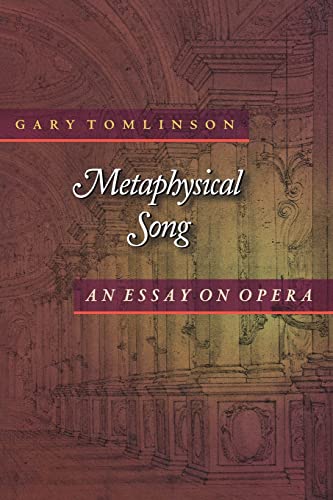
Inhaltsangabe
In this bold recasting of operatic history, Gary Tomlinson connects opera to shifting visions of metaphysics and selfhood across the last four hundred years. The operatic voice, he maintains, has always acted to open invisible, supersensible realms to the perceptions of its listeners. In doing so, it has articulated changing relations between the self and metaphysics. Tomlinson examines these relations as they have been described by philosophers from Ficino through Descartes, Kant, and Nietzsche, to Adorno, all of whom worked to define the subject's place in both material and metaphysical realms. The author then shows how opera, in its own cultural arena, distinct from philosophy, has repeatedly brought to the stage these changing relations of the subject to the particular metaphysics it presumes. Covering composers from Jacopo Peri to Wagner, from Lully to Verdi, and from Mozart to Britten, Metaphysical Song details interactions of song, words, drama, and sounds used by creators of opera to fill in the outlines of the subjectivities they envisioned. The book offers deep-seated explanations for opera's enduring fascination in European elite culture and suggests some of the profound difficulties that have unsettled this fascination since the time of Wagner.
Die Inhaltsangabe kann sich auf eine andere Ausgabe dieses Titels beziehen.
Über die Autorin bzw. den Autor
Gary Tomlinson
Von der hinteren Coverseite
"A fascinating and sensitive study of how philosophers have probed the problem of subjectivity through the passage of the operatic voice. Tomlinson's work is notable for the way it combines a thorough knowledge of the history of music and opera with an understanding of contemporary problems of theory and methodology."--Lydia Goehr, Columbia University
"This extraordinary book offers us an 'alternative story' of the history of opera. . . . [It] will have an important . . . effect on the way we think about opera."--Roger Parker, Oxford University
Auszug. © Genehmigter Nachdruck. Alle Rechte vorbehalten.
Metaphysical Song
An Essay On Opera
By Gary TomlinsonPRINCETON UNIVERSITY PRESS
Copyright © 1999 Princeton University Press
All rights reserved.
ISBN: 978-0-691-00409-9All rights reserved.
Contents
Preface, ix,
I Voices of the Invisible, 3,
II Late Renaissance Opera, 9,
III Early Modern Opera, 34,
IV Modern Opera, 73,
V Nietzsche: Overcoming Operatic Metaphysics, 109,
VI Ghosts in the Machine, 127,
VII The Sum of Modernity, 147,
Notes, 157,
Index, 181,
CHAPTER 1
VOICES OF THE INVISIBLE
Just as the operatic voice has fascinated us, in the West, continuously for four hundred years, so we have felt the need again and again to formulate explanations of its force. Two recent scholarly developments suggest that the time may be ripe for a new such formulation. First, the notion of voice in opera has grown increasingly complex and rich in recent years. It has been scrutinized from enough perspectives—from narratology to post-Freudian and post-Lacanian psychoanalysis, from feminist theory to queer sensibility—that we must think twice before presuming to know just who expresses what as a singer portrays for us a dramatic role. Musicologists in particular have tried out on the operatic voice a wide array of the approaches to utterance and self that have emerged from other academic disciplines. In the process voice has seemed at times almost to displace the musical score at the heart of operatic study. It has done so provocatively and, often, productively.
The second development is the anthropological impulse, broadly speaking, that drives many of the human sciences these days, which I would sum up as the quest for a knowledge of others that can alienate even as it illuminates, a knowledge that is of ourselves in its being of others. In musicology, in the wake of this impulse, an assertion such as Carl Dahlhaus's from some years back that "the task of historical hermeneutics is to make alien material comprehensible" no longer seems self-evident. The prevailing winds have shifted, far enough indeed that the historian's aim may at times seem fully the opposite of Dahlhaus's—an aim, precisely, of making comprehensible material alien. At the very least the hermeneutic task seems now to require a joining or reconciliation of the two trajectories, a distancing of materials that somehow brings with it new familiarity in them and new knowledge of ourselves.
This defamiliarizing impulse has grown strong enough in musicology that we may now see that our tendency to describe our operatic commitment as "fascination" is no happenstance choice of words. It signals processes set in motion by operatic singing and enactment that remain for us mysterious in their distance from our self-conscious, rationalized conceptions and in their proximity to some more atavistic wellspring in us of sensibility and emotion. We tend to forget the precisely magical entailments of fascination, its invoking of hidden forces that inhabit the history of the word and characterize the phenomena it has conveyed at least as far back as the Latin fascinum of late antiquity. As we overcome this forgetfulness, we might begin to sense—or sense anew, since it is a connection that has been more often noted than ignored over the last four centuries—that opera is inevitably and rightly implicated in a magical history. "Fascination" is an apt watchword for the genre's links, throughout its history, with extravagance, un- or hyperreality, and irrationality.
In global perspective this association connects opera to a wide, deep, and cross-cultural mainstream of vocal functions. The effects of operatic singing constitute one subspecies within a huge family of human experiences brought about by heightened utterance—chanting, shouting, singing, incantation, whatever. These experiences are found in countless different cultural settings—probably, indeed, they are determining features of all cultural settings. They extend across a span of time that, were we in a position to measure it, would likely be found to equal the whole history of human society. In them, voice, employed in exceptional ways and in special, carefully demarcated circumstances, opens to perception invisible realms. Voice connects its bearers and hearers to ordinarily supersensible realities.
The essay that follows in the first place advances a claim that opera, through its history, has been a chief staging ground in elite Western culture for a belief in the existence of two worlds, one accessible to the senses, the other not. Operatic singing has supplied for the elite societies of early modern and modern Europe a potent experience of a metaphysics as well as of a physics, of an immaterial as well as of a material world.
Opera, needless to say, was not the first and has not been the only important European singing to bring about such an experience. Another, the liturgical chant of the Middle Ages, always walked a fine line between the revelation of a Christian supersensible and some other, more mundane display. (In the religious context this was a problem. Augustine worried famously about the tightrope act, and a millennium later Erasmus and many others were still worrying.) But opera is unique in elite European culture of the last four centuries: unique in its extraordinary history of sustained creativity from the late Renaissance on; in the central, ritualistic functions that changing societies have accorded it across that time; and even (if we include under its aegis various outgrowths such as musical comedy) in the dramatic staging altogether of the act of singing.
Across this influential history, opera has not always envoiced the same invisible realms or envoiced them in the same ways. Instead the genre has witnessed, registered, and indeed helped to define several fundamental changes in the arrangement of perceived and imperceptible worlds. Opera, in other words, has embodied not one Western metaphysics but several. As Adorno once put it (in a gnomic tone reminiscent of his colleague Walter Benjamin), operatic metaphysics "is absolutely not a realm of invariance which one could grasp by looking out through the barred windows of the historical; it is the glimmer of light which falls into the prison itself." The four-hundred-year history of the genre is measured off by these shifting, shimmering metaphysics. Though we habitually conceive it as a unitary progress, operatic history might rather be rethought as a set of diverse manifestations, differing at fundamental levels of cultural formation, of the older, deeper, and broader impulse to voice an ordering of the world that includes invisible terrains. Opera's history can be mapped and partitioned according to the various supersensible realms it has brought to audible perception and the changing ways it has done so.
These differing hidden realms, it should be understood, are posited here not as absolute supersensible realities but as cultural constructions. They are what is presumed by a particular society to lie beyond the limits of its sensate perception. But by virtue of this marking of boundaries, this setting-off of a place beyond the liminal extremes granted to perception, the hidden realms become real indeed. They answer to deep conditions of possibility of knowledge, imagination, and aspiration in the cultures that give rise to them. They reflect the deepest ways in which a culture plots its place, and the places of the individuals that constitute it, in the world.
And, to repeat, these realms are time and again rendered...
„Über diesen Titel“ kann sich auf eine andere Ausgabe dieses Titels beziehen.
Suchergebnisse für Metaphysical Song: An Essay on Opera (Princeton Studies...

Beispielbild für diese ISBN
Metaphysical Song
Verlag:
Princeton University Press, 1999
ISBN 10: 0691004099
ISBN 13: 9780691004099
Gebraucht
Softcover
Anbieter: Wonder Book, Frederick, MD, USA
Verkäuferbewertung 5 von 5 Sternen

Zustand: Very Good. Very Good condition. A copy that may have a few cosmetic defects. May also contain light spine creasing or a few markings such as an owner's name, short gifter's inscription or light stamp. Artikel-Nr. U14C-04222
Gebraucht kaufen
EUR 6,40
Versand gratis
Versand innerhalb von USA
Versand innerhalb von USA
Anzahl: 2 verfügbar
Beispielbild für diese ISBN
Metaphysical Song: An Essay on Opera
Verlag:
Princeton University Press, 1999
ISBN 10: 0691004099
ISBN 13: 9780691004099
Gebraucht
Paperback
Anbieter: ThriftBooks-Dallas, Dallas, TX, USA
Verkäuferbewertung 5 von 5 Sternen
Paperback. Zustand: Very Good. No Jacket. May have limited writing in cover pages. Pages are unmarked. ~ ThriftBooks: Read More, Spend Less. Artikel-Nr. G0691004099I4N00
Gebraucht kaufen
EUR 7,10
Versand gratis
Versand innerhalb von USA
Versand innerhalb von USA
Anzahl: 1 verfügbar
Beispielbild für diese ISBN
Metaphysical Song
Verlag:
Princeton University Press, 1999
ISBN 10: 0691004099
ISBN 13: 9780691004099
Gebraucht
paperback
Anbieter: Books From California, Simi Valley, CA, USA
Verkäuferbewertung 4 von 5 Sternen

paperback. Zustand: Good. Artikel-Nr. mon0003724012
Gebraucht kaufen
EUR 3,99
EUR 4,43 Versand
Versand innerhalb von USA
Versand innerhalb von USA
Anzahl: 1 verfügbar
Beispielbild für diese ISBN
Metaphysical Song
Verlag:
Princeton University Press, 1999
ISBN 10: 0691004099
ISBN 13: 9780691004099
Gebraucht
paperback
Anbieter: Books From California, Simi Valley, CA, USA
Verkäuferbewertung 4 von 5 Sternen
paperback. Zustand: Very Good. Artikel-Nr. mon0003686933
Gebraucht kaufen
EUR 5,58
EUR 4,43 Versand
Versand innerhalb von USA
Versand innerhalb von USA
Anzahl: 1 verfügbar
Beispielbild für diese ISBN
Metaphysical Song : An Essay on Opera
Verlag:
Princeton University Press, 1999
ISBN 10: 0691004099
ISBN 13: 9780691004099
Gebraucht
Softcover
Anbieter: Better World Books, Mishawaka, IN, USA
Verkäuferbewertung 5 von 5 Sternen
Zustand: Good. Former library copy. Pages intact with minimal writing/highlighting. The binding may be loose and creased. Dust jackets/supplements are not included. Includes library markings. Stock photo provided. Product includes identifying sticker. Better World Books: Buy Books. Do Good. Artikel-Nr. GRP88761107
Gebraucht kaufen
EUR 10,07
Versand gratis
Versand innerhalb von USA
Versand innerhalb von USA
Anzahl: 1 verfügbar
Beispielbild für diese ISBN
Metaphysical Song: An Essay on Opera: 12 (Princeton Studies in Opera)
Verlag:
Princeton University Press, 1999
ISBN 10: 0691004099
ISBN 13: 9780691004099
Gebraucht
Paperback
Anbieter: WorldofBooks, Goring-By-Sea, WS, Vereinigtes Königreich
Verkäuferbewertung 5 von 5 Sternen
Paperback. Zustand: Very Good. The book has been read, but is in excellent condition. Pages are intact and not marred by notes or highlighting. The spine remains undamaged. Artikel-Nr. GOR008164280
Gebraucht kaufen
EUR 3,64
EUR 6,59 Versand
Versand von Vereinigtes Königreich nach USA
Versand von Vereinigtes Königreich nach USA
Anzahl: 1 verfügbar
Beispielbild für diese ISBN
Metaphysical Song: An Essay on Opera: 12 (Princeton Studies in Opera, 12)
Anbieter: AwesomeBooks, Wallingford, Vereinigtes Königreich
Verkäuferbewertung 5 von 5 Sternen
Paperback. Zustand: Very Good. Metaphysical Song: An Essay on Opera: 12 (Princeton Studies in Opera, 12) This book is in very good condition and will be shipped within 24 hours of ordering. The cover may have some limited signs of wear but the pages are clean, intact and the spine remains undamaged. This book has clearly been well maintained and looked after thus far. Money back guarantee if you are not satisfied. See all our books here, order more than 1 book and get discounted shipping. Artikel-Nr. 7719-9780691004099
Gebraucht kaufen
EUR 5,55
EUR 4,85 Versand
Versand von Vereinigtes Königreich nach USA
Versand von Vereinigtes Königreich nach USA
Anzahl: 2 verfügbar
Beispielbild für diese ISBN
Metaphysical Song: An Essay on Opera
Verlag:
Princeton University Press, 1999
ISBN 10: 0691004099
ISBN 13: 9780691004099
Gebraucht
Soft cover
Anbieter: Raritan River Books, Philadelphia, PA, USA
Verkäuferbewertung 5 von 5 Sternen
Soft cover. Zustand: Good+. Paperback. Some occasional pencil underlining, else very good condition. Book. Artikel-Nr. 5057145
Gebraucht kaufen
EUR 6,36
EUR 4,43 Versand
Versand innerhalb von USA
Versand innerhalb von USA
Anzahl: 1 verfügbar
Beispielbild für diese ISBN
Metaphysical Song: An Essay on Opera: 12 (Princeton Studies in Opera, 12)
Anbieter: Bahamut Media, Reading, Vereinigtes Königreich
Verkäuferbewertung 4 von 5 Sternen
Paperback. Zustand: Very Good. This book is in very good condition and will be shipped within 24 hours of ordering. The cover may have some limited signs of wear but the pages are clean, intact and the spine remains undamaged. This book has clearly been well maintained and looked after thus far. Money back guarantee if you are not satisfied. See all our books here, order more than 1 book and get discounted shipping. Artikel-Nr. 6545-9780691004099
Gebraucht kaufen
EUR 5,82
EUR 8,21 Versand
Versand von Vereinigtes Königreich nach USA
Versand von Vereinigtes Königreich nach USA
Anzahl: 2 verfügbar
Beispielbild für diese ISBN
Metaphysical Song: An Essay on Opera (Princeton Studies in Opera, 12)
Verlag:
Princeton University Press, 1999
ISBN 10: 0691004099
ISBN 13: 9780691004099
Gebraucht
Softcover
Anbieter: Anybook.com, Lincoln, Vereinigtes Königreich
Verkäuferbewertung 5 von 5 Sternen
Zustand: Good. This is an ex-library book and may have the usual library/used-book markings inside.This book has soft covers. In good all round condition. Please note the Image in this listing is a stock photo and may not match the covers of the actual item,400grams, ISBN:9780691004099. Artikel-Nr. 9641381
Gebraucht kaufen
EUR 20,04
EUR 15,34 Versand
Versand von Vereinigtes Königreich nach USA
Versand von Vereinigtes Königreich nach USA
Anzahl: 1 verfügbar