
Verwandte Artikel zu Syria's Peasantry, the Descendants of Its Lesser...
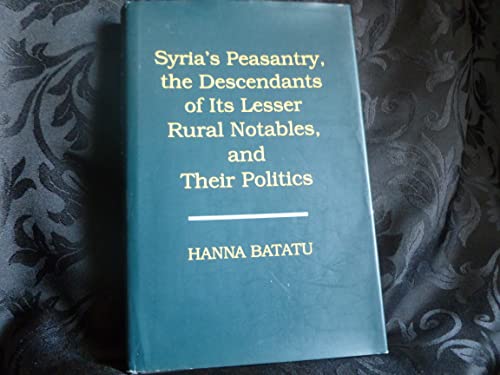
Inhaltsangabe
In this book, the distinguished scholar Hanna Batatu presents a comprehensive analysis of the recent social, economic, and political evolution of Syria's peasantry, the segment of society from which the current holders of political power stem. Batatu focuses mainly on the twentieth century and, in particular, on the Ba`th movement, the structures of power after the military coup d'état of 1963, and the era of îvfiz al-Asad, Syria's first ruler of peasant extraction. Without seeking to prove any single theory about Syrian life, he offers a uniquely rich and detailed account of how power was transferred from one demographic group to another and how that power is maintained today. Batatu begins by examining social differences among Syria's peasants and the evolution of their mode of life and economic circumstances. He then scrutinizes the peasants' forms of consciousness, organization, and behavior in Ottoman and Mandate times and prior to the Ba`thists' rise to power. He explores the rural aspects of Ba`thism and shows that it was not a single force but a plurality of interrelated groups--prominent among them the descendants of the lesser rural notables--with different social goals and mental horizons. The book also provides a perceptive account of President Asad, his personality and conduct, and the characteristics and power structures of his regime. Batatu draws throughout on a wide range of socioeconomic and biographical information and on personal interviews with Syrian peasants and political leaders, offering invaluable insights into the complexities of a country and a regime that have long been poorly understood by outsiders.
Die Inhaltsangabe kann sich auf eine andere Ausgabe dieses Titels beziehen.
Über die Autorin bzw. den Autor
Hanna Batatu
Von der hinteren Coverseite
"This is a richly textured study. . . . The book is full of interesting and novel ways of understanding Syrian peasant behavior and why peasants cannot be discussed as a single socioeconomic or political force or group."--Philip S. Khoury, Massachusetts Institute of Technology
"This is a profound and comprehensive study of modern Syria that is unlikely to be surpassed for a very long time. It is a model of how social history should be written, and of how it can be used to explain the politics of a complex society like Syria."--Rashid Khalidi, University of Chicago
Aus dem Klappentext
"This is a richly textured study. . . . The book is full of interesting and novel ways of understanding Syrian peasant behavior and why peasants cannot be discussed as a single socioeconomic or political force or group."--Philip S. Khoury, Massachusetts Institute of Technology
"This is a profound and comprehensive study of modern Syria that is unlikely to be surpassed for a very long time. It is a model of how social history should be written, and of how it can be used to explain the politics of a complex society like Syria."--Rashid Khalidi, University of Chicago
„Über diesen Titel“ kann sich auf eine andere Ausgabe dieses Titels beziehen.
Suchergebnisse für Syria's Peasantry, the Descendants of Its Lesser...

Beispielbild für diese ISBN
Syria's Peasantry, the Descendants of Its Lesser Rural Notables, and Their Politics
Verlag:
Princeton University Press, 1999
ISBN 10: 0691002541
ISBN 13: 9780691002545
Gebraucht
Hardcover
Anbieter: Better World Books, Mishawaka, IN, USA
Verkäuferbewertung 5 von 5 Sternen

Zustand: Good. Former library copy. Pages intact with minimal writing/highlighting. The binding may be loose and creased. Dust jackets/supplements are not included. Includes library markings. Stock photo provided. Product includes identifying sticker. Better World Books: Buy Books. Do Good. Artikel-Nr. 68457245-6
Gebraucht kaufen
EUR 103,76
Versand gratis
Versand innerhalb von USA
Versand innerhalb von USA
Anzahl: 1 verfügbar
Foto des Verkäufers
Syria's Peasantry, the Descendants of Its Lesser Rural Notables, and Their Politics
Verlag:
Princeton University Press, US, 1999
ISBN 10: 0691002541
ISBN 13: 9780691002545
Neu
Hardcover
Anbieter: Rarewaves USA, HEBRON, KY, USA
Verkäuferbewertung 5 von 5 Sternen
Hardback. Zustand: New. In this book, the distinguished scholar Hanna Batatu presents a comprehensive analysis of the recent social, economic, and political evolution of Syria's peasantry, the segment of society from which the current holders of political power stem. Batatu focuses mainly on the twentieth century and, in particular, on the Ba'th movement, the structures of power after the military coup d'etat of 1963, and the era of ivfiz al-Asad, Syria's first ruler of peasant extraction. Without seeking to prove any single theory about Syrian life, he offers a uniquely rich and detailed account of how power was transferred from one demographic group to another and how that power is maintained today. Batatu begins by examining social differences among Syria's peasants and the evolution of their mode of life and economic circumstances. He then scrutinizes the peasants' forms of consciousness, organization, and behavior in Ottoman and Mandate times and prior to the Ba'thists' rise to power.He explores the rural aspects of Ba'thism and shows that it was not a single force but a plurality of interrelated groups--prominent among them the descendants of the lesser rural notables--with different social goals and mental horizons. The book also provides a perceptive account of President Asad, his personality and conduct, and the characteristics and power structures of his regime. Batatu draws throughout on a wide range of socioeconomic and biographical information and on personal interviews with Syrian peasants and political leaders, offering invaluable insights into the complexities of a country and a regime that have long been poorly understood by outsiders. Artikel-Nr. LU-9780691002545
Neu kaufen
EUR 138,88
Versand gratis
Versand innerhalb von USA
Versand innerhalb von USA
Anzahl: Mehr als 20 verfügbar
Beispielbild für diese ISBN
Syria's Peasantry, the Descendants of Its Lesser Rural Notables, and Their Politics
Anbieter: BennettBooksLtd, Los Angeles, CA, USA
Verkäuferbewertung 5 von 5 Sternen
hardcover. Zustand: New. In shrink wrap. Looks like an interesting title! Artikel-Nr. Q-0691002541
Neu kaufen
EUR 137,06
EUR 6,24 Versand
Versand innerhalb von USA
Versand innerhalb von USA
Anzahl: 1 verfügbar
Foto des Verkäufers
Syria's Peasantry, the Descendants of Its Lesser Rural Notables, and Their Politics
Verlag:
Princeton University Press, US, 1999
ISBN 10: 0691002541
ISBN 13: 9780691002545
Neu
Hardcover
Anbieter: Rarewaves USA United, HEBRON, KY, USA
Verkäuferbewertung 5 von 5 Sternen
Hardback. Zustand: New. In this book, the distinguished scholar Hanna Batatu presents a comprehensive analysis of the recent social, economic, and political evolution of Syria's peasantry, the segment of society from which the current holders of political power stem. Batatu focuses mainly on the twentieth century and, in particular, on the Ba'th movement, the structures of power after the military coup d'etat of 1963, and the era of ivfiz al-Asad, Syria's first ruler of peasant extraction. Without seeking to prove any single theory about Syrian life, he offers a uniquely rich and detailed account of how power was transferred from one demographic group to another and how that power is maintained today. Batatu begins by examining social differences among Syria's peasants and the evolution of their mode of life and economic circumstances. He then scrutinizes the peasants' forms of consciousness, organization, and behavior in Ottoman and Mandate times and prior to the Ba'thists' rise to power.He explores the rural aspects of Ba'thism and shows that it was not a single force but a plurality of interrelated groups--prominent among them the descendants of the lesser rural notables--with different social goals and mental horizons. The book also provides a perceptive account of President Asad, his personality and conduct, and the characteristics and power structures of his regime. Batatu draws throughout on a wide range of socioeconomic and biographical information and on personal interviews with Syrian peasants and political leaders, offering invaluable insights into the complexities of a country and a regime that have long been poorly understood by outsiders. Artikel-Nr. LU-9780691002545
Neu kaufen
EUR 132,51
EUR 44,88 Versand
Versand innerhalb von USA
Versand innerhalb von USA
Anzahl: Mehr als 20 verfügbar
Foto des Verkäufers
Syria's Peasantry, the Descendants of Its Lesser Rural Notables, and Their Politics
Anbieter: GreatBookPricesUK, Woodford Green, Vereinigtes Königreich
Verkäuferbewertung 5 von 5 Sternen
Zustand: New. Artikel-Nr. 402984-n
Neu kaufen
EUR 177,31
EUR 17,98 Versand
Versand von Vereinigtes Königreich nach USA
Versand von Vereinigtes Königreich nach USA
Anzahl: Mehr als 20 verfügbar
Foto des Verkäufers
Syria's Peasantry, the Descendants of Its Lesser Rural Notables, and Their Politics
Verlag:
Princeton University Press, 1999
ISBN 10: 0691002541
ISBN 13: 9780691002545
Gebraucht
Hardcover
Anbieter: GreatBookPricesUK, Woodford Green, Vereinigtes Königreich
Verkäuferbewertung 5 von 5 Sternen
Zustand: As New. Unread book in perfect condition. Artikel-Nr. 402984
Gebraucht kaufen
EUR 189,63
EUR 17,98 Versand
Versand von Vereinigtes Königreich nach USA
Versand von Vereinigtes Königreich nach USA
Anzahl: Mehr als 20 verfügbar
Beispielbild für diese ISBN
Syria's Peasantry, the Descendants of Its Lesser Rural Notables, and Their Politics
Anbieter: Revaluation Books, Exeter, Vereinigtes Königreich
Verkäuferbewertung 5 von 5 Sternen
Hardcover. Zustand: Brand New. 413 pages. 9.50x6.25x1.50 inches. In Stock. Artikel-Nr. x-0691002541
Neu kaufen
EUR 235,49
EUR 14,98 Versand
Versand von Vereinigtes Königreich nach USA
Versand von Vereinigtes Königreich nach USA
Anzahl: 2 verfügbar