
Verwandte Artikel zu Human Cognition Neuropsychology A Textbook with Readings
Suchergebnisse für Human Cognition Neuropsychology A Textbook with Readings

Beispielbild für diese ISBN
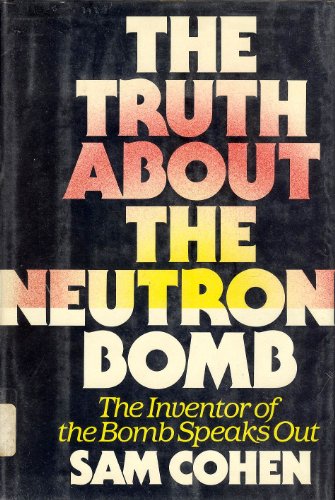
The Truth About the Neutron Bomb, The Inventor of the Bomb Speaks Out
Anbieter: ThriftBooks-Atlanta, AUSTELL, GA, USA
Verkäuferbewertung 5 von 5 Sternen

Hardcover. Zustand: Fair. No Jacket. Readable copy. Pages may have considerable notes/highlighting. ~ ThriftBooks: Read More, Spend Less. Artikel-Nr. G0688016464I5N00
Gebraucht kaufen
EUR 10,73
Versand gratis
Versand innerhalb von USA
Versand innerhalb von USA
Anzahl: 1 verfügbar
Beispielbild für diese ISBN
The Truth About the Neutron Bomb, The Inventor of the Bomb Speaks Out
Anbieter: ThriftBooks-Dallas, Dallas, TX, USA
Verkäuferbewertung 5 von 5 Sternen
Hardcover. Zustand: Fair. No Jacket. Missing dust jacket; Readable copy. Pages may have considerable notes/highlighting. ~ ThriftBooks: Read More, Spend Less. Artikel-Nr. G0688016464I5N01
Gebraucht kaufen
EUR 10,73
Versand gratis
Versand innerhalb von USA
Versand innerhalb von USA
Anzahl: 1 verfügbar
Foto des Verkäufers
The Truth About the Neutron Bomb, The Inventor of the Bomb Speaks Out
Anbieter: Southampton Books, Sag Harbor, NY, USA
Verkäuferbewertung 5 von 5 Sternen
Hardcover. Zustand: Like New. First Edition. First Edition, Later Printing. Published by Morrow, 1983. Octavo. Hardcover. Book is like new. Dust jacket is like new. Artikel-Nr. 549895
Gebraucht kaufen
EUR 112,09
EUR 4,34 Versand
Versand innerhalb von USA
Versand innerhalb von USA
Anzahl: 1 verfügbar
Beispielbild für diese ISBN
The Truth About the Neutron Bomb; The Inventor of the Bomb Speaks Out
Verlag:
William Morrow and Company, New York, 1983
ISBN 10: 0688016464
ISBN 13: 9780688016463
Gebraucht
Hardcover
Erstausgabe
Anbieter: Ground Zero Books, Ltd., Silver Spring, MD, USA
Verkäuferbewertung 5 von 5 Sternen
Hardcover. Zustand: Very good. Zustand des Schutzumschlags: Very good. First Edition [stated]. 226 pages. Footnotes. Illustrations. DJ has slight wear and soiling and is in a plastic sleeve. Minor edge soiling. Samuel Theodore Cohen (January 25, 1921 - November 28, 2010) was an American physicist who is generally credited as the father of the neutron bomb. He was born on January 25, 1921, and raised in New York City. He studied mathematics and physics at University of California, Los Angeles before joining the United States Army after the Japanese attack on Pearl Harbor. In 1944 he worked on the Manhattan Project in the efficiency group at Los Alamos and calculated how neutrons behaved in Fat Man, the atomic bomb that was later detonated over Nagasaki, Japan. After the war he joined the RAND Corporation. At RAND Corporation in 1950, his work on the intensity of fallout radiation first became public when his calculations were included as a special appendix in Samuel Glasstone's book The Effects of Atomic Weapons. Cohen was responsible for recruiting the famous strategist Herman Kahn into the RAND Corporation. During the Vietnam War, Cohen argued that using small neutron bombs would end the war quickly and save many American lives, but politicians were not amenable to his ideas and other scientists ignored the neutron bomb in reviewing the role of nuclear weapons. He was a member of the Los Alamos Tactical Nuclear Weapons Panel in the early 1970s. President Carter delayed development of the neutron bomb in 1978. Derived from a Kirkus review: Cohen was the RAND Corporation physicist who in 1958 did the calculations demonstrating the feasibility of a neutron bomb: A tactical, "antipersonnel" weapon, that is, causing little heat or blast damage (hence little physical destruction), and having considerably less long-term radiation effect that thermonuclear weapons. Cohen relates his long, ultimately losing efforts to foster the neutron bomb--frustrated on the one hand by adherents of the Big Bang, on the other by the anti-nuke forces, and overall by "politics": Reagan's announced in 1981 that the US would produce neutron warheads, but not stockpile them in Europe--so as not to aggravate European objections to missile deployment. There follows: 1) an argument against US involvement in NATO (if we stay, they'll never defend themselves); 2) a defense of death-by-neutron bomb (better than being "burned by napalm, or crushed by blast concussion," etc.); 3) a brief for neutron weapons as against either all-out ground war or "blasting a city to smithereens.". Artikel-Nr. 57152
Gebraucht kaufen
EUR 112,09
EUR 4,35 Versand
Versand innerhalb von USA
Versand innerhalb von USA
Anzahl: 1 verfügbar
Foto des Verkäufers
The Truth About the Neutron Bomb: The Inventor of the Bomb Speaks Out
Verlag:
William Morrow and Company, New York, 1983
ISBN 10: 0688016464
ISBN 13: 9780688016463
Gebraucht
Hardcover
Erstausgabe
Anbieter: Between the Covers-Rare Books, Inc. ABAA, Gloucester City, NJ, USA
Verkäuferbewertung 5 von 5 Sternen
Hardcover. Zustand: Near Fine. Zustand des Schutzumschlags: Near Fine. First edition. 226pp. Black and white illustrations. Faint foxing on the page edges else near fine in a near fine dust jacket with toning and some edgewear. Artikel-Nr. 621451
Gebraucht kaufen
EUR 112,09
EUR 4,79 Versand
Versand innerhalb von USA
Versand innerhalb von USA
Anzahl: 1 verfügbar