
Verwandte Artikel zu The Methodist Experience in America Volume 1: A History
Inhaltsangabe
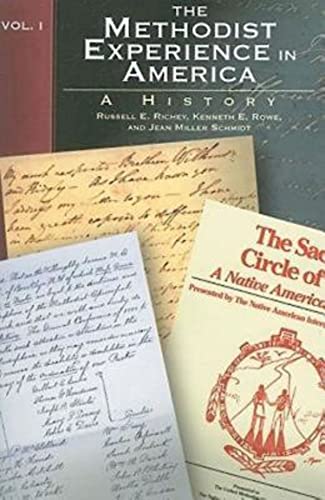
Beginning in 1760, this comprehensive history charts the growth and development of the Methodist and Evangelical United Brethren church family up and through the year 2000. Extraordinarily well-documented study with elaborate notes that will guide the reader to recent and standard literature on the numerous topics, figures, developments, and events covered. The volume is a companion to and designed to be used with THE METHODIST EXPERIENCE IN AMERICA: A SOURCEBOOK, for which it provides background, context and interpretation. Contents include: Launching the Methodist Movements 1760-1768 Structuring the Immigrant Initiatives 1769-1778 Making Church 1777-1784 Constituting Methodism 1784-1792 Spreaking Scriptural Holiness 1792-1816 Snapshot I- Methodism in 1816: Baltimore 1816 Building for Ministry and Nuture 1816-1850s Dividing by Mission, Ethnicity, Gender, and Vision 1816-1850s Dividing over Slavery, Region, Authority, and Race 1830-1860s Embracing the War Cause(s) 1860-1865 Reconstructing Methodism(s) 1866-1884 Snapshot II- Methodism in 1884: Wilker-Barre, PA 1884 Reshaping the Church for Mission 1884-1939 Taking on the World 1884-1939 Warring for World Order and Against Worldliness Within 1930-1968 Snapshot III- Methodism in 1968: Denver 1968 Merging and Reappraising 1968-1984Holding Fast/Pressing On 1984-2000
Die Inhaltsangabe kann sich auf eine andere Ausgabe dieses Titels beziehen.
Über die Autorin bzw. den Autor
Russell E. Richey, Dean Emeritus of Candler School of Theology and William R. Cannon Distinguished Professor of Church History Emeritus, is author or editor of twenty books, including Denominationalism (1977, 2010) and Reimagining Denominationalism (1994, 2010).
Auszug. © Genehmigter Nachdruck. Alle Rechte vorbehalten.
The Methodist Experience in America Volume 1
By Russell E. RicheyAbingdon Press
Copyright © 2010 The United Methodist Publishing HouseAll right reserved.
ISBN: 978-0-687-24672-4
Chapter One
Launching the Methodist Movements: 1760–68
Where does one start the story of United Methodism? With the formative experiences in the Susanna and Samuel Wesley home? Or with John and Charles Wesley in Georgia in the 1730s? Or with John's Aldersgate experience? Or with George Whitefield's American tours and the First Great Awakening? Or with competitive "spontaneous" beginnings in the 1760s through Robert Strawbridge in Maryland, through William Otterbein and Martin Boehm in the middle colonies, and through Barbara Heck, Philip Embury, and Thomas Webb in New York? Or with the roots of the several evangelical movements in Pietism?
Pietism
The story of United Methodism requires a wide perspective. Pietism, because it underlay or affected the several Methodist movements, provides such a canvas, and William Otterbein (1726–1813) will first claim our attention, as he does in MEA I (Sources 1760). Pietism was a transatlantic, transconfessional, diffuse religious reform impulse that sought to sustain the authentic witness of the faith but that in so doing defined itself initially over against orthodoxy and later over against aspects of the Enlightenment. The faith so "preserved" differed. Pietist or Pietist-like assumptions, beliefs, mores, and communal structures typified the patterns of life and thought espoused by its Lutheran pioneers, Philipp Jakob Spener (1635–1705) and August Hermann Francke (1663–1727); by the Moravians; by Roman Catholic Jansenists; by the Hasidic Jews; by late Puritanism; by British evangelicalism (Anglican and Presbyterian); and by the panoply of colonial revivalism. Diversely expressed, the movement named itself diversely. In the North American context it bore the identity of evangelicalism or revivalism.
Pietist and Pietist-like movements characteristically emphasized
? experimental religion, locating the religious impulse in the heart (will and affections); ? both consciousness and expression of the heart's commitments (conversion and testimony); ? an obedient life, strict moral codes, and corporate discipline as appropriate expressions thereof; ? the accessibility of the biblical word and rule to the awakened lay spirit; ? growth in the faith through active devotions but also through education, educational programs, and literature, all adjusted to suit age, culture, and circumstance; ? the importance of a witness communally shared through prayer, Bible reading, hymns, and preaching; ? everyday life as a sacrament to be shaped and enlivened by a vibrant faith and expressed in holy living; and ? biblical doctrine or doctrines as the light by which all this activism stays on course.
(For expressions of such experimental religion in early Methodist movements, see Sources 1760, 1773, 1775a, 1780b, 1785a, 1785b, 1785c, 1787, 1789a, 1791b, 1791c, 1798 on class meetings, and 1800b.)
Pietist emphasis on doctrine proved insufficient, careless, or imprecise to the "scholastics" who were typically in positions of authority and viewed themselves as consolidators of the sixteenth-century reformations. Those in power complained as well that Pietists did not measure up to what tradition had expected in zeal for the ritual or sacramental life. Opponents, therefore, found the movement's slights as objectionable as its emphases.
Protestant Pietism shaped experimental religion around the conversion experience, understood not simply as a forensic alteration in one's status with God but as a discernible inner change. In this transformation one became a reborn Nicodemus, a recreation in Christ, whose character and life manifested a new identity in fruits of the Spirit. Pietism resourced those reborn and those seeking rebirth in small groups that encouraged members to make the Scripture normative for everyday life, that sheltered individuals and families from "the world," and that empowered them to counter its claims and demands. In and through such conventicles, little churches within the church, collegia pietatis, laity (male and female) gained voice and exercised leadership, a challenge and threat to public and religious conventions. Pietism drew such leadership into active missionary endeavor at home and abroad. It extended the gospel and invitation into Christian community to populations previously ignored or over previously insurmountable confessional barriers. And wherever it prospered, it challenged those who had settled for formal, notional, legal, or outward religiosity and repudiated the easy compromise that religion had made with status, wealth, power, display, and prerogative. Against such worldliness, Pietists invoked the witness of the prophets and the teaching of Jesus. In such worldliness, Pietism discerned the sin or sins that separated individuals from God. In particular, Pietism offered a prophetic critique of established, more priestly, and unregenerate forms of Christianity and leaders so characterized. Though it sought reform, it eschewed polemics and sought the widest possible unity among likeminded persons. The several resources that Pietism offered—new identity, community voluntarily created, a competitive missionary spirit, courage to persist despite society's disdain, willingness to forge new alliances—proved highly functional in the new American environment.
Pietism provided a new way of life for its adherents and motivation to tackle society's ills. It spoke of corruption, of power, of authority, of legitimacy. By identifying the corrupt—the luxury of gentility or laxness of clergy—it broke social conventions of deference and passive obedience. It did not, however, weave these elements of social critique into a program for systemic reform or a theory of new world order or a vision of the godly state or even of the church as an anticipation thereof. Such a civil or societal theology, as offered by Puritans and other Calvinists, had brought chaos to Europe. Pietists, though highly communal on a local level and creatively productive of new ecclesial institutions, would work their transformations from the bottom up rather than the top down. Renewal would start with the conversion experience rather than parliamentary act, with a conventicle rather than a reform program, with missionary outreach rather than armed insurrection.
That beginning point for change has earned for Pietism labels of individualistic, moralistic, and otherworldly. And certainly by contrast to Puritanism, Pietism offered a social ethic unwedded to a theory of the state and strategies for reform. Yet some who felt Pietism's denunciation of worldliness found it radically transformative. Others experienced it as socially revolutionary. Many denounced it as tasteless. Where it prevailed, Pietism had the capacity to shape society and culture. The transmission of this culture then became a communal and preeminently a family project, permitting and requiring vital roles for women as well as men. In the eighteenth and particularly in the nineteenth century, women involved themselves on behalf of revival—within families, nurturing the piety of spouse, children, and servants; in congregations, through prayer groups and Sunday schools; and outward into community, nation, and world through mission, benevolent, and...
„Über diesen Titel“ kann sich auf eine andere Ausgabe dieses Titels beziehen.
Suchergebnisse für The Methodist Experience in America Volume 1: A History

Beispielbild für diese ISBN
The Methodist Experience in America: A History: null
Anbieter: World of Books (was SecondSale), Montgomery, IL, USA
Verkäuferbewertung 5 von 5 Sternen

Paperback. Zustand: Good. Beginning in 1760, this comprehensive history charts the growth and development of the Methodist and Evangelical United Brethren church family up and through the year 2000. Extraordinarily well-documented study with elaborate notes that will guide the reader to recent and standard literature on the numerous topics, figures, developments, and events covered. The volume is a companion to and designed to be used with THE METHODIST EXPERIENCE IN AMERICA: A SOURCEBOK, for which it provides background, context and interpretation. Contents include: Launching the Methodist Movements 1760-1768 Structuring the Immigrant Initiatives 1769-1778 Making Church 1777-1784 Constituting Methodism 1784-1792 Spreaking Scriptural Holiness 1792-1816 Snapshot I- Methodism in 1816: Baltimore 1816 Building for Ministry and Nuture 1816-1850s Dividing by Mission, Ethnicity, Gender, and Vision 1816-1850s Dividing over Slavery, Region, Authority, and Race 1830-1860s Embracing the War Cause(s) 1860-1865 Reconstructing Methodism(s) 1866-1884 Snapshot I- Methodism in 1884: Wilker-Barre, PA 1884 Reshaping the Church for Mission 1884-1939 Taking on the World 1884-1939 Warring for World Order and Against Worldliness Within 1930-1968 Snapshot I- Methodism in 1968: Denver 1968 Merging and Reappraising 1968-1984Holding Fast/Pressing On 1984-2000. Artikel-Nr. 00101521126
Gebraucht kaufen
EUR 5,64
Versand gratis
Versand innerhalb von USA
Versand innerhalb von USA
Anzahl: 3 verfügbar
Beispielbild für diese ISBN
The Methodist Experience in America Volume I: A History
Anbieter: ThriftBooks-Dallas, Dallas, TX, USA
Verkäuferbewertung 5 von 5 Sternen
Paperback. Zustand: Very Good. No Jacket. May have limited writing in cover pages. Pages are unmarked. ~ ThriftBooks: Read More, Spend Less. Artikel-Nr. G0687246725I4N00
Gebraucht kaufen
EUR 6,23
Versand gratis
Versand innerhalb von USA
Versand innerhalb von USA
Anzahl: 1 verfügbar
Beispielbild für diese ISBN
The Methodist Experience in America Volume I: A History
Anbieter: ThriftBooks-Phoenix, Phoenix, AZ, USA
Verkäuferbewertung 5 von 5 Sternen
Paperback. Zustand: Very Good. No Jacket. May have limited writing in cover pages. Pages are unmarked. ~ ThriftBooks: Read More, Spend Less. Artikel-Nr. G0687246725I4N00
Gebraucht kaufen
EUR 6,23
Versand gratis
Versand innerhalb von USA
Versand innerhalb von USA
Anzahl: 1 verfügbar
Beispielbild für diese ISBN
The Methodist Experience in America Volume I: A History
Anbieter: ThriftBooks-Dallas, Dallas, TX, USA
Verkäuferbewertung 5 von 5 Sternen
Paperback. Zustand: Good. No Jacket. Former library book; Pages can have notes/highlighting. Spine may show signs of wear. ~ ThriftBooks: Read More, Spend Less. Artikel-Nr. G0687246725I3N10
Gebraucht kaufen
EUR 6,23
Versand gratis
Versand innerhalb von USA
Versand innerhalb von USA
Anzahl: 1 verfügbar
Beispielbild für diese ISBN
The Methodist Experience in America Volume I: A History
Anbieter: ThriftBooks-Atlanta, AUSTELL, GA, USA
Verkäuferbewertung 5 von 5 Sternen
Paperback. Zustand: Very Good. No Jacket. May have limited writing in cover pages. Pages are unmarked. ~ ThriftBooks: Read More, Spend Less. Artikel-Nr. G0687246725I4N00
Gebraucht kaufen
EUR 6,23
Versand gratis
Versand innerhalb von USA
Versand innerhalb von USA
Anzahl: 1 verfügbar
Beispielbild für diese ISBN
The Methodist Experience in America Volume I: A History
Anbieter: ThriftBooks-Dallas, Dallas, TX, USA
Verkäuferbewertung 5 von 5 Sternen
Paperback. Zustand: As New. No Jacket. Pages are clean and are not marred by notes or folds of any kind. ~ ThriftBooks: Read More, Spend Less. Artikel-Nr. G0687246725I2N00
Gebraucht kaufen
EUR 6,23
Versand gratis
Versand innerhalb von USA
Versand innerhalb von USA
Anzahl: 1 verfügbar
Beispielbild für diese ISBN
The Methodist Experience in America Volume I: A History
Anbieter: ThriftBooks-Reno, Reno, NV, USA
Verkäuferbewertung 5 von 5 Sternen
Paperback. Zustand: Very Good. No Jacket. May have limited writing in cover pages. Pages are unmarked. ~ ThriftBooks: Read More, Spend Less. Artikel-Nr. G0687246725I4N00
Gebraucht kaufen
EUR 6,23
Versand gratis
Versand innerhalb von USA
Versand innerhalb von USA
Anzahl: 1 verfügbar
Beispielbild für diese ISBN
The Methodist Experience in America, Vol. 1
Verlag:
Abingdon Press (edition ), 2010
ISBN 10: 0687246725
ISBN 13: 9780687246724
Gebraucht
Paperback
Anbieter: BooksRun, Philadelphia, PA, USA
Verkäuferbewertung 5 von 5 Sternen
Paperback. Zustand: Very Good. It's a well-cared-for item that has seen limited use. The item may show minor signs of wear. All the text is legible, with all pages included. It may have slight markings and/or highlighting. Artikel-Nr. 0687246725-11-1
Gebraucht kaufen
EUR 11,65
Versand gratis
Versand innerhalb von USA
Versand innerhalb von USA
Anzahl: 1 verfügbar
Beispielbild für diese ISBN
The Methodist Experience in America, Vol. 1
Anbieter: Ria Christie Collections, Uxbridge, Vereinigtes Königreich
Verkäuferbewertung 5 von 5 Sternen
Zustand: New. In English. Artikel-Nr. ria9780687246724_new
Neu kaufen
EUR 55,72
EUR 13,34 Versand
Versand von Vereinigtes Königreich nach USA
Versand von Vereinigtes Königreich nach USA
Anzahl: Mehr als 20 verfügbar
Beispielbild für diese ISBN
The Methodist Experience in America: A History: Vol 1
Anbieter: Revaluation Books, Exeter, Vereinigtes Königreich
Verkäuferbewertung 5 von 5 Sternen
Paperback. Zustand: Brand New. 768 pages. 8.75x5.75x1.50 inches. In Stock. Artikel-Nr. x-0687246725
Neu kaufen
EUR 70,89
EUR 17,72 Versand
Versand von Vereinigtes Königreich nach USA
Versand von Vereinigtes Königreich nach USA
Anzahl: 2 verfügbar