Inhaltsangabe
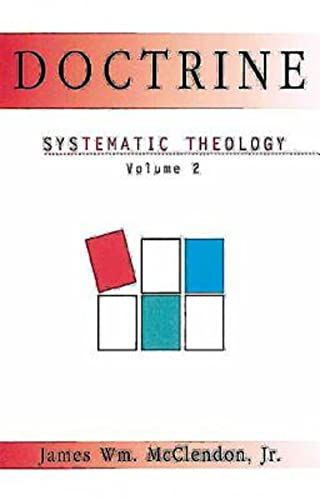
Christian doctrine, McClendon tells us, is no laundry list of propositions to be believed, but is rather an essential practice of the church. Doctrines are those shared convictions which the church must teach and live out if it is to be the church. The author rejects the prevailing assumptions stemming from the rationalism of the Enlightenment, and redefines theology as a discipline within the context of particular religious beliefs and practices of concrete believing communities. McClendon ties the reading of Scripture to the community's understanding of itself and its own mission.
Die Inhaltsangabe kann sich auf eine andere Ausgabe dieses Titels beziehen.
Über die Autorin bzw. den Autor
James McClendon, Jr. was Distinguished Scholar in Residence, Fuller Theological Seminary, Pasadena, California. He passed away in October of 2000.
Von der hinteren Coverseite
Christian doctrine, McClendon tells us, is no laundry list of propositions to be believed, but is rather an essential practice of the church. Doctrines are those shared convictions which the church must teach and live out if it is to be the church.
Auszug. © Genehmigter Nachdruck. Alle Rechte vorbehalten.
Doctrine
Systematic Theology Volume II
By James WM. Mcclendon Jr.Abingdon Press
Copyright © 1994 fames Wm. McClendon, Jr.
All rights reserved.
ISBN: 978-0-687-11021-6All rights reserved.
Contents
PROSPECT,
CHAPTER ONE WHAT IS DOCTRINE?,
PART I: THE RULE OF GOD,
Introduction,
CHAPTER TWO BEGINNING OF THE END: ESCHATOLOGY,
CHAPTER THREE THE NEW IN CHRIST: SALVATION AND SIN,
CHAPTER FOUR CREATION AND SUFFERING,
PART II: THE IDENTITY OF JESUS CHRIST,
Introduction,
CHAPTER FIVE THE SAVING CROSS: ATONEMENT,
CHAPTER SIX JESUS THE RISEN CHRIST,
CHAPTER SEVEN THE IDENTITY OF GOD,
PART III: THE FELLOWSHIP OF THE SPIRIT,
Introduction,
CHAPTER EIGHT THE QUEST FOR CHRISTIAN COMMUNITY,
CHAPTER NINE THE SIGNS OF SALVATION: CHRISTIAN WORSHIP,
CHAPTER TEN HOLY SPIRIT AND MISSION,
RETROSPECT,
CHAPTER ELEVEN AN ESSAY ON AUTHORITY,
BIBLIOGRAPHY,
INDEX OF NAMES AND TOPICS,
BIBLICAL INDEX,
CHAPTER 1
What Is Doctrine?
In shaping its teaching, the church seeks to be simply the church, so that Christians may be a people who find in Christ their center, in the Spirit their communion, in God's reign their rule of life. The convictions that make such a common life possible fall into three broad, overlapping categories, those that inform Christian living(moral convictions), those that display the substance of Christian faith(doctrinal convictions), and those that open out into a Christian vision or worldview (philosophical convictions). The present volume is concerned with the second of these, those convictions that constitute Christian teaching or doctrine. It is important here that life, faith, and vision are not three realities but one: it is not as though what is done can be pried apart from what is taught or what is envisioned; rather these volumes constitute three distinct probes, three levels of inquiry, into a single 'life-faith-vision', one whole. With this understanding, the interest of this volume can be expressed in a question: What must be taught in today's churches if they are to be what they claim to be? In brief, what must the church teach to be the churchnow? That question requires refinement (some might prefer "to be authentic church now"), yet it is not to be evaded in doctrinal theology.
Two paralyzing worries may grip anyone who takes up such a volume today. The first is a worry about bias: How can this book, or any other, utter theological truth—the truth about God and all that is God's—without displaying mere bias, either hidden or overt? Perhaps we, here, think this, but they, there, think otherwise, and who is to judge between us and them? If we say the revelation in our scripture refutes the claims of their scripture, will they not say the same back to us? If our history says we shall put our trust in Jesus, or in the God of Jesus, have they not other names for God, even other gods, by which they will call our history into question? Young Dietrich Bonhoeffer told his students that theology should begin in silence. Yes, but in view of this plurality of religious perspectives, a plurality that permits no easy bracketing of differences, should that silence ever be broken? One recalls the ancient Greek thinker Simonides, who, when his students asked "What are the gods?" hesitated so long in answering that finally they ceased to ask. Though despite Simonides this volume now stands written, might not a wise reader hesitate interminably before taking it up?
The other paralyzing worry seems just the contrary, but tends to the same outcome. Now the question is, not whether theological doctrine can be fair to the distant views of other religions and cultures, but whether it will be fair to the reader's own. Again this is a worry about bias. In one way or another each of us has acquired the religious (or irreligious) convictions we now have. Every human being comes to have some convictions, and most readers of this book doubtless cherish convictions on the very topics addressed here—last things, salvation and sin, creation and suffering, Christ and God, Israel and the churches, and all the rest. If a discussion of these happens to nurture one's convictions and resolve one's doubts, well and good. But what if the book is biased against them, undermines them? Perhaps does so in subtle ways the reader cannot foresee or avert? Theology, like major surgery, must treat matters as dear as life itself. Thus a self-protective reader may rightly wonder whether he or she really needs this operation, really needs this book.
A clever retort might be that these two worries about bias, against other cultures and religions in the wide world and against the reader's own standpoint, nicely cancel one another. For how can one fairly object that a book may lack a universal outlook when one is not willing to consider any view but one's own? Or how can one justly cling to one's own view if not yet informed about the alternative views of one's fellow believers or neighbors? Isn't such a position itself biased, pot calling kettle black? Yet the retort may be more clever than valid. For it seems to assume that any particular standpoint is necessarily unworthy, an assumption that will not stand close examination—indeed, one that defeats itself.
In any case, this volume attempts to take seriously what lies behind both sorts of objections. It takes seriously the existence of a plurality of convinced communities, not only the Christian one (or the 'baptist' one) that is this book's community of reference. It does not assume that the others are all false and this one alone true. Nor on the other hand does it assume that all are moving toward a common truth along different roads. Such assumptions are not needed at this point, for the task of the present volume is merely to be clear about Christian teaching. Volume III will examine some of these assumptions about others and their relation to Christian life and faith. Certainly the 'other ways' are there, and they are significant, but now we have this task. This volume properly begins in Chapter Two, and readers eager to get to the heart of the matter may wish to go to the next chapter at once. The present chapter seeks to explain (§1) how doctrinal theology is related to church teaching itself and (§2) to Bible study, and to show (§3) the relation of the present work to each of these and to its context.
This volume also recognizes that prospective readers have divergent beliefs. None of us comes to the theological task as a blank book to be inscribed by our teachers. Rather we come as formed human beings with convictions that constitute us as the people we are. And the aim here is not to remake or even directly to challenge the convictions of each reader—that is a pastoral task, not a theological one. Instead it will ask and seek to answer the question, What must the church teach if it is really to be the church? That is a question addressed to no single individual, but to a community; neither the author nor any single reader can provide determinate answers even if we would, and there may be a plurality of 'correct' answers in various life settings. Yet in a roundabout way and in the long run what appears here may indeed challenge the present beliefs of each of us. To hear such a challenge is a risk worth taking if the outcome, as I trust it will, "gives substance to our hopes and convinces us of realities we do not...
„Über diesen Titel“ kann sich auf eine andere Ausgabe dieses Titels beziehen.
Weitere beliebte Ausgaben desselben Titels

Suchergebnisse für Systematic Theology Volume 2: Doctrine (Systematic...

Beispielbild für diese ISBN
Doctrine: Systematic Theology Volume 2
Anbieter: ThriftBooks-Atlanta, AUSTELL, GA, USA
Verkäuferbewertung 5 von 5 Sternen

Paperback. Zustand: Good. No Jacket. Pages can have notes/highlighting. Spine may show signs of wear. ~ ThriftBooks: Read More, Spend Less. Artikel-Nr. G0687110211I3N00
Beispielbild für diese ISBN
Doctrine: Systematic Theology Volume 2
Anbieter: ThriftBooks-Atlanta, AUSTELL, GA, USA
Verkäuferbewertung 5 von 5 Sternen
Paperback. Zustand: Very Good. No Jacket. May have limited writing in cover pages. Pages are unmarked. ~ ThriftBooks: Read More, Spend Less. Artikel-Nr. G0687110211I4N00
Beispielbild für diese ISBN
Doctrine: Systematic Theology Volume 2
Anbieter: ThriftBooks-Dallas, Dallas, TX, USA
Verkäuferbewertung 5 von 5 Sternen
Paperback. Zustand: Fair. No Jacket. Readable copy. Pages may have considerable notes/highlighting. ~ ThriftBooks: Read More, Spend Less. Artikel-Nr. G0687110211I5N00
Beispielbild für diese ISBN
Doctrine: Systematic Theology Volume 2
Anbieter: ThriftBooks-Dallas, Dallas, TX, USA
Verkäuferbewertung 5 von 5 Sternen
Paperback. Zustand: As New. No Jacket. Pages are clean and are not marred by notes or folds of any kind. ~ ThriftBooks: Read More, Spend Less. Artikel-Nr. G0687110211I2N00
Beispielbild für diese ISBN
Doctrine Vol. 2 : Systematic Theology Volume 2
Anbieter: Better World Books, Mishawaka, IN, USA
Verkäuferbewertung 5 von 5 Sternen
Zustand: Good. Used book that is in clean, average condition without any missing pages. Artikel-Nr. 9088589-6
Beispielbild für diese ISBN
Doctrine Vol. 2 : Systematic Theology Volume 2
Anbieter: Better World Books, Mishawaka, IN, USA
Verkäuferbewertung 5 von 5 Sternen
Zustand: Good. Former library book; may include library markings. Used book that is in clean, average condition without any missing pages. Artikel-Nr. 15072882-6
Foto des Verkäufers
Systematic Theology Volume 2: Doctrine: v. 2 (Doctrine: Systematic Theology)
Anbieter: WeBuyBooks, Rossendale, LANCS, Vereinigtes Königreich
Verkäuferbewertung 5 von 5 Sternen
Zustand: Good. Most items will be dispatched the same or the next working day. A copy that has been read but remains in clean condition. All of the pages are intact and the cover is intact and the spine may show signs of wear. The book may have minor markings which are not specifically mentioned. Annotations to some page edges/pages, may include notes, highlighting or underlining. Artikel-Nr. wbs4878132890
Gebraucht kaufen
EUR 14,57
Versand:
EUR 8,91
Von Vereinigtes Königreich nach USA
Anzahl: 1 verfügbar
Foto des Verkäufers
Systematic Theology Volume 2: Doctrine: v. 2 (Doctrine: Systematic Theology)
Anbieter: WeBuyBooks, Rossendale, LANCS, Vereinigtes Königreich
Verkäuferbewertung 5 von 5 Sternen
Zustand: Very Good. Most items will be dispatched the same or the next working day. A copy that has been read, but is in excellent condition. Pages are intact and not marred by notes or highlighting. The spine remains undamaged. Artikel-Nr. wbs3584550965
Gebraucht kaufen
EUR 14,57
Versand:
EUR 8,91
Von Vereinigtes Königreich nach USA
Anzahl: 1 verfügbar
Beispielbild für diese ISBN
Systematic Theology: Doctrine (Volume 2)
Anbieter: Anybook.com, Lincoln, Vereinigtes Königreich
Verkäuferbewertung 5 von 5 Sternen
Zustand: Good. Volume 2. This is an ex-library book and may have the usual library/used-book markings inside.This book has soft covers. Clean from markings. In good all round condition. Please note the Image in this listing is a stock photo and may not match the covers of the actual item,900grams, ISBN:9780687110216. Artikel-Nr. 9708348
Gebraucht kaufen
EUR 27,16
Versand:
EUR 14,78
Von Vereinigtes Königreich nach USA
Anzahl: 1 verfügbar
Beispielbild für diese ISBN
Doctrine: Systematic Theology: Vol 002
Anbieter: Revaluation Books, Exeter, Vereinigtes Königreich
Verkäuferbewertung 5 von 5 Sternen
Paperback. Zustand: Brand New. 540 pages. 9.25x6.25x1.25 inches. In Stock. Artikel-Nr. x-0687110211
Neu kaufen
EUR 52,56
Versand:
EUR 14,27
Von Vereinigtes Königreich nach USA
Anzahl: 2 verfügbar