
Verwandte Artikel zu 7 Ways of Teaching the Bible to Adults: Using Our Multiple...
Inhaltsangabe
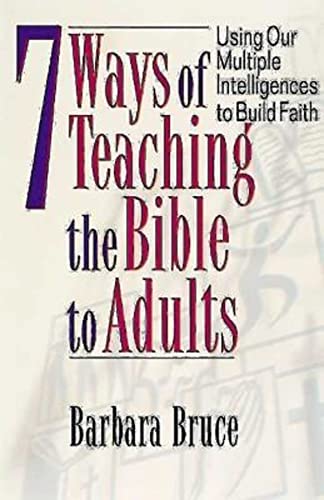
This book shows teachers of adults how to use styles of learning to enhance the student's experience and enrich their own teaching. A chapter is devoted to each of the seven styles: verbal, independent, social, visual, physical, musical and logical. Each chapter includes: suggestions for blending the style into lessons, questions to help teachers determine their own preferences, a lesson focusing on the learning style, and a prayer demonstrating the style. A bibliography, appendices and a self-discovery sheet are included. Appropriate for group or individual study and teacher training.
Die Inhaltsangabe kann sich auf eine andere Ausgabe dieses Titels beziehen.
Über die Autorin bzw. den Autor
Barbara Bruce has worked as a Christian educator for nearly twenty years. She is the owner of Process: CREATIVITY, a consulting firm offering workshops in creative and critical thinking. She is the author of Teaching Children Bible Basics, 7 Ways of Teaching the Bible to Children, Standing Up Against the Odds, Start Here; Teaching and Learning With Adults, 7 Ways of Teaching the Bible to Adults, and Our Spiritual Brain. Her most recent publication is Mental Aerobics: 75 Ways to Keep Your Brain Fit.
Auszug. © Genehmigter Nachdruck. Alle Rechte vorbehalten.
7 Ways of Teaching the Bible to Adults
Using Our Multiple Intelligences to Build Faith
By Barbara A. BruceAbingdon Press
Copyright © 2000 Abingdon Press
All rights reserved.
ISBN: 978-0-687-09084-6All rights reserved.
Contents
Foreword,
Preface,
Introduction.,
How to Use This Book,
Most Favored Ways of Learning,
An Overview of Multiple Intelligences,
1—Verbal/Linguistic Intelligence,
2—Logical/Mathematical Intelligence,
3—Visual/Spatial Intelligence,
4—Body/Kinesthetic Intelligence,
5—Musical/Rhythmic Intelligence,
6—Interpersonal Intelligence,
7—Intrapersonal Intelligence,
Afterword,
Appendix,
Bibliography,
CHAPTER 1
Verbal/Linguistic Intelligence
"IN THE BEGINNING WAS THE WORD ..." (John 1:1)
God spoke the world into being with the words, "Let there be light" (Genesis 1:3). The Christian world knows God's Word through Jesus the Christ. Words, both spoken and written, have shaped and formed Christians for centuries.
The Bible as we know it began in the telling of stories around campfires. The oral tradition insured that stories of God's greatness and of the faith of God's people were passed on from generation to generation. All this took place long before there was a written word. These stories, told around campfires, sung in the psalms, and later recited in the homes of people who could not read, kept God's message alive. The words were so powerful they filled generations of illiterate but faithful people with hope.
As language developed in the written form, stories of faith were recorded to insure their preservation. Monks painstakingly copied the Bible by hand until Gutenberg's invention of the printing press made the Bible available to more people. Today the Bible and other books relating to faith help people all over the world read and know God's word.
Verbal/Linguistic Intelligence incorporates our ability to use the spoken and written word to communicate. By the use of speaking and listening, reading and writing, we explore, expand, and express our deepest thoughts and emotions. We can do this in literally hundreds of ways. For many this is the most used intelligence.
PROFILE
Connie is editor of her church's newsletter. She expresses herself well and thinks in words. She has a love of language and enjoys reading, writing, and playing with words. Connie is a good listener and often can find a story within a story to interest the congregation. She is an avid attender of the adult class and often does research beyond class time.
Careers that favor the Verbal/Linguistic Intelligence include authors, editors, poets, journalists, and talk show hosts.
BRAIN RESEARCH
Personal storytelling makes connections between past and current information. This connection helps imprint learning.
Beginning your class by discussing the last lesson helps imprint the meaning and make connections from week to week.
Ending your class by revisiting the focus of the lesson in a variety of ways helps imprint learning.
Practicing positive affirmations enhances the learning environment.
Using discussion, debate, and questions stimulates the brain to think deeper and richer.
Asking how and why questions draws out patterns that expose the limitations of thinking.
Using semantic memory by incorporating word association, similarities, and differences imprints learning.
Using acrostics helps form patterns for recall.
ENVIRONMENT
An environment conducive to the Verbal/Linguistic learner incorporates posted information, such as an agenda for the day's activities, ground rules for classroom behavior, a glossary of terms to be used or that have been used in previous lessons. This environment should be rich with written materials such as Bible dictionaries, commentaries, and other resource books. Magazines and newspapers dealing with timely issues that support your lessons are invaluable resources for this kind of learner.
VOCABULARY
Use the following words to engage your Verbal/Linguistic learners:
answer debate elaborate give examples paraphrase recall
argue define embellish interpret present restate
convince discuss explain interview read summarize
STIMULATE the Verbal/Linguistic Intelligence by using these techniques in your lesson:
* Invite your students to share a personal anecdote with a partner relating to content;
* Read or recite a poem or story that leads into the content;
* Invite students to "tell me all you know about ..." (the content);
* Use a cartoon or comic strip related to your lesson;
* Record or ask questions that will be covered in the content.
INCORPORATE the Verbal/Linguistic Intelligence by teaching with several of these techniques:
* Read a specific Scripture verse in several different versions or translations. Compare and contrast what the writers are attempting to communicate by their choice of words;
* Use Bible dictionaries or commentaries as you study a specific Scripture passage to get a deeper understanding of the meaning of words, the cultural influences, and the traditions that undergird that passage;
* Agree to an open discussion of thoughts, reactions, feelings, insights about Scripture passages;
* Debate an issue in a formal or informal way;
* Share how a particular Scripture passage has meaning in your life;
* Study the Scripture for the sermon. Make your own discoveries and explore what the Scripture means to you to bring a broader understanding to the message each Sunday;
* Read books that offer insights and challenge understandings of Scripture;
* Write reactions to your Scripture study in the form of
poems (see page 105 for sample formats)
journal entries of a particular character in your study
editorials or letters to the editor about your study
letters to or from a major character in your study
reports on various aspects of your lesson
* Tell "round robin" scriptural stories—one person begins with a few sentences, each succeeding
* person continues the story from where the last person left off;
* Record your definitions of faith (remind your learners there are no right or wrong answers);
* Keep a journal of miracles—share them periodically;
* Use the "jigsaw" technique—each person/small group studies part of the lesson and shares the part with the total group;
* Use "T Charts" (see page 33 for example);
* Brainstorm ideas (see "Rules for Brainstorming," page 32);
* Use a concordance—find as many scriptural references as you can for a key word in your lesson;
* Open your Bible at random. Close your eyes and point to a place on the page. Read the scriptural passage. Discover what it is saying to you today;
* Select a Scripture passage and read it each day for a week. Reflect on the message you receive each day;
* List Top Ten Reasons for ...;
* Read a scriptural passage. Go back and read it again, asking what participants see, hear, and feel as the words are read;
* Create a journal to record evidence of: happiness, sadness, excitement, new life, and so on;
* Read the phrase, "Christ the Lord is risen today" six times, each time emphasizing a different word to find the nuance in the...
„Über diesen Titel“ kann sich auf eine andere Ausgabe dieses Titels beziehen.
Suchergebnisse für 7 Ways of Teaching the Bible to Adults: Using Our Multiple...

Beispielbild für diese ISBN
7 Ways of Teaching the Bible to Adults: Using Our Multiple Intelligences to Build Faith
Anbieter: World of Books (was SecondSale), Montgomery, IL, USA
Verkäuferbewertung 5 von 5 Sternen

Zustand: Good. Item in good condition. Textbooks may not include supplemental items i.e. CDs, access codes etc. Artikel-Nr. 00097948511
Gebraucht kaufen
EUR 4,28
Versand gratis
Versand innerhalb von USA
Versand innerhalb von USA
Anzahl: 4 verfügbar
Beispielbild für diese ISBN
7 Ways of Teaching the Bible to Adults: Using Our Multiple Intelligences to Build Faith
Verlag:
Abingdon Press (edition ), 2000
ISBN 10: 0687090849
ISBN 13: 9780687090846
Gebraucht
Paperback
Anbieter: BooksRun, Philadelphia, PA, USA
Verkäuferbewertung 5 von 5 Sternen
Paperback. Zustand: Fair. The item might be beaten up but readable. May contain markings or highlighting, as well as stains, bent corners, or any other major defect, but the text is not obscured in any way. Artikel-Nr. 0687090849-7-1-13
Gebraucht kaufen
EUR 4,29
Versand gratis
Versand innerhalb von USA
Versand innerhalb von USA
Anzahl: 1 verfügbar
Beispielbild für diese ISBN
7 Ways of Teaching the Bible to Adults : Using Our Multiple Intelligences to Build Faith
Anbieter: Better World Books, Mishawaka, IN, USA
Verkäuferbewertung 5 von 5 Sternen
Zustand: Good. Pages intact with minimal writing/highlighting. The binding may be loose and creased. Dust jackets/supplements are not included. Stock photo provided. Product includes identifying sticker. Better World Books: Buy Books. Do Good. Artikel-Nr. 4301079-6
Gebraucht kaufen
EUR 6,19
Versand gratis
Versand innerhalb von USA
Versand innerhalb von USA
Anzahl: 2 verfügbar
Beispielbild für diese ISBN
7 Ways of Teaching the Bible to Adults : Using Our Multiple Intelligences to Build Faith
Anbieter: Better World Books, Mishawaka, IN, USA
Verkäuferbewertung 5 von 5 Sternen
Zustand: Very Good. Pages intact with possible writing/highlighting. Binding strong with minor wear. Dust jackets/supplements may not be included. Stock photo provided. Product includes identifying sticker. Better World Books: Buy Books. Do Good. Artikel-Nr. 741633-6
Gebraucht kaufen
EUR 6,19
Versand gratis
Versand innerhalb von USA
Versand innerhalb von USA
Anzahl: 1 verfügbar
Beispielbild für diese ISBN
7 Ways of Teaching the Bible to Adults
Anbieter: ThriftBooks-Phoenix, Phoenix, AZ, USA
Verkäuferbewertung 5 von 5 Sternen
Paperback. Zustand: Good. No Jacket. Pages can have notes/highlighting. Spine may show signs of wear. ~ ThriftBooks: Read More, Spend Less. Artikel-Nr. G0687090849I3N00
Gebraucht kaufen
EUR 6,28
Versand gratis
Versand innerhalb von USA
Versand innerhalb von USA
Anzahl: 1 verfügbar
Beispielbild für diese ISBN
7 Ways of Teaching the Bible to Adults
Anbieter: ThriftBooks-Dallas, Dallas, TX, USA
Verkäuferbewertung 5 von 5 Sternen
Paperback. Zustand: Good. No Jacket. Pages can have notes/highlighting. Spine may show signs of wear. ~ ThriftBooks: Read More, Spend Less. Artikel-Nr. G0687090849I3N00
Gebraucht kaufen
EUR 6,28
Versand gratis
Versand innerhalb von USA
Versand innerhalb von USA
Anzahl: 1 verfügbar
Beispielbild für diese ISBN
7 Ways of Teaching the Bible to Adults
Anbieter: ThriftBooks-Reno, Reno, NV, USA
Verkäuferbewertung 5 von 5 Sternen
Paperback. Zustand: Good. No Jacket. Pages can have notes/highlighting. Spine may show signs of wear. ~ ThriftBooks: Read More, Spend Less. Artikel-Nr. G0687090849I3N00
Gebraucht kaufen
EUR 6,28
Versand gratis
Versand innerhalb von USA
Versand innerhalb von USA
Anzahl: 1 verfügbar
Beispielbild für diese ISBN
7 Ways of Teaching the Bible to Adults
Anbieter: ThriftBooks-Atlanta, AUSTELL, GA, USA
Verkäuferbewertung 5 von 5 Sternen
Paperback. Zustand: Good. No Jacket. Pages can have notes/highlighting. Spine may show signs of wear. ~ ThriftBooks: Read More, Spend Less. Artikel-Nr. G0687090849I3N00
Gebraucht kaufen
EUR 6,28
Versand gratis
Versand innerhalb von USA
Versand innerhalb von USA
Anzahl: 1 verfügbar
Beispielbild für diese ISBN
7 Ways of Teaching the Bible to Adults: Using Our Multiple Intelligences to Build Faith
Anbieter: Wonder Book, Frederick, MD, USA
Verkäuferbewertung 5 von 5 Sternen
Zustand: Very Good. Very Good condition. A copy that may have a few cosmetic defects. May also contain light spine creasing or a few markings such as an owner's name, short gifter's inscription or light stamp. Artikel-Nr. Z00A-01479
Gebraucht kaufen
EUR 6,43
Versand gratis
Versand innerhalb von USA
Versand innerhalb von USA
Anzahl: 4 verfügbar
Beispielbild für diese ISBN
7 Ways of Teaching the Bible to Adults: Using Our Multiple Intelligences to Build Faith
Anbieter: Wonder Book, Frederick, MD, USA
Verkäuferbewertung 5 von 5 Sternen
Zustand: Good. Good condition. A copy that has been read but remains intact. May contain markings such as bookplates, stamps, limited notes and highlighting, or a few light stains. Artikel-Nr. D06B-03058
Gebraucht kaufen
EUR 6,43
Versand gratis
Versand innerhalb von USA
Versand innerhalb von USA
Anzahl: 2 verfügbar