
Verwandte Artikel zu Colossians (Abingdon New Testament Commentaries)
Colossians (Abingdon New Testament Commentaries) - Softcover
Buch 19 von 20: Abingdon New Testament Commentaries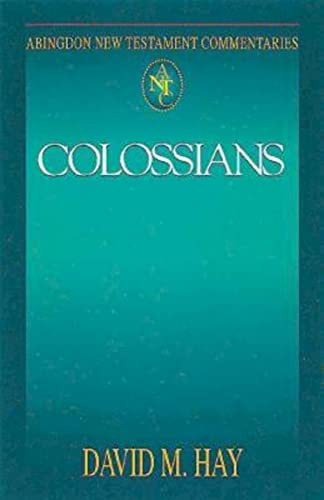
Inhaltsangabe
The short letter to the Colossians has played a significant role in the development of Christian thought. Its emphases on salvation as largely realized here and now, on knowledge in relation to faith, on Christ as the head of the church, on the entire cosmos and all humanity as the objects of God’s work of redemption through him, and on Paul’s authority—all these point in the direction of church theology at the end of the apostolic period. Christian notions of ethical responsibility between asceticism and worldliness, as well as the subordination of wives to husbands and slaves to masters, were influenced by the “household table” of Colossians 3:18–4:1. In the fourth century Colossians' Christological claims surfaced on opposite sides of the Arian controversy, which dealt with the status of the Son of God in relation to the Father/Creator and the created order. In the nineteenth and twentieth centuries, Colossians attracted special attention as theologians and ordinary believers have wrestled with new questions about science and religious pluralism.
Die Inhaltsangabe kann sich auf eine andere Ausgabe dieses Titels beziehen.
Über die Autorin bzw. den Autor
DAVID M. HAY is the Joseph E. McCabe Professor of Religion at Coe College in Cedar Rapids, Iowa. He is a graduate of Duke University and has a Ph.D. from Yale University. (2000)
Auszug. © Genehmigter Nachdruck. Alle Rechte vorbehalten.
Abingdon New Testament Commentaries: Colossians
By David M. HayAbingdon Press
Copyright © 2000 Abingdon Press
All rights reserved.
ISBN: 978-0-687-05802-0All rights reserved.
Contents
Foreword,
Preface,
List of Abbreviations,
Introduction,
Commentary,
Select Bibliography,
Index,
CHAPTER 1
Commentary
Salutation (1:1-2)
The opening salutation (1:1-2) follows the normal convention of ancient letter-writing: "A to B, greetings." The formulation of the greetings in terms of "Grace and peace" may reflect Jewish practice. For example, a Jewish revolutionary a couple of generations after Paul began a letter, "From Simon ben Kosheba to Jeshua ben Gilgola and the people of his company: peace!" (Lohse 1971, 5). The formula, "Grace to you and peace," is found, however, at the beginning of all of Paul's other letters ("mercy" is added to grace and peace in 1 Tim 1:2 and 2 Tim 1:2), so there is no need to think that the Colossians would have had specifically Jewish associations with the phrase.
* * *
The writer identifies himself as the famous and revered apostle and speaks of being an apostle in relation to Jesus Christ—a leader whose words are to be taken as representing the mind of Christ (cf. Rev 1:1-2) and the will of God. Throughout the letter Paul addresses his readers in an authoritative and official, though always friendly and encouraging, tone. The letter opening apparently assumes that Paul is well-known by reputation to the readers, that they understand the title of "apostle" (used only here in the letter) and that they are not disposed to challenge Paul's right to claim it.
The reference to Timothy both associates him with the writing of the letter and distinguishes his authority from Paul's. Timothy is simply a Christian "brother," just as all the persons addressed in the letter are "brothers and sisters" (v. 2). Though Timothy may in fact have had a major hand in the composing of Colossians (see the introduction), the letter itself makes no such claim for him. The salutations of several other Pauline letters (2 Cor 1:1; Phil 1:1; 1 Thess 1:1; 2 Thess 1:1; Phlm 1) mention Timothy's name immediately after Paul's (exactly the same phrase about Paul and Timothy is found in 1:1 and 2 Cor 1:1). Still, the emphasis of the letter is on the apostle Paul as author, not on Timothy, and the letter-writer will soon shift from "we" (1:3-4, 7-9) to the Pauline "I" (predominant in 1:24–2:5; 4:3-4, 7-18).
Timothy is not mentioned again in Colossians (not even in 4:10-11, where we might expect his name to resurface). Still, the reference in 1:1 would make a particularly strong impression if the Colossians are assumed to know that he is an important coworker and trusted member of Paul's missionary team (see especially 1 Thess 2:7 [where Timothy is even called an "apostle"]; 3:1-6; Rom 16:21; 1 Cor 4:17; 16:10-11; 2 Cor 1:19; later church interpretations of him are offered in Acts 16:1-3; 17:14; 18:5; 19:22; 20:4; Heb 13:23; and 1–2 Timothy).
The persons addressed are described as "the saints and faithful brothers and sisters in Christ in Colossae" (v. 2). This is the only Pauline letter in which the letter opening refers to the addressees as "brothers and sisters" or "brothers" (Gk. adelphoi). Perhaps Paul and Timothy want to stress that the Colossian Christians, personally unknown as they were, are nonetheless members of their spiritual family. On the other hand, the word "church" does not appear in the address, just as it is lacking in the salutations in Rom 1:7 and Phil 1:1 (which, like Colossians, characterizes its addressees as "saints").
Holiness, or sanctification, was a primary characteristic of Israel in the Old Testament and the Jewish tradition, and it connotes separation and purity based on divine election (cf. 3:12). A moral dimension cannot be denied, however. Personal and communal purity will be a major theme in 2:16–3:17, and there, too, the writer will emphasize that purity stems from the relationship with God and Christ. This relationship is established in faith; hence "faithful" in 1:2 probably also implies both the personal efforts of individual Christians as well as solid trust in what God has already bestowed through Christ. The meaning of "faith" will be spelled out at length in 1:5–3:4.
The opening greeting speaks of grace and peace "from God our Father" without adding the phrase "and the Lord Jesus Christ," which concludes every other salutation in the Pauline letters with the exception of 1 Thess 1:1. (Some manuscripts have added the phrase in Col 1:2, obviously because later scribes thought its omission must have been a copyist's error.) Given the high prominence ascribed to Christology later in the letter, no diminution of Jesus' importance can be intended. Emphasis on God as "our Father" unites Paul, Timothy, the Colossians, and all who are related to the Father through "his beloved Son" (1:13).
As in many other Pauline letters, "grace" marks the opening greeting and the very end of the letter (4:18). It emphasizes that salvation is a gift God gives through Christ (various aspects of grace will be highlighted when it is mentioned again in 1:6; 3:16; and 4:6; though Colossians never directly speaks of the grace of Christ). "Peace" is commonly used in Jewish as well as Christian letter greetings, and it connotes salvation, not mere absence of outward conflict—a general well-being or condition of harmony between God and human beings as well as within human communities (cf. 1:20; 3:15).
* * *
The Christian existence that unites letter writers and addressees is here defined in terms of holiness and peace (terms recalling OT Israel's relation to God) as well as faith and grace (terms especially linked in the Pauline letters with the Christian revelation). Everything depends and grows out of the common grounding of the apostle and those he addresses in the power of God. And just as their identity and origins are briefly mentioned, so, too, is the purpose of their lives: to manifest purity, faithfulness, and peace. These ideas permeate the letter's theological affirmations and moral instructions.
Letter Introduction (1:3–2:5)
The first part of the letter presents the foundations on which the direct instructions to the Colossians, beginning with 2:6, are based. This introduction includes a thanksgiving (1:3-8), which is followed by a petition (1:9-11) and a summary interpretation of the gospel message in three sections: a brief statement centered on God the Father (1:12-14), a hymn in honor of Christ (1:1520), and an application to the Colossians (1:21-23). The entire passage (1:3-23) may also be regarded as an extended thanksgiving. It is followed by a description of Paul and his service of the gospel, which explains his goals and authority as he writes to the Colossians (1:24–2:5). Overall this part of the letter defines the identities of the intended readers and the writer (Paul) in relation to the work and purposes of God. The delay in getting around to the polemic in 2:6-23 suggests that Paul thinks the ground for that attack must be carefully prepared.
Thanksgiving (1:3-8)
Paul's letters often begin with a thanksgiving. In this he follows with distinctive modifications a pattern well attested in ancient hellenistic-pagan and Jewish letters (e.g., 2 Macc 1:10-17). The motif of prayer unites sections 1:3-8 and 9-11, although with this distinction: Verses 3-8 concentrate on Paul and Timothy's thanksgiving for the Colossian church (with particular emphasis on the...
„Über diesen Titel“ kann sich auf eine andere Ausgabe dieses Titels beziehen.
Suchergebnisse für Colossians (Abingdon New Testament Commentaries)

Beispielbild für diese ISBN
Abingdon New Testament Commentaries: Colossians
Anbieter: ThriftBooks-Dallas, Dallas, TX, USA
Verkäuferbewertung 5 von 5 Sternen

Paperback. Zustand: Good. No Jacket. Pages can have notes/highlighting. Spine may show signs of wear. ~ ThriftBooks: Read More, Spend Less. Artikel-Nr. G0687058023I3N00
Gebraucht kaufen
EUR 11,08
Versand gratis
Versand innerhalb von USA
Versand innerhalb von USA
Anzahl: 1 verfügbar
Beispielbild für diese ISBN
Abingdon New Testament Commentaries: Colossians
Anbieter: Better World Books, Mishawaka, IN, USA
Verkäuferbewertung 5 von 5 Sternen
Zustand: Good. Pages intact with minimal writing/highlighting. The binding may be loose and creased. Dust jackets/supplements are not included. Stock photo provided. Product includes identifying sticker. Better World Books: Buy Books. Do Good. Artikel-Nr. 68959359-6
Gebraucht kaufen
EUR 11,66
Versand gratis
Versand innerhalb von USA
Versand innerhalb von USA
Anzahl: 1 verfügbar
Beispielbild für diese ISBN
Abingdon New Testament Commentaries: Colossians
Anbieter: Better World Books, Mishawaka, IN, USA
Verkäuferbewertung 5 von 5 Sternen
Zustand: Very Good. Former library copy. Pages intact with possible writing/highlighting. Binding strong with minor wear. Dust jackets/supplements may not be included. Includes library markings. Stock photo provided. Product includes identifying sticker. Better World Books: Buy Books. Do Good. Artikel-Nr. 741796-6
Gebraucht kaufen
EUR 11,66
Versand gratis
Versand innerhalb von USA
Versand innerhalb von USA
Anzahl: 1 verfügbar
Beispielbild für diese ISBN
Colossians [Abingdon New Testament Commentaries]
Anbieter: Windows Booksellers, Eugene, OR, USA
Verkäuferbewertung 5 von 5 Sternen
Paperback. Near fine. 182 pp. Artikel-Nr. 709382
Gebraucht kaufen
EUR 9,17
EUR 6,68 Versand
Versand innerhalb von USA
Versand innerhalb von USA
Anzahl: 1 verfügbar
Beispielbild für diese ISBN
Abingdon New Testament Commentaries: Colossians
Verlag:
Abingdon Press, Nashville, 2000
ISBN 10: 0687058023
ISBN 13: 9780687058020
Gebraucht
Soft cover
Erstausgabe
Anbieter: Salsus Books (P.B.F.A.), Kidderminster, Vereinigtes Königreich
Verkäuferbewertung 5 von 5 Sternen
Soft cover. Zustand: Very Good. 1st Edition. 192pp paperback, very good. Artikel-Nr. 078708
Gebraucht kaufen
EUR 11,01
EUR 17,82 Versand
Versand von Vereinigtes Königreich nach USA
Versand von Vereinigtes Königreich nach USA
Anzahl: 1 verfügbar
Beispielbild für diese ISBN
Abingdon New Testament Commentaries: Colossians
Anbieter: Ria Christie Collections, Uxbridge, Vereinigtes Königreich
Verkäuferbewertung 5 von 5 Sternen
Zustand: New. In English. Artikel-Nr. ria9780687058020_new
Neu kaufen
EUR 29,12
EUR 11,13 Versand
Versand von Vereinigtes Königreich nach USA
Versand von Vereinigtes Königreich nach USA
Anzahl: Mehr als 20 verfügbar
Beispielbild für diese ISBN
Colossians (Abingdon New Testament Commentaries)
Anbieter: Revaluation Books, Exeter, Vereinigtes Königreich
Verkäuferbewertung 5 von 5 Sternen
Paperback. Zustand: Brand New. 192 pages. 9.00x6.00x0.75 inches. In Stock. Artikel-Nr. x-0687058023
Neu kaufen
EUR 30,40
EUR 11,88 Versand
Versand von Vereinigtes Königreich nach USA
Versand von Vereinigtes Königreich nach USA
Anzahl: 2 verfügbar