
Verwandte Artikel zu New Interpreter's Handbook of Preaching
Inhaltsangabe
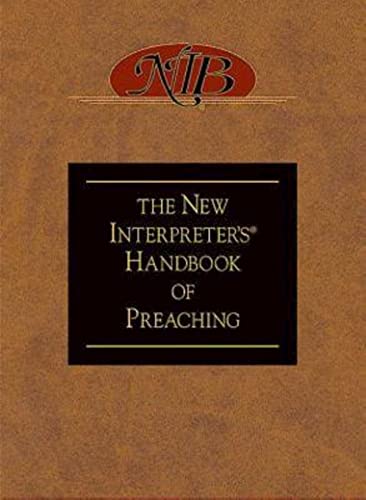
The New Interpreter's Handbook of Preaching is a major reference tool for preaching, with articles on every facet of Christian sermon preparation and delivery. This resource is both scholarly and practical. It focuses on the most distinctive feature and greatest strength of homiletics as a discipline: It is rooted in interdisciplinary scholarship and it develops theory geared to practice. Its theory arises out of the study of both excellent preaching past and present and actual sermon preparation and composition. When theory and practice critique each other, it is possible to produce guidelines that assist greater excellence and economy in preaching the gospel. Excellence in standards is an area in which homiletics needs to grow, and this project will be both a means to encourage and develop it. A guiding question throughout will be, Will it preach? The answers will be offered in the sense that "here is something that works well," rather than "here is something to try." Preachers will turn to this resource with the expectation that they will find scholarly treatment of topics, brief bibliographies of relevant key books and articles, along with practical methodological suggestions for preachers to employ. The contributors are homileticians, preachers, and writers in various disciplines who are committed to the pulpit through practice.
Die Inhaltsangabe kann sich auf eine andere Ausgabe dieses Titels beziehen.
Über die Autorin bzw. den Autor
Emmanuel College, Toronto School of Theology
Auszug. © Genehmigter Nachdruck. Alle Rechte vorbehalten.
The New Interpreter's Handbook of Preaching
By Paul Scott WilsonAbingdon Press
Copyright © 2008 Abingdon Press
All rights reserved.
ISBN: 978-0-687-05556-2All rights reserved.
Contents
General Editor's Preface,
How to Use the Handbook of Preaching in a Homiletics Classroom,
Weekly Sermon Preparation Using the Handbook of Preaching,
1. BIBLE,
2. BIBLE GENRES,
3. ETHICS,
4. LITERARY CRITICISM,
5. POETICS,
6. PREACHER,
7. SOCIAL LOCATION,
8. EXPERIENCE,
9. RHETORIC,
10. SERMON,
11. THEOLOGY,
CHAPTER 1
Part 1 Introduction: Choosing and Delimiting the Text
Stephen Farris
In some Christian traditions it is common for preachers to read texts in church but to preach on something entirely different with little or no use of any scriptural text. Whatever the merits of such preaching, the focus of this entry is the pattern of preaching on some part of one or more texts read aloud during the liturgy. In such preaching the sermon grows out of the preacher's study of the text. Here the importance of choosing and delimiting the text cannot be overstated. It is the primary step in responsibly interpreting that text for preaching. A preacher who irresponsibly chooses and delimits the text can make the text say what it was never intended to say. By contrast, the preacher who carefully chooses and delimits more likely allows the text to speak its own word rather than a word imposed upon it.
Though choosing and delimiting a text are two aspects of the same process and frequently happen simultaneously, they will be treated here as separate steps. First, there is the matter of choosing a text. A traditional method is to search in Scripture until one finds a text that seems appropriate to the situation of the congregation or season. The possible advantages of this method include relevance to the contemporary context and the room it may give to the work of the Holy Spirit. (Though surely, the Holy Spirit can also work through a more disciplined method!) In practice, however, preachers may lose precious time vacillating among texts or may choose texts they like or ones that seem to say what they have already decided they want to say. There is the possibility of creating over the years a personal mini-lectionary of texts that say only what the preacher already knows and believes.
A better choice is to follow a lectionary of the wider church, the Revised Common Lectionary. (See LECTIONARY AND THE CHRISTIAN YEAR.) Although the selection of texts in the lectionary has been criticized, it covers a wide variety of texts, and its christological and seasonal focus is as likely to be as acceptable as anything else that could be devised. In many denominations it can be used simply as a tool to facilitate the choice of lessons. There are considerable advantages to preaching the lectionary. The preacher need not waste time wandering through Scripture in desperate search of a likely text for the coming Sunday. Moreover, the lectionary forces one to study and preach on texts that one would not willingly choose. The spiritual discipline of preaching difficult texts may lead to the perception of more light and truth. Furthermore, there are many lectionary-based resources available in books and journals and online. Those resources often provide prayers, other elements of the liturgy, children's stories, and appropriate hymns for the service. There are even lectionary-based Christian education curricula. Many communities have lectionary study groups, and if these are lacking locally, they can be found online. There is an embarrassment of riches available for the lectionary preacher.
A choice still faces lectionary preachers: Which of the four texts will they preach from, or will they attempt to preach upon a link among two or more texts for the day? Finding a link among all four texts is often difficult. Connections that may be identified among four texts often seem forced. Moreover, attempting to address four texts in the sometimes brief span allotted to the sermon may mean that none of these texts is treated adequately. It is frequently the case, however, that there is an obvious and compelling connection between two readings for the day. To address the connection between these readings can be a valuable option. To preach entirely from one of the texts remains the primary option for most preachers; however, in some circles there appears to be an expectation that the sermon will be preached on the Gospel text. To preach the Gospel text invariably or nearly so may leave the congregation ignorant of the rest of Scripture. It may even turn preachers into practical Marcionites. Marcion was a 2nd-cent. heretic who repudiated the authority of the OT for Christians. Never or rarely to preach on a section of Scripture is effectively to deny its authority. Moreover, the psalm for the day, though sometimes passed over even by lectionary resources, ought not to be ignored. Psalms, with their raw human emotions and sometimes disturbingly direct language, can be marvelous preaching material.
The lectionary is not the only disciplined approach to choosing a text. Another practice, LECTIO CONTINUA, has an ancient history in the church and, before it, in the synagogue. (Although patterns of reading Scripture in the synagogues of NT and earlier times cannot be fully determined, it seems likely that lectio continua was a common practice.) This is the practice of reading and preaching through a biblical book in order. This approach enables the congregation to hear the preaching text in its canonical context. Texts are always heard and interpreted in relation to their contexts. The lectionary creates its own context because each text is inevitably heard by worshipers in relation to the other lections of the day that are read aloud with it. This process may do particular damage to OT texts that may be radically reinterpreted, not always for the better, in light of the christological context in which the lectionary generally places them. A fair and sustained treatment of OT texts on their own terms may sometimes require abandonment of the lectionary. Another advantage of lectio continua is that the preacher may be able to amortize the investment of time and energy in understanding the background and situation of a biblical book over a number of preaching Sundays. Lectio continua may deepen the congregation's knowledge of and respect for Scripture. Some lectio continua is present in the lectionary itself at certain times. Where this is the case, the advantages of lectio continua belong to the lectionary also.
Preachers may also organize their work around doctrinal series, such as a study of the Apostles' Creed or another summary of Christian doctrine. Some preachers choose to begin with human need, popular questions of the day, or contemporary social issues. The number of potential organizing principles for a sermon series is limited only by the creativity of the preacher. In all these cases, the choice of the text is a secondary task. A text is chosen primarily because of its apparent relation to the topic of the day. A common variant of this approach is to select from the reading a particular verse or portion of a verse and to preach not so much the text itself, but the doctrine addressed in the verse. In such sermons the preacher is likely to move to other texts throughout Scripture that address the same doctrine rather than to consider extensively the canonical context of the verse in question. Doctrinal preaching probably requires some such use of Scripture....
„Über diesen Titel“ kann sich auf eine andere Ausgabe dieses Titels beziehen.
Suchergebnisse für New Interpreter's Handbook of Preaching

Beispielbild für diese ISBN
The New Interpreter's® Handbook of Preaching
Anbieter: Better World Books, Mishawaka, IN, USA
Verkäuferbewertung 5 von 5 Sternen

Zustand: Good. Pages intact with minimal writing/highlighting. The binding may be loose and creased. Dust jackets/supplements are not included. Stock photo provided. Product includes identifying sticker. Better World Books: Buy Books. Do Good. Artikel-Nr. 14849068-6
Gebraucht kaufen
EUR 20,07
Versand gratis
Versand innerhalb von USA
Versand innerhalb von USA
Anzahl: 2 verfügbar
Beispielbild für diese ISBN
The New Interpreter's® Handbook of Preaching
Anbieter: Better World Books, Mishawaka, IN, USA
Verkäuferbewertung 5 von 5 Sternen
Zustand: Good. Former library copy. Pages intact with minimal writing/highlighting. The binding may be loose and creased. Dust jackets/supplements are not included. Includes library markings. Stock photo provided. Product includes identifying sticker. Better World Books: Buy Books. Do Good. Artikel-Nr. 50170580-6
Gebraucht kaufen
EUR 20,07
Versand gratis
Versand innerhalb von USA
Versand innerhalb von USA
Anzahl: 1 verfügbar
Beispielbild für diese ISBN
The New Interpreter's� Handbook of Preaching
Anbieter: Wonder Book, Frederick, MD, USA
Verkäuferbewertung 5 von 5 Sternen
Zustand: Good. Good condition. Like New dust jacket. A copy that has been read but remains intact. May contain markings such as bookplates, stamps, limited notes and highlighting, or a few light stains. Artikel-Nr. U00A-03767
Gebraucht kaufen
EUR 27,62
Versand gratis
Versand innerhalb von USA
Versand innerhalb von USA
Anzahl: 1 verfügbar
Beispielbild für diese ISBN
The New Interpreter's Handbook of Preaching
Anbieter: Windows Booksellers, Eugene, OR, USA
Verkäuferbewertung 5 von 5 Sternen
Hardcover with dust jacket. VG/VG. Slightly chipped dust jacket 506 pp. Artikel-Nr. 730975
Gebraucht kaufen
EUR 34,11
EUR 6,71 Versand
Versand innerhalb von USA
Versand innerhalb von USA
Anzahl: 1 verfügbar
Beispielbild für diese ISBN
The New Interpreter's® Handbook of Preaching
Anbieter: Ria Christie Collections, Uxbridge, Vereinigtes Königreich
Verkäuferbewertung 5 von 5 Sternen
Zustand: New. In English. Artikel-Nr. ria9780687055562_new
Neu kaufen
EUR 64,60
EUR 17,84 Versand
Versand von Vereinigtes Königreich nach USA
Versand von Vereinigtes Königreich nach USA
Anzahl: Mehr als 20 verfügbar
Beispielbild für diese ISBN
New Interpreters Bible Handbook of Preaching
Anbieter: Revaluation Books, Exeter, Vereinigtes Königreich
Verkäuferbewertung 5 von 5 Sternen
Hardcover. Zustand: Brand New. 506 pages. 10.75x8.00x1.25 inches. In Stock. Artikel-Nr. x-0687055563
Neu kaufen
EUR 84,13
EUR 17,91 Versand
Versand von Vereinigtes Königreich nach USA
Versand von Vereinigtes Königreich nach USA
Anzahl: 2 verfügbar