
Verwandte Artikel zu The Gospel and Letters of John (Interpreting Biblical...
The Gospel and Letters of John (Interpreting Biblical Texts): Interpreting Biblical Texts Series - Softcover
Buch 4 von 11: Interpreting Biblical Texts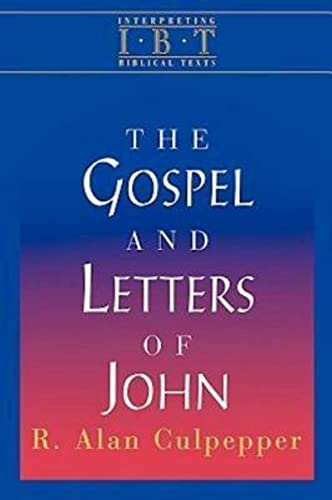
Inhaltsangabe
In this volume, R. Alan Culpepper considers both the Gospel and the Letters of John. The book begins with a close look at the relationship between John and the Synoptics and a summary of John's distinctive thought and language. The second chapter addresses the fascinating issues regarding the origins of the Gospel and the letters: authorship, sources, and composition. The history of the Johannine community is reviewed in chapter three. Chapter four interprets the plot of the Gospel and prepares the student to read John as literature by providing a brief orientation to narrative criticism. The fifth chapter turns to more traditional concerns: John as theology. This chapter provides a digest of the Christology, theology, and eschatology of John. The sixth through the eighth chapters, the heart of the book, guide the student through a reading of the Gospel. The ninth chapter serves as an introduction to the Letters, noting especially their relationship to the Gospel. Each letter is treated in turn. The final chapter examines the challenges and potential of the Johannine literature as documents of faith. "In previous writings Alan Culpepper has shown himself to be one of the best Johannine scholars of our time. He not only conveniently draws together his research but also shows himself to be an excellent teacher". -Raymond E. Brown
Die Inhaltsangabe kann sich auf eine andere Ausgabe dieses Titels beziehen.
Über die Autorin bzw. den Autor
R. Alan Culpepper is Dean of the McAfee School of theology, Mercer University, Atlanta, Georgia.
Auszug. © Genehmigter Nachdruck. Alle Rechte vorbehalten.
The Gospel and Letters of John
By R. Alan CulpepperAbingdon Press
Copyright © 1998 Abingdon Press
All rights reserved.
ISBN: 978-0-687-00851-3All rights reserved.
Contents
FOREWORD,
PREFACE,
CHAPTER 1 INTRODUCTION TO THE JOHANNINE LITERATURE,
PART ONE INTRODUCING THE JOHANNINE WRITINGS,
CHAPTER 2 THE COMPOSITION OF THE JOHANNINE WRITINGS,
CHAPTER 3 THE GOSPEL AND LETTERS AS THE LITERATURE OF A COMMUNITY,
CHAPTER 4 THE GOSPEL AS LITERATURE,
CHAPTER 5 THE THEOLOGY OF THE JOHANNINE WRITINGS,
PART TWO INTERPRETING THE JOHANNINE WRITINGS,
CHAPTER 6 INTERPRETING THE FOURTH GOSPEL: JOHN 1–4,
CHAPTER 7 INTERPRETING THE FOURTH GOSPEL: JOHN 5–12,
CHAPTER 8 INTERPRETING THE FOURTH GOSPEL: JOHN 13–21,
CHAPTER 9 INTERPRETING THE LETTERS,
PART THREE RESPONDING TO THE JOHANNINE WRITINGS,
CHAPTER 10 THE GOSPEL OF JOHN AS A DOCUMENT OF FAITH,
NOTES,
SELECTED BIBLIOGRAPHY,
INDEX,
CHAPTER 1
Introduction to the Johannine Literature
The Johannine literature is distinctive in several respects. John is the only Gospel in the New Testament that has letters related to it. The relationship is much closer than the Gospel of Luke and the Letters of Paul, or the Gospel of Mark and the Letters of Peter.
John differs from the other three canonical Gospels so dramatically that they are called Synoptic Gospels ("seeing alike"), whereas John is unique. John has its own language and idiom, its own chronology of the ministry of Jesus, its own view of Jesus' identity and works, and its own theology.
John is arguably the most influential book of the New Testament. It alone depicts Jesus as the Word (Greek, Logos), a fact which has made John the seedbed for much of the church's theology. One has only to think of the doctrine of the Trinity to see the importance of John for Christian thought. The relationship of Jesus to God as Son to Father breaks through only occasionally in the Synoptics, but it emerges full-blown in the Fourth Gospel. The double nature of Jesus as human and divine also confronts us more dramatically in John than elsewhere, and John has more to say about the Holy Spirit than any other writing in the New Testament.
The engaging factor is that John is at once the simplest of the Gospels and the most difficult. It is the Gospel most frequently translated into other languages and the Gospel written in the easiest Greek. But it can also be difficult to understand. The Gospel always calls us to walk further with it and ponder it longer. In this respect, it is both a home and a horizon, a place of security and a place of challenge. (Because of this, you might wish to preface your study of John and your reading of this book by turning first to chapter 10 to gain an overview of some of the ethical, theological, and historical challenges these writings pose to communities of faith today.) I hope that you will find the study of this Gospel so engaging that it will never let you go. If this happens, you will gain a lifelong source of intellectual and spiritual stimulation that will never let you stop probing its mysteries.
WHAT IS JOHN?
Is John best understood as history, theology, or literature? John is a narrative that presents Jesus as the Christ, the Son of God who lived at a particular time in history. As a historical narrative it raises problems of the relation of history to faith, God to humanity, and time to the eternal. How could a writer convey the significance of the advent of the eternal Son of God in human history? Neither an unvarnished historical account nor a theological treatise would be adequate. The event was both history and revelation, so the events and content of that revelation interpret one another, and this in a narrative context.
As we wrestle to understand John and discern the extent to which it is history, we will learn that the evangelist is writing for a particular believing community facing a specific set of historical conditions. So, revelation both emerges out of history and is interpreted back into history. From your study I hope that you will also see ways in which the revelation imparted in the life of Jesus and interpreted for the Johannine community can reach into our own historical circumstances.
John as Literature
Suppose that you wanted to write a story about a divine being who had come to earth in human form—perhaps a script for a television series. What form might the story take? What plot lines would be open to you? There are two basic options that grow out of the premise of the story. The first would be, How does anyone know that this human figure is a divine being if he looks, talks, and acts like a human being? How does his identity become known? That is the plot of the Gospel of Mark. According to Mark, no one knew at first who Jesus was, and even those closest to him only discover who he really is at or after his death and resurrection. The voice from heaven at Jesus' baptism is addressed to him alone. We readers know that Jesus is God's Son, but no one around Jesus knows until his death, and it is his death and resurrection, not his power or teachings, that make his identity known.
In John, by contrast, Jesus tells everyone who he is. From the very first chapter both he and others use the church's lofty titles to describe his identity. There is no question about how people discover who Jesus is—he tells them, and tells them repeatedly. Now the question becomes, How do people respond to his claim to be the Son of God? Why do some believe him and others do not? What different responses can we see in the Gospel, and what are the different levels or stages of faith?
While the Gospel tells the story of Jesus, it also draws us as readers into it and seeks to move us along the continuum of responses to a higher level of response to Jesus as the Revealer.
John as History
John is paradoxically both the most and the least historical of the four Gospels. Good arguments can be raised in favor of the accuracy of John's geographical references, its chronology of the ministry and death of Jesus, the nature of the debates or trials that led to Jesus' execution, and the relationship of Jesus to John the Baptist—to take only a few illustrative points. On the other hand, the style of Jesus' speech in John is thoroughly Johannine, resembling more nearly the way the author of the Johannine Epistles writes than the style and idiom of Jesus' teaching in the Synoptic Gospels. In John, Jesus usually speaks in long discourses rather than in the short sayings and parables characteristic of the Synoptics. In addition, Jesus speaks more explicitly of his identity and messianic role in John than in the Synoptics; this suggests that John reflects later Christian response to Jesus more explicitly while the Synoptics preserve the actual sayings of Jesus more accurately. Even where the Synoptics may be more accurate historically, however, John perceptively highlights elements of truth about Jesus.
John as Theology
The Gospel and Letters of John were written in the midst of fierce theological debate. One's place within the community was defined by one's confession of Jesus as the Messiah. At first, believing Jews distinguished themselves from others in the synagogue by their confession that Jesus was the Messiah. Then, when the community of believers separated from the synagogue, their confession defined them over against the pagan, Greco-Roman world. When divisions developed within the community over...
„Über diesen Titel“ kann sich auf eine andere Ausgabe dieses Titels beziehen.
Suchergebnisse für The Gospel and Letters of John (Interpreting Biblical...

Beispielbild für diese ISBN
The Gospel and Letters of John: Interpreting Biblical Texts Series
Verlag:
Abingdon Press (edition ), 1998
ISBN 10: 0687008514
ISBN 13: 9780687008513
Gebraucht
Paperback
Anbieter: BooksRun, Philadelphia, PA, USA
Verkäuferbewertung 5 von 5 Sternen

Paperback. Zustand: Very Good. It's a well-cared-for item that has seen limited use. The item may show minor signs of wear. All the text is legible, with all pages included. It may have slight markings and/or highlighting. Artikel-Nr. 0687008514-11-6
Gebraucht kaufen
EUR 5,41
Versand gratis
Versand innerhalb von USA
Versand innerhalb von USA
Anzahl: 1 verfügbar
Beispielbild für diese ISBN
Gospel and Letters of John
Anbieter: World of Books (was SecondSale), Montgomery, IL, USA
Verkäuferbewertung 5 von 5 Sternen
Paperback. Zustand: Good. In this volume, R. Alan Culpepper considers both the Gospel and the Letters of John. The book begins with a close look at the relationship between John and the Synoptics and a summary of John's distinctive thought and language. The second chapter addresses the fascinating issues regarding the origins of the Gospel and the letters: authorship, sources, and composition. The history of the Johannine community is reviewed in chapter three. Chapter four interprets the plot of the Gospel and prepares the student to read John as literature by providing a brief orientation to narrative criticism. The fifth chapter turns to more traditional concerns: John as theology. This chapter provides a digest of the Christology, theology, and eschatology of John. The sixth through the eighth chapters, the heart of the book, guide the student through a reading of the Gospel. The ninth chapter serves as an introduction to the Letters, noting especially their relationship to the Gospel. Each letter is treated in turn. The final chapter examines the challenges and potential of the Johannine literature as documents of faith. In previous writings Alan Culpepper has shown himself to be one of the best Johannine scholars of our time. He not only conveniently draws together his research but also shows himself to be an excellent teacher. --Raymond E. Brown. Artikel-Nr. 00108906140
Gebraucht kaufen
EUR 5,49
Versand gratis
Versand innerhalb von USA
Versand innerhalb von USA
Anzahl: 3 verfügbar
Beispielbild für diese ISBN
The Gospel and Letters of John: Interpreting Biblical Texts Series
Anbieter: ThriftBooks-Reno, Reno, NV, USA
Verkäuferbewertung 5 von 5 Sternen
Paperback. Zustand: Very Good. No Jacket. May have limited writing in cover pages. Pages are unmarked. ~ ThriftBooks: Read More, Spend Less. Artikel-Nr. G0687008514I4N00
Gebraucht kaufen
EUR 5,95
Versand gratis
Versand innerhalb von USA
Versand innerhalb von USA
Anzahl: 1 verfügbar
Beispielbild für diese ISBN
The Gospel and Letters of John: Interpreting Biblical Texts Series
Anbieter: ThriftBooks-Dallas, Dallas, TX, USA
Verkäuferbewertung 5 von 5 Sternen
Paperback. Zustand: Good. No Jacket. Pages can have notes/highlighting. Spine may show signs of wear. ~ ThriftBooks: Read More, Spend Less. Artikel-Nr. G0687008514I3N00
Gebraucht kaufen
EUR 5,95
Versand gratis
Versand innerhalb von USA
Versand innerhalb von USA
Anzahl: 1 verfügbar
Beispielbild für diese ISBN
The Gospel and Letters of John: Interpreting Biblical Texts Series
Anbieter: ThriftBooks-Phoenix, Phoenix, AZ, USA
Verkäuferbewertung 5 von 5 Sternen
Paperback. Zustand: Very Good. No Jacket. Former library book; May have limited writing in cover pages. Pages are unmarked. ~ ThriftBooks: Read More, Spend Less. Artikel-Nr. G0687008514I4N10
Gebraucht kaufen
EUR 5,95
Versand gratis
Versand innerhalb von USA
Versand innerhalb von USA
Anzahl: 1 verfügbar
Beispielbild für diese ISBN
The Gospel and Letters of John: Interpreting Biblical Texts Series
Anbieter: ThriftBooks-Atlanta, AUSTELL, GA, USA
Verkäuferbewertung 5 von 5 Sternen
Paperback. Zustand: Good. No Jacket. Pages can have notes/highlighting. Spine may show signs of wear. ~ ThriftBooks: Read More, Spend Less. Artikel-Nr. G0687008514I3N00
Gebraucht kaufen
EUR 5,95
Versand gratis
Versand innerhalb von USA
Versand innerhalb von USA
Anzahl: 1 verfügbar
Beispielbild für diese ISBN
The Gospel and Letters of John: Interpreting Biblical Texts Series
Anbieter: ThriftBooks-Dallas, Dallas, TX, USA
Verkäuferbewertung 5 von 5 Sternen
Paperback. Zustand: Fair. No Jacket. Missing dust jacket; Readable copy. Pages may have considerable notes/highlighting. ~ ThriftBooks: Read More, Spend Less. Artikel-Nr. G0687008514I5N01
Gebraucht kaufen
EUR 5,95
Versand gratis
Versand innerhalb von USA
Versand innerhalb von USA
Anzahl: 1 verfügbar
Beispielbild für diese ISBN
The Gospel and Letters of John: Interpreting Biblical Texts Series
Anbieter: ThriftBooks-Reno, Reno, NV, USA
Verkäuferbewertung 5 von 5 Sternen
Paperback. Zustand: Good. No Jacket. Pages can have notes/highlighting. Spine may show signs of wear. ~ ThriftBooks: Read More, Spend Less. Artikel-Nr. G0687008514I3N00
Gebraucht kaufen
EUR 5,95
Versand gratis
Versand innerhalb von USA
Versand innerhalb von USA
Anzahl: 1 verfügbar
Beispielbild für diese ISBN
The Gospel and Letters of John: Interpreting Biblical Texts Series
Anbieter: ThriftBooks-Phoenix, Phoenix, AZ, USA
Verkäuferbewertung 5 von 5 Sternen
Paperback. Zustand: Very Good. No Jacket. May have limited writing in cover pages. Pages are unmarked. ~ ThriftBooks: Read More, Spend Less. Artikel-Nr. G0687008514I4N00
Gebraucht kaufen
EUR 5,95
Versand gratis
Versand innerhalb von USA
Versand innerhalb von USA
Anzahl: 1 verfügbar
Beispielbild für diese ISBN
The Gospel and Letters of John: Interpreting Biblical Texts Series
Anbieter: ThriftBooks-Phoenix, Phoenix, AZ, USA
Verkäuferbewertung 5 von 5 Sternen
Paperback. Zustand: Fair. No Jacket. Readable copy. Pages may have considerable notes/highlighting. ~ ThriftBooks: Read More, Spend Less. Artikel-Nr. G0687008514I5N00
Gebraucht kaufen
EUR 5,95
Versand gratis
Versand innerhalb von USA
Versand innerhalb von USA
Anzahl: 1 verfügbar